Dominic Bourbeau doesn’t realize what a great painter he is.
Soft-spoken, Dominic is Minnesota nicer-than-nice. His unassuming nature shows up in his humble view of his work, which is colorfully geometric and stunning.
During last year’s Arizona Fine Art Expo in Scottsdale, Dominic’s artwork was tucked into a corner with little traffic flow, but I saw his work and was stopped cold by it.
In fact, his mid-century modern-style paintings intimidated me. How do you approach a genius? Especially one who is always painting, canvas lying flat on the table, head down? But it turned out that Dominic is highly approachable and generous with his time in explaining his supplies and techniques.
At this year’s Expo (January to March 2018), Dominic’s booth was in a high-traffic area near the cafe so his wall of art could be seen from the main hallway. Again this winter, Dominic kept his head down and painted constantly, but was as approachable and responsive to visitors as ever.
Hopefully, after hearing so many folks see his art for the first time and say “Wow!,” Dominic will realize how special his painting is.
Dominic’s Aubrey Hepburn-esque painting ran on the December 2017 cover of Modern Luxury Scottsdale magazine, and his sassy mid-century portrait of a well-dressed woman in red was used on all the Expo passes.
During the Expo, Dominic had to paint all day, every day, seven days a week, because everything he hung on his booth wall sold. Instantly.
Or, he was asked to paint one of his classics, like Frank Sinatra’s Living Room, five times. Maybe six. Maybe seven.
“This was the year of commissions,” Dominic says, laughing. “I finally lost count.”
Luckily, not every client wanted to take possession of their painting before the Expo closed on March 25, allowing Dominic to return to Minneapolis and complete all his unfinished commissions.
One day at Kinko’s in Scottsdale, Dominic was scanning his painting of Frank Sinatra’s Living Room when an architect from Palm Springs saw the painting and asked about it. Dominic told the guy he painted it and the man instantly pulled out his check book and commissioned the painting for his home.
“That was unbelievable,” Dominic says to me the day it happened, and he’s shaking his head, like it shouldn’t have happened.
But it’s totally believable that someone saw his artwork and instantly wanted it. Dominic’s style is infectious.
His brother, Martin Bourbeau, is also an artist at the Expo. Martin uses cake frosting tubes to pipe paint onto magnificent landscapes on huge canvases, layering and layering the lines of paint to create 3-D art. They’re gorgeous and impressive and expensive.
“I originally struggled with how to price my paintings,” Dominic says, echoing every other artist. Pricing is always tricky. With advice from his fellow artists, Dominic has charged slightly more for his work lately, particularly when a subject is selling well, but psychologically it’s still hard for him to increase his prices.
This winter, he began to paint cityscapes depicting well-known landmarks, making them smaller than his usual paintings, and they all sold.
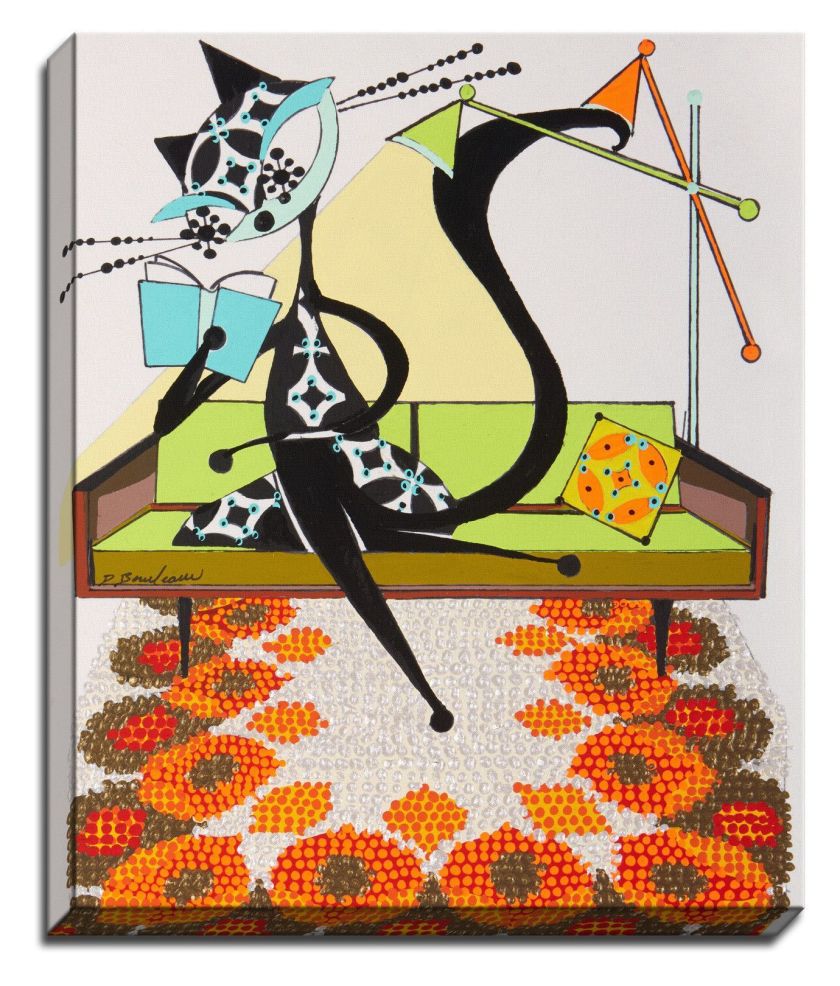
He painted a cat, then more cats, and the paintings sold before he could even hang them on the wall.
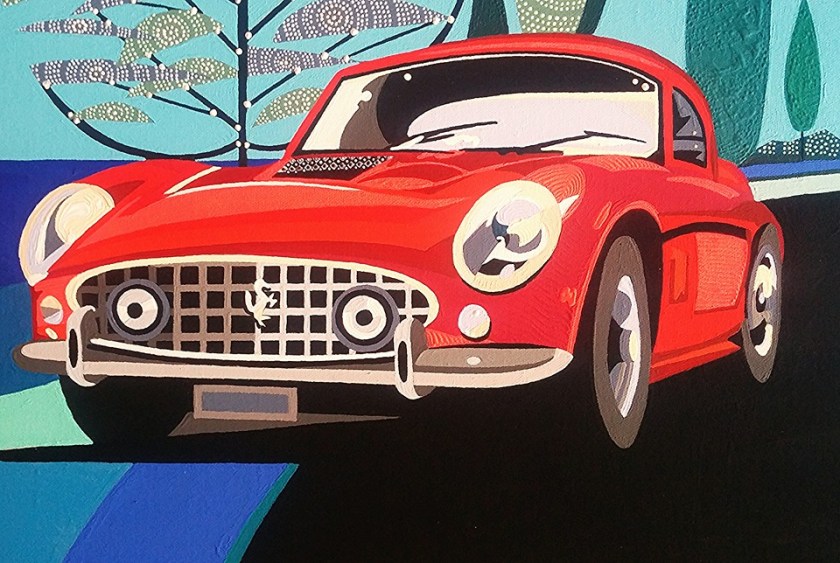
Gouache is Dominic’s medium of choice. Pronounced “gwash,” the medium is another type of watercolor, though it remains opaque rather than translucent and it dries matte. It’s fitting that Dominic uses Gouache because the medium was first used in creating Medieval Illuminated manuscripts and then became popular with French and Italian painters in the 18th century.
Also, before digital design, gouache was commonly used by Mid-20th century commercial artists because the medium made crisp images and letters possible, and it photographed well.
“I draw out the design in pencil, sketch over it in pen,” Dominic says, “and when all the details are done, I’ll start painting, which is the fun part.”
He smiles big.
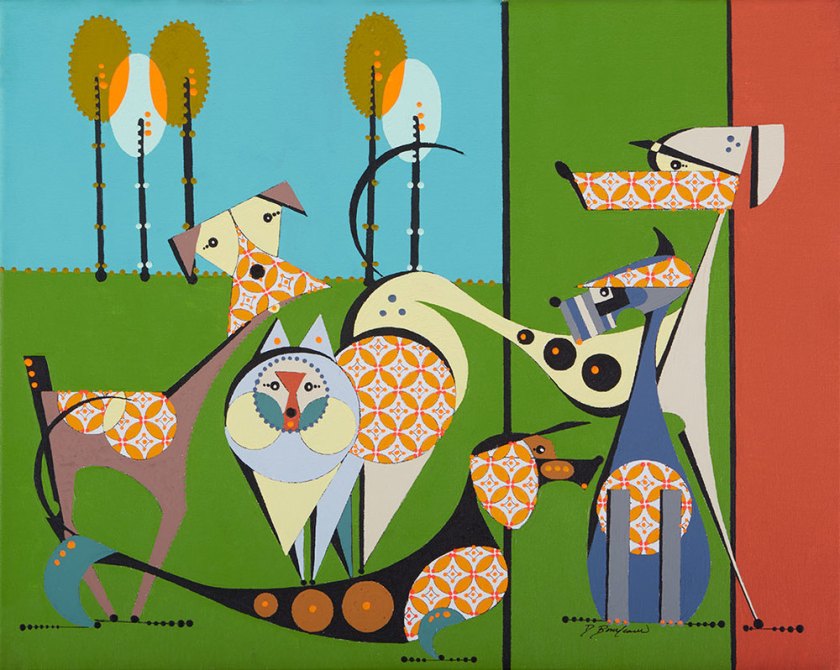
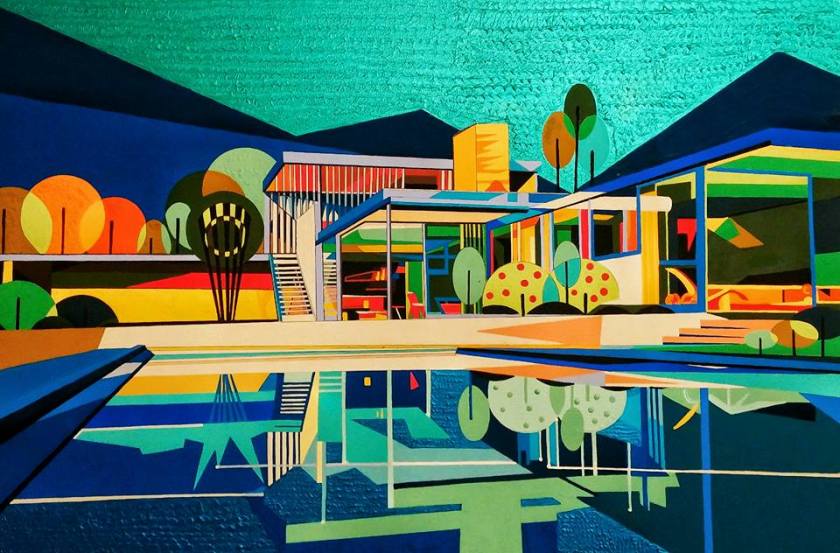
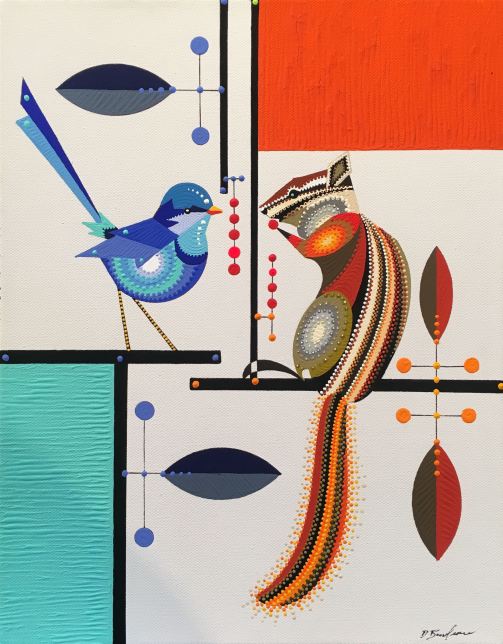
His technique is to texture different blocks of color by adding wavy or squiggly lines, or dots. His dots are amazing and appear to be machine-made, but he produces each one with absolute focus and precision.
While attending a boarding school in Michigan, Dominic studied iconology and followed the tradition of mixing his own tempura paints, including using a beetle to produce red.
In Iconology, every line has a purpose, nothing is used simply for the sake of being ornate. The strong geometry and symbolism of iconology are present in Dominic’s style.
Dominic’s artistic experiences also include throwing pottery, drawing portraits and painting murals for Shakespearean stage sets. He greatly admires artists such as Eames, Frank Lloyd Wright and Charley Harper, and is captivated by their use of simple, yet bold, design based on sophisticated, yet minimalist, geometry.
“I was able to pull from each of my past artistic experiences a segment of its beauty and technique,” Dominic says. “The geometry of iconography, the simple shapes of pottery, the puzzle-like composition of stained glass windows, the details of a portrait drawing, and the intensity especially in color of a mural painting.”
Frank Sinatra’s Living Room
Dominic, at 38, is the oldest of 11 children.
“All eight boys are artistic,” Dominic says. “My three sisters are not artistic. One brother, Peter, has a Master’s in Art and teaches art in a boarding school.”
Their mother, a school teacher, always brought art projects home for the kids to play with.
Dominic almost completed his Master’s in Art, so he could teach, but decided against teaching when he noticed students were using it as an elective and weren’t serious about learning.
Instead he got a degree to be a Surgical Technician and for 12 years now has specialized in assisting orthopedic surgeons in mostly hip and knee replacements.
With his “casual” employment, Dominic is hired to be the personal assistant of a physician and can work when he wants. That’s how he’s been able to take off three months for the last three winters to exhibit at the Expo in Scottsdale. Being a surgical assistant is a great gig; as long as Dominic is attached to a surgeon and keeps his medical qualifications current, he gains seniority in his position with the hospital.
Fours years ago, Dominic’s artistry was discovered by his hospital co-workers when he was drawing on sterile paper towels in the operating room. He then received commissions to create pen and ink portraits of his colleagues’ kids and families, or portraits of pets wearing sunglasses. Dr. Santos, a co-worker, asked Dominic to create anatomy illustrations for a book, including sketches of a spine and spinal implant.
At home in Minneapolis, Dominic paints in his kitchen, which does double-duty as his art studio.
Dominic is on his careful way to ultimately making a living solely as an artist.
In the meantime, he keeps his head down and paints for hours every day, in addition to doing all his own marketing and accounting… when he isn’t assisting in surgeries or exhibiting in Scottsdale.
I predict he’ll hit it big one day.
Maybe then he’ll realize just what a great artist he is.
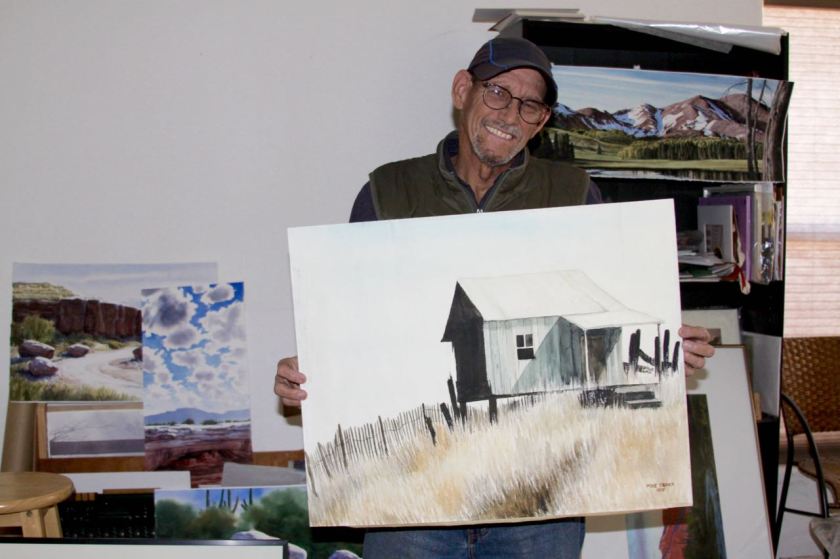
Mike Padian’s watercolor abilities were the best kept secret in Black Canyon City… until now. He’s mastered the medium, and life.
Watercolor Wizard
I met Mike last spring at a cooking class taught by Matt, French chef and owner of Nora Jean’s Koffee Kitchen; the second-best kept secret in Black Canyon City.
Mike’s talent as a watercolorist was the best kept secret.
During the monthly classes, where a group of wanna-be chefs try our hands at classic French dishes crafted with Matt’s imaginative twists, I’m always drawn to Mike, his sunny nature, quick smiles and absolute delight in the color, texture and chemistry of veggies, oils, meats and spices.
Delight. That’s Mike.
When I learned Mike painted watercolors, and asked him about it during class, he was standing behind a chair, hands resting on its back. Folks at our table were busy shoving haricots cooked with slivered almonds and garlic mashed potatoes into our mouths as Mike modestly said, “Yes, I paint watercolors.”
He mentioned being mystified by people who master oil painting. Soon, I’d learn just how modest Mike was being.
Last November, Black Canyon City hosted its third annual Hidden in the Canyon self-guided art studio tour. The weekend event included six artist studios in the small city. Each studio hosted multiple artists working in various mediums. When my husband Brent and I learned of the artist tour, we were in!
Most importantly, whatever studio Mike was exhibiting in would be our first stop.
Mike, along with a jewelry maker, glass artist and ceramicist, was showing his work in Lori M’s beautiful home, practically a museum of paintings, sculptures, ceramics, multi-media pieces and furniture by many artists; all tasteful and arranged for living with, not just looking at.
Lori is Black Canyon City’s patron saint of art patrons and she’s a huge Mike Padian fan.
“Wow,” Brent said when we first saw Mike’s watercolors, set up in Laura’s dining room, just off the patio. “Who knew he was this good?”
I had suspected Mike’s talent was great. But, the details… the colors. How was he able to so deftly manipulate colored water, the slipperiest of all media?
We immediately selected a small, rectangular landscape in a complementary frame and bought it. Fast. Before someone else did.
Lori, the homeowner, is a pretty woman, dark shiny hair, who was adorned in eclectic necklaces, bracelets and earrings made by local artists, each piece revealing her taste and personality.
“Since you bought a painting from Mike,” Lori said, “I want to show you something.”
She turned and removed a chair that blocked visitors from entering her living room. I felt like we had won the lottery as we followed Laura on our mysterious journey through her treasure-filled home. I found it difficult to walk forward because my head was constantly turning to take in each large painting, or sculptured figure or carved wall-hanging. Surprisingly, I didn’t bump into Lori, and Brent didn’t bump into me, when Lori stopped outside the closed door to her bedroom.
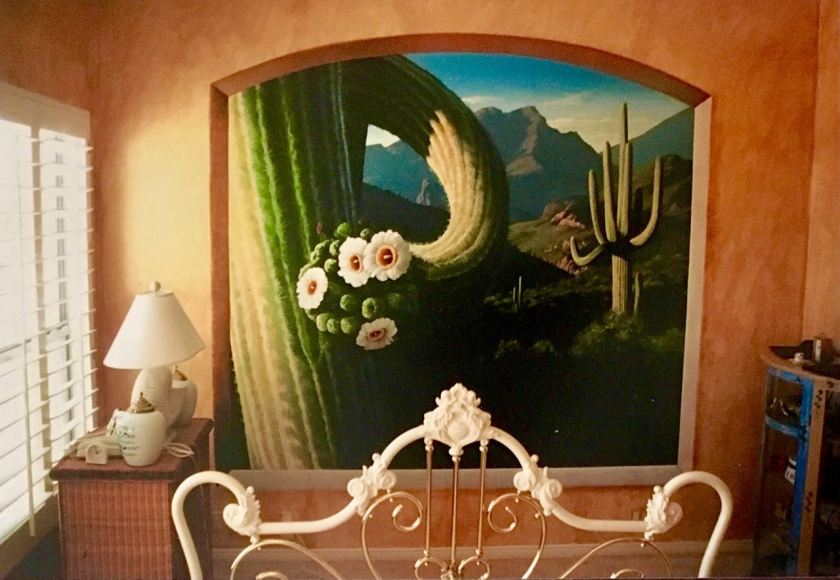
Drum roll, please. My head was actually buzzing with anticipation when we stepped into her room and our eyes immediately went to the mural over Lori’s metal bed, a faux window filled with a colorful Sonoran Desert scene.
Mike’s mural in Laura M’s bedroom
“What?!” is all I could say. Vaguely, I sensed Mike’s presence, but all my attention was on the gorgeous, red-blooming Ocotillo, white-tipped wildflowers and stately Saguaros showing through the optical illusion of a deep-set window.
Brent leaned over the bed to put his hand on the fake window sill and exclaimed, “I thought it was a real window ledge!”
The entire wall was painted to look like plaster, cracked in some places. Right then, I knew I had to feature Mike on this blog.
Lori beamed, clearly proud and in awe of Mike’s extraordinary talent. There was a hint of tears as she said, “The only reason I agreed to host artists in my home today is because of Mike.”
Lori knew something that would take me a little longer to figure out. Mike’s entire life had been spent making art, in one physical way or another, and sharing its beauty with people.
On a Saturday afternoon in December, I visited Mike in his home and began to put the pieces together, the ones Lori was already intimately familiar with, the ones that could bring tears of sadness and joy.
Mike’s home behind Ron’s Market is wooden, narrow and deep, reminiscent of shotgun houses found in the Deep South where I’m from. Cozy and inviting, each room is well-appointed and a reflection of Mike; his interests, his passions.
“I like my house,” he says simply.
His “Happy Wall” in the dining room has a kayak and paddles resting in a corner, a row of carefully arranged beer glasses, and a long, perfectly-executed oil painting, one of Mike’s masterpieces, of the Dirty Devil River, a tributary of Lake Powell. “The Dirty Devil only gets enough flow for kayaking five days out of the year,” Mike said. “We had a blast for a week on this river.”
Mike likes his beer/ale/lager dark and stout. In fact, he finishes a pint as we begin our tour of his home, and pours a new one.
“Would you like one?” he asks. A beer is tempting, but I say no. I must remain sharp and focused so I can remember everything he says.
Next to the refrigerator is a mound of empty beer bottles tucked into cases stacked one on the other. I stare at the pile.
“Don’t judge,” Mike says.
“I’m not judging,” I say. “Brent plans to build a greenhouse with walls of colored bottles. He’s not interested in brown bottles, so I’m just checking out how many clear and colored bottles you have.”
“I didn’t just drink all of those,” Mike says, still concerned I’m judging. “I’ve been saving them for a while.”
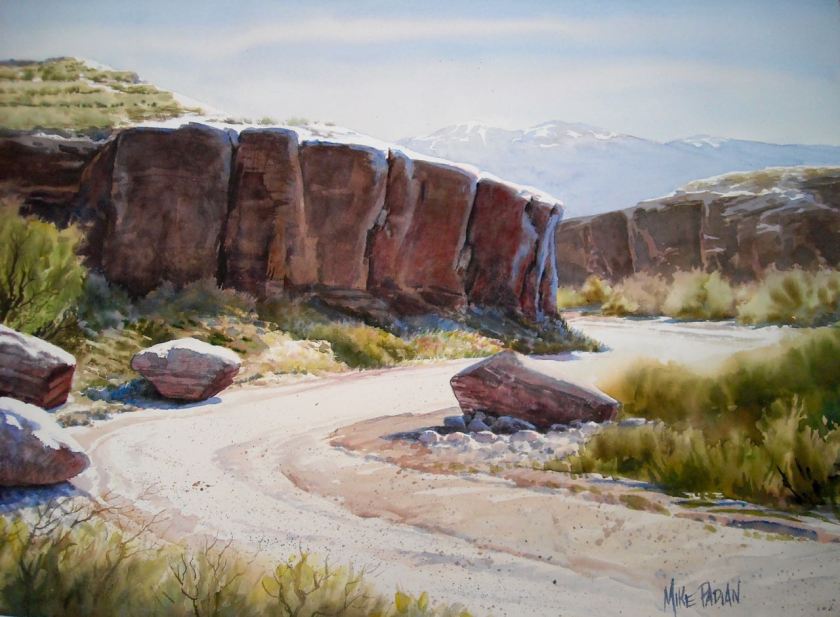
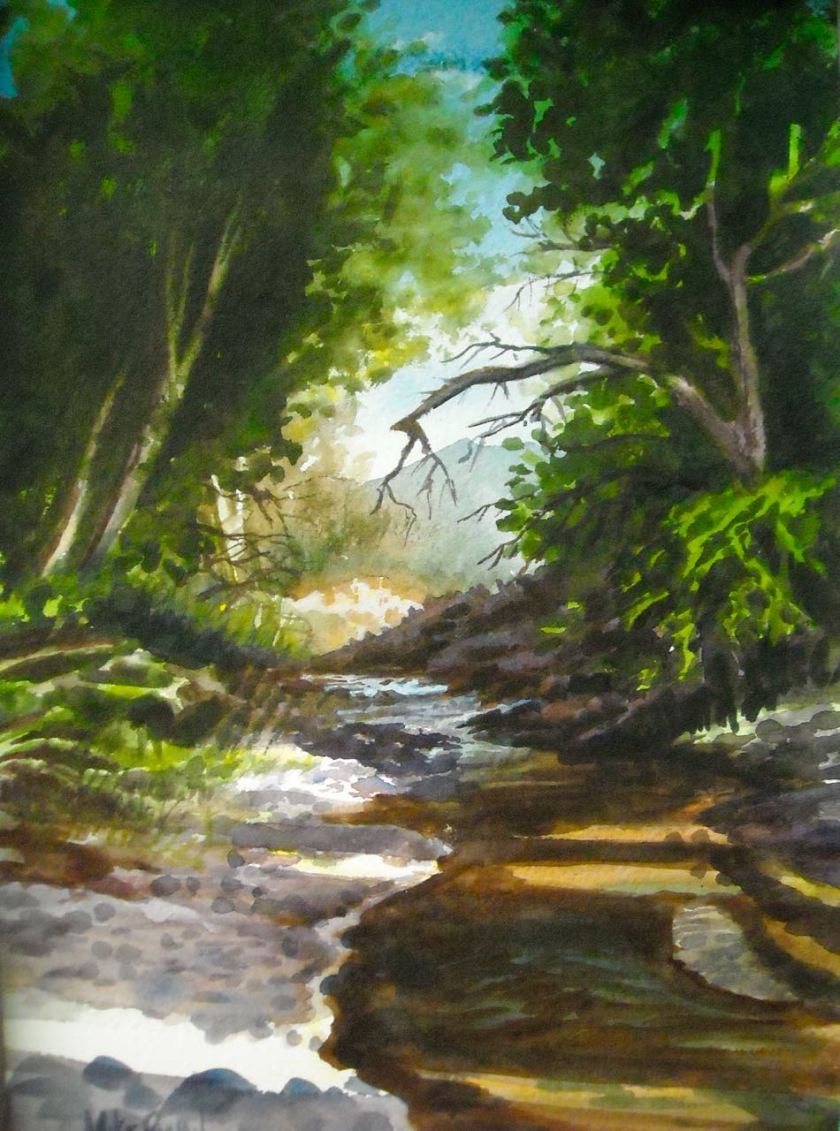
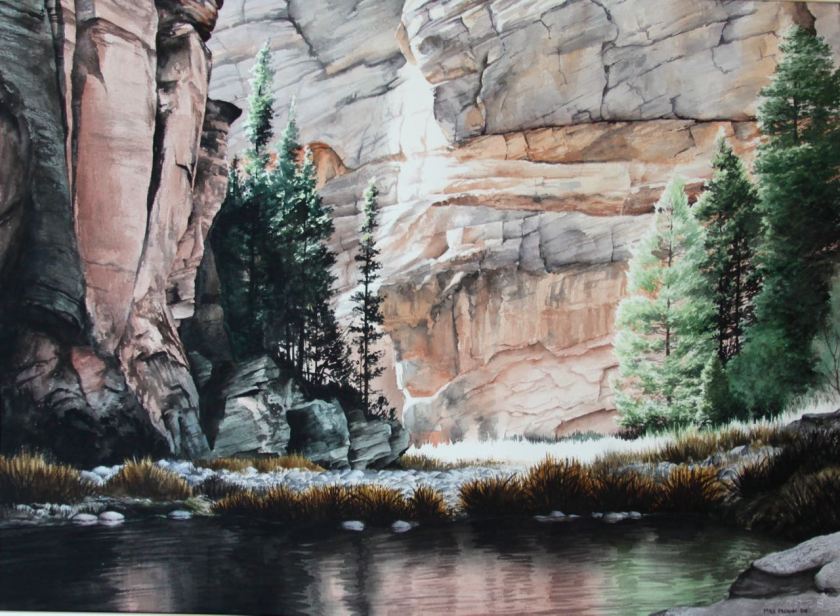
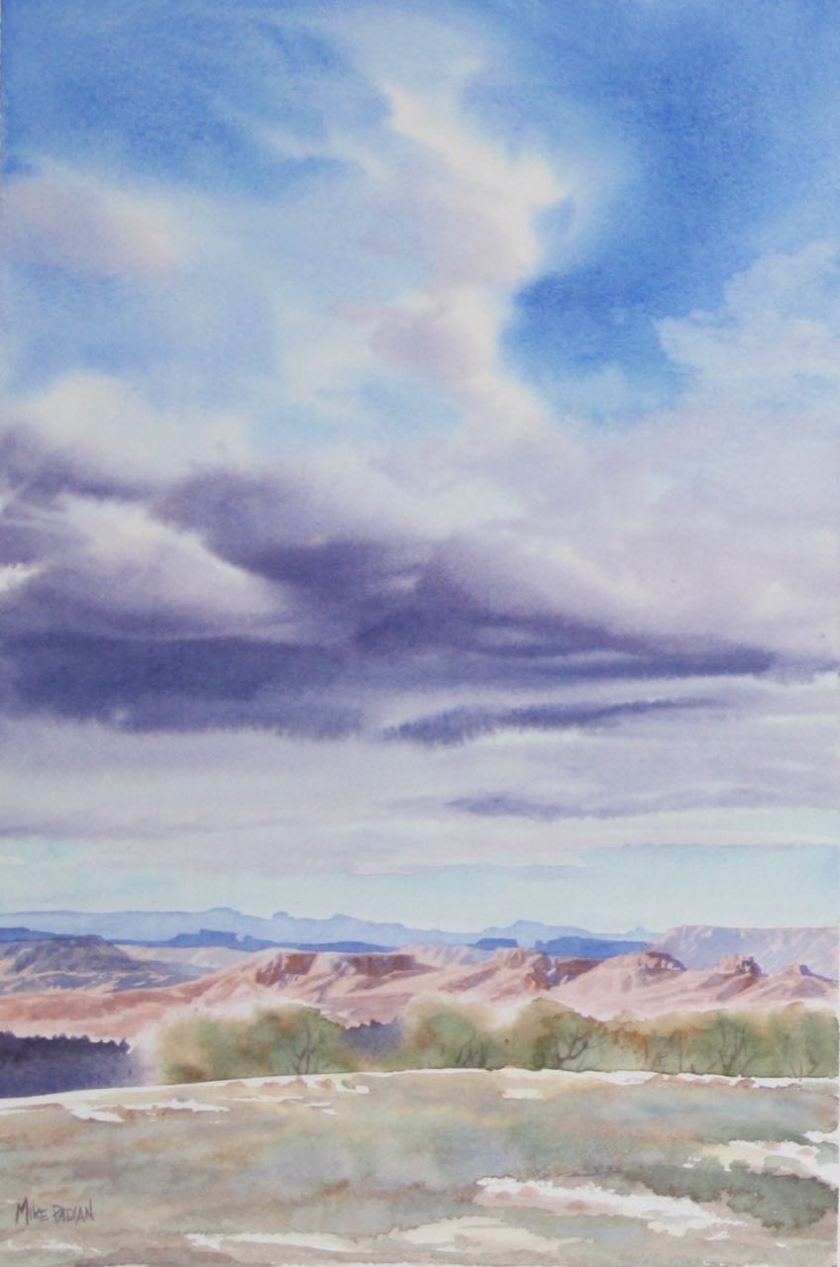
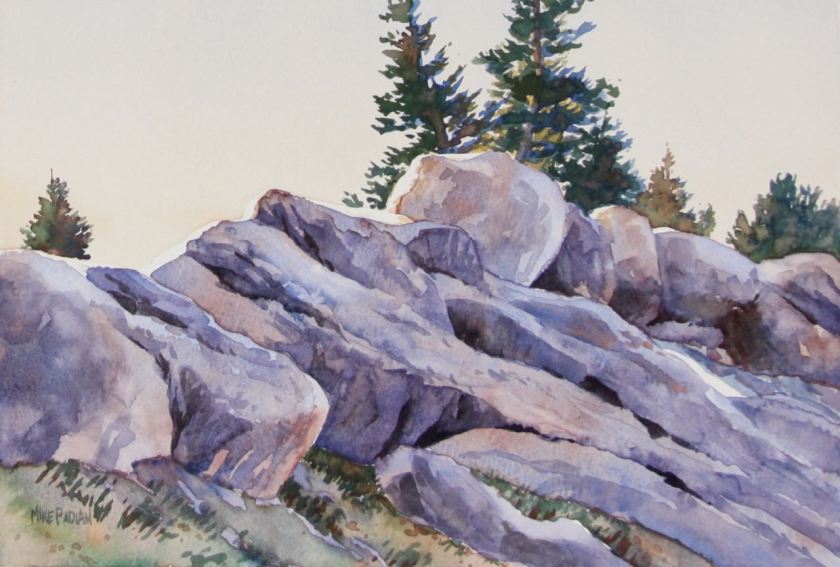
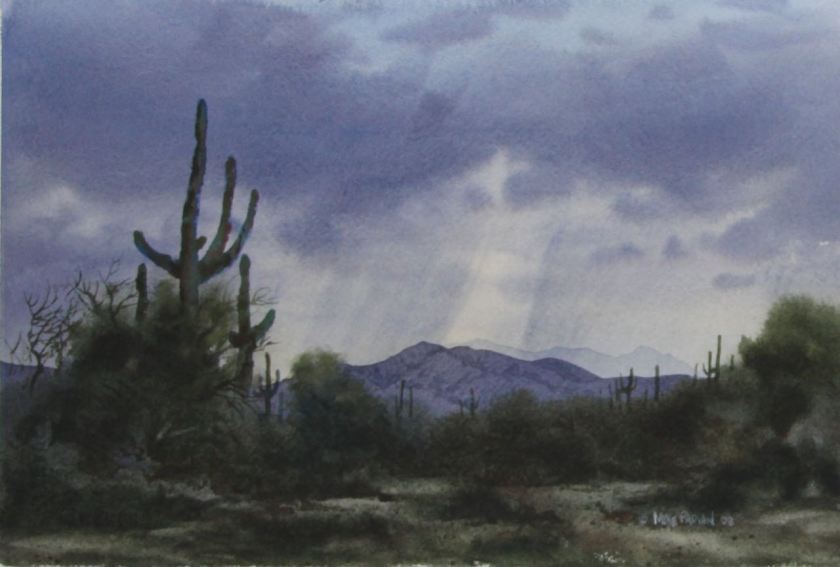
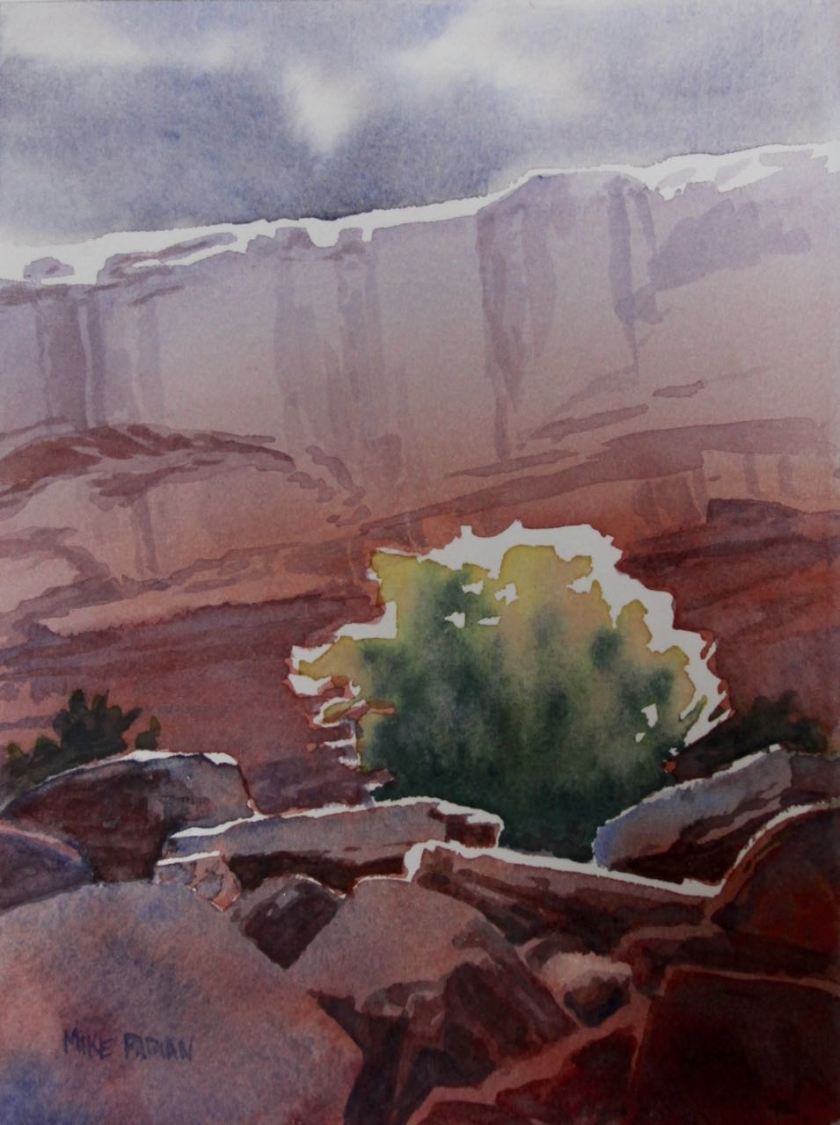
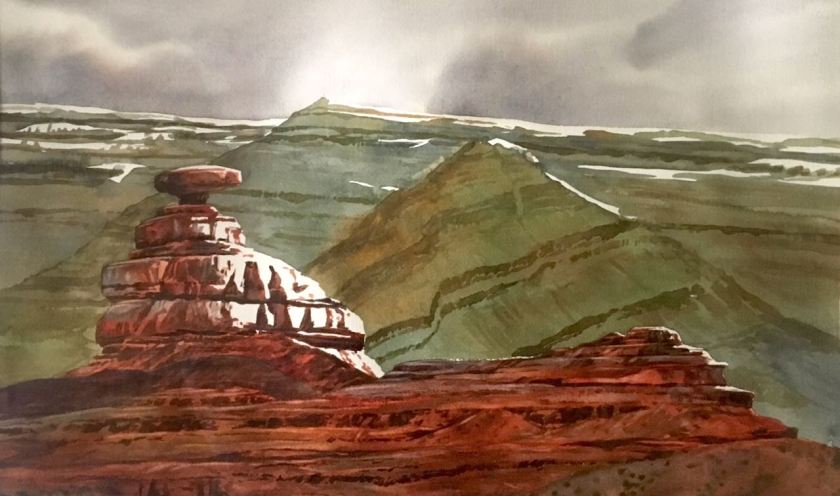
I’m truly not judging Mike, about anything. In fact, as we talk through the afternoon and explore his watercolors of all shapes and sizes, framed on the wall or tucked into boxes under tables, my high estimation of him steadily and steeply rises.
As we talk about his life, and painting, we pull out more and more pieces, each distinct and breath-taking. Mike knows the geographic location of each landscape, even those from his imagination. I feel like a gold miner striking a vein and can’t get enough. “Bring it on,” I say, when he remembers another stash.
Some of the framed watercolors reflect light from windows, which can be seen in the photographs we’re taking. Instead of going through the trouble of taking the paintings out of their frames, we pull them off the wall, prop them up and Mike stands across the room with a giant piece of cardboard, moving it up or down, right or left, according to my directions, attempting to block light from over the kitchen sink or through the sliding glass doors. It’s rather comical and the photos don’t turn, of course. They look like stars shooting out of desert rocks.
But that’s okay. Mike hands me a CD labeled “MIKE PADIAN’S PAINTINGS” and I happily discover these very framed masterpieces are quality jpegs on the CD.
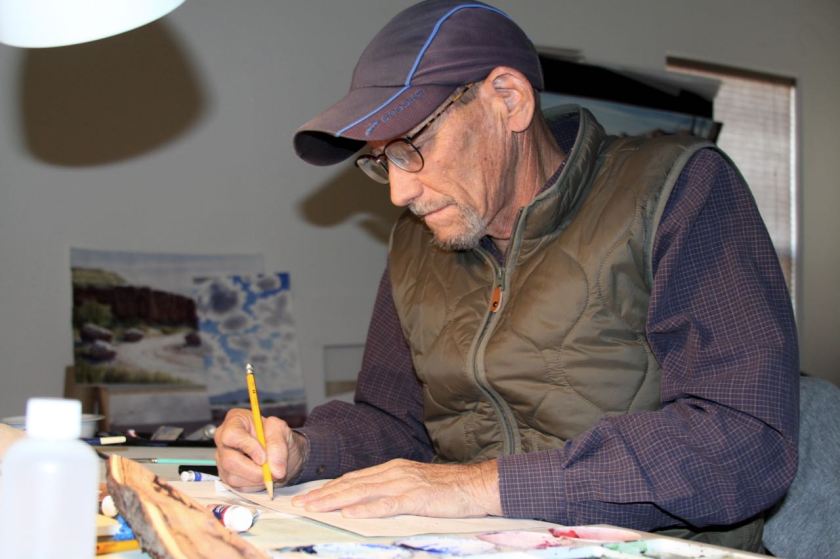
In his studio, Mike and I excitedly arrange his library of unframed watercolors, one by one, on a white background and take photographs, me feeling like an amateur photographer next to the master. Like the guy who washed Michelangelo’s paint brushes, or brought him a sandwich.
‘Don’t judge,’ I think as I try to capture each piece of artwork with just the right light at just the right angle.
Distortions would be bad; I want to be true to Mike’s art. And to Mike.
Mike created his first painting at the age of nine. “It was large,” Mike says, “and Mother still has it.”
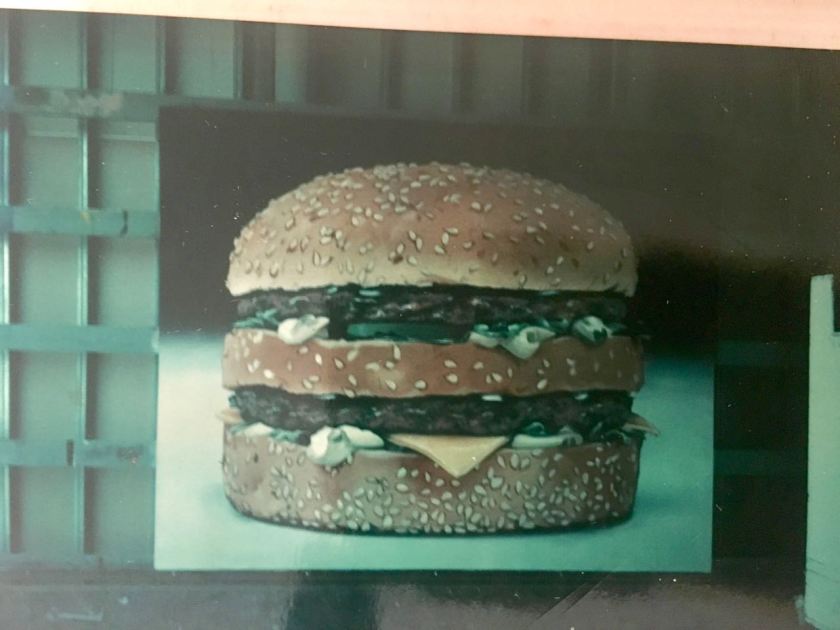
For 23 years, painting billboards 48-feet long was all in a day’s work for Mike. He painted 10-foot tall Big Macs, giant portraits of Phoenix newscasters and naked women. Well, he only painted naked women on Fridays as a practical joke for his boss, Don Weber; on Monday, Mike would paint clothes on the women before the billboards were hung in public.
10-Foot tall Big Mac sitting in the workshop
Mike admits that at 5′ 4″, he’s not a big man, so it’s ironic he created such massive artwork. “We used a projector,” Mike says, “to create enlarged sketches that I then painted in with detail. We had to paint quickly, too, because time was money.”
After billboard painting, Mike began a mural painting business in 2003. One day in 2004, he found out he needed a heart transplant… right away.
“In the emergency room, the doctor asked how many heart episodes I’d had, and I told him two. He said, ‘most people die on the third one,’ so I immediately went on the donor list, knowing that my small heart cavity meant I’d need the heart from a small woman or child.” The doctors gave Mike seven days to live.
A heart became available on Day Five.
These days, if you ask Mike how he’s doing, his face lights up as he says, “Great! Can’t complain.” If anyone has a right to complain, it’s Mike. The medicines necessary these many years to keep his body from rejecting the donor heart have damaged his health in significant ways. However, Mike chooses laughter over the alternative; curling up in a fetal position and dropping out.
Besides, Mike is too busy preparing for art shows and spending time with his brother Ron, who lives nearby, and crafting exquisite culinary dishes for his mother and stepfather; like Madeira sauce with tarragon and mushrooms.
While Mike focuses on watercolor painting, folks continue to fall in love with him and his work… it’s simply impossible not to!
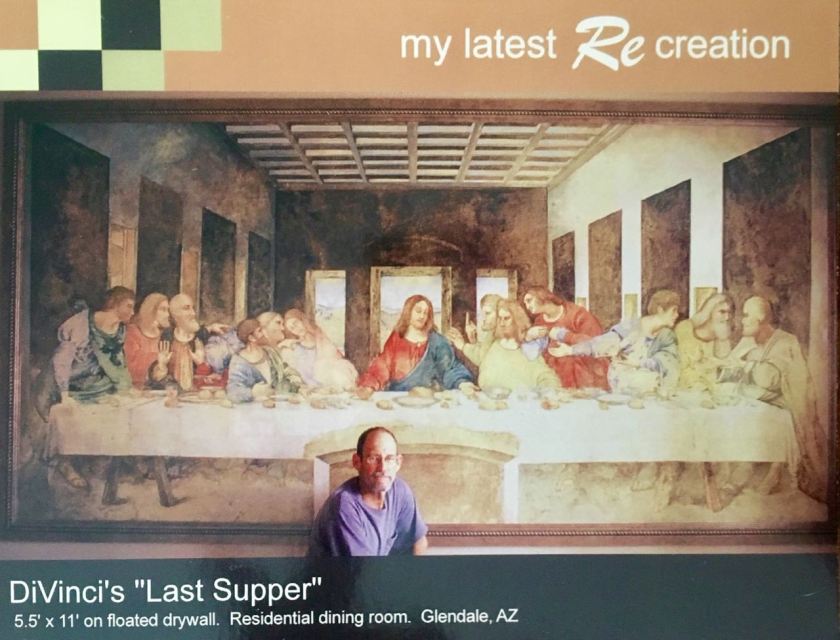
In the short time Mike painted murals around Phoenix, he was kept busy by quite a few customers. For his favorite client, Mike painted Davinci’s Last Supper on the man’s dining room wall, a John Force funny car mural in his home office and a movie-themed mural of vintage film posters surrounded by popcorn and movie reels on the wall over his TV.
Mike poses with his “Last Supper” mural
“My client called me this past December and told me he painted over the Last Supper mural,” Mike chuckles. “I mean, it was his to paint over. Now he wants me to paint a scene with the Ten Commandments’ stone tablets, maybe with Mt. Sinai in the background.”
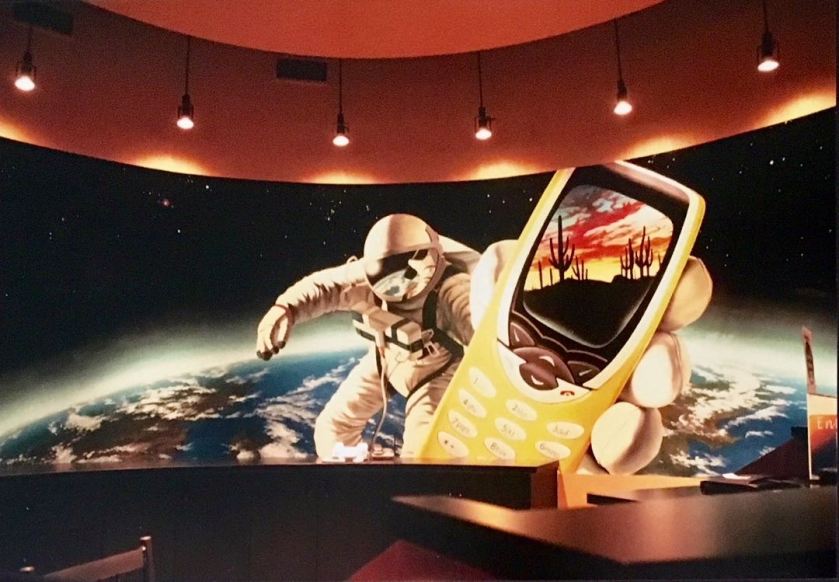
Mike’s mural work, like the one in Laura’s bedroom, is stunning and often contains T’rompe-l’oeil (French for “deceive the eye”), imagery that creates an optical illusion of objects existing in three dimensions. In homes, Mike has painted windows with desert scenes, extended hallways, floral trims and scroll work. He even painted a space-themed mural for a phone store.
The real hallway ends just after the hanging lamp. Everything beyond that point is illusion.
LEARNING TO PAINT ON A LARGE SCALE
Mike grew up in Phoenix and graduated from Moon Valley High School in 1976. He started painting billboards and signs one year later.
“At first, I was sloping panels and cleaning up messes. My boss said I should learn how to draw letters to scale, and once I had experience doing letters, I could paint billboards.”
Mike took a lettering class at Maricopa County College. Back then, all lettering was drawn out by hand using math to determine spacing, letter widths and heights. Every step was manual, no computers. After a year of lettering, Mike began painting his own billboards and over the next two decades, learned on-the-job.
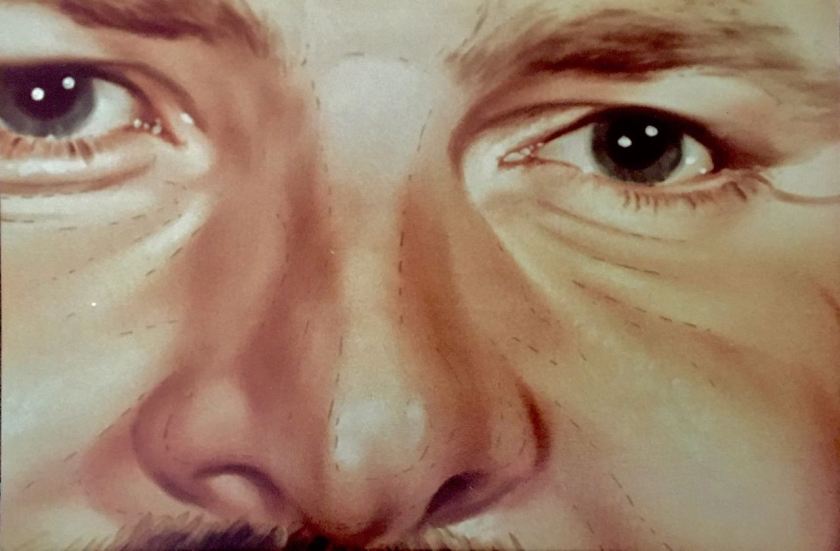
Painting giant faces on billboards was difficult because Mike was too close to see the entire face. To compensate, he developed a system of dotted lines to identify where he was on the face.
Mike’s dotted lines on a billboard face from the 80s.
“A line of long dashes meant a long blend,” Mike says. “Shorter dashes meant a short blend of colors and shadows, and dots represented things I needed to change. For instance, I would outline eyes in dots and knew I needed to go outside of those lines.”
Mike educated himself in the Venyetti effect, a phenomenon that causes proportions to distort when an image is enlarged. “Venyetti effect is especially critical when painting large objects on billboards,” Mike says. “A one percent distortion, or difference in size, can change the entire face.” Painting a huge face might have taken Mike an entire day. He didn’t want to have to redo the whole thing by not taking potential distortions into account.
Mike mostly painted billboards on the ground in a giant studio, though sometimes he would need to climb up on the catwalk and paint from there, which was dangerous for obvious reasons. While most billboards were 14-feet high and 48-feet long, some had 16- or 17-foot high extensions, making them mega-tall billboards.
Mike paints high in the air, under the desert sun.
Not only could rain ruin the paint on an outdoor job, the chance of falling was ever-present. In fact, Mike fell twice. Once when working with his boss, Don, on a billboard on Grand Avenue near the train tracks. They were standing on the catwalk when a board snapped and they both fell 15 feet. Mike landed in a barbed wire fence and got hung up. Don hit a truck and bounced onto Mike, then walked away unscathed, saying, “That’s what a good apprentice is for. Thanks, Mike.”
Even while bloodied with mud packed in his nose, Mike climbed back up and continued the job.
In the early 1990’s, with the advent of computers and big ink printers capable of producing large vinyl pieces, printing raced to overtake hand-painting. Within a decade, hand-painting would be gone.
“In the early days of printed billboards, the inks were inferior,” Mike says, “and our clients thought it looked awful. They would ask us to fix it. I had to match the dot matrix with a solid paint color, which was very difficult to do, all the while standing on the catwalk. To check my work, I’d have to climb down, run back to look at it, and then climb back up again.”
Around 1999, Mike decided he no longer wanted to be a billboard monkey, stretching vinyl, fixing bad print jobs and climbing up and down. It was simply too dangerous.
WORDS AND IMAGES
Mike’s artistic skills are broader than painting. He has always written poetry, lyrics and articles for magazines. During the 1980s and 1990s, while Mike painted billboards, he also ran his own stock photography company. Drawn to recreational sports and the outdoors, Mike took photos of models while kayaking, snow skiing, mountain biking and hiking. He catalogued the photos for use by publications and also sent monthly submissions to outdoor magazines and visitor guides.
In addition to publishing photos, Mike occasionally wrote pieces for Bike magazine, Mt. Bike magazine and National Geographic Explorer magazine. He honed his writing chops with Sweat Magazine.
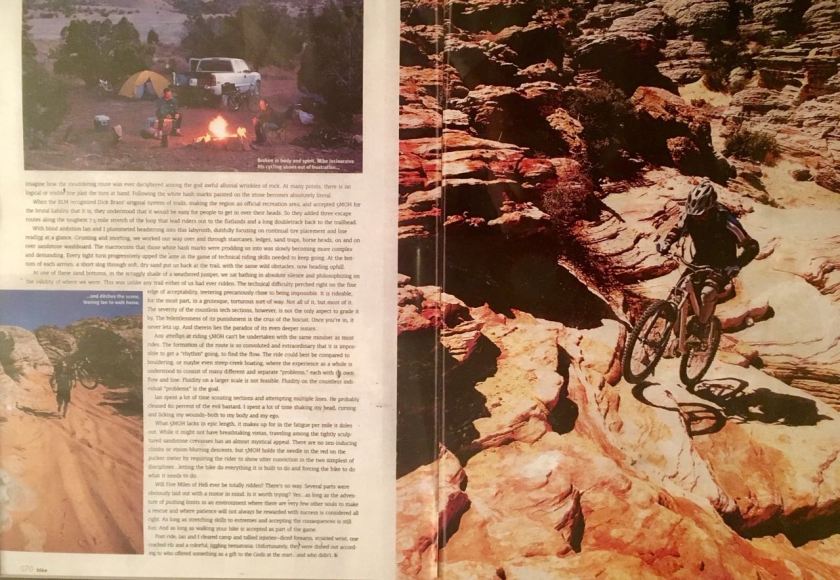
Here’s an excerpt from an article Mike photographed and wrote for Bike magazine about the Five Miles of Hell (5MOH) trail system in Utah. The intro reads, “In this part of Utah, west and north of Moab’s storied red rocks, there’s a trail with a cruel name and a brutal reputation. To ride it, torture is salvation, punishment the prize.”
“What 5MOH lacks in epic length, it makes up for in the fatigue per mile it doles out. While it might not have breathtaking vistas, traveling among the tightly sculpted sandstone creases has an almost mystical appeal. There are no zen-inducing climbs or vision-blurring descents, but 5MOH holds the needle in the red on the pucker-meter by requiring the rider to show utter conviction in the two simplest of disciplines… letting the bike do everything it is built to do and forcing the bike to do what it needs to do.”
A spread of Mike’s article with photos of his model.
Mike’s ex-wife, Jill, published a piece in Bike magazine about Mike’s stock photography adventures titled People Who Ride. Here’s an excerpt:
“Then there was the time he came home two hours late and parked his truck in front of the house but didn’t get out. He just sat there. I kept working at my desk, figuring he was jamming to a song on the radio. Finally, a plaintive bleating of the truck horn awakened me to the fact that all was not right in the world of Kodachrome.
I found him naked except for a beer in his hand. That position was all the better for the setting sun to glint off the cactus prickers stuck all over his legs and buttocks, allowing me to find and pluck them from his body with tweezers. As I performed the delicate surgery, he of course fumed about the shots he’d missed.”
Mike doesn’t take up a lot of space in this world. He doesn’t push his ways on those around him. He’s gentle, unless conquering a river or landscape, either in kayaks, on bikes or with watercolors. He’s thoughtful. For instance, as a stock photographer, he would sometimes urge his clients to give their business to another stock photographer, one who was making a living at it, unlike Mike, who had his full-time job of painting billboards. Mike is considerate of others, sometimes to his own deprivation. But that’s who Mike is.
In 2005, Mike donated 4,000 of his stock photos of Downtown Phoenix to the city archives. He estimates 12,000 slides of outdoor recreational photos are currently stored in his art studio. “They’re outdated,” Mike says. I try to convince him publications would find value in those scenes, which could be considered vintage by now. Everything vintage is “in” these days. Besides, shot through his artistic eye, and on film nonetheless, these thousands of photos are pure Mike Padian Art.
WATERCOLOR
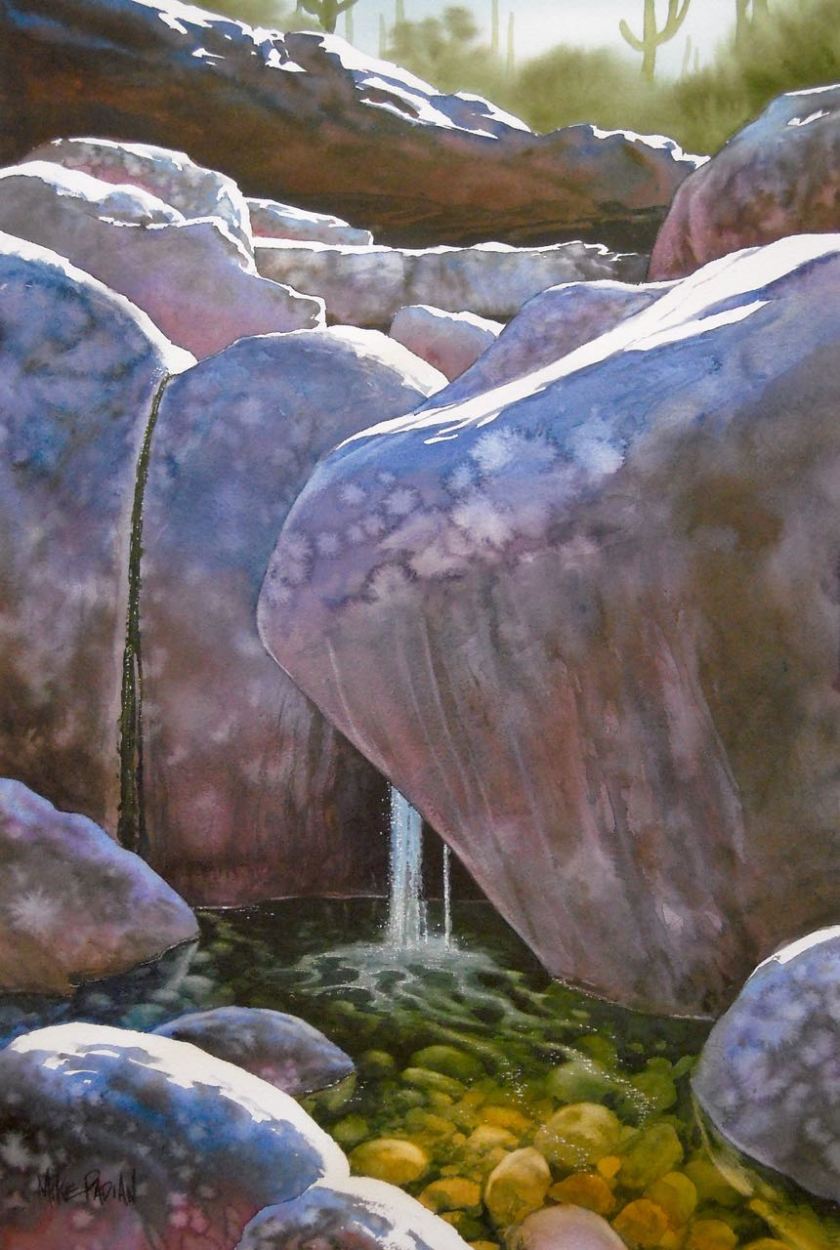
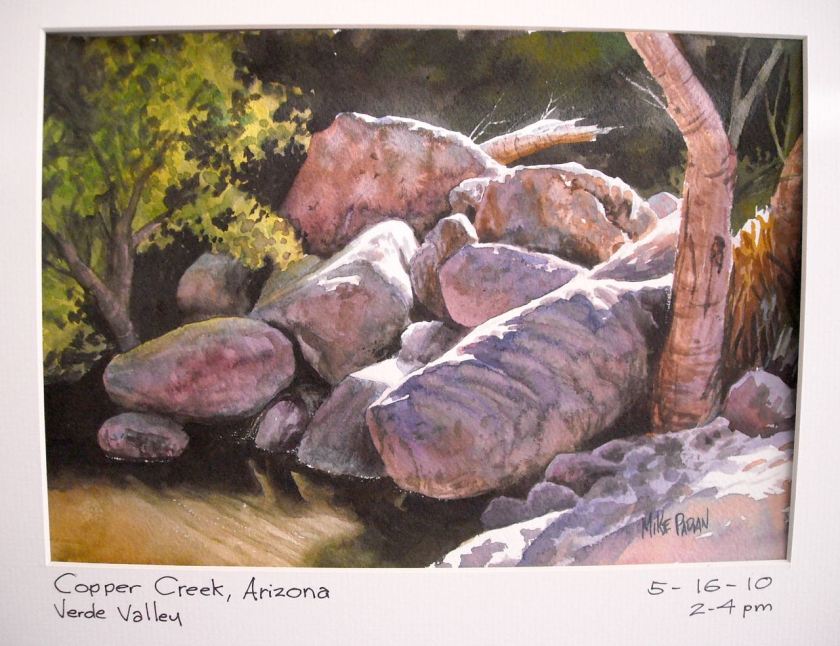
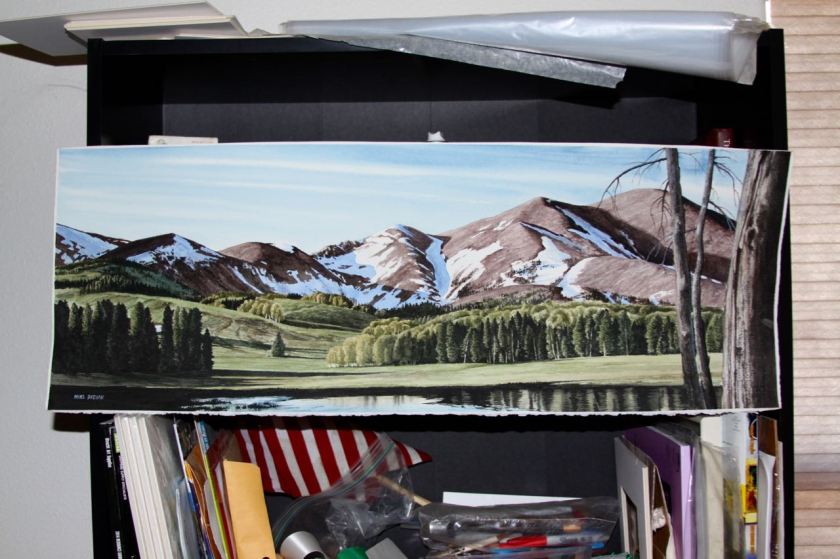
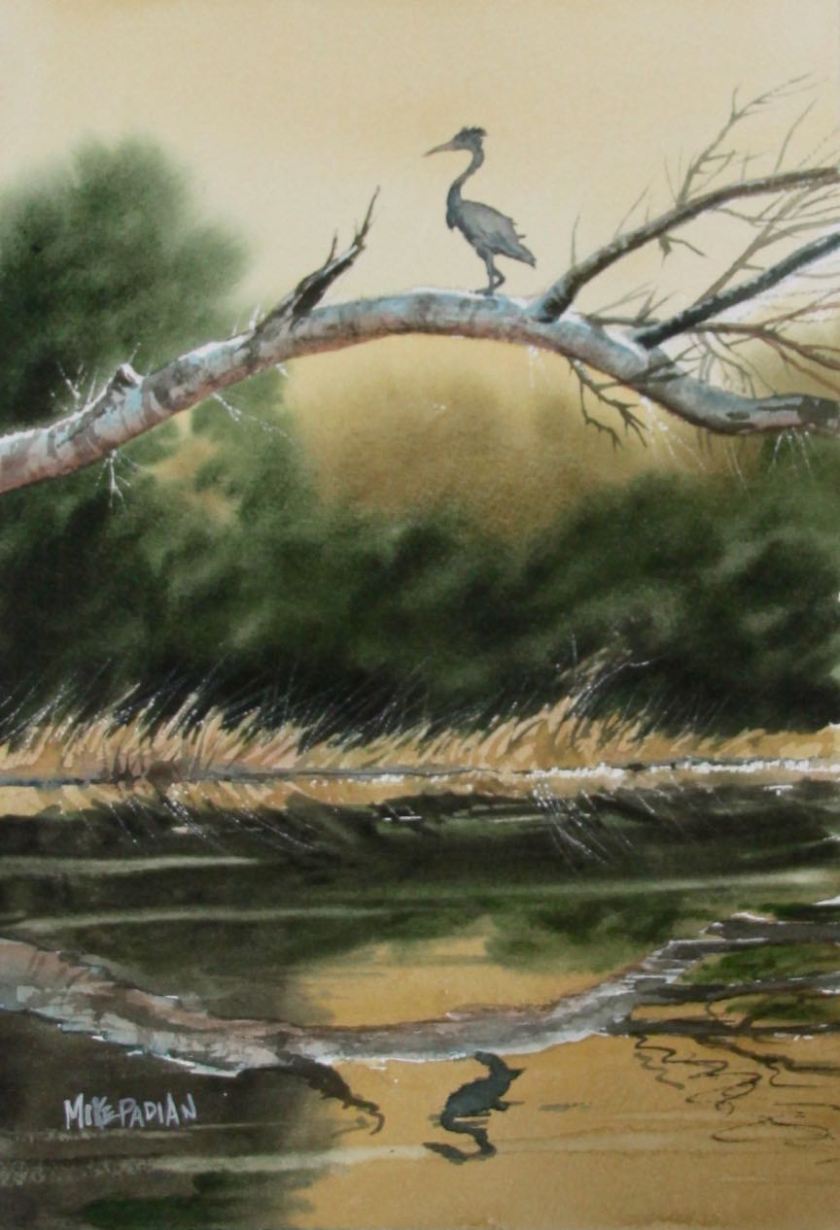
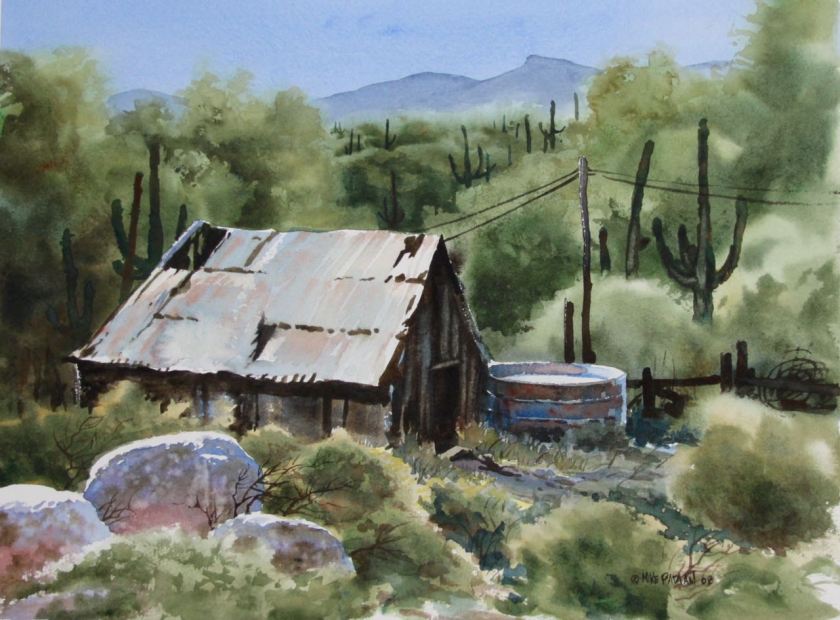
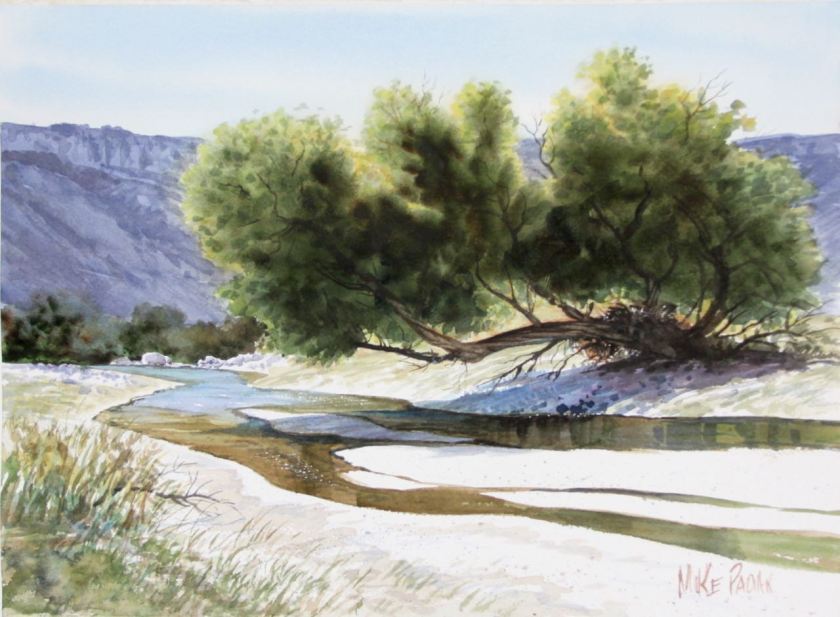
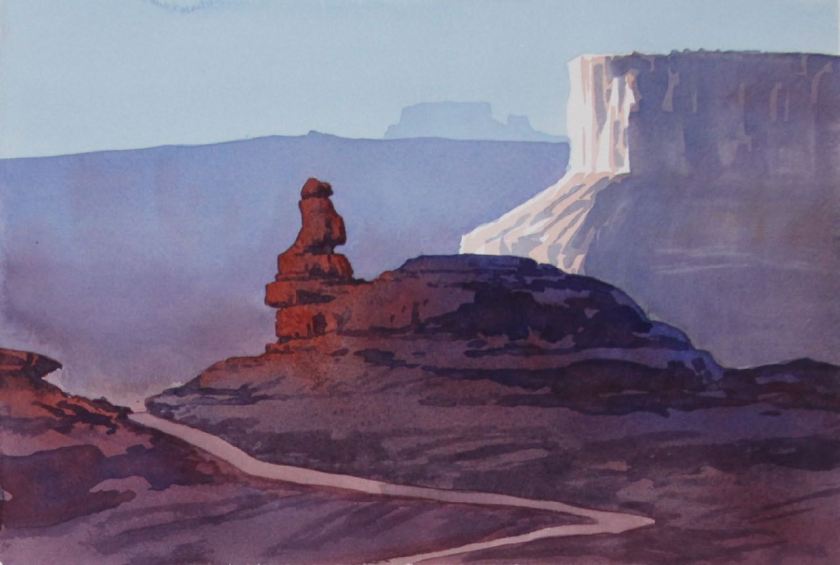
Watercolor is Mike’s medium of choice, and desert landscapes are his forte.
“Some people don’t like working with watercolors because they’re hard to manipulate,” Mike says. “People get frustrated at how difficult it can be to place the color exactly where they want it. But that’s what I love about it. It’s such a thrill when the colors go into place and turn out as I’d imagined.”
The “imagining” is Mike’s favorite part of the process. He uses an engineering approach to carefully plan exactly how he’ll apply colors in layers to create the image in his head. He will spend time thinking and strategizing before ever putting brush to paper.
Once his strategy is in place, Mike can create a painting in a day, including time for drying between layers. “I’ll paint the sky,” Mike says, “then I’ll wash dishes while it dries.”
“I’m self-taught,” Mike says. “I’ve learned from a lot of people by listening. I’m never too proud to attend a demonstration or a class. And I’ve studied light my whole life.”
In one class, Mike had an epiphany. “You must look past what you’re looking at to see the true colors,” Mike says. “An instructor in Sedona showed us how to look through a small hole punched into cardboard to view the object and see the colors as they really are.”
Nature can be a powerful teacher, too. “I hadn’t understood hot and cool in colors until one day I was hiking, not really thinking about painting, when I saw the sun burn around—and appear to nearly burn through—a saguaro. I was able to then see the orange and red, purple and blue in the rocks.”
Mike uses his knowledge of photography to enhance his eye for painting. “In photography, you must trick the camera into seeing the colors in the shadows, make lighter spots more light, and it works with painting, too.”
Years ago, Mike used black in his watercolors. “I don’t use black as a darkening agent anymore,” Mike says. “I’m able to manipulate my color pallet to get good dark colors without black.”
Mike had always painted from photographs, but after his heart transplant, he began to make up images in his head. Eventually, he began plein air painting, which is now his preference. Attending the Moab Plein Air Festival in Utah is one of his favorite past-times.
“They have competitions within a certain geographic area and you’re given a time frame for completing a painting and framing it,” Mikes says. He’s won several awards for various competitions, including Plein Air.
Mike’s Awards
First Place – Water media, 2014 Escalante Plein Air
Second Place – Water Media, 2013 Moab Plein Air Festival
First Place – Water Media, 2012 Moab Plein Air Festival
Honorable Mention – 2011, 36th Annual Western Federation of Watercolor Societies
Award of Excellence, 2011 AZ Watercolor Association Spring Exhibit
Purchase Selection – 2010 Watercolor West Juried Exhibit
Merchant Award – 2009 AZ Watercolor Association Spring Exhibit
Award of Excellence – 2008 AZ Watercolor Association Fall Exhibit
He enjoys the process of painting, it makes him happy, especially when he tries a new technique and it works. “It feeds my soul,” Mike says.
“You know, one painting represents four paintings, because three other paintings didn’t turn out exactly right. They had some glitch, but that happens working with any medium. Just the process itself, many times a painting doesn’t work out.”
Mike keeps the ones that don’t turn out and he’ll use the back for experimenting with colors. “I’ll rip up the really bad ones, though,” he admits, laughing.
His work space is simple and not crowded with paints, paper or other supplies. He works with only a few small tubes of paint or watercolors. “I’m not a supply hoarder. It’s funny to have so few supplies because when I was painting murals, I bought paints by the pint or gallons.”
One raised drawing table, a work table and shelving occupy Mike’s creative space. Here he sketches and paints with his film cameras snugly stored in a nearby closet. Mike’s studio is at the back of his house. Soft light filters through the blinds. It’s quiet. A perfect spot to contemplate/engineer his paintings.
Mike sells his paintings through art shows, word of mouth, Sho ‘N Tell retail space in Rock Springs, and in the upstairs gallery at the Rock Springs Cafe. He has a devoted following, which now includes me and Brent. To give back, Mike donates paintings for various fundraisers around Phoenix.
Painting and preparing gourmet meals hasn’t been Mike’s only creative outlets, though. He’s also built a house and drummed.
Starting in 2000, for 53 weeks Mike and his then-wife of 25 years, Jill, built a home in Black Canyon City. Mike took a year off of work and acted as general contractor. He also did much of the on-hands work, including drywall, finishing, installing windows and logging his own timber from the Mogollon rim to hewn into vegas for his patio. Vegas are logs used as posts on patios or as architectural features indoors, perhaps to emphasize entry space between rooms.
Unfortunately, Mike went into the hospital for the heart transplant in 2004.
Mike built this gate in his backyard.
In his younger days, Mike played the drums, preferring to perform progressive rock by groups like Gentle Giant, Gong and Yes. But a couple of times, he was asked to sit in with a Country & Western band to play for residents of Shangri La, the famous nudist resort that’s been in New River, Arizona, for at least 50 years.
“I prefer rock music,” Mike says, “so I faked half of the Country & Western songs. But the crowd didn’t care. They were all just dancing in their natural glory on the tennis court, having a good time. After the first set, they started yelling for the band to take off our clothes, but we didn’t,” he laughs.
The second time the band played at Shangri-La, the bass player and guitarist dropped acid. “The guitarist went into a Jimi Hendrix riff and all these naked people stopped dancing to look at him like he was crazy.”
Most of his gigs were with professional bands and Mike even recorded in a studio; back then, it would have been on a reel-to-reel or tape cassette.
Mike’s life has always been about making art, beginning at the age of eight with painting, then as a billboard painter right out of high school, and eventually as a stock photographer, writer, drummer, gourmet cook, mural painter and watercolorist.
Mike has consistently brought beauty into the world.
“As I age,” Mike says, “I don’t need to paint every day like I used to. But I do have two compositions in my head right now and I need to draw them out, get them down on paper.”
In the last year, Mike’s painting has been overshadowed by other priorities, like going to dialysis three days a week for three-hour sessions each time.
“Dialysis isn’t awful,” Mike reassures me, “but it’s not great, either. Usually I put in ear plugs and just try to sleep through it.”
How considerate of Mike to make me and others feel better about what he has to endure. Just like he urged his clients to give other photographers their business, Mike thinks about not taking from others to give to himself. That’s why he is hesitant to seek donor kidneys; he speculates there’s a chance he might only live for two more years with new kidneys, which would take kidneys away from someone else who might live longer. I try to argue the point but Mike is following a deeply-ingrained moral imperative. That’s who he is. And that’s why I respect him.
“I have to make a decision, though,” Mike says. “I need to decide soon if I’m going to move forward with kidney transplants.”
One thing’s for sure, Mike is ready to crank up his painting again, dialysis sessions and moral dilemmas be damned!
“With everything I’ve studied, I haven’t mastered any of it, just figured things out. I was never a great biker or kayaker or skier or photographer. I’ve done everything half-assed, except for painting. I think I’ve finally mastered watercolor.”





 Dominic’s artistic experiences also include throwing pottery, drawing portraits and painting murals for Shakespearean stage sets. He greatly admires artists such as Eames, Frank Lloyd Wright and Charley Harper, and is captivated by their use of simple, yet bold, design based on sophisticated, yet minimalist, geometry.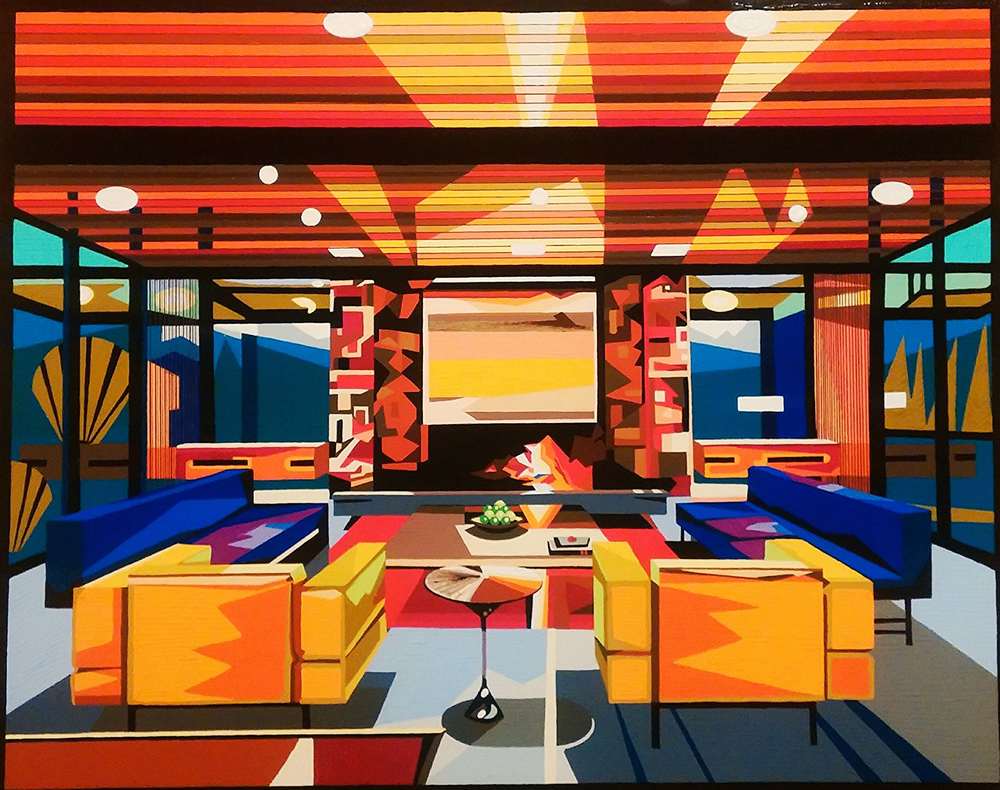
















 Cre8-Space