
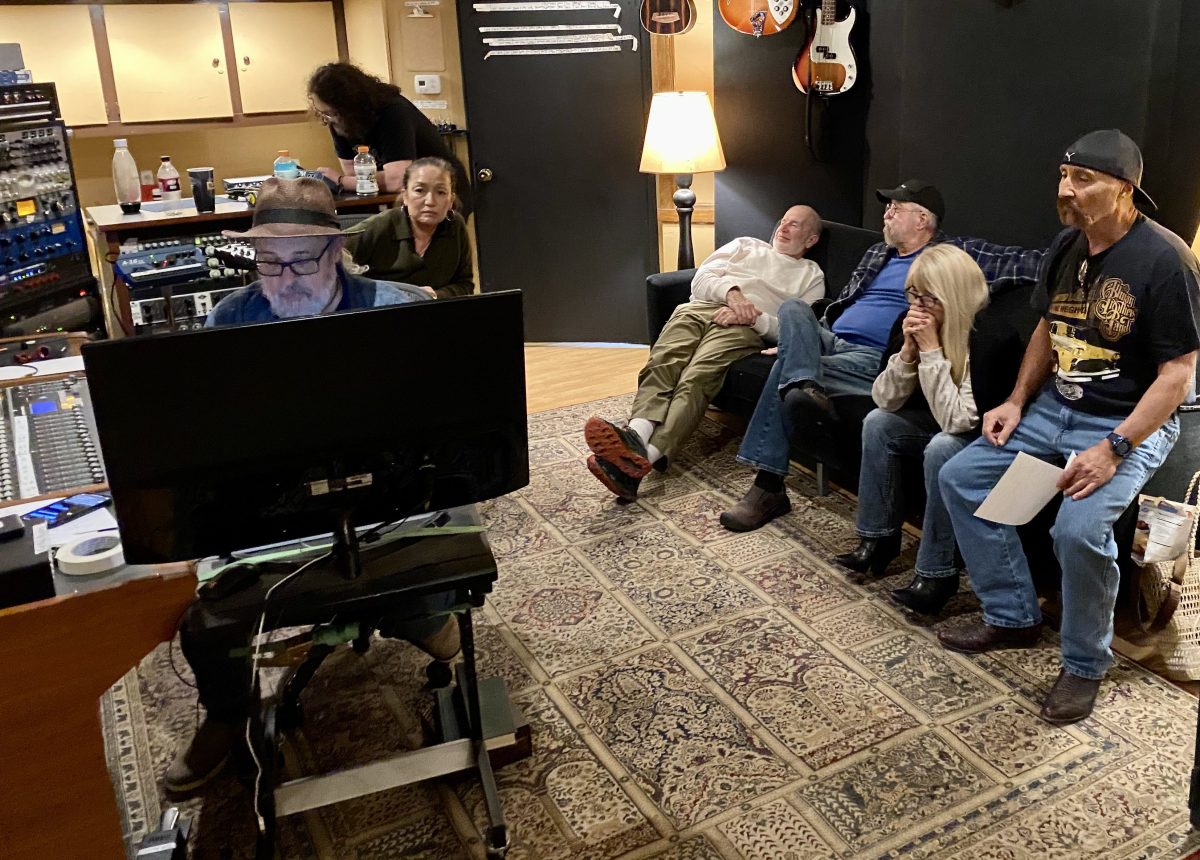
Clayton Ivey has sat on hundreds of recording studio couches in his 55 years of playing keyboard on thousands of songs with some of the greatest musical artists from around the world. He was also producer on some of those toe-tapping and chart-topping songs recorded in Muscle Shoals or Nashville or Memphis or NY or LA.
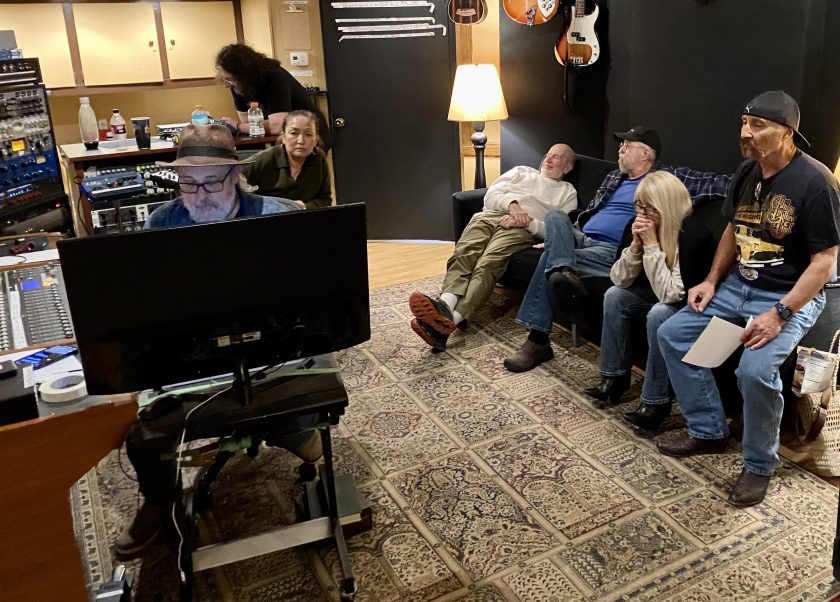
“I love this room,” Clayton says, sitting on a long black velvet couch facing the recording board where Charles Holloman, owner of East Avalon Recorders, focuses on the computer’s pulsing tracks.
Of all the studio rooms he’s occupied, Clayton likes this room the best.

Across the room, blues guitarist Reddog faces the recording booth, swaddled by his Stratocaster. His stance and uniform — backward baseball cap, black T-shirt and cowboy boots, cinched jeans — hasn’t changed in the 35 years I’ve known him.
Reddog’s cool exterior belies his churning passion for the blues, and the hard, hard work he’s done leading up to this moment: standing in Charles’ studio with just two sessions scheduled to record his nine songs alongside some crazy-talented musicians.

We can’t leave women out of Reddog’s art form. Debra, his girlfriend, is here, supporting his every effort and documenting the scene. Also, female back-up singers will record in a subsequent session. Any time Reddog mentions adding the women’s voices to a chorus or intro, his eyes light up and he smiles underneath his Deputy Dawg mustache.
In this moment, though, Reddog’s cool exterior might just crack under the pressure of guiding a team of spirited musicians in laying down the rhythm for his album of diverse songs: a lullaby, a straight blues tune, a Steely Dan throw-back, a jazzy instrumental, and a Marshall Tucker-sounding homage to the sound legacy of Macon and Muscle Shoals.
I can’t say any more about Reddog’s songs or the album right now, but I’ll definitely write about all the details when the album launches in late 2025.
“I’ve always loved this room,” Clayton continues from the couch, where he’s reclined, his long legs crossed at the ankles.
“It’s cozy,” Charles says, spinning from his computer to face Clayton.
The black walls, baffles, fairy lights, and layers of rugs create the feeling of being in a Genie’s bottle; a place you don’t mind hanging out when the Muscle Shoals magic starts to happen.
East Avalon Recorders is Clayton’s favorite place for making music. He’s the reason Reddog is recording his second album with Charles, a North Carolina native who learned music technology at Georgia State University and followed his dream of moving to Muscle Shoals and opening his studio.
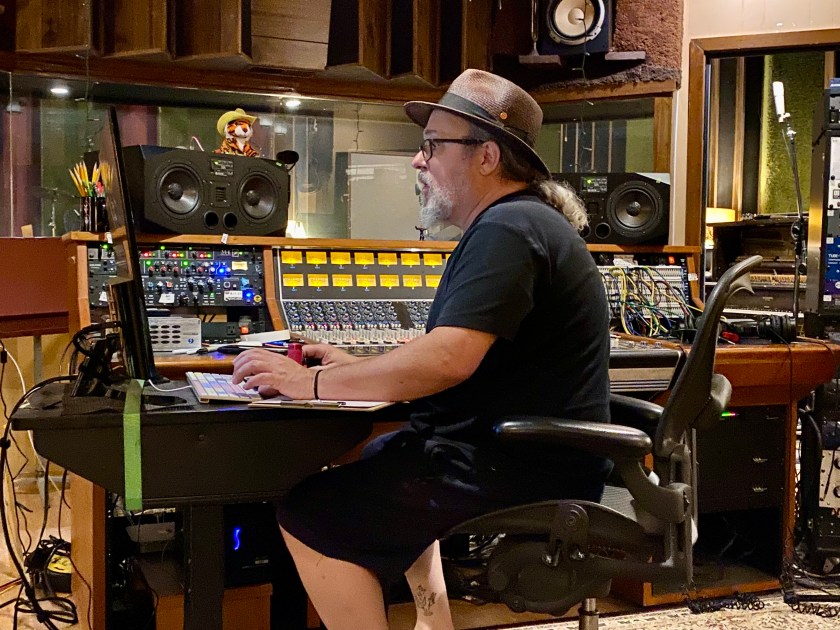
Charles carved the studio out of a 60s ranch-style home on East Avalon Drive, tucked behind industrial buildings only blocks from the flashing lights of Muscle Shoals’ airport.
Adding to the coziness, sound barriers of heavy velvet curtains or glass screen doors block noise from the house’s entry and kitchen. The woolen rugs dampen the sound.
There’s a living room for chatty people to visit, so their words aren’t captured, and a bedroom for musicians to catch up on sleep. Many, many people have poured themselves onto the black velvet couch where Clayton is chilling.
Charles didn’t share any specific story about a couch-crasher — like the one about Joe Cocker at Muscle Shoals Sound Studio sleeping on their camel-colored couch in a drugged state for a week, burning cigarette holes in the leather. It’s the same couch the Rolling Stones can be seen sitting on in the Muscle Shoals documentary. That same couch is still in the renovated Muscle Shoals Sound Studio today… patched with duct tape.
When Clayton agreed to play keyboard on Reddog’s album he pulled in Bob Wray on bass (another legendary session player) and Justin Holder on drums. Clayton also chose Charles and East Avalon Recorders. After recording an album at East Avalon in 2021, Reddog was hooked on Charles, too.
“Charles is so attentive and accommodating, Man,” Reddog says. “He’s kind and does good work.”
“What do you know about this rug?,” I ask Charles, pointing to the large rug under our feet. Its intricate floral design with sleeping lambs looks authentically Turkish, indicating great value, unlike the computer stand which is propped up by two books and held together with a blue ratchet strap. This comical (and effective) rigging shows how most recording studios in Muscle Shoals are not fancy. That’s because plain, good people use plain, good sense to design their plain, good creative spaces.
After all, studio design is all about the physical properties of sound waves. Expenses are spared on the aesthetics of a studio and lavished on the equipment that captures the sound. Placement of instruments, baffles, and ceilings are more important than decor when capturing sound. For instance, walls are sometimes angled 10 degrees to properly direct sound, and baffles of burlap-covered insulation help to “deaden” an area. Those baffles may not be pretty, but they work.
Muscle Shoals, thank the good Lord, is bling-free.
“My Mom bought this rug in the early 90s,” Charles says, looking down. He’s always responsive like that, turning his full attention to others. He’s also consistently upbeat, a laugh at the ready behind his beard and glasses. He’s the one usually cracking everyone up with his sharp wit. Funny flies out of Charles as natural and unstoppable as a sneeze. “For eight years these chairs have rolled over this rug, but you don’t see any wear.”
There is absolutely no wear on that nice rug. And why does the rug matter? Because if it’s truly antique and from the middle east, its value would indicate Charles comes from a well-to-do family. Yet, he doesn’t act like it. He’s as humble as his studio’s decor.
Charles is a down-to-earth guy. Nice and hard working.
As a musician, Clayton clearly feels at home here with Charles. The kind of home where family surrounds you, so you can be your true self. No judgment. Reddog feels at home here, too, even though he’s got some nervous energy as he prepares to record with Clayton.
Looking at Clayton — kicked back on the couch in his “Cat Dad” ball cap — you’d never know his storied career included playing keyboards for Etta James, Clarence Carter, Wilson Pickett, Mac Davis, and hundreds of other artists whose music nudged societal changes and still shapes our lives.
Clayton started playing at Rick Hall’s FAME Studios after the original group of session players, The Swampers, left to form Muscle Shoals Sound Studios. Clayton later opened Wishbone, his own recording palace closer to the Tennessee River. After selling Wishbone, he continues to play at studios around town… at his pleasure. Because, after his years on a piano bench, Clayton can do what he wants when he wants.
When Debra asks Clayton how many sessions he’s played since the 60s, he says, “Probably 10,000-15,000.” We all agree the total is likely closer to 15,000.

Clayton is just like his buddy Bob Wray and other Muscle Shoals session musicians: even though they’ve contributed to hundreds of hit records, and spent time with the most famous of celebrities, their daily life mirrors us average folk.
Clayton’s discography will wow anyone who looks him up, but Clayton is still the same Muscle Shoals guy of his youth: humble, funny, tolerant, hard working, straight talking, excellent piano player, and proud Papa to his feline “boys,” Scooter and Ollie.
He loves those two cats to pieces.
Bob, a Wisconsin native who somewhat resembles Walter Matthau, is another guileless, long-time session player who performed on hundreds of hit records and currently enjoys his simple Muscle Shoals life.
Bob still lives in his 1947 lakeside house which he bought in 1976 and proceeded — with his own hands — to put in all new plumbing and electrical systems. He’s had nine dogs since 1976, mostly labs, and his current pet, Elke (pronounced Elkah), is the first one to live inside. Bob is discovering the joys of having a puppy underfoot in the kitchen.
Bob is cool. Maybe it’s the decades of performing with famous people… and being famous himself. He’s not easily rattled and at 77 he still carries his own bass to his car, even in the dark and rain, even when others offer to help.
When Bob and Clayton sit together on the velvet couch in Charles’ cozy studio, they argue like Matthau and Jack Lemon in the movie Grumpy Old Men. Those of us lucky enough to witness their teasing banter can’t help but snigger and relish the fake acrimony. They may be “old,” (I’m not totally convinced of that) but these men definitely aren’t grumpy.
Clayton and Bob started playing together 55 years ago when the Osmonds came to Muscle Shoals; their first song playing together was One Bad Apple.
“Donnie Osmond was 11 years old,” Clayton says from under his cap bill. “I can’t believe he’s now 66!”
Donnie Osmond turned 67 in December 2024.
And yet here these two men are, still playing sessions together (and apart) and still arguing over chord charts, which Clayton writes.

Chord charts have a long history, but a special version is used in most Muscle Shoals studios, a method popularized in Nashville by Neal Matthews, Jr., who charted songs for the Jordanaires.
Talk about super-famous and super-prolific studio musicians! The Jordanaires formed in the late 1940s as a harmony gospel group and sang as back-up on thousands of hits, including most of Elvis’ gospel and hit-movie songs, only dispersing in 2013 when the group’s leader, Gordon Stoker, died from a stroke. Because Stoker was owner of the group’s name, he took it with him in death.
Matthews’ method of charting chords became known as the Nashville Number System (NNS) and he literally wrote the book on it: The Nashville Numbering System: An Aid to Playing by Ear. The method uses numbers to designate chords and other symbols for tone and sustain, etc.
Looking at a chart is like looking at space math.
“Heeeeere’s your chart,” Charles says to Justin, the drummer, a tall wild-child with a massive heart and massive black wavy hair which makes him look a little like Weird Al Yankovic. But Justin isn’t weird, he’s 150% alive with a wit to match Charles’ quick humor. Their exchanges are entertainment anyone would pay to see. If they go through with their podcast idea of “Muscle Shoals Now” (which I pray they do!!), it’ll be the most-accessed podcast in history.
Justin, 42 and built like a wrestler, loves wrestling and is on a high in the studio because he met his childhood hero, Hulk Hogan, just two days before. Adding to his glee, Justin tells us how he and his buddy were singing while waiting in line to see the Hulk and they made it onto the local news.

Justin is high on life. He’s a session drummer around town, has recently worked with Band Loula, and will tour with Shenandoah for six months as their drummer heals from shoulder surgery. Musicians like Justin don’t just get invited to sessions because of their talent, they get picked because of their cheery personality and awesome attitude.
So when Charles hands Justin the chord chart for the next Reddog song they’ll record, Justin compliments Charles by saying, “Man, NO ONE hands me a chart the way you do.”
Charles energetically replies, “It’s an art. It’s Chart Art!”
Everything these guys are doing in the studio, from playing instruments to creating a collaborative environment, is art. Of course, folks comment on how a chord chart looks like trigonometry, not art.
As the players are all listening to Clayton explain number by number how he charted this particular Reddog song, Bob shouts out, “it’s wrong” and “it doesn’t make sense,” and Charles declares, “It’s Muscle Shoals Math.”
“Chart Art” and “Muscle Shoals Math”: Charles is the Shakespeare of this hamlet, making up new word phrases.
Clayton charted all of Reddog’s songs for the drum, bass, and keyboards weeks in advance of this session. These charts are excellent for players to use instead of reading sheet music, allowing them to create their own riffs throughout the song.
Clayton can play any keyboard, any genre. He’s quite a sight sitting at the grand piano, or Wurlitzer electric piano, or the Hammond B3 organ.
I’m terribly sorry for every person in this world who hasn’t had the privilege of watching/hearing Clayton run his fingers over any keyboard while recording or just warming up those fingers.

At the Wurlitzer, he sits with earphones on, but the right ear exposed.
“Remember this tune?” Clayton says, glancing at me and Debra. The Wurlitzer hums out the chorus of Patches, the great Clarence Carter song.
“That’s Patches!” I say, thrilled to recognize it and sing along on the chorus.
“I played piano on that tune,” Clayton says, still pushing on keys.
Just the day before, Debra and I had stood in Studio A at FAME Records where Clarence and Clayton had recorded that very song and we listened as Jordan, our tour guide, played Patches through the studio’s incredible speakers. In the Very Room it was recorded in! Standing by the Very Piano. And now here’s Clayton, the Very Player on that song. I felt dizzy.

Then FAME tour-guide Jordan, who’s also an assistant engineer, played other songs recorded in Studio A, like Etta James singing Tell Mama, and Wilson Pickett singing Hey Jude, with Duane Allman on guitar, and Aretha Franklin’s I Never Loved a Man (the way I love you), and there, in front of us, was the grand piano she sat at and sang at. [Learn more about our FAME Tour]
The story of Aretha recording just that one song at FAME involves her drunken husband and studio owner Rick Hall later confronting the couple in their hotel room. I won’t share the story because Rick Hall tells it so well in his book The Man from Muscle Shoals: My Journey from Shame to Fame.

In his book, Rick tells stories about each hit song and artists he discovered, and best of all, it comes with a CD of the documentary Muscle Shoals.
Clayton is in the documentary!
“Do you remember this one?” Clayton says from the Wurlitzer.
Debra and I are digging this name-that-tune game. As Clayton is playing a few notes, Charles calls out to him.
“Clayton, let’s get started!”
“Hang on a minute!” Clayton yells, continuing to play for us.
“Baby, Baby,” Clayton says, and I finish by singing, “Don’t get hooked on me. That’s Mac Davis!”
“That’s right, I played keyboard on so many of his albums,” Clayton says.
And now Clayton is playing keyboard on Reddog’s album, right in front of us.
“Oh, sure,” Clayton says each time Reddog asks him to play another keyboard; He’ll practically run over, put on earphones, and play a few riffs to wake up the instrument.
These session players are seeing each of Reddog’s songs for the first time in real time. Clayton listened in advance and created the chord charts, so he’s had time to think about what he’d like to play on each song. But Justin on the drums and Bob on the bass are just now hearing the songs as Reddog plays and sings each one all the way through.
As Reddog plays and sings, Clayton, Bob, and Justin reference the chord chart and discuss amongst themselves what they’ll play during intros, verses, bridges, choruses, etc.
Sometimes they’re so inspired by what they’re hearing, they’ll get off that black velvet couch and head to the studio, walking quickly, with purpose. Bob is usually the first off the couch and marching to his bass. The musicians then perform the song together as Charles captures it all.
Occasionally someone will yell out “damn” or “shit” as they flub a note and the music stops while Charles, with a click of the mouse, backs them up a measure or two and they start over.

When the song has been recorded, these raucous musicians return to the couch, or Justin lies on the floor behind the sound board, and they all listen to their playing.
“Oh, I can fix that,” Bob says when he hears a missed bass note or an arhythm.
I just hear a good song, but there goes Bob, headed toward the booth’s door, saying to Charles, “Let me fix that spot,” or “let me take it from the top.” Bob’ll sit alone in the recording booth with his bass and run through the entire song all by himself.
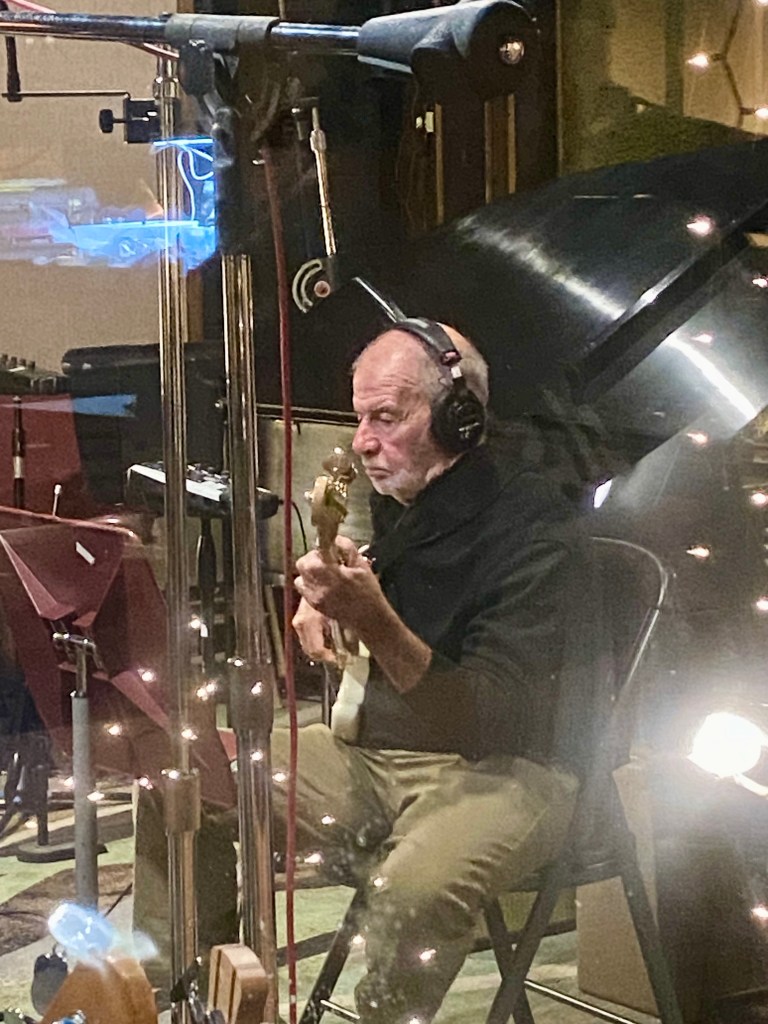
Not to be outdone, Clayton will stand up and trot toward the booth saying, “I’m gonna’ redo that bridge on the acoustic,” and Charles just clicks the mouse and they re-record.
After 55 years as professional musicians, Clayton and Bob still want their sound to be perfect, and they’ll spend the extra time and energy to get it right, not listening to anyone who disagrees. They still have their work ethic. They still care.
They still trot to their instrument to do better.
By the end of the second night, we all feel like family.
Donna, Bob’s lovely friend, heats up the the crockpot of meatballs and tins of yummy jalapeño dip and artichoke dip she made for our crowd. We have to be quiet in the kitchen for most of the night because Reddog set his amplifier in there. Something about getting a better guitar tone with greater volume. So the amp is set apart to avoid overwhelming the other sounds.
On our tour of Muscle Shoals Sound Studio earlier in the day, Chase, our tour guide, explained how Duane Allman would stand just outside the bathroom door, with the door open and his amp blasting inside the tiny room, and Duane would crank up his amp nearly twice as loud as the other instruments, to get that better tone.
Duane played that way on Boz Skaggs’ Loan me a Dime, one of my favorite tunes of all time, of all genres. That song is perfect and when tour-guide Chase had pointed to where I was standing and said that’s where Duane had played Loan me a Dime decades ago, I got goose bumps all over.
On the Muscle Shoals Sound Studio tour, Chase also played Take a letter, Maria, the first official hit for the new studio and its founders, the Swampers: Barry Beckett, Jimmy Johnson, Roger Hawkins, and David Hood.
For nine years at Muscle Shoals Sound Studio, from 1978-1987, before they moved to a bigger studio down by the Tennessee river, the Swampers were involved in the biggest hits of the day. Barry Beckett, the piano player, was an intelligent man of few words and the only one who could read music, so he charted the songs at that studio.
The Swampers got their start at FAME as the second group of session players hired by Rick after the first group gained recognition from their many hits and struck out on their own to further their careers.

The Muscle Shoals Sound Studio building started out as a casket showroom and continued on after the Swampers moved out, possibly as an appliance store at one point. The building eventually became run down but with the release of the Muscle Shoals documentary, a foundation was formed to restore and reconstruct the studio just like it appeared in 1978. The instruments that had gone home with musicians came back and were placed where they had originally stood.
Muscle Shoals Sound Studio is still available for recording, but three of the original Swampers are gone, leaving only David Hood to carry on their legacy.
Visitors to the Muscle Shoals Sound Studio will find their jaws dropping at stories from the studio’s glory days, as told by guides Chase and Terrell, a Muscle Shoals native who worked for record companies his entire career.
Terrell even went to Capricorn Record’s famous annual picnics back in the 70s where Dickey Betts ate off his plate and drank his cocktail while Terrell talked with Phil Walden, founder of Capricorn (with his brother Alan). Now living in Muscle Shoals and retired at 71, Terrell gives tours and tells stories.
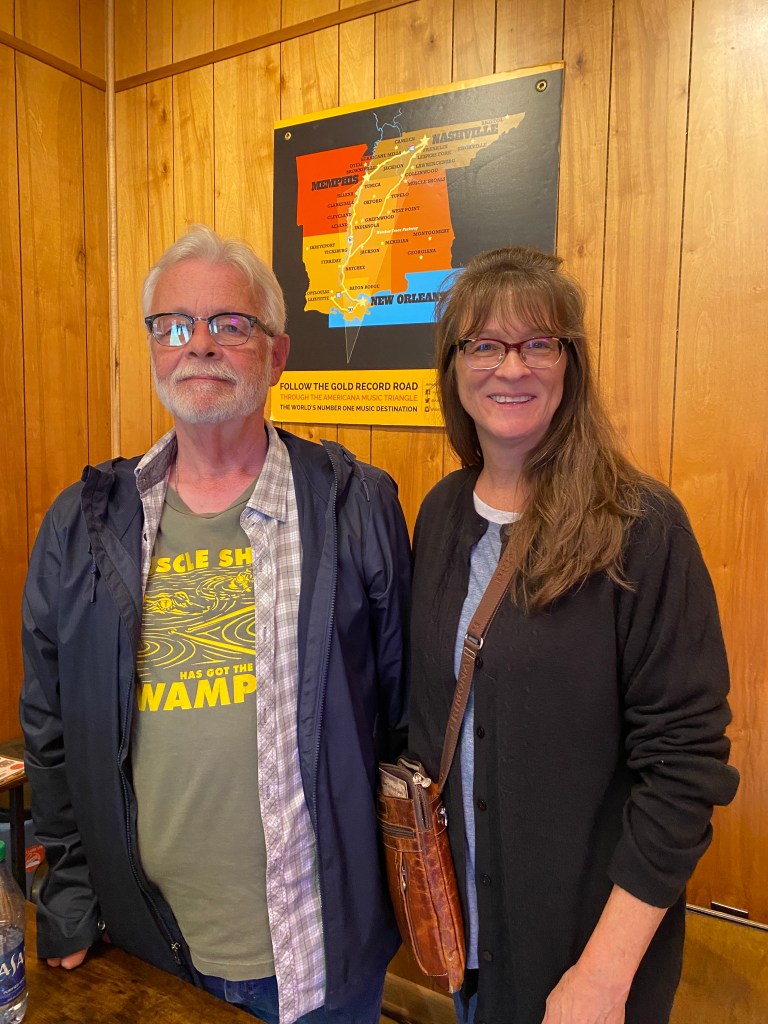
Seems you can stand anywhere in Muscle Shoals, say the name of a musician, and someone nearby will have a story about working with, playing with, fighting with, or just interacting with that person. The shoals are just as covered up in good stories as they’re covered up in good music and good musicians. And history and successes.
Rick Hall also had a linkage with Phil Walden and Capricorn Records — not just with Duane playing at FAME for a year before forming the Allman Brothers Band –but with Otis Redding recording at FAME. The studios also have a history of cooperating with other studios in Memphis and Nashville, each city only 2.5 hours from Muscle Shoals.
These cities are all part of the golden Americana Music Triangle reaching from Nashville to Memphis and on down through Muscle Shoals, Tupelo, and other hotspots, all the way to New Orleans.
The golden triangle encompasses areas where nine distinct American musical genres emerged: Blues, Jazz, Country, Rock n’ Roll, R&B/Soul, Gospel, Southern Gospel, Cajun/Zydeco, and Bluegrass. That’s a hell of a lot of artistry and history, dating back to the Paleolithic period before the arrival of Europeans, to be proud of. A hell of a lot.
Makes a person woozy to think of the musical masters and average Joes and Janes all dedicated to making music through good times and through horrible, oppressive times.
The Americana Music Triangle isn’t just a region where nine genres were formed; it’s where The Nine American Musical Genres originated.
I’m disappointed my home state of Georgia didn’t make it onto the map. We’re terribly proud of our musical history. But I’m grateful to have grown up around Macon with soul, “Southern rock,” R&B, blues, etc.
I lucked into being a Georgian by birth; Reddog chose the Deep South as his home decades ago. As a songwriter, singer, and guitarist, he was drawn to the region and performed in Atlanta for decades. Learn more about Reddog’s musical journey in this article.
Reddog’s current recording at East Avalon Recorders is a testament to his talent and fine skills and love of music. He wrote the songs at his kitchen table, just like Dickey Betts wrote Ramblin’ Man in the kitchen at the Big House, the Allman Brothers’ home located on Highway 41 in Macon and now a museum honoring the band.
Reddog was inspired as a teenager to pick up a guitar after hearing Duane Allman play. As a 70-year-old songwriter, Reddog writes his songs in his Pensacola, Florida, home and then begins more work: organizing recording dates, players, travel plans, finances, rehearsals, etc., all toward the goal of producing an album.
The rhythm section goes down in these two recording sessions, then Reddog will come back to record his vocals with final lyrics, and then his beloved female back-up singers will layer in grace and beauty, filling each song to its fullest.
As we’re recording over two days, Clayton pulls triple duty on the Wurlitzer, acoustic piano, and B3 organ, while Justin, the drummer, plays a dual role of drums and percussion, adding separate tracks for maracas, the tambourine, and a clapping tool. As with everything he does, Justin brings in the joy with his percussion playing; it’s hard not to smile when Justin is being Justin.
Come to think of it, being in the studio, watching the crew work and create, and cut up and tease each other, made my face ache from constant smiling.
Muscle Shoals hasn’t changed much since the 60s. I mean, chain restaurants and stores have moved in, but much of the old buildings/architecture remains, like a time capsule wedged in place by surrounding towns.
On our Muscle Shoals Sound Studio tour, Chase had told Debra and I that he got the tour guide job through a college friend. That evening, arriving for Reddog’s recording, we met Colin, an assistant engineer. At some point Colin mentioned having worked as a tour guide.
“Did you work at Muscle Shoals Sound Studio? I asked. “And did you get Chase his tour guide job?”
“Yes, I did,” Colin said.
“We just met him today and he told us his college friend got him the tour guide gig,” I tell Colin, laughing at the small-townness of meeting these two friends separately on the same day.
Music in Muscle Shoals is a tight industry; the studios seem to collaborate more than compete with each other. The musicians play at all the studios… and there are quite a few studios in town.
The Shoals area is about making music, playing creatively, supporting each other’s growth, and sharing opportunities. When everyone in Muscle Shoals plays to their strengths and to the community’s mystical roots, the entire area is lifted up… together.
And sustained like a note held.

Clayton and Bob walk around like the small-town guys they are, with a mountain of stellar legacy work behind them. They’re still building up that mountain. They carry the history of the Shoals sound in their blood and spread it to others like a virus people choose to catch.
Smart guitarists, singers, and songwriters like Reddog understand the value of working with and taking musical cues from Clayton and Bob.
After recording twice at East Avalon with Charles, and playing alongside Clayton, Bob, and Justin, Reddog is now woven into the musical heritage and magical mysticism of Muscle Shoals; an organic fabric that grows stronger with time.
 Cre8-Space