Cara Heard: Mixed Media Artist

Cara taught herself to paint, built Lush Art to teach others, and then sold her business 11 years later. She’s navigating this transition — mourning Lush Art while looking ahead to reinvent her livelihood. Find out how she’s doing. And how she does it with such wit and grace.

Self-taught artists rarely start a business where they get to teach others. But Cara Heard did. That’s how brave she is.

“I try to avoid fear,” Cara says. “Nothing good ever comes from living in a state of fear. People can get stuck in it.”

Starting a business of any kind takes courage. Cara didn’t just start a business while living amongst people who knew and loved her. Oh, no, she brought her teaching studio Lush Art from North Carolina to Warner Robins, Georgia, when her husband Jon got a job at Perdue in nearby Perry. She didn’t know a soul in middle Georgia.

Not a soul.

Cara wanted to lift souls up, though, so she created Lush Art as a safe space for creativity, experimentation, and growth, and where she enjoyed watching women blossom with confidence in their artistry. Through Lush Art, Cara built a team of instructors who taught adults and children from surrounding towns, and then a few years later moved the team to a 1920 Sears Roebuck Kit Home on Main Street in quaint Perry, Georgia — affectionately called “Perry-dise” by locals. Over the years, her the team and regular clients became family.

“Lush evolved into a vibrant community and a home for people to bring art into their hearts and minds,” Cara says. “While it started under the genre of ‘paint and sip,’ that term began to make me cringe just a year in because Lush Art had become so much more.”

Watching women blossom and celebrating each client was Cara’s barometer of how much her own cup was being filled through her business.

Just one class of regulars, loving their Lush Art experience with Cara (center bottom).

Cara likes change, seeks it out at times, and is resilient when change is pushed upon her. She likes trying new things and is continually learning, even from mistakes.

Running a small business requires that kind of curiosity and flexibility. As the years ticked by and Lush Art settled into class schedules for adults and summer camps for kids, the routine became… well… routine. Maybe even rut-like. The pandemic and its aftermath also seemed to change the dynamic of clients and their expectations.

“To learn something new we must be willing to be beginners again,” Cara says, “And I was seeing that people wanted to be masters right away. They didn’t have the beginner’s mind.”

Now when Cara would ask herself if her cup was being filled or drained, more often the answer was “drained.” Slowly — like the formation of an idea to divorce a spouse — Cara was feeling, but not quite seeing, a need to divorce herself from Lush Art; an acknowledgement that would take time to face fully, and one she couldn’t speak out loud for months.

“I was meeting with my Small Business Administration consultant and discussing my feelings about Lush Art, and she just said to me, ‘Sounds like you don’t want to be here anymore.’ And I repeated what she said, ‘I don’t want to be here anymore.’”
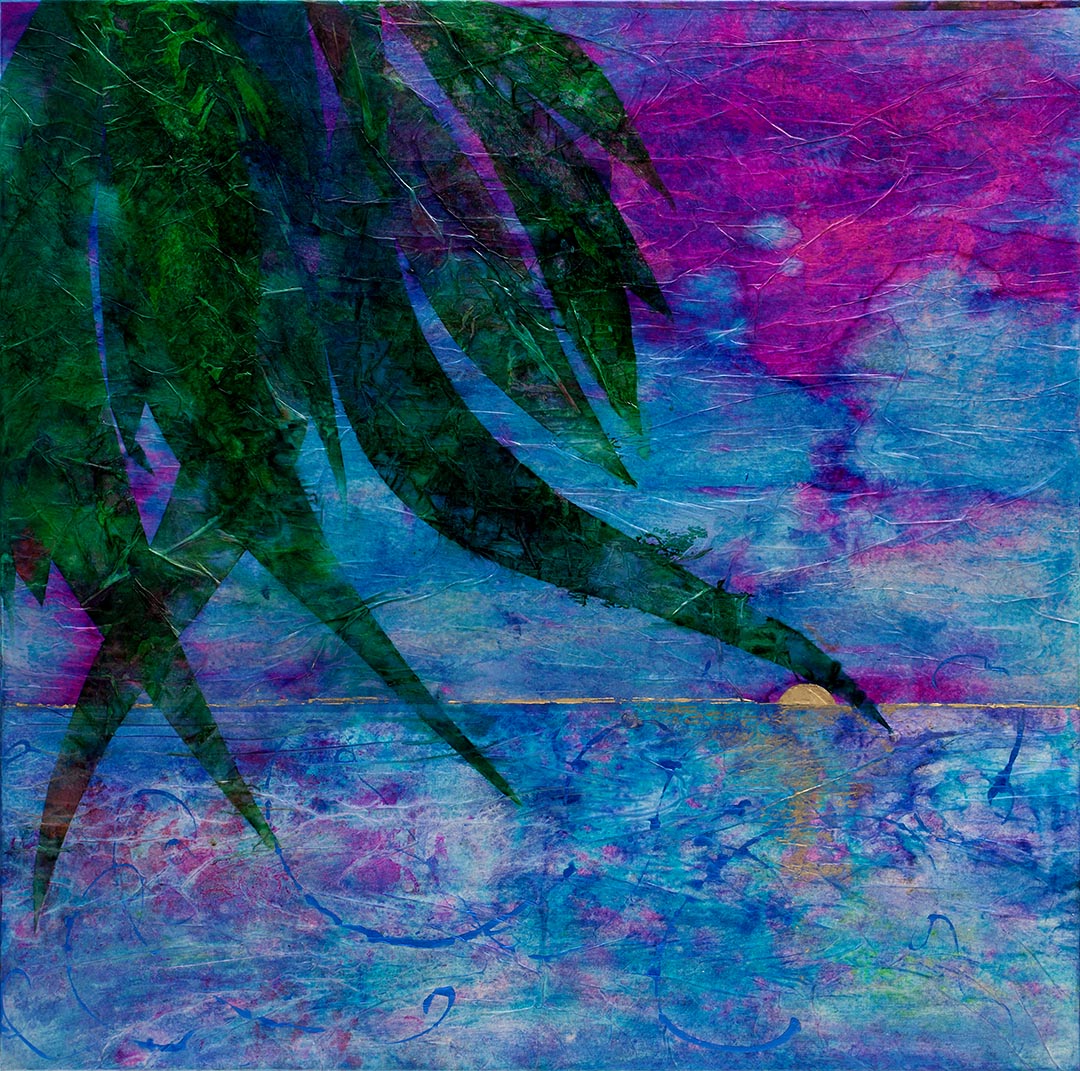
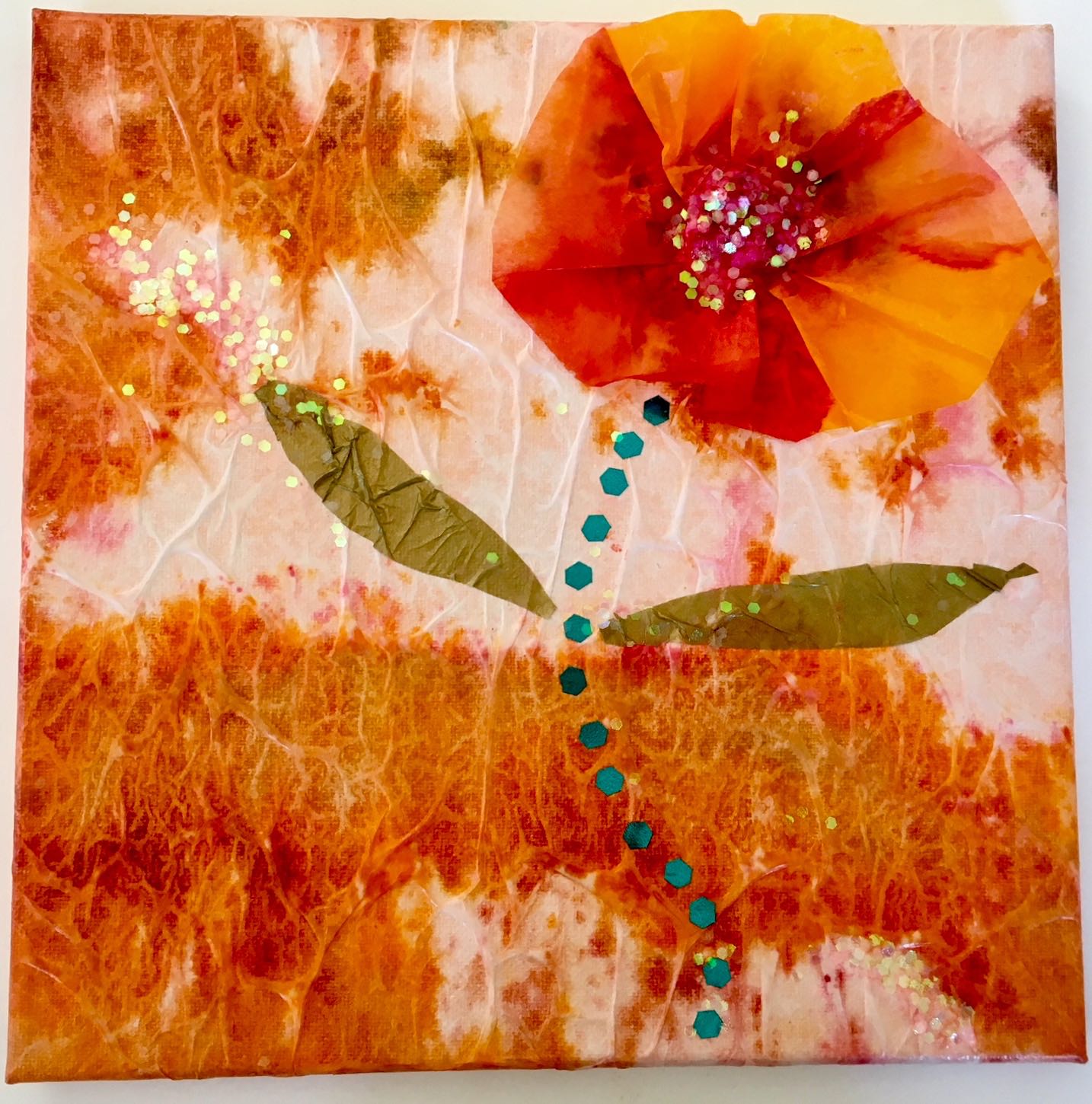
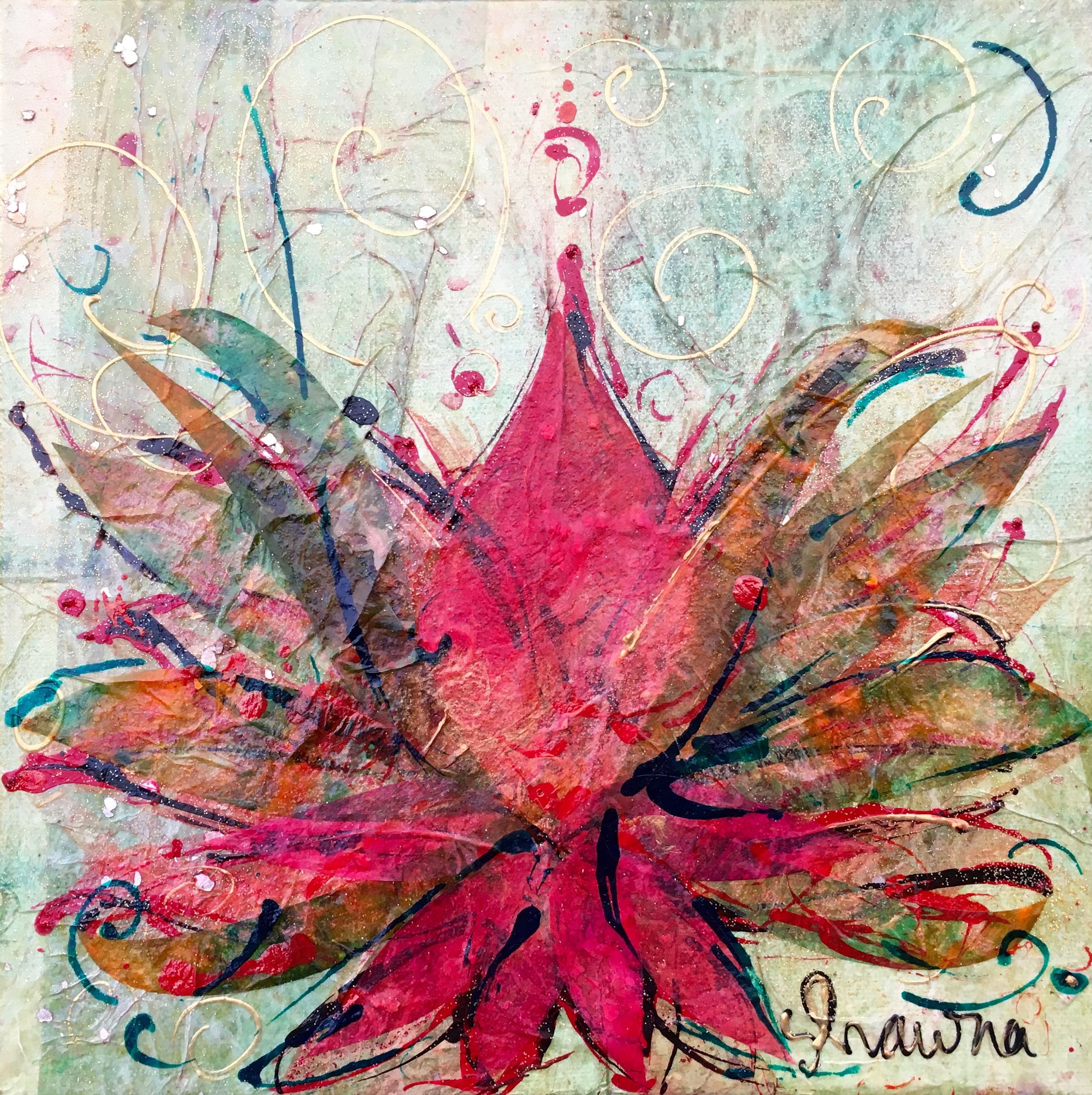
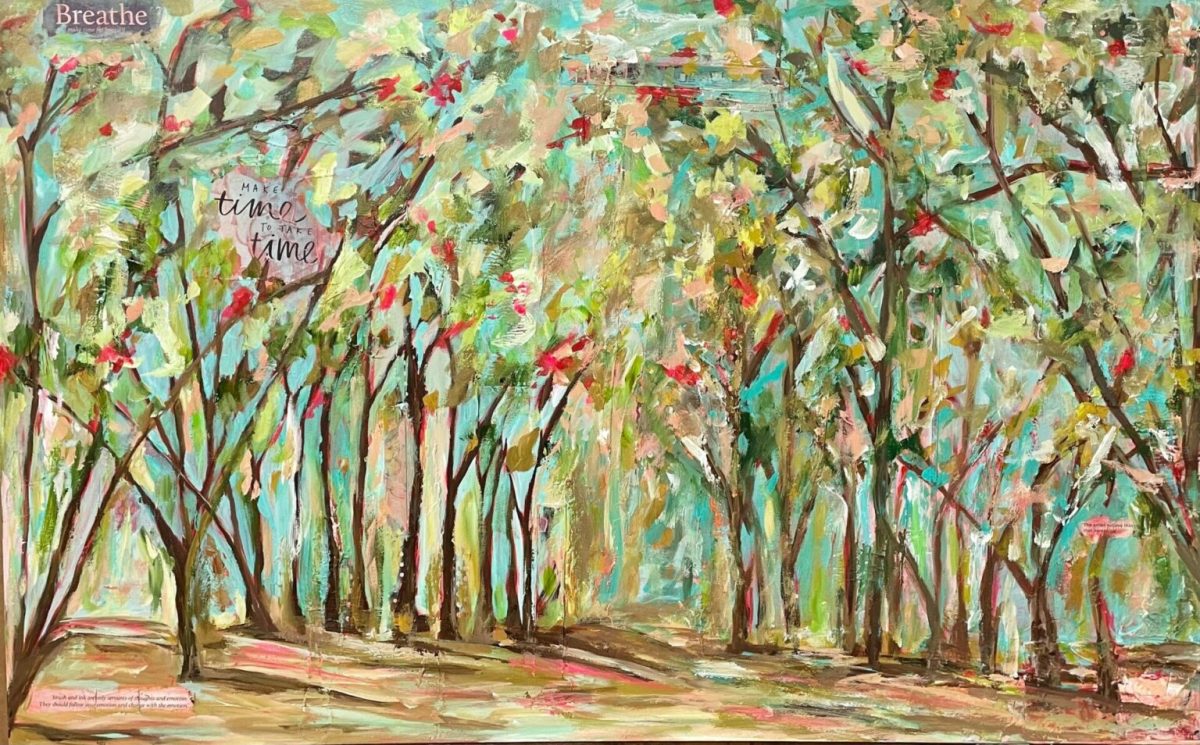
a Cara Heard original mixed media piece.

The first time Cara said those words out loud was the beginning of her current transition: putting her business up for sell, turning it over to a new owner, and figuring out how she wanted to make art and a living.

“They say selling a business is like a death,” Cara says, “And you go through the stages of grief.”

Even though Cara chose to sell her business, it’s her baby, existing because of her drive and hard work, and years tending to all the demands of a small business.

Like most people who identify with their job, Cara identified herself as being Lush Art.

“I’m still in mourning and I have to decide who I am without Lush Art,” Cara says.

Yet, the sell of her business couldn’t have been more perfect. Organic even. Cara sold it to Heather DeLoatch, a friend and long-time Lush Art instructor and manager.

Cara and Heather met years before when Heather was teaching English at Georgia Military College and bartending at Wartown Taphouse in Warner Robins. Heather was responsible for the menu art behind the bar and when Cara, a patron of the bar, saw the art she asked, “who did that?” Heather owned up, causing Cara to instantly say, “You’re going to teach art,” and Heather instantly responding, “No, I’m not.”

Guess who won? Cara convinced Heather to start working as an assistant at Lush Art… and eventually coached her to start teaching. When the manager of Lush Art moved away, Heather took on the management role while continuing to teach.

“After years of managing Lush Art, I felt comfortable doing the business side. When Cara decided to sell the business, my husband and I thought about buying it.”

Heather and her husband own Lumber & Ink, a woodworking shop, and are familiar with the ins and outs of running a small artist-based business, so they decided to buy Lush Art.

“I’ve always said my life is like an I Love Lucy episode,” Cara wrote on Instagram during the transition, “and I’m so thankful to have had Heather be my Ethel all these years. I’m so proud of who [Heather] has become and who she will go on to be.”
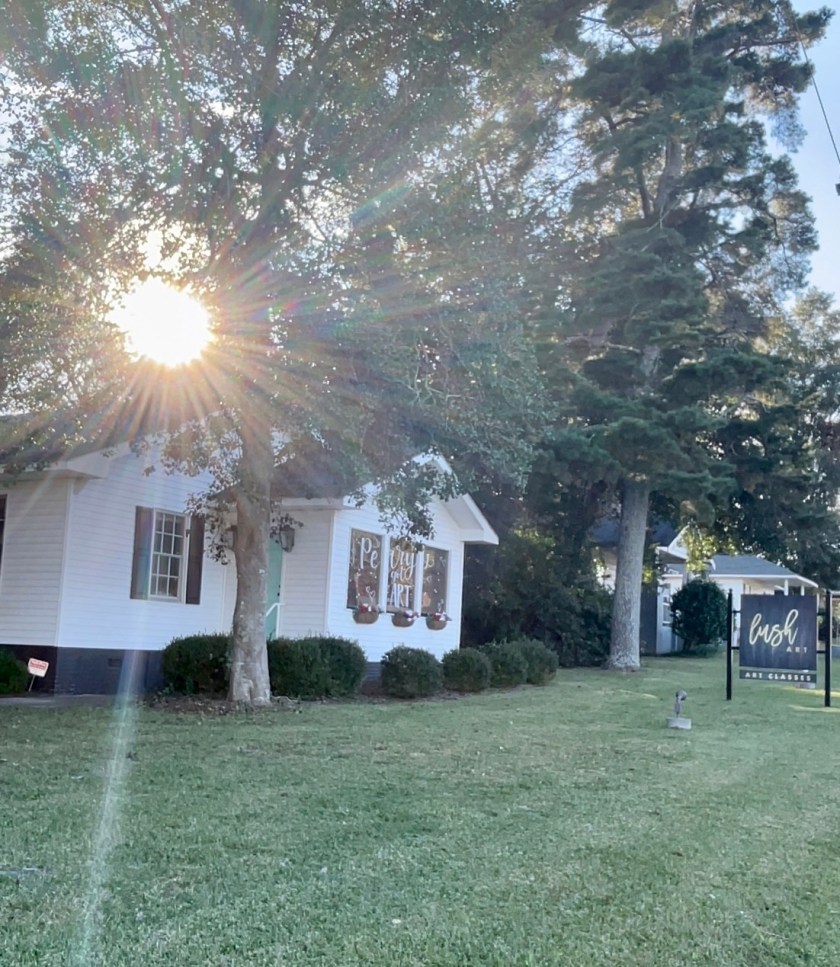
Lush Art Studio on Main Street in Perry, Georgia.

Now that Heather has taken over Lush Art, and added “Studio” to the business name, regulars can still find lots of fun and engaging classes at the old Sears house on Main Street. Plus, the studio instructors participate in local events held at unique venues — Main St. Bar in Perry, for example — where they share their love of art with folks from all over middle Georgia.

Over the years, using her collaborative instincts, Cara has coached people into becoming true artists and then coaxed them into becoming assistants and teachers, just as she did with Heather.

Adrianne Jones is another perfect example of Cara’s “proactive” mentoring style. An Air Force IT system Program Lead, Adrianne found painting at Lush Art to be therapeutic. As a self-described Type A personality, she felt challenged by Cara’s art classes where visual abstraction rules.

“Her classes wreaked havoc on my need for patterns, neat lines, and ordered blending,” Adrianne says. “I got into it so much Cara eventually dubbed me Blendy McBlenderson.”

Adrianne learned from Cara to let go and trust the process.

“I’m a HUGE trust-the-process fan,” says Cara. “I’m also a huge proponent of if-it-doesn’t-work, doesn’t-spark-feeling, isn’t-right… I’ll just paint over it.”

Adrianne enjoyed taking Cara’s cues to shut down her analytical brain while creating — without being concerned about the final product.

“I started working at Lush Art kind of on a whim,” Adrianne says. “Cara and I were out for drinks bemoaning the retirement of one of Lush Art’s favorite instructors. Since I’m a fixer, I was offering up a pep talk and said, ‘Cara, you have seven years worth of her paintings. Hire somebody to teach repeats.’ Well, guess who she hired to teach the repeats? Me!”
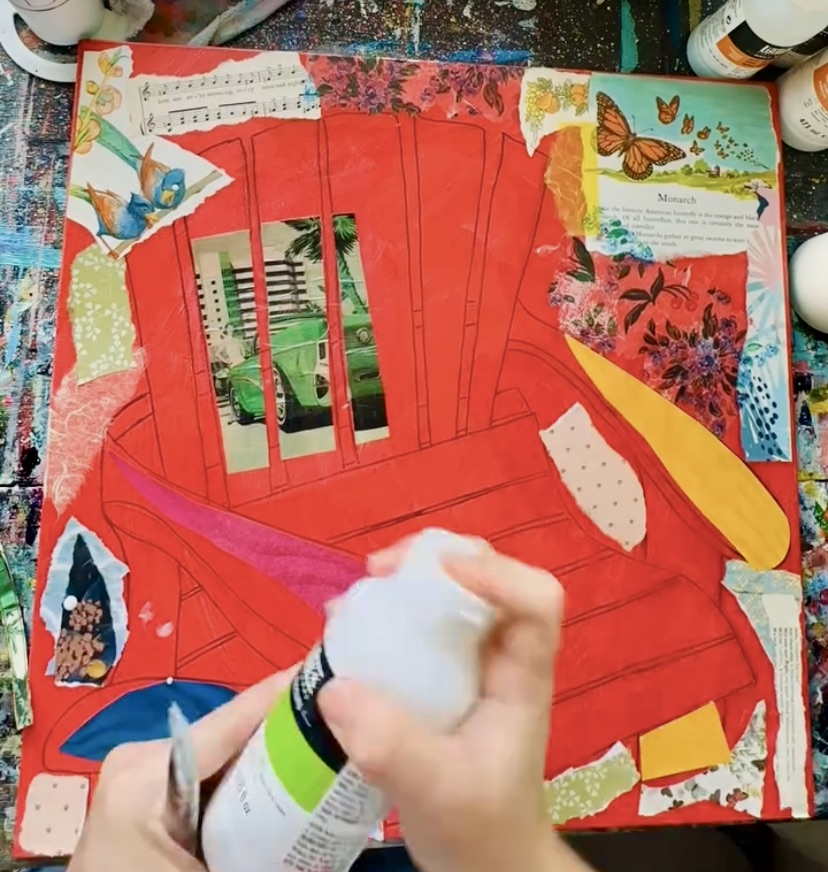
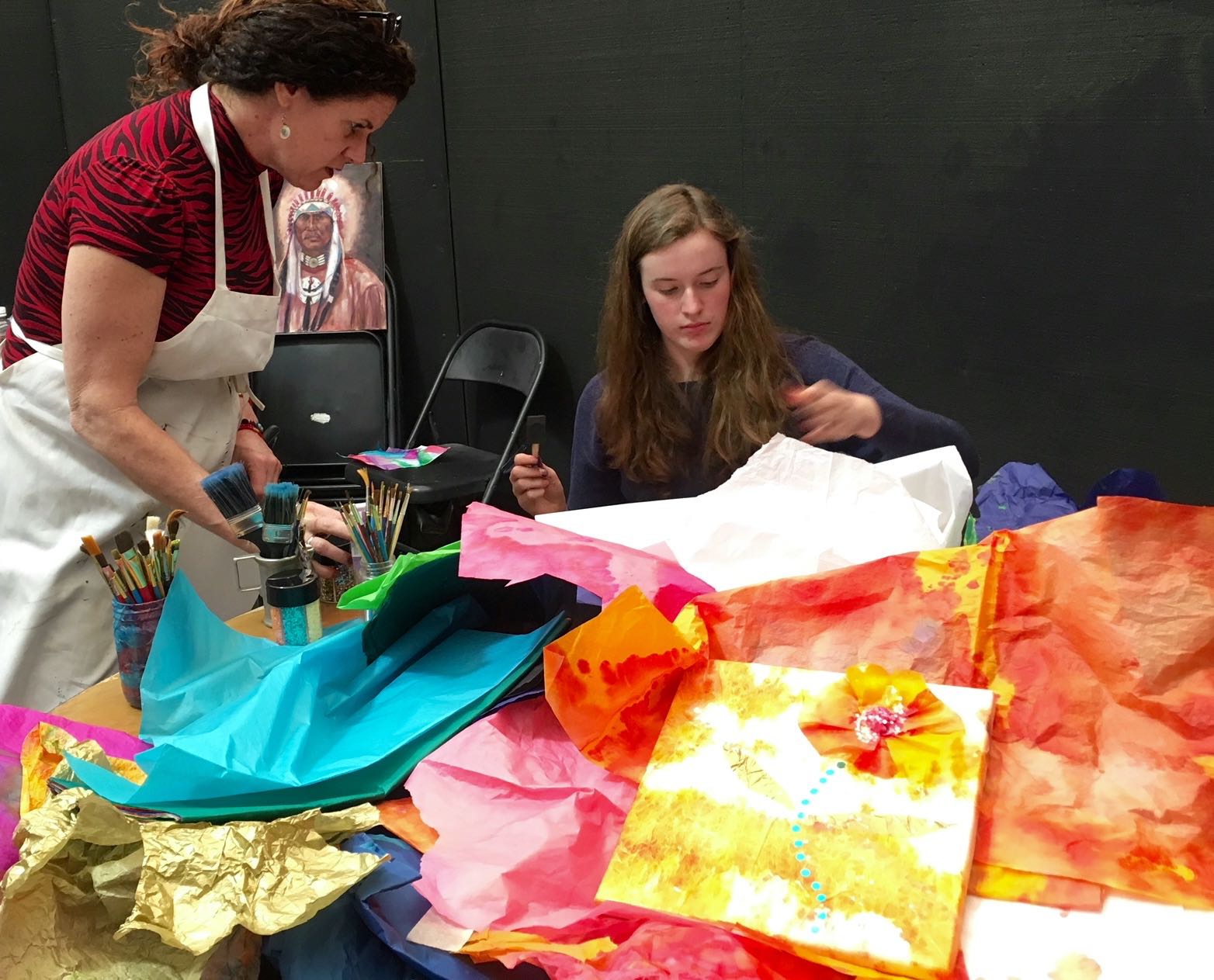
Cara creating a Mixed Media piece.

In her usual way of knowing what others need before they know themselves, Cara began giving Adrianne “assignments” that led to the creation of original artwork.

“Cara knew I loved a challenge and she dared me out of my comfort zone,” Adrianne says.

Adrianne expresses how inspired she is by Cara’s approach to living out loud, displaying emotions authentically, letting others know it’s okay “to be on the struggle bus with something,” showing her creativity by pairing wild colors and patterns in her clothing and art, and having the audacity to pursue “her big, crazy ideas,” all with “a strong dose of sarcasm and excellent sense of humor.”

Lush Art Studio has a new owner who’s building on the Lush Art family Cara started years ago, and continuing to grow the studio from the roots of courage, authenticity, and wildness planted at its inception.

“I’ve tended to meet people when they were going through some deep, dark shit,” Cara says. “And I’ve been thrilled to see people ‘trust the process’ using art to pull them out. And… perhaps a well-placed curse word or phallic joke helped, too.”

Cara, inspired by nature, with her plein air painting.

Cara, originally from Greenwood, Arkansas, spent her early career as a hair stylist, having ample opportunities to stretch her creative muscles while listening to her clients and giving them what they wanted. Styling hair may be the most difficult client-based service out there; one wrong snip and the client can be devastated.

Understanding each person’s needs and using artistic precision to cut and color hair taught Cara how to make people happy, one client at a time.

Later, as a stay-at-home Mom with her young son Griffin, Cara missed having that creative outlet and decided to learn to paint, not just to express herself but also as a way to decorate her home without spending tons of money on mass-produced art — which is still a point of contention for her to this day. (See the Appendix below for buying original art in the Macon/Middle Georgia area).

Through experimentation, Cara eventually landed on mixed media as her favorite form of expression.
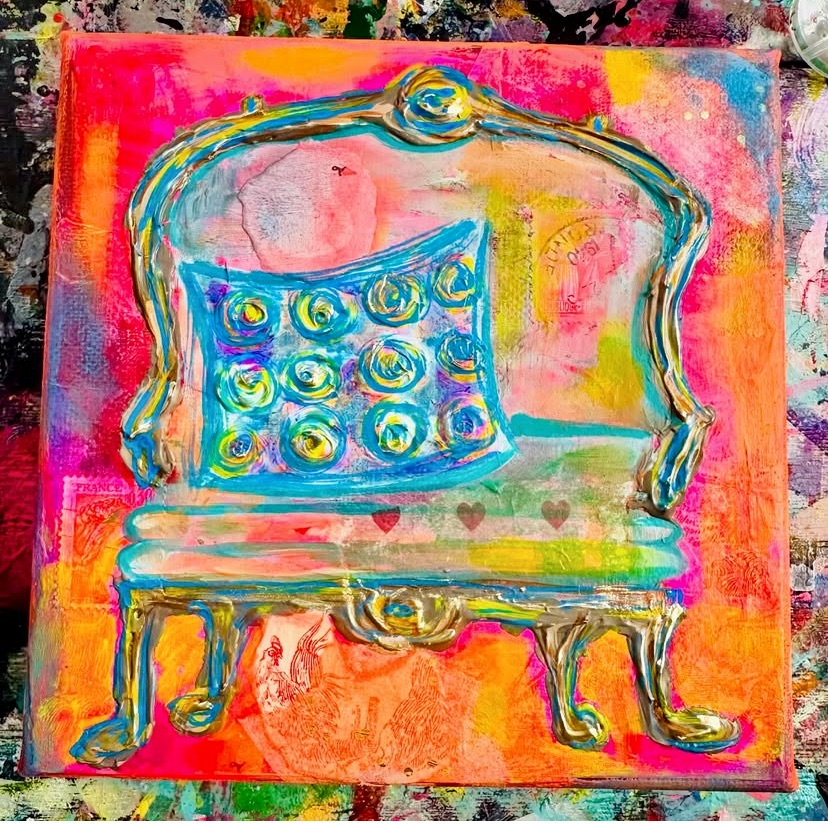
One of Cara’s chairs in a series.

“I can’t just create, though,” Cara says about her creative process, clearly driven by her need to always be free to explore her way. We might even say Cara has a need to re-wild herself to find her creative groove.

“It’s like a book club,” She says. “If I’m told I have to read a specific book, my brain rebels and wants to do anything other than read that book. Sometimes I can fake it and make it happen but that’s rare and whatever I paint looks forced.”

Wanting to teach others to paint authentically from their gut makes complete sense for Cara, who uses color without hesitation to express her inner wild child. She might be an introvert, but her artwork shouts in brilliant hues.

“I spent a lot of time in my head as a child, have always had a big imagination and have always been a daydreamer. Is it manifesting? Is it a waste of time? Is it a way to relax? Who knows? Before I go to sleep I imagine things I’d like to happen.”
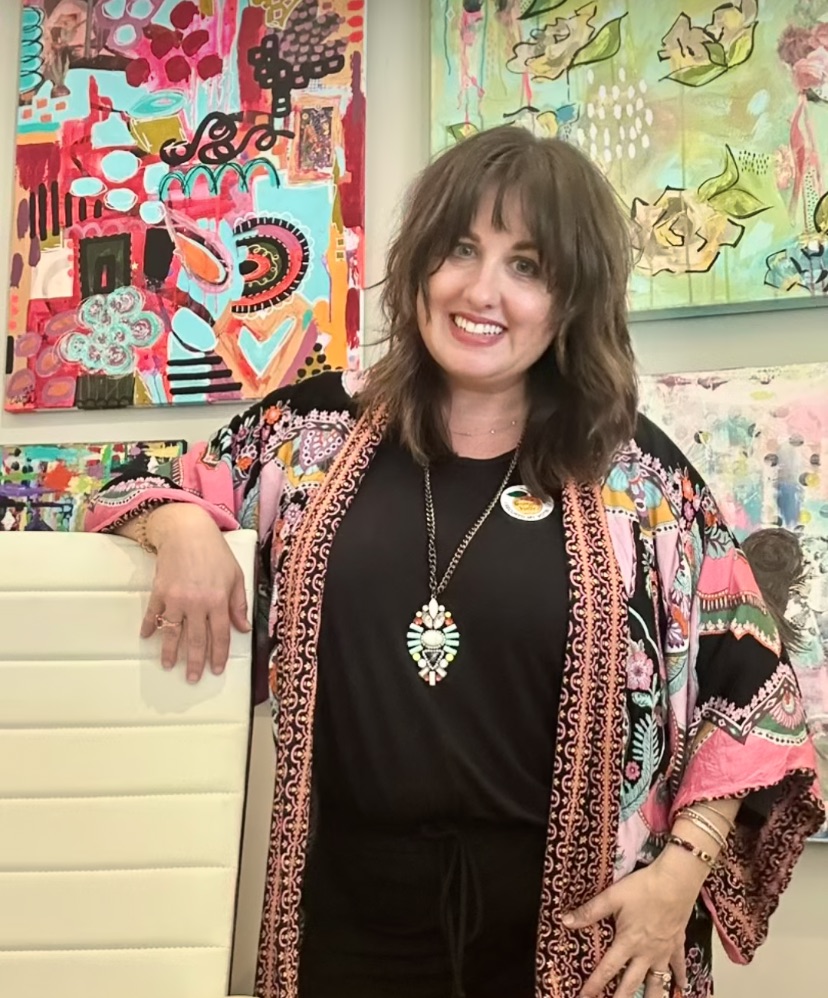
Cara in her element.

These days, Cara is looking for a balance between making art and making a living. Through Cara Heard Co she offers marketing consulting and content creation, and occasionally she teaches mixed media art (such as at Wesleyan College in Macon where I took her class). Cara also co-manages 478 Creatives, a group of artists, photographers, graphic designers, writers, ceramicists, etc., from all over Middle Georgia who meet monthly in Macon.

Cara and her Co-Manager of 478 Creatives, Erin Hawkins, a Macon-based muralists and graphic designer, each earn a small stipend that covers their management expenses but isn’t enough to support them. That hasn’t stopped Cara and Erin from creating a robust program for 478 Creatives members while pursuing their individual art careers.

“Cara is one of my favorite people to brainstorm with,” Erin says. “Her creative ideas are always inspiring and thought-provoking.”
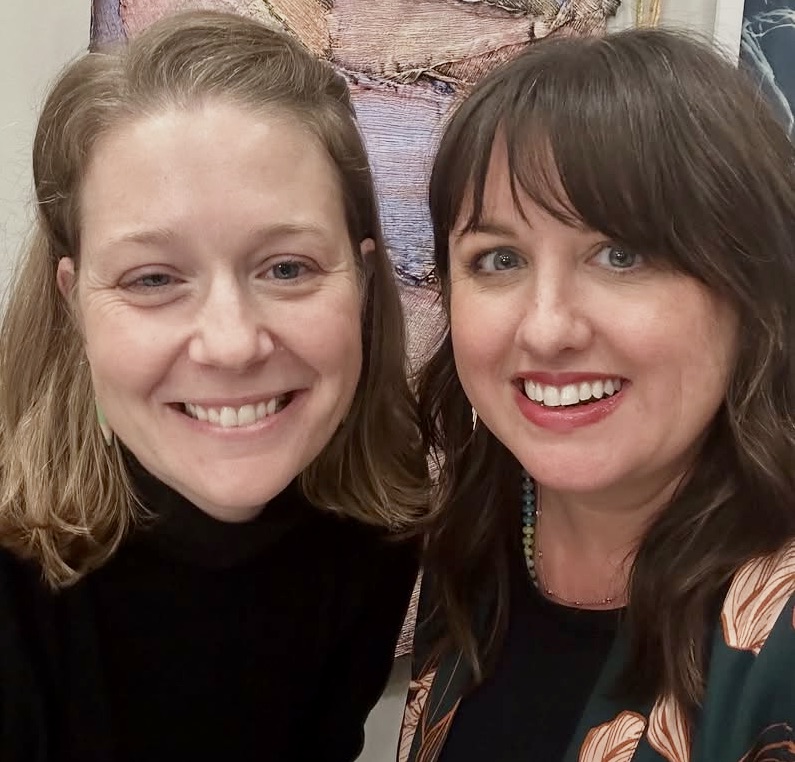
Erin Hawkins and Cara Heart, Co-Managers of 478 Creatives.

Cara and Erin made a strategic move for their creative group by forming a partnership with the Macon Arts Alliance, providing the Alliance with access to the creative people they want to promote while also giving creatives a way to embed in Macon’s cultural scene.

Cara considers herself “silly and sarcastic,” but there’s nothing silly about Cara or her concern for others, including animals. Her sarcasm is light and humorous.

She doesn’t hide her emotions or thoughts, which most people appreciate as Cara being authentically Cara. She is kind, a smile at the ready behind her big blue eyes, but she’s also complex, formed of layers like the mixed media art she creates.
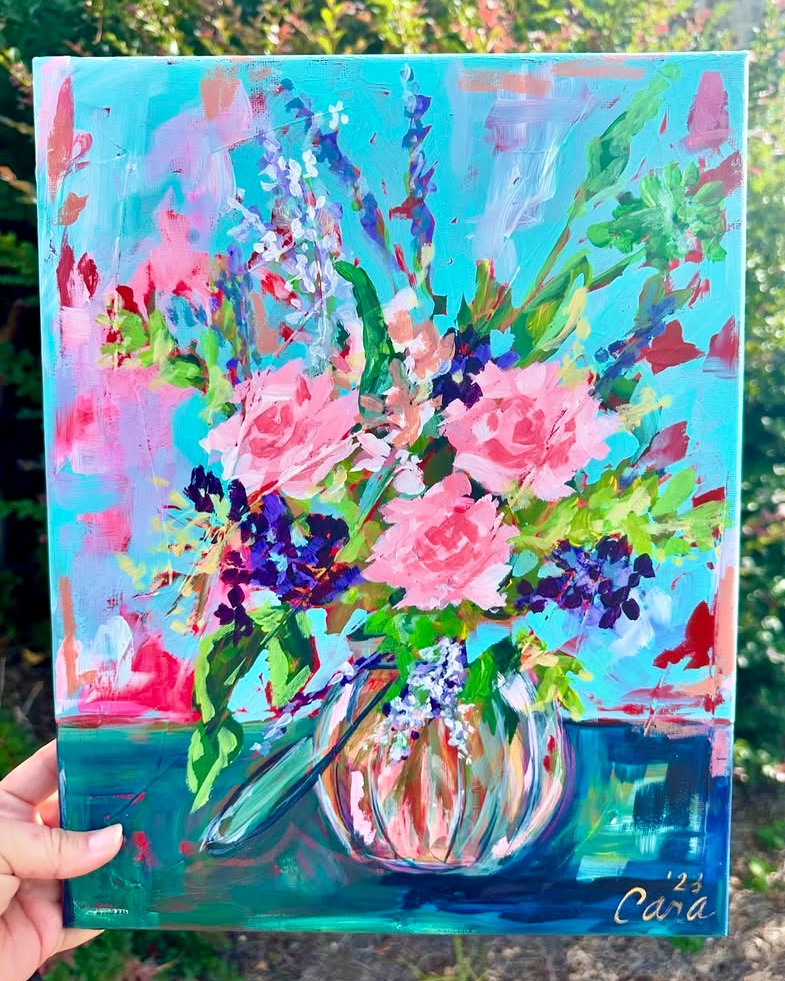
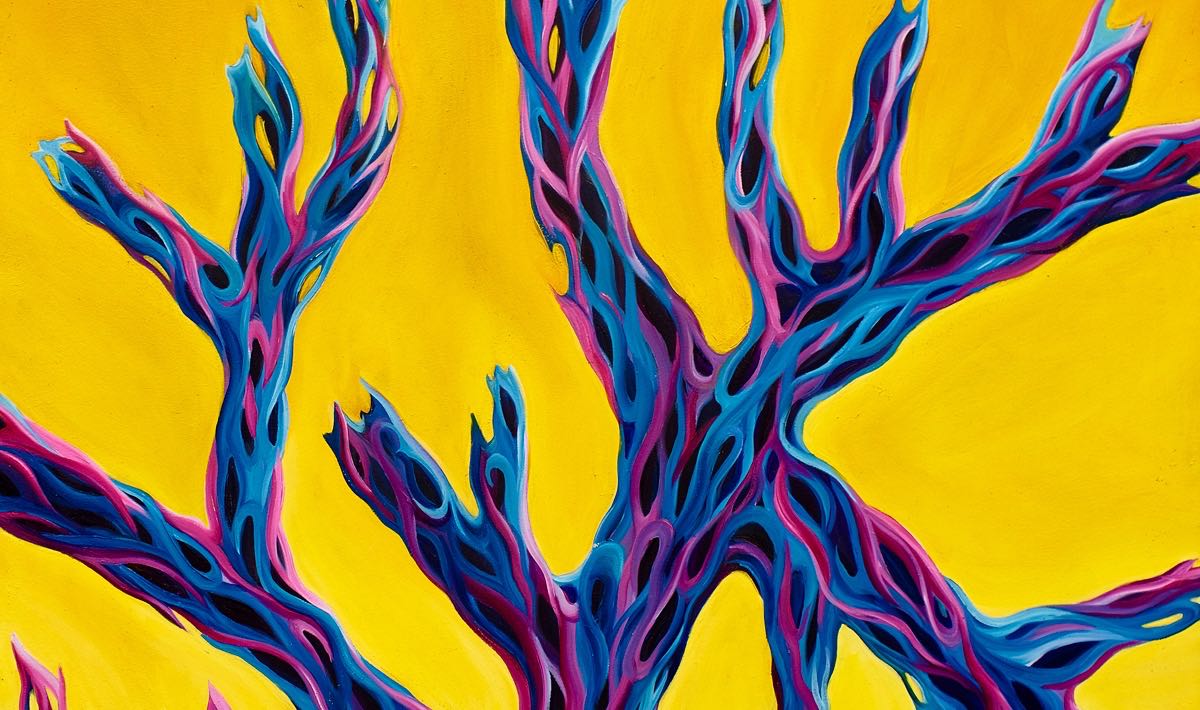
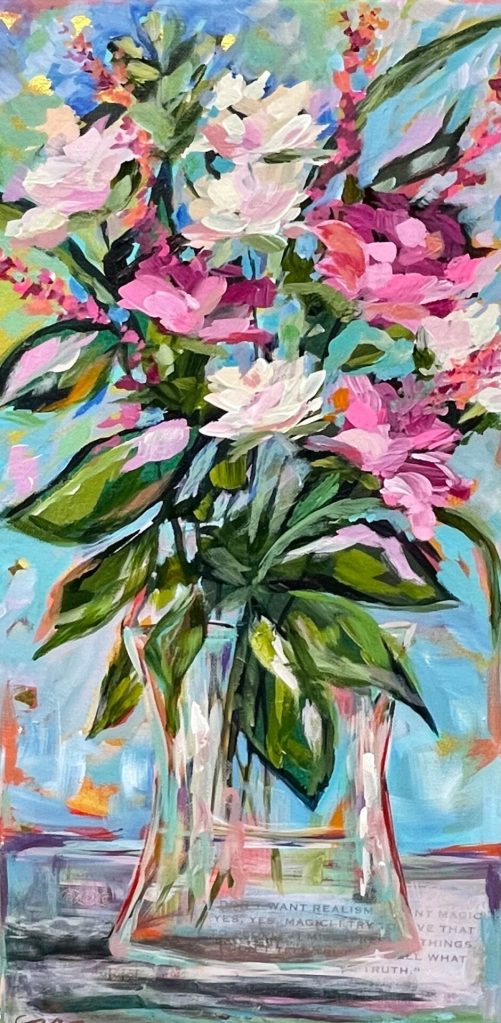
A Cara Heard original.

“I like layers,” Cara laughs. “The more layers the better. The reason I’ve latched on to mixed media is because there can be so many stories in the layers. I can hide things that only I know are in there. I also set an intention for each piece, or for the owner of the piece… And even after I forget what is hidden, I know the intention was good or powerful. I believe it gives the art energy.”

Not that she’s covering everything up. Cara delights in her clients finding the meaningful symbols she layers into their commissioned art pieces. After all, it was covering up “mistakes” that made Cara love mixed media.

“I started in mixed media by painting over paintings I didn’t love, a way of making lemonade with lemons. Although I’d much rather turn that into a margarita.”

She’s always layering in that humor, too.

The more time spent with Cara, the more layers are revealed:

  • She knows her values and stands firm in them
  • She’s a feminist who fiercely defends and promotes women, and imbues her art with patriarchal-busting sentiments to inspire women to change the world
  • She had the word “meraki” tattooed onto her painting arm because it means to put a little of your soul into everything you create. “I truly believe that,” Cara says. 
  • She encourages everyone to create with abandon and joy, results be damned!
  • She wants everyone around her to feel triumphant and appreciated
  • She strove to empower other women to start their own businesses by being a model of entrepreneurship
  • She’s an Enneagram Seven
  • She strongly believes we should all decorate our homes with pieces made by local artists, not pieces from chain stores
  • She knows Maya Angelou was spot on for saying,“You can’t use up creativity. The more you use it, the more you have.”
  • She believes Elizabeth Gilbert got it right in her book Big Magic by suggesting creative ideas present themselves to us and we must act on them or the ideas will move on to the next creative person
  • She is guided and inspired by nature and travel, both offering new ways of seeing light and color
  • She prefers dark roast unsweetened Starbucks Iced Coffee with a splash of milk and pure maple syrup to fuel her creative adventures
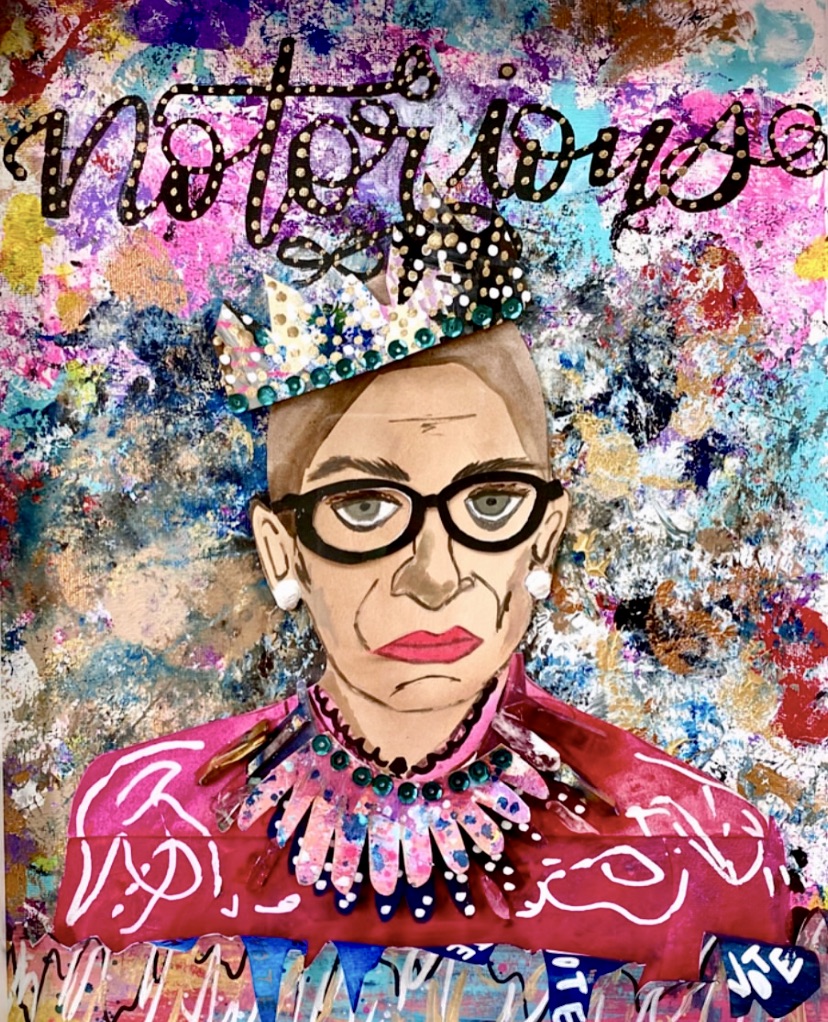
Ruth Bader Ginsberg, an example of Cara’s pro-woman artistry.

Cara promotes women in their new and established businesses, hence her membership in The Web, a Macon work-share space designed for local solo-preneurs and small business owners. Cara joined The Web when it was first launched in 2019 and her art is usually on display in the little gallery space at the The Web. (Learn more about The Web and its founders in the appendix.)

“I had to separate myself from my environment to see how I felt,” Cara says about her trip to France last year, where she attended a month-long artists’ residency at Château D’Orquevaux. She had been accepted to the residency two years before but could’t get away — she was was caring for her parents as they recovered from a serious RV accident. Luckily, the residency told her to pick an alternate date and she was able to venture to France in April 2024, when she was still running Lush Art.

Cara considers herself lucky to have been accepted into the residency from the large pool of worldwide applicants.

The countryside chateau is near the village of Orquevaux, with a population of 50 souls and no businesses; many locals are employed by the residency.

Surrounded by entrancing french countryside, far away from her life in Georgia, freed from daily concerns like managing a business, preparing meals, and cleaning, Cara was able to focus on creating art in her own private studio, working at any hour — everything she might need was accessible 24/7.
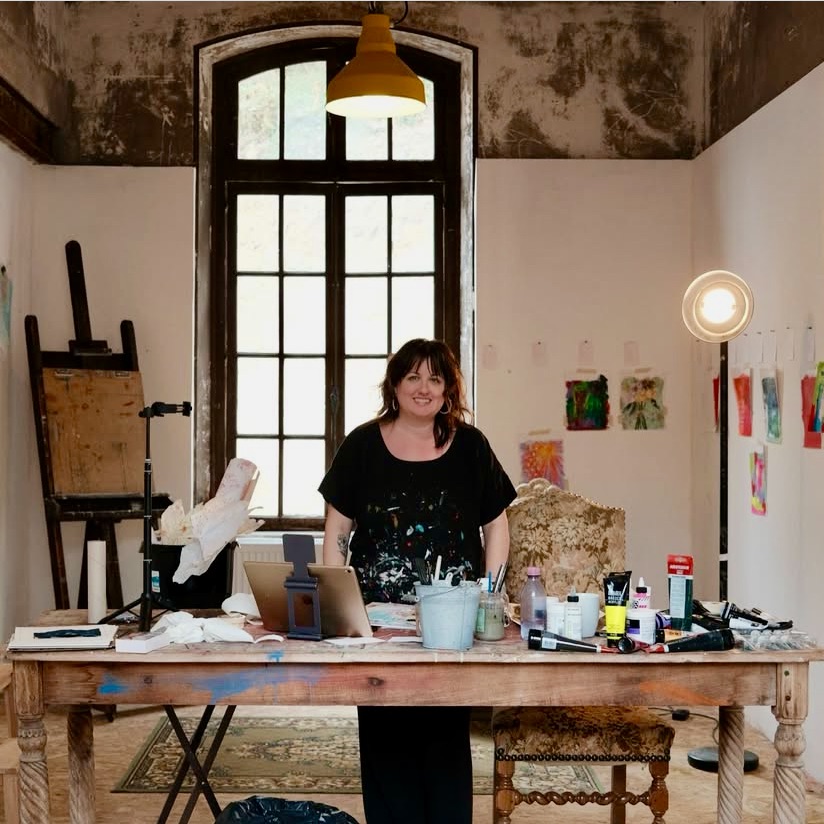
Cara in her resident studio at Château D’Orquevaux.

The beautiful countryside was a major supporting element in Cara’s experience, allowing for long, contemplative hikes.

She found the freedom from day-to-day responsibilities mind-expanding and leaned into forming bonds with her fellow artists, understanding what true collaboration feels like, and reevaluating her life in a meaningful way.

Cara is a collaborator, after all, and her experience in France showed her what would be possible back home among her fellow artists. And once back home, she could see her “daily grind” much more clearly, thus beginning her journey to selling Lush Art.
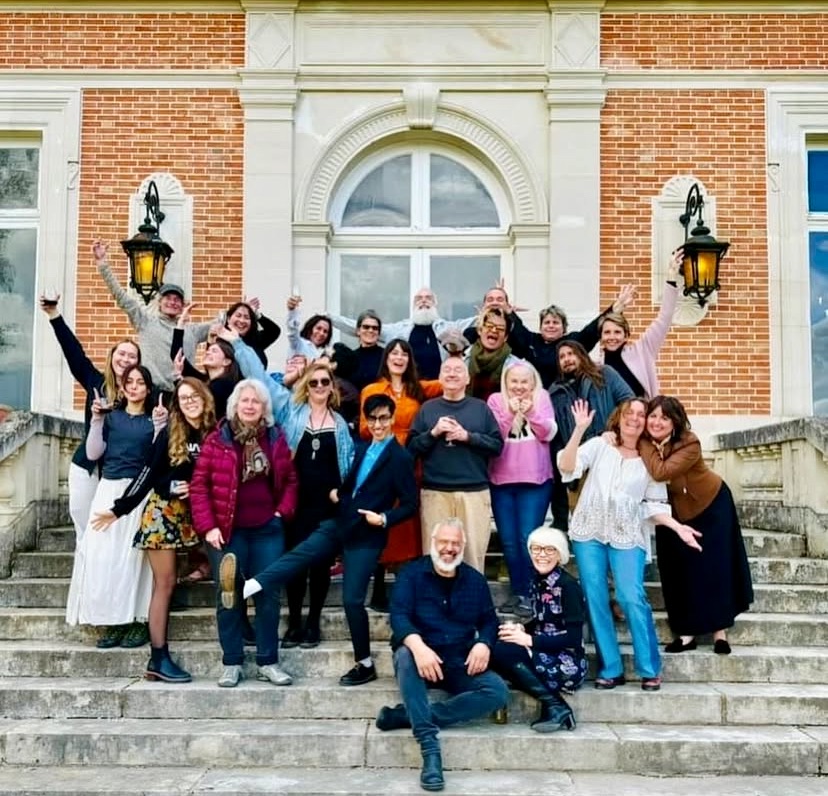
Cara, far right, with her fellow resident artists in France.

Cara then sold her business to Heather without even knowing what her next steps would be. That’s the resilient part of her spirit, the part that’s ready for new experiences and ready to pivot, like recently taking on the Marketing Strategist role for a new online community that supports the work of Dr. Jerry Lerner, a resiliency expert and author of Unraveled to Unrivaled: Embracing the Four Dimensions of Resilience.

“When Dr. Lerner asked me why I was burnt out with Lush Art,” Cara says, “my response was I felt people were harder to build up and the efforts were too draining. I hope by promoting his work, I will help people feel better in a different way than I could through Lush Art.”

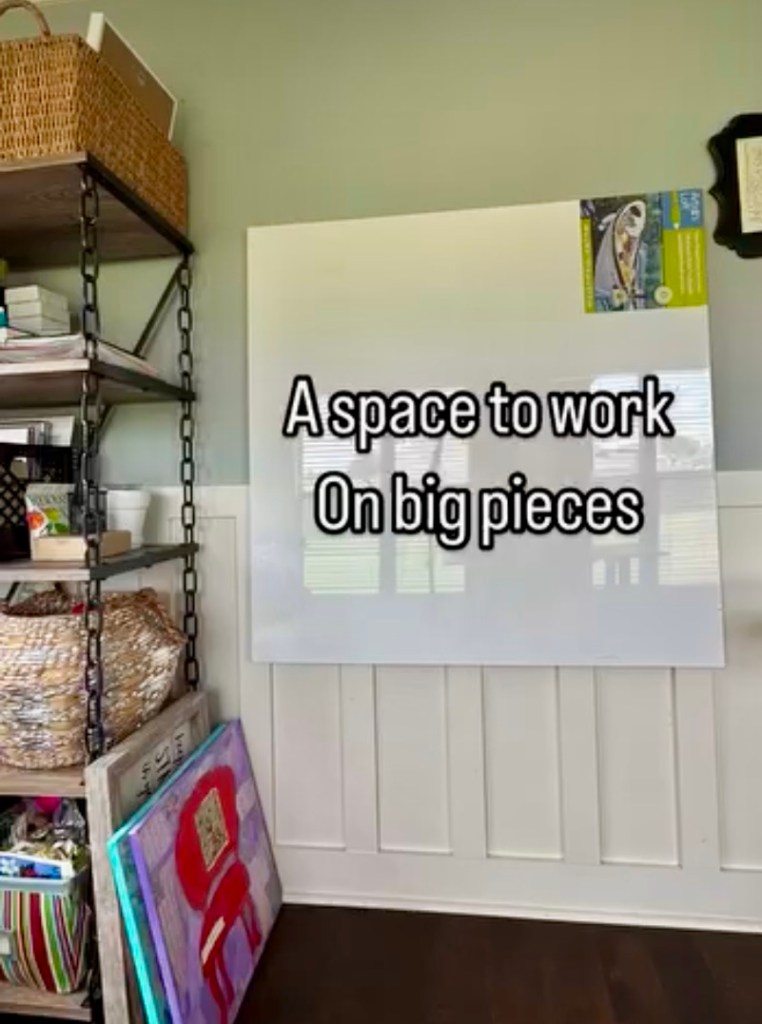
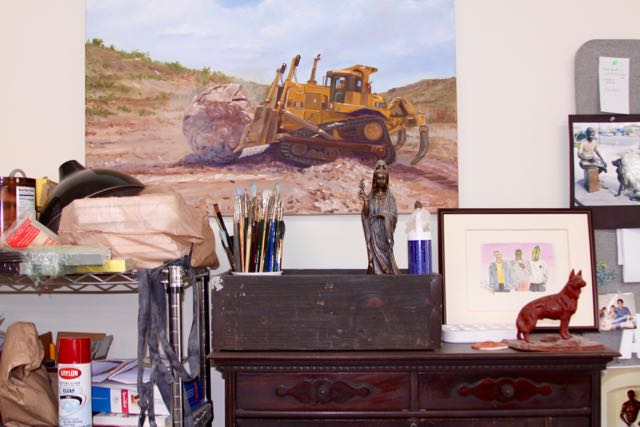
Kudos to Cara for managing to fit most of her supplies from Lush Art into her creative space at home. She has organized her space to hold the things she can’t live without from her Lush Art days, and also to house her current works and past pieces.
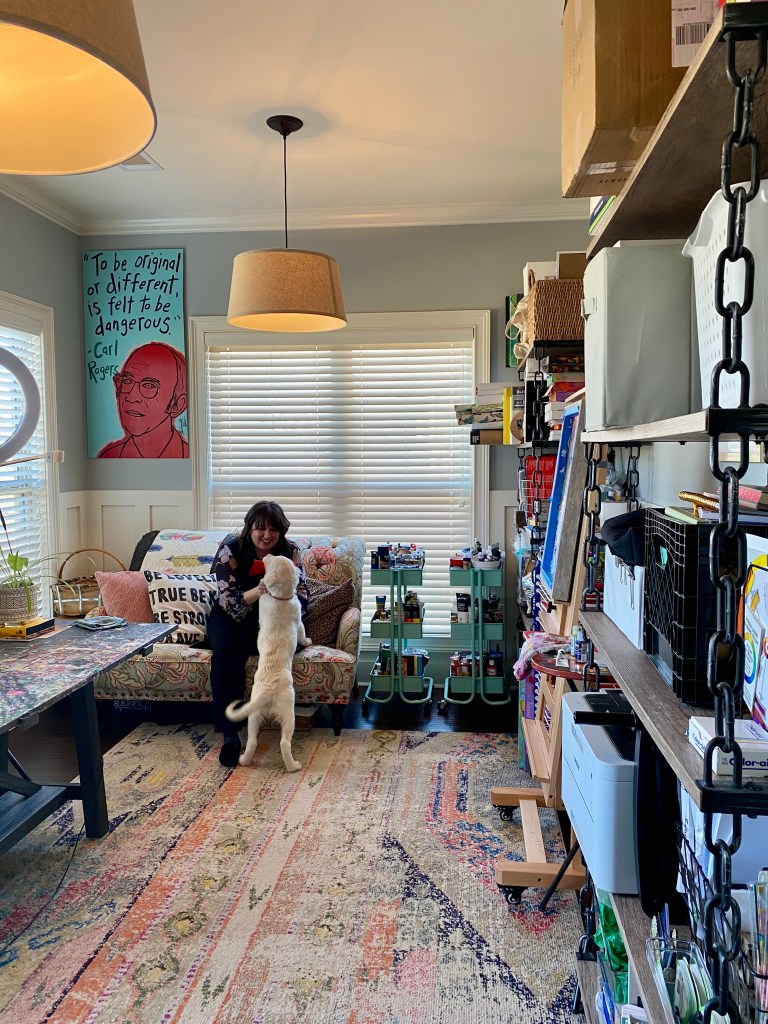
Her two dogs, Bodhi and Hattie, visit her creative space regularly for head rubs!
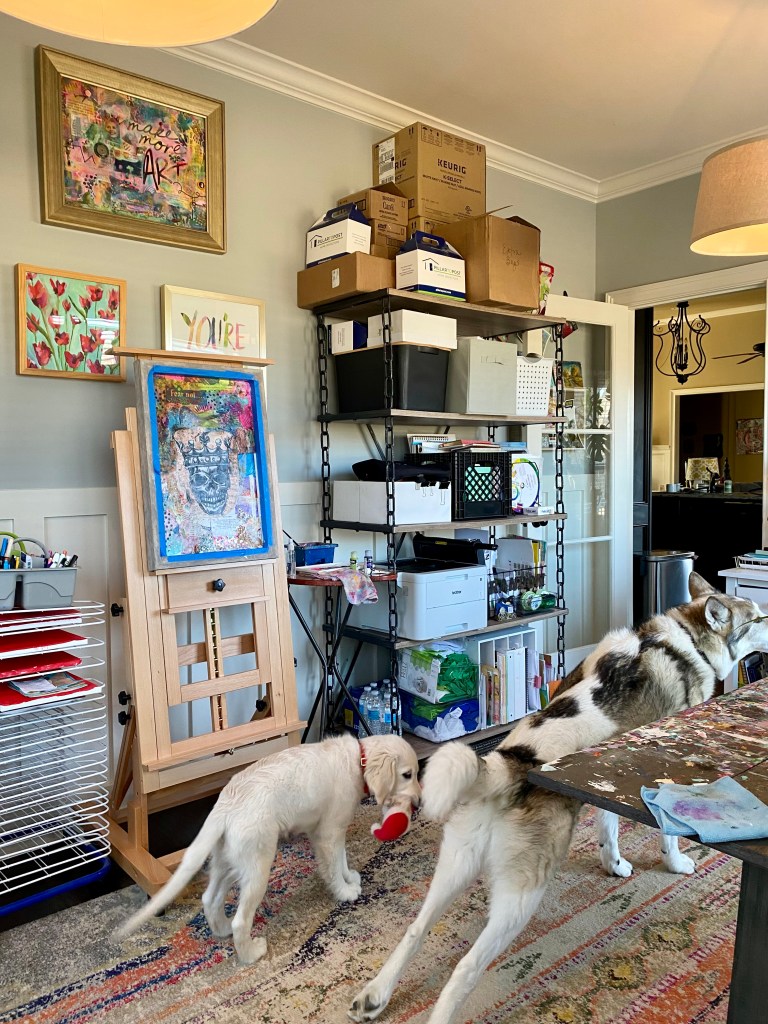
Cara’s “Death” Tarot card, in progress, on the easel
(with Hattie and Bodhi visiting).

Cara recently worked on a mixed media piece representing a Tarot Death card for an art show — it has already sold. The Tarot piece dovetails perfectly with the project she worked on while in France, where she used mixed media to represent the Lenormand deck of 36 oracle cards.
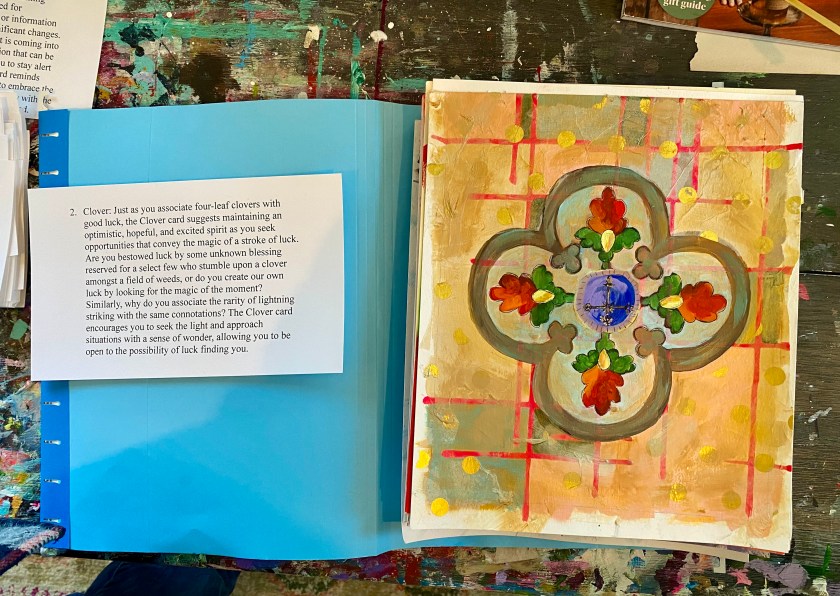
Cara’s rendition of the Oracle Clover card, painted in France.

“The Lenormand deck is used for cartomancy and divination, and it differs from the more common Tarot cards,” Cara says. She plans to eventually have her 36 oracle art pieces printed as a card deck.
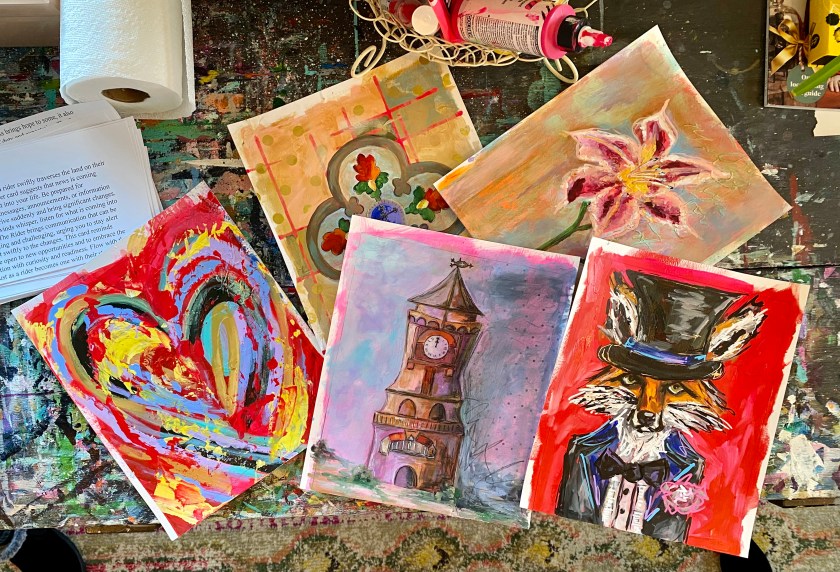
A sampling of Cara’s 36 Oracle cards painted during her artist residency.
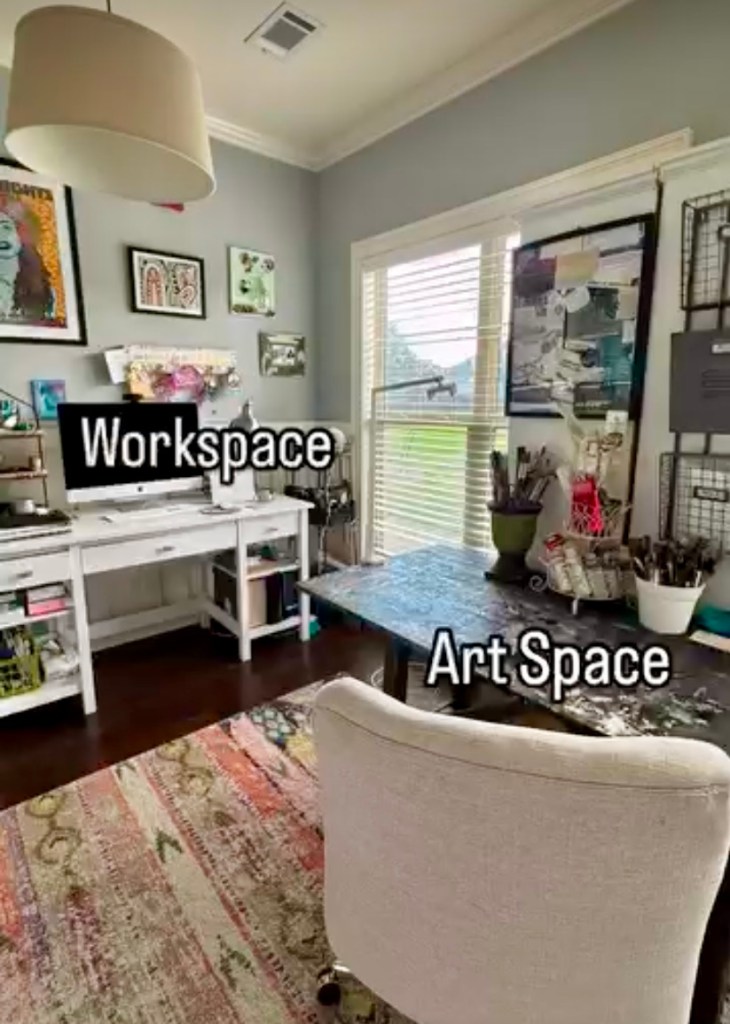
Cara’s creative space always evolves: here’s a recent past rendition with helpful labels.
…and another recent rendition now altered.

Cara is passionate about facilitating the 478 Creatives group with Erin.

“Connecting people to creativity is at the core of what I do,” Cara says. “I’ve experienced the transformative power of community first hand, which is why I’m dedicated to fostering a welcoming environment for all.”
Started in 2021 by Erin, the 478 Creatives group is on a mission.

“Our mission is to cultivate a thriving ecosystem where creativity flourishes, connections deepen, and artistic endeavors thrive. We believe in the power of creativity to transcend boundaries and unite individuals from all walks of life. Welcoming creatives of every age, background, and skill level, we are committed to providing a supportive space for exploration, growth, and collaboration.”

Cara and Erin do amazing things when coordinating the monthly meetings, bringing in artists to speak and educate, hosting workshops, leading a collaborative group art piece, or just having fun, like they did by playing bingo at historic Grant’s lounge in downtown Macon. Monthly meetings are held at different venues around town, sometimes at the Macon Arts Alliance gallery on First Street or the Alliance’s Mill Hill location.

The Macon Arts Alliance is hosting a show in their gallery this month, kicking off on April 4, and will exclusively exhibit the juried works by creatives in the 478 region. Cara’s work will be on view during the show, which runs through the end of April 2025.
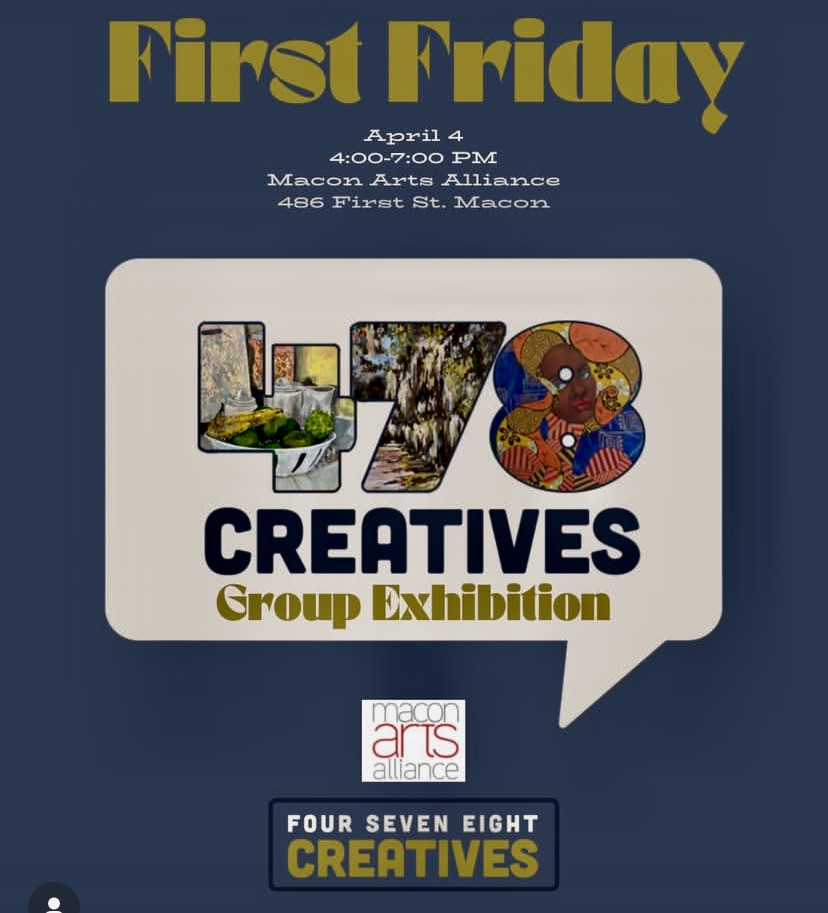
Some time in 2025, the group anticipates holding occasional meetings in Erin’s new studio space in Downtown Macon where she’ll house her Mama Hawk Draws business.

The best part of the meetings is mingling with artists of all mediums, sharing ideas, and collaborating on projects that arise from random conversations.

“Cara has an incredible talent for connecting with people,” Erin says, “and making everyone feel welcome to our 478 Creatives meet-ups. Her mentoring spirit encourages fellow creatives to grow, and her boundless creativity constantly inspires me and my own artwork.”
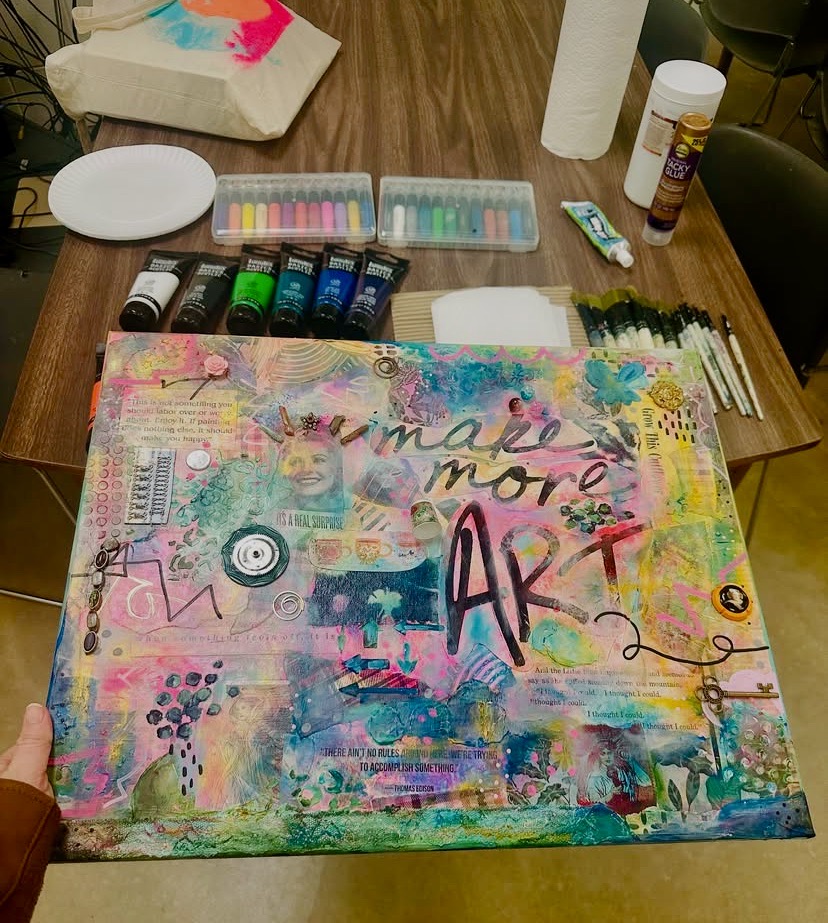
Cara’s in-progress art piece in the Wesleyan College art class she taught.

Erin and Cara are both talented with a brush and paint and also with digital illustrations. Erin designed the logo for the 478 Creatives group and Cara designs the monthly event invitations.

“After each event,” Cara says, “Erin and I ask each other if our cup is filled or drained. So far, we have both felt filled.”

“I loved it, I hated it, I lived it, I breathed it,” Cara wrote on Instagram to the people who supported her during her Lush Art years. “It allowed me to grow up, to connect with so many incredible people, to be a stronger person, to be a better artist. It’s bittersweet to say goodbye, you’ve all changed my life. It’s fitting to go out on a full moon.”

These days, Cara is refilling her well, feeling her resilience and being that brave soul who’s courageous enough to follow what she loves while fulfilling family responsibilities.
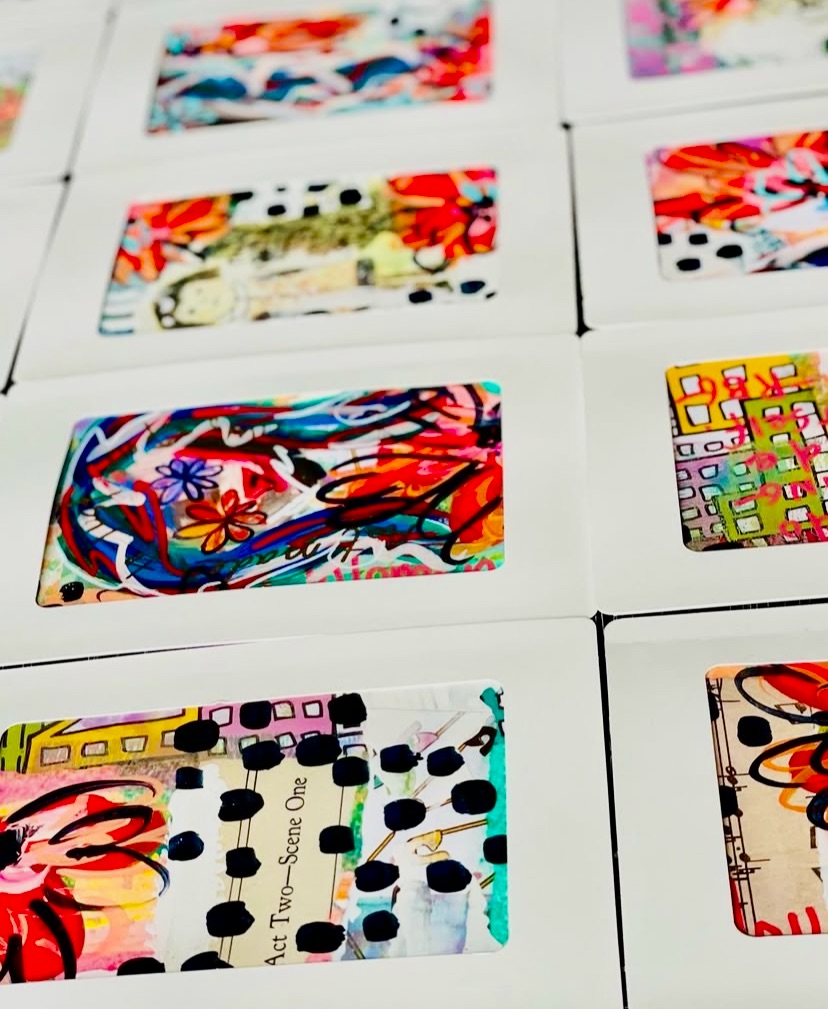
Mixed media samples of smaller pieces.

This transition has been an incubation period where Cara assesses options for her marketing consultancy business and artistic work. Recently, that included making art in anger — a rarity for her, — but essential for helping to digest everything that’s going on in our country right now.

During this transition, Cara’s openness to what the universe might bring has now manifested the largest art commission of her career! Cara is painting 18 unique art pieces to hang in the new Central Georgia Cancer Care facility, designing with powerful colors to inspire patients going through extreme health challenges and to bring a little hope and joy to their families .

“11+ years of hard work,” Cara recently wrote on Instagram, “a shift in passion, and a leap into the unknown… and then, through the power of community, connections, and referrals, my biggest art commission yet. Proof that when you pour into others, the right opportunities find their way back to you.”

Her largest commission ever is also proof that Cara is a talented artist who’s easy to work with and determined to get it right.
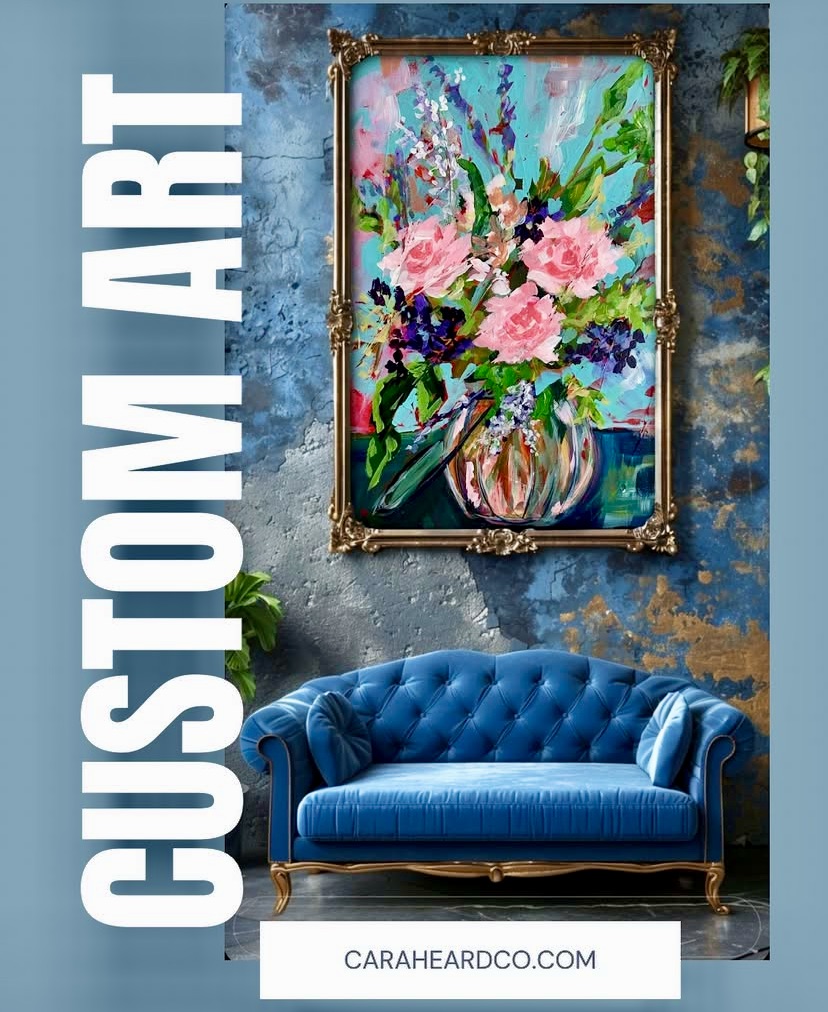
One of Cara’s original goals for Lush Art was to build a local creative community. She did that. After selling Lush Art, she continues to build a creative community through 478 Creatives.

As Cara navigates this life transition, using her talents to make a living while pursuing artistic adventures, a big part of her destiny is based on her tendency to gather and inspire people — especially creative people — and to cheer them on to greatness.

Her Self included.


Website: https://www.caraheardco.com/

Facebook: https://www.facebook.com/groups/1007790463184312/

Instagram: https://www.instagram.com/caraheardco

LinkedIn: https://www.linkedin.com/in/cara-heard-a2202812

478 Creatives Instagram: https://www.instagram.com/478creatives/

“There’s something special about being surrounded by original art,” Cara says. “Art that was made with love, with feeling.”

Here are a few options for finding local art made with love and feeling in the Macon/Middle Georgia area:

Macon Arts Alliance Gallery – The Gallery at 486 First Street has a retail shop in addition to the exhibition space. They sell art pieces in all mediums (pottery, paintings, jewelry, photography, sculpture, fabric arts, etc.) made by 300 artists from the Middle Georgia area. (Hours: Tuesday – Friday, 10am-5pm). You can also support the Alliance and it’s work in boosting local artist. They’re celebrating their 40th anniversary with an Art Market on May 17, from 10am to 4pm, at the Mill Hill Community Arts Center. (Tickets are $5 at the door only).

Macon365 – A complete listing of all cultural events around Macon so you know where to go to find original art. They including happenings in Music, Stage, Art & Culture. “Subscribe” on their website to receive their newsletter full of upcoming art shows and other events, large and small.

The Web Workshare – The Art Gallery at the Clubhouse in the Web’s office displays Cara’s artwork on a rotating basis along with art by other local artists — including renowned textile artist Wini McQueen. The Web workshare space is located at the same address as Macon Magazine: 1083 Washington Avenue. Cara joined The Web as a member when it was launched in December 2019 by three Macon businesswomen: Susannah Cox Maddox (Publisher/Editor in Chief of Macon Magazine, Elizabeth Schorr (ES&CO), and Jessica Walden (owner of Rock Candy Tours).

Bohemian Den – This shop at 502 Cherry Street, owned by Scott Mitchell, supports social justice issues, curates fair trade products from around the world, and sells original and prints of artwork by Macon’s best artists, such as Redefiningshe.

Rabbit Hole – This smartly curated home goods and decor shop at 811 Forsyth Street is owned by couple Autumn Van Gunten and artist Cedric Smith who sells his own artwork in the store, along with art from other local artists and creatives from around the world. They also sell some Bitter Southerner apparel. Cedric spoke at a 2024 478 Creatives meeting and is featured in the February/March 2025 issue of Macon Magazine.

First Friday – The first Friday of every month is a great time to visit downtown Macon for live music, good eats, cold brews, and local shopping. Many restaurants, stores, and galleries are open and showing off their latest acquisitions or simply celebrating Macon’s artistic and musical culture. Visit New Town Macon’s Facebook page to see who’s participating in each First Friday, or just show up and be surprised.

Gallery West – Photographer Kirk West has photographed musical artists for decades and was road manager for the Allman Brothers for 20 years. He and his wife bought The Big House that would later become the Allman Brothers Museum. Gallery West, which just celebrated its 10th anniversary, sells Kirk’s photographs and books in the 3rd Street shop in downtown Macon. The Gallery also features artwork, mostly paintings, by local artists like Johnny Mo.

Macon Magazine – The December 2024/January 2025 issue shares their annual “Local-Loving Gift Guide” to various products produced locally, including art pieces. Erin’s glass ornaments from her Mama Hawk Draws company were featured in this recent gift guide!

Artist Gift Market – Every November/December, the Artist Gift Market is held for six weeks and features all types of items made by local artists including pottery, t-shirts, scarves, books, jewelry, home decor, etc. Watch for information about the Artist Gift Market in 2025.

Triangle Arts Macon – They’re hosting an Artist Market on Saturday, April 26, from 11am to 5pm featuring original art, food trucks, a kids zone, demos and open house, and music. 206 Lower Elm Street, Macon, GA 31106.

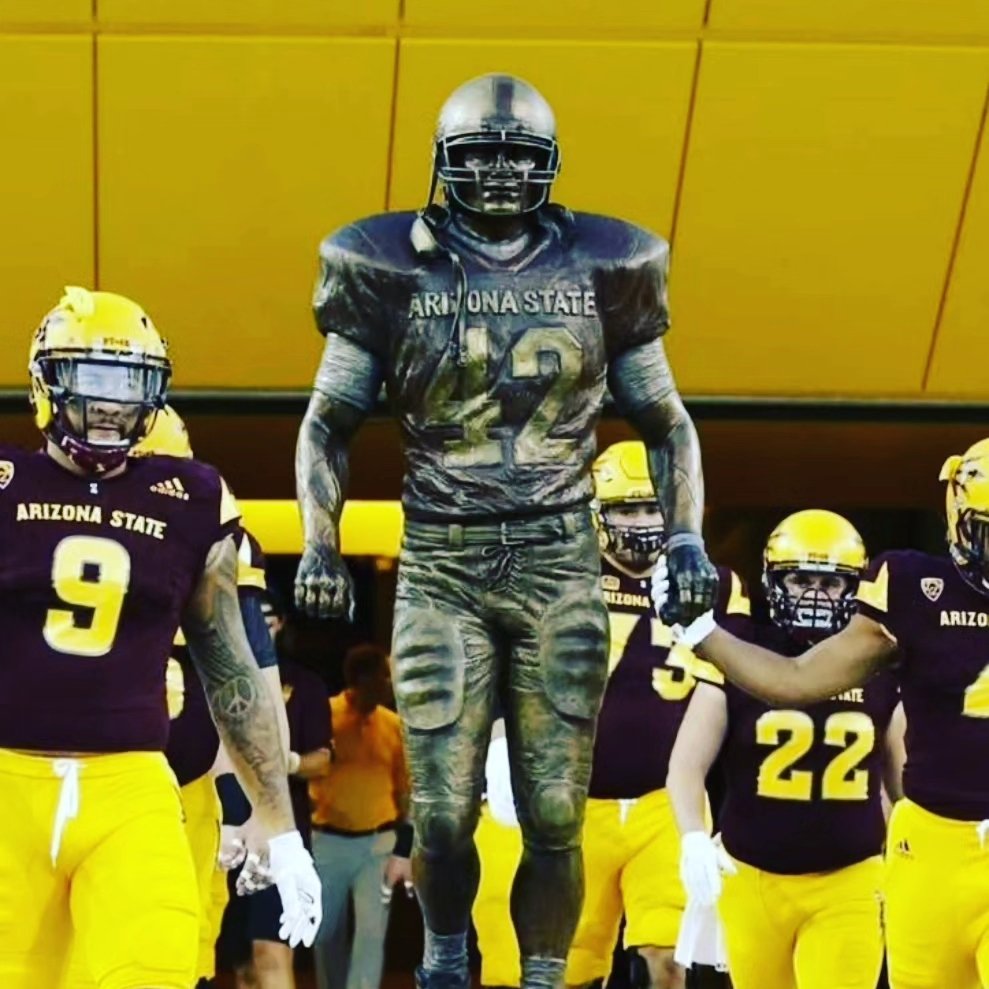
Jeff Carol Davenport, Sculptor, Part 2

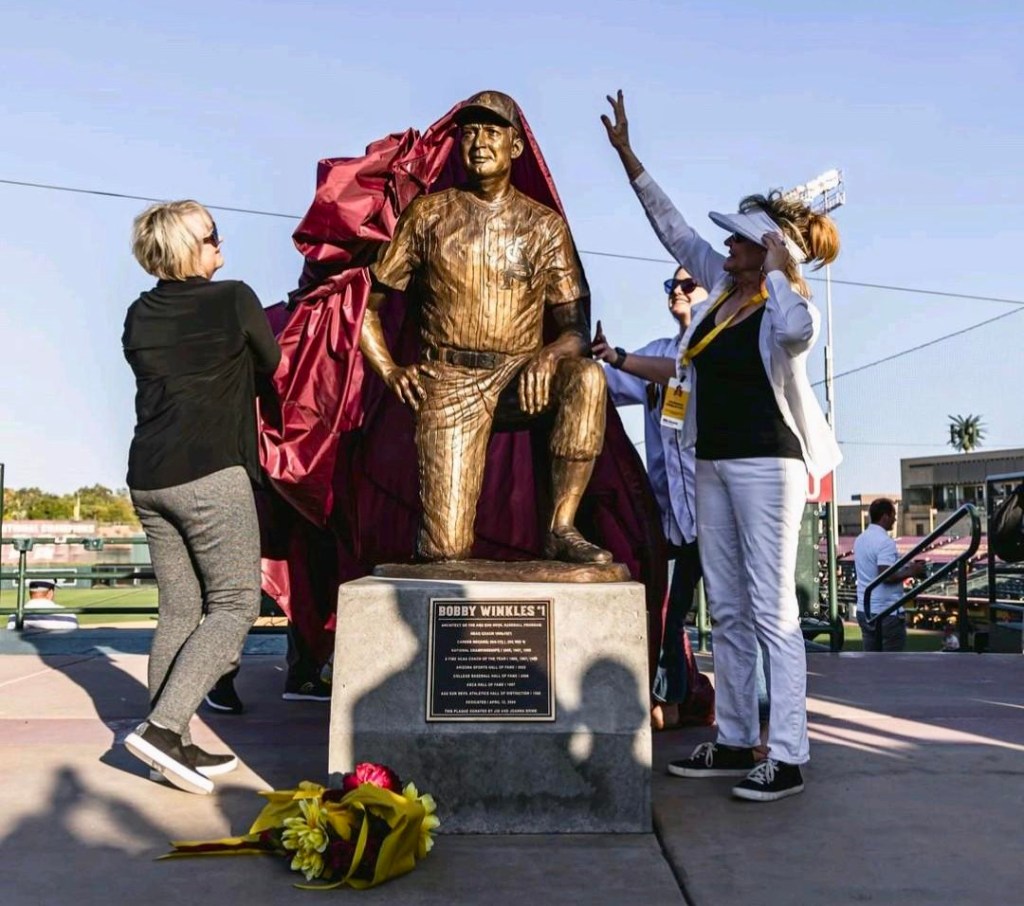
Jeff has done it again! After her Pat Tillman sculpture was installed at Arizona State University in 2017, Jeff’s statue of Coach Bobby Winkles was unveiled there in April 2024. Plus, she’s been creating new art pieces every single day!

Jeff Carol Davenport looked around her studio, trying to see it through new eyes as she tidies up in anticipation of hosting VIPs from Arizona State University’s baseball program.

Keeping her studio neat is a constant challenge; pottery materials, paints and sculpting tools are scattered across various work stations. But she must get her creative space looking organized and welcoming; a big sculpting project is on the line!

Will she get the commission from ASU to sculpt a life-size likeness of beloved baseball Coach Bobby Winkles? What an opportunity that would be for Jeff!

Bobby Winkles coached ASU’s Sun Devils baseball team from 1958, when the school adopted the varsity sport, until 1971, taking the team to the national championship three times. He’s considered the architect of ASU’s baseball program… and also a legend.

When she had received an email two weeks before — asking if she was interested in the sculpting job — Jeff responded with an immediate “absolutely.”

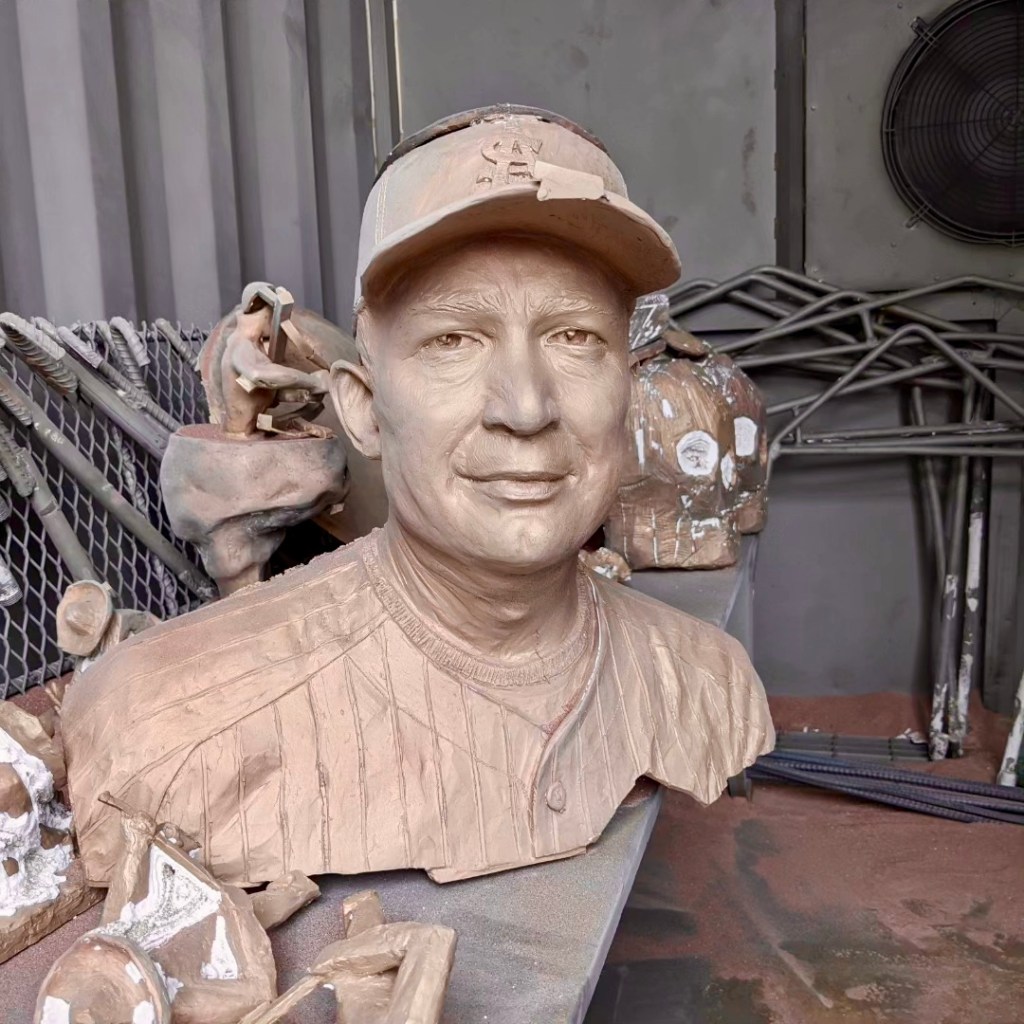
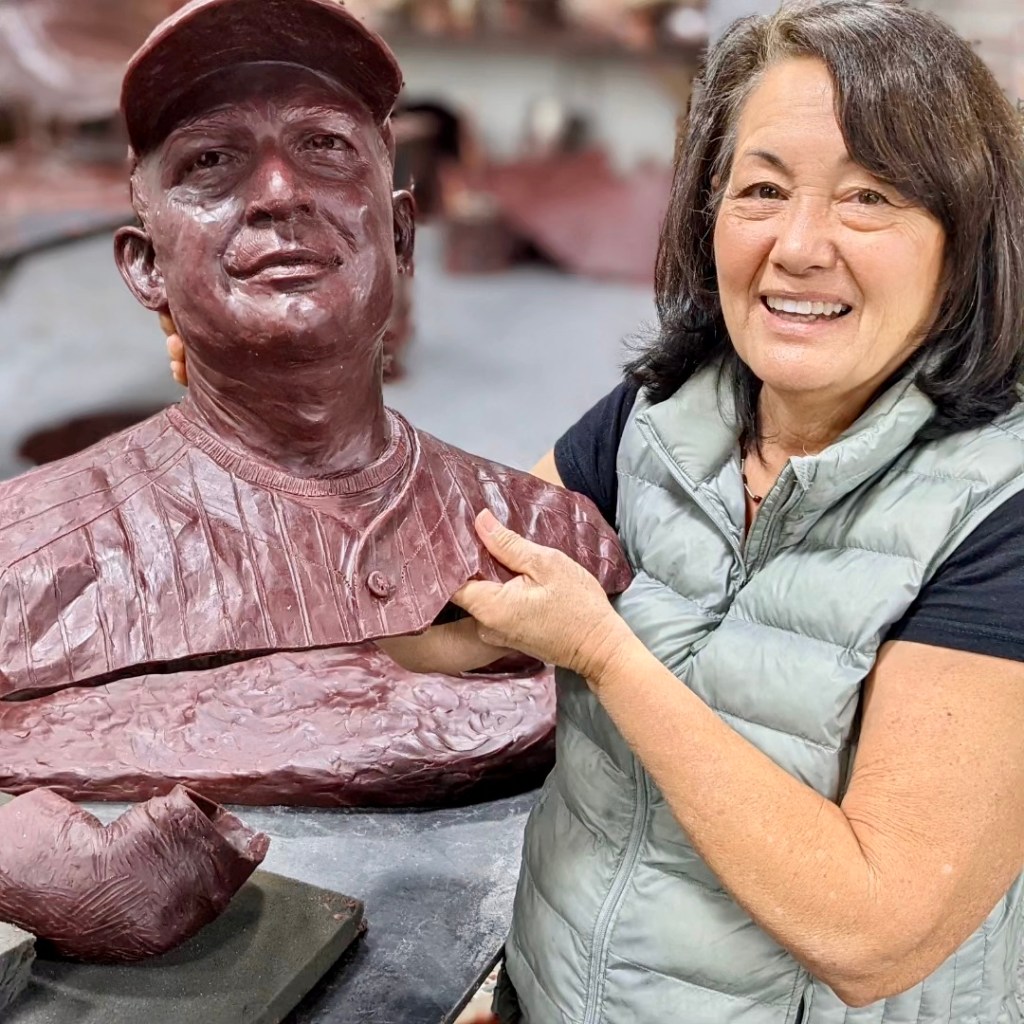
When the three baseball reps were shown into Jeff’s detached art studio filled with colorful paintings, ceramics and sculptures, they immediately saw the maquette of Coach Winkles that Jeff had been working on. She has a gift for capturing faces in clay and she had Coach Winkles looking just like he did in a photo sent by the baseball committee.

Many artists won’t even sculpt a maquette as a prototype if they haven’t secured a contract. But Jeff does. She doesn’t mind doing a little work for a potential client without receiving money or without an upfront promise of getting the job. Not many people in any field think like that.

“They walked into my studio and seemed very happy with the maquette,” Jeff says. “They liked it, and I thought ‘this is going to be a go.’”

“Thanks so much,” one man said to Jeff. “We’re looking at two other artists and will be in touch.”

“That made me feel down,” Jeff says. “I thought, ‘maybe I won’t get the commission.’”

ASU players touch Jeff’s Patt Tillman sculpture before each game.

They knew that Jeff had already sculpted Pat Tillman, former ASU football star, for a life-size bronze sculpture installed at ASU, so that would hopefully help sell her to this committee. Yet, even with creating Pat Tillman’s sculpture, Jeff didn’t take the Coach Winkles prospective job for granted.

“I don’t expect these things,” she says.

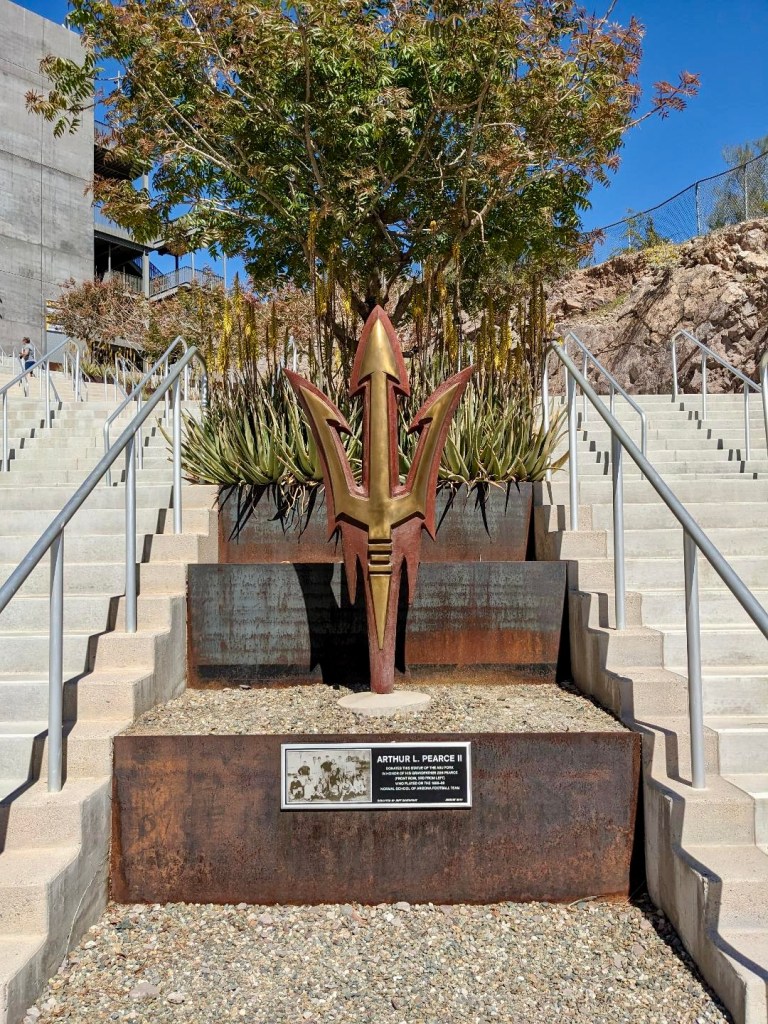
Pitchfork in ASU’s Mountain America stadium.

Jeff had also created the bronze Pitchfork sculpture placed in ASU’s Mountain America stadium.

Her mode is to keep working, no matter what, and that’s what she did until the day in early 2024 when she received word that the committee had selected her to sculpt Coach Winkles!

At the unveiling ceremony in April 2024, one of the committee members said to Jeff, “The minute we walked in and saw the maquette, we knew you were the artist for the job. We had to follow our formal selection process, though.”

“But, they knew,” Jeff says, enjoying the thought of their immediate acceptance of her skills, even if they couldn’t say anything at the time.
Those are the lows and highs for artists who put their art out into the world. The highs and lows never really stop, even for seasoned artists, but they hopefully become less intense with time and experience.

Unveiling Coach Winkles’ sculpture at entrance to Phoenix Municipal Stadium.

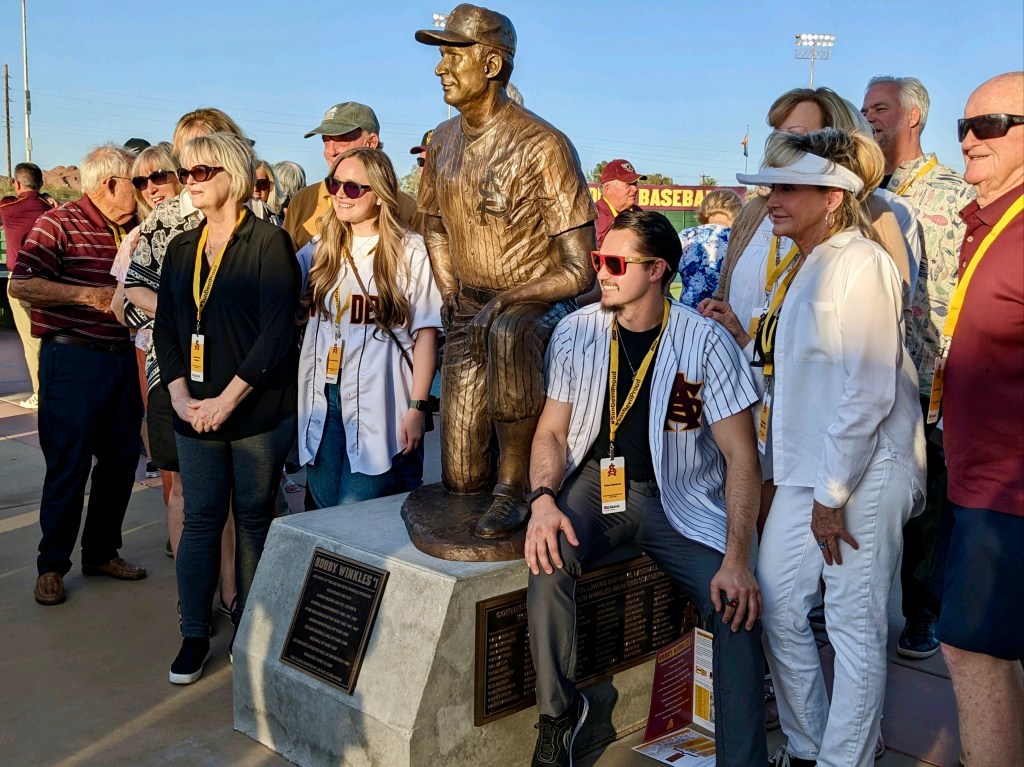
Jeff was on a high at the unveiling ceremony and she was honored to meet Bobby Winkles’ family, including his grandchildren.

She considers her Bobby Winkles sculpture to be her “star accomplishment.”

Coach Winkles family and friends celebrate unveiling.

“But what about Pat Tillman’s sculpture?,” I say. “That’s a star accomplishment, too.”

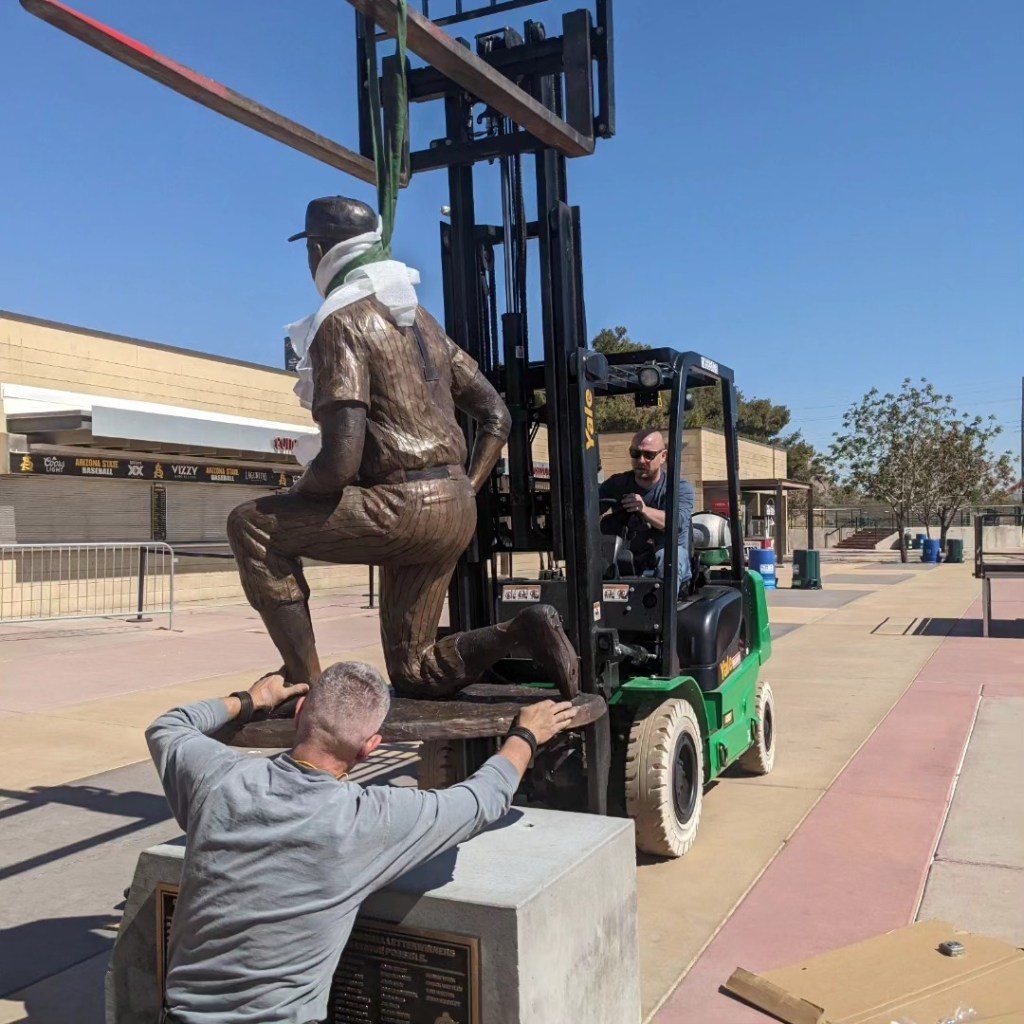
“Yes, but Pat’s sculpture is in an area of the ASU stadium where mainly the staff and team have access, so the general public doesn’t always see it. Coach Winkles’ sculpture is on the third-base concourse at the entrance of the Phoenix Municipal Stadium, ASU’s home park. Everyone attending a game will walk by Coach Winkles’ statute when entering and leaving the stadium.”

This news article from ASU gives a great overview of the sculpture and its unveiling celebration.

ASU plans to add more sculptures on the stadium’s walkway and they’ve indicated they want Jeff to be involved.

“Adding new sculptures may not happen for a while,” Jeff says. “These things don’t always happen fast, but I’m happy that more good things might be coming.”

Jeff Carol Davenport’s tireless creative force was on full display in my first spotlight of her in 2017. Back then she was still teaching ceramics at Sandra Day O’Connor High School in Phoenix, counting down the days until she could retire and throw herself completely into sculpting, both bronze and ceramics.

While teaching high schoolers during the day, Jeff’s time in her home studio was busy, busy, busy.

Now that she’s retired, she’s unstoppable!

Jeff might be your creative kindred spirit if you wake up wanting to get to work on a project and go to bed thinking about tomorrow’s projects… while art ideas pop into your mind night and day.

She’s usually working on several pieces of art in different mediums, spread out in her studio at designated work areas: the pottery wheel area, the glazing area, the jewelry-making area, the painting area.

Jeff’s detached art studio filled with supplies, paintings, prototypes and inspiration.

“Making art fulfills the need that I apparently have,” Jeff says, “to always be creating and be productive. Creativity breeds creativity.”

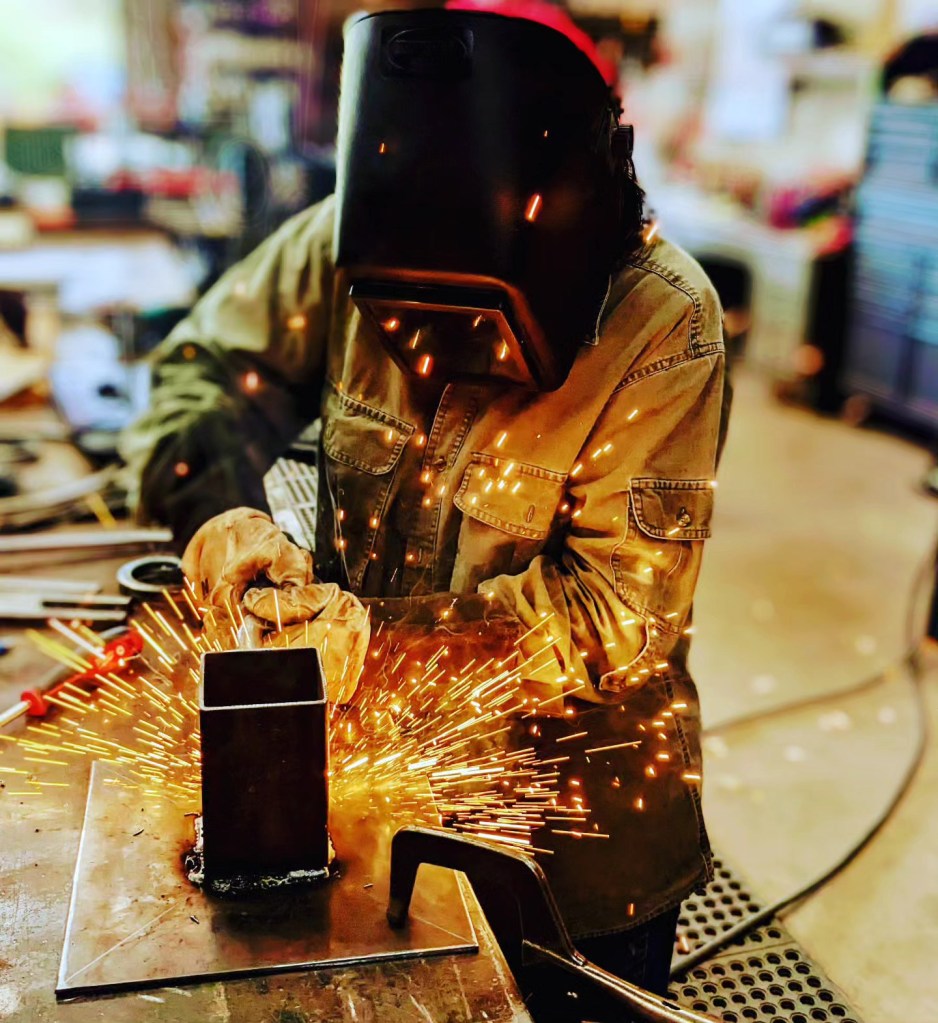
Since retiring from teaching in May 2022, her production rate has sky-rocketed, just as she had yearned for during those working years. Jeff paints, makes ceramics, creates sculptures to be cast in bronze — managing them through every step of the casting process — and now makes jewelry. She’s even learning to weld!

Yet, as productive as she is, there’s never enough time to make all the beautiful things flooding her brain.

Jeff and her husband Mike have an off-grid vacation home in New Mexico that they’re building by themselves…and they bought another nearby lot so Jeff is now hankering to build a small dwelling there, too. By hand!

Jeff welding a base for one of her sculptures.

She somehow remains focused on her multiple art projects but one distraction she finds pleasant is her two-year-old granddaughter, Adaliya, who lives with Jeff’s son, Jeff, and his wife Aiya in Flagstaff. (Jeff, the mom, is also a hunter and for years has gone on multiple Elk and deer hunts with her son Jeff.)

When not with family, Jeff is in her studio making things like:
• Branded ceramic mugs as corporate gifts for her son Cori’s clients
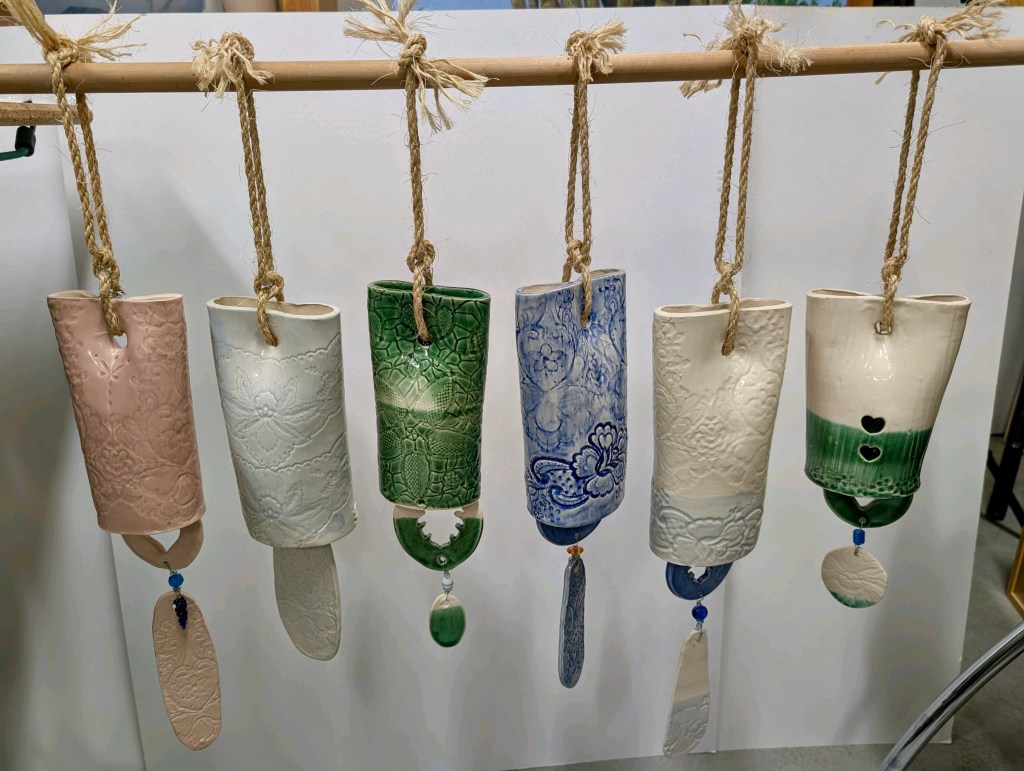
• Ceramic bells
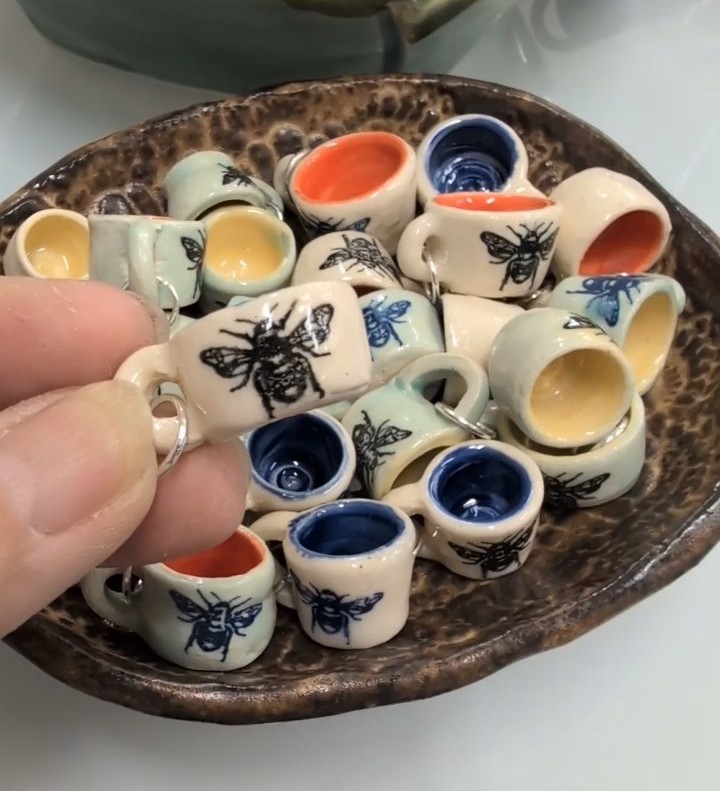
• Small branded ceramic coffee cups and bee earrings for a local boutique
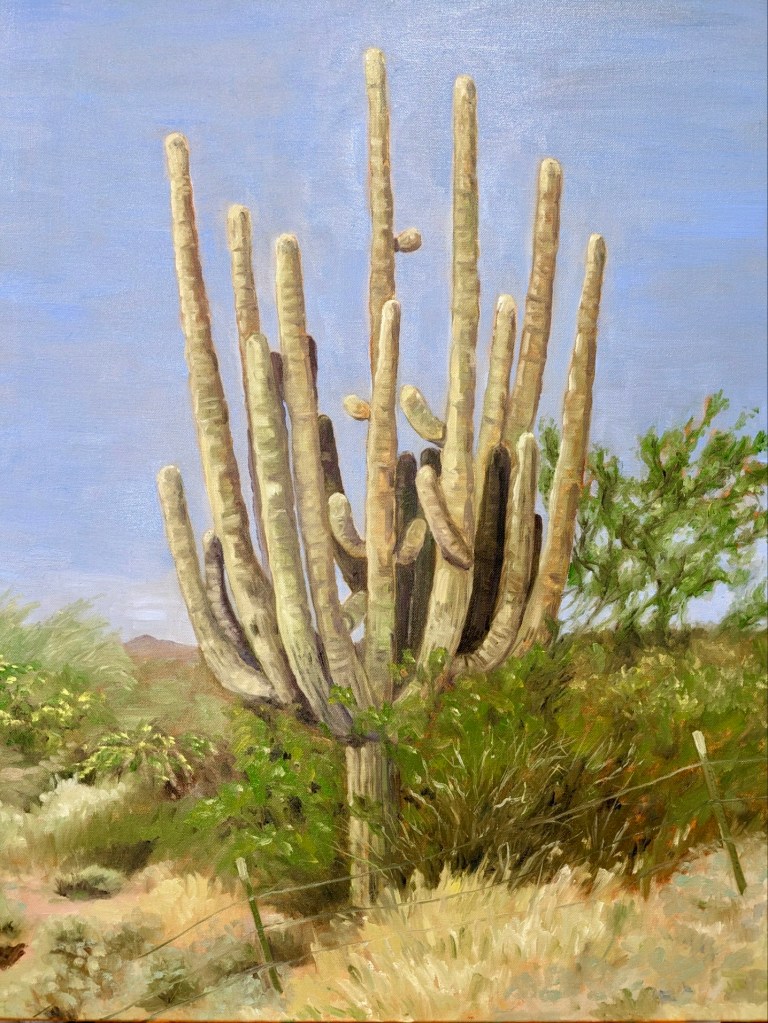
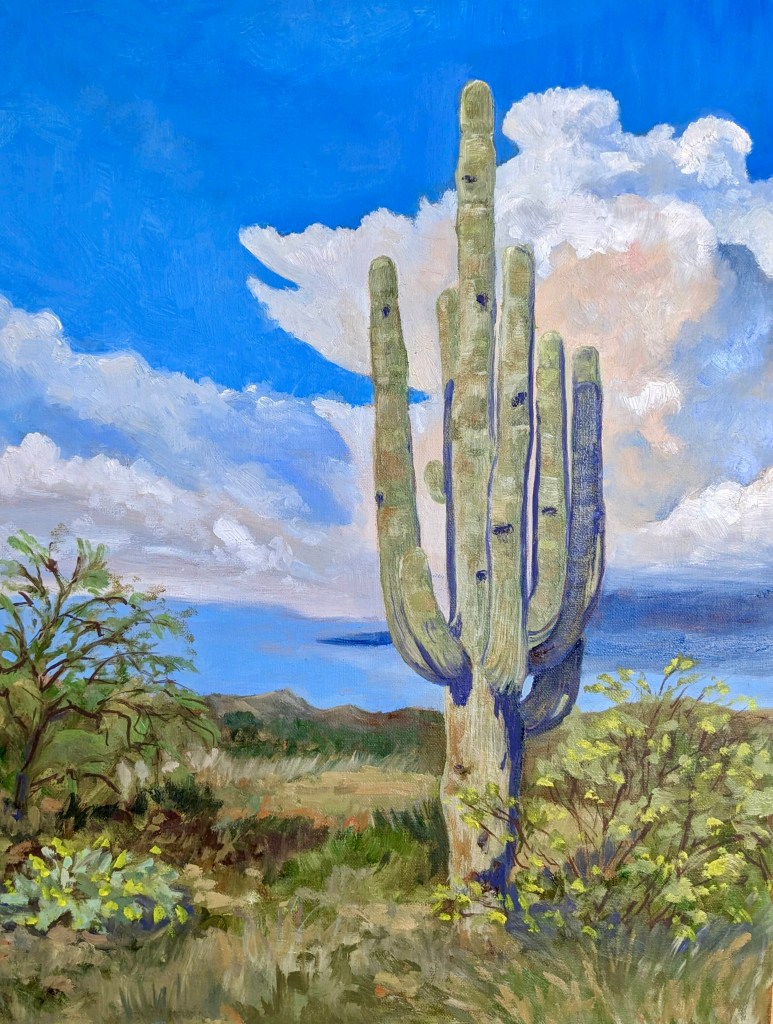
• Paintings of giant saguaros that live near home in New River, AZ
• Small animals from clay to fire at her next Wood-fire Workshop in Northern Arizona
• Maquettes of commissioned statues to be enlarged and cast at the local foundry (where Jeff worked for 20 years)

Most of Jeff’s art is inspired by her Sonoran Desert surrounds, where she grew up and has lived her entire life: 66 years so far.

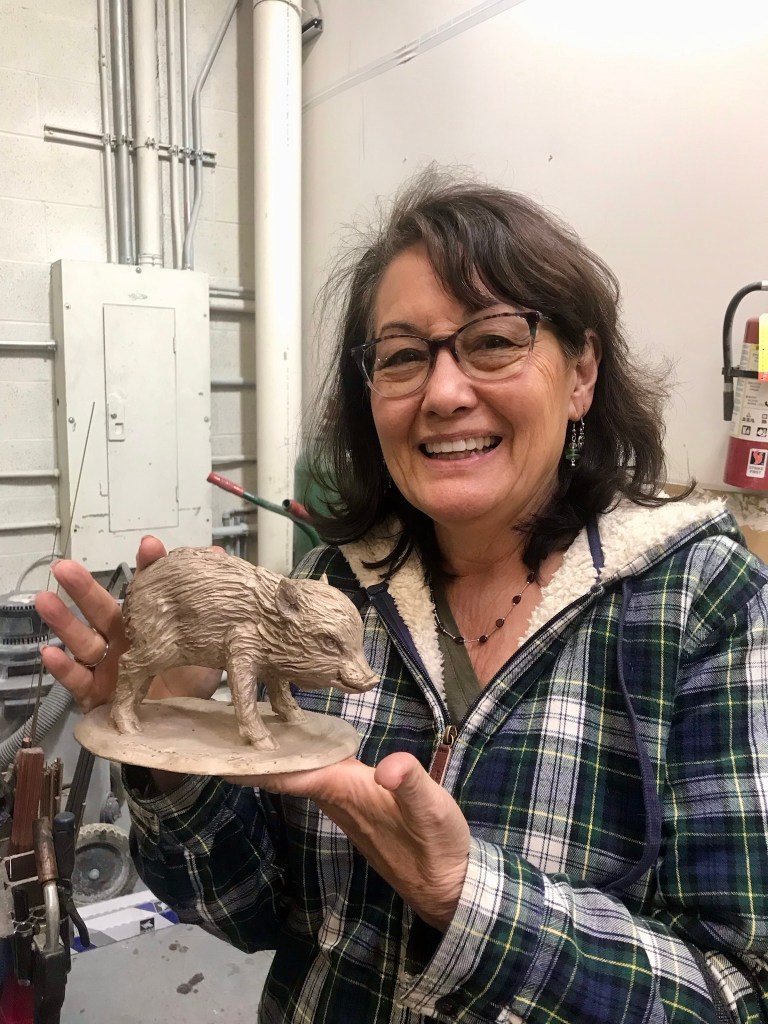
She has a distinct aesthetic style, able to create adorable desert animals like javelina or bunny rabbits that look soft and realistic, even in bronze.
Sure, she’d like to participate in some of the annual winter art shows in Phoenix, Scottsdale, or Wickenberg. She plans to continue applying to those shows until the organizers recognize her tenacity and invite her to exhibit.

Jeff showing off her small javelina sculpture.

But Jeff doesn’t want fame and fortune at this stage in her life. She just wants to keep making all her wonderful creations and have people appreciate them… and purchase them so she can buy more supplies and make more beautiful things!

“I don’t know how to get where I’d like to be,” Jeff says. “I don’t look at rejections, though. Instead I look at what works for me. Like the Bobby Winkles sculpture. I just keep working to get those kind of jobs. In the meantime, I keep my creativity going and keep making art.”

Coach Winkles in clay.

STUDIO

Jeff admits her studio isn’t organized like one might see in a magazine. Stuff is everywhere, stacked in containers, stuffed into drawers, sitting on desks and tables, all akimbo. But it works for Jeff.

“I have Dis-organizational Organization,” she says with a chuckle. Her different work areas may be cluttered but she gets lots of work done at each one.
“I’m a visual person so it helps me to see my supplies. If I were to organize them into a tidy little space, I’d probably lose everything. If my glazes are on the table, I’m more productive versus having to go search out where I put things.”

Coach Winkles in the wax stage of the lost wax method.

If she puts things away she forgets about them.

“I found a box of jewelry-making supplies at a yard sale and was going through it,” Jeff says, “when my neighbor Brent suggested I just offer them a price for the whole box, and I did. The other day I found that box and started pulling out silver solder and some cabochons, which I can use in pieces right now. But I had forgotten about the supplies in that box! What else in the studio is tucked into boxes that I’ve forgotten about?!”

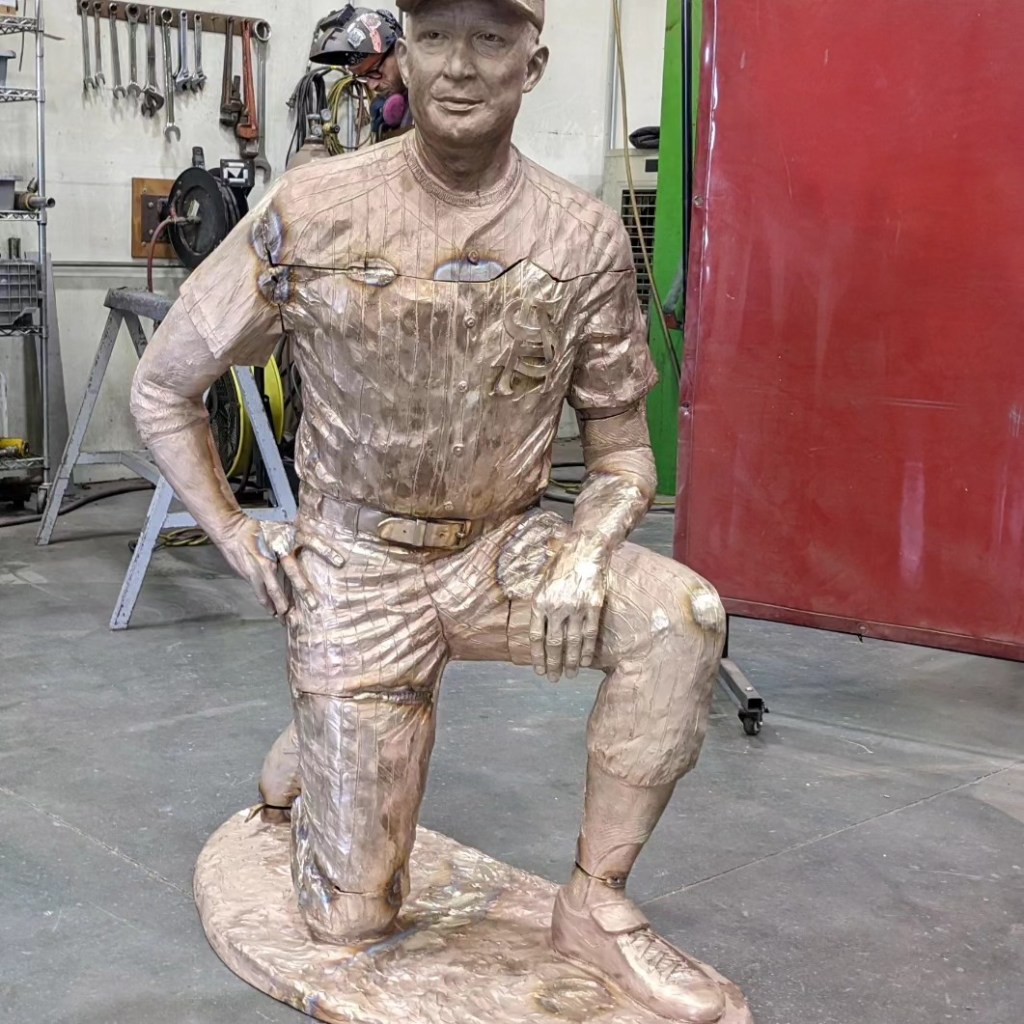
Coach Winkles bronze sculpture in process.

The cost of materials is a huge part of making art for any artist, especially when they’re trying to set prices for their work. Also included are the thousands of hours of training and dedication that an artist puts into mastering their craft. As patrons of creative people, we’re buying that skill and expertise when we purchase a piece of their art.

“It sometimes feels like I’m paying people to buy my art,” Jeff laughs, “because maybe I can never get back the money I‘ve put into all my endeavors.” She has multiple pottery wheels, mounds of clay, several kilns, and materials for jewelry that include precious gems and fine metals. The cost of building a creative space to work in must also be part of the calculation.

“For one of the ceramic bells I make, it’s not just about how much clay the bell takes, “ Jeff says, “it’s also about electricity to fire the kiln, studio space, and the time it takes to sculpt and then assemble the finished product.”

Every little expense adds up, especially when she’s working across multiple mediums. Luckily Jeff and Mike love to shop at yard sales and thrift stores and that helps in financing her art.

STAND-OUT SCULPTOR

Of course more good things, and more great sculpture commissions, are coming to Jeff.

No other sculptor can produce what she does for what she charges.

“I provide a great product for the cost,” Jeff says. “No one else would do what I do, like making prototypes without an agreement in place. My prices are reasonable. I come highly recommended and know how to manage my time and meet any client’s deadline. I always do things on time.”

Coach Winkles sculpture going into place at ASU’s stadium.

Jeff has been building a reputation for doing these public projects for decades. After working at the local foundry for 20 years, she knows every process of casting bronze. She can do the physical work of mold making and cleaning seams, etc. Being local, she can meet her clients at the foundry at any time during the process and explain each stage. For local clients, delivery fees are not as expensive as delivery costs would be from an out-of-state artist.

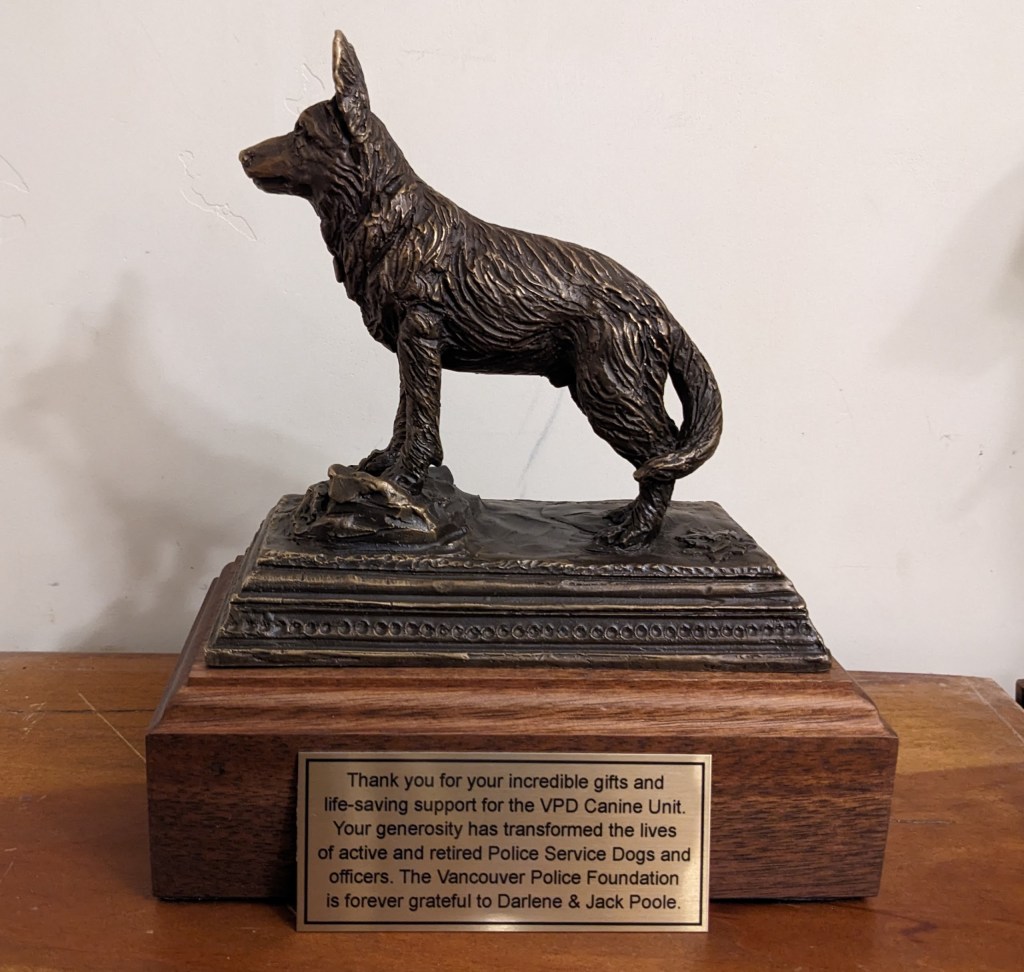
Gift from the Vancouver K9 PD to a donor, sculpted by Jeff from her prior life-sized memorial.

“People respond to my style,” Jeff says. “My work is realistic but I have a really nice style. Plus my large body of work with sculptures installed around the state and elsewhere demonstrate my expertise and talent. I can stand up with the best of artists.”

What Jeff doesn’t mention is her positive attitude and sunny outlook. Or her kindness. She is a pleasure to be around and a complete sweetheart for her clients to deal with.

Jeff is a sculptor who can design in a short period of time with minimal input from clients and nail their concept from the start. It’s rare that a client asks her to redo her original design. Jeff’s relationship with the folks at the foundry make it easy to process any statue from start to finish. She knows the foundry, its people and equipment. They know her and trust her.

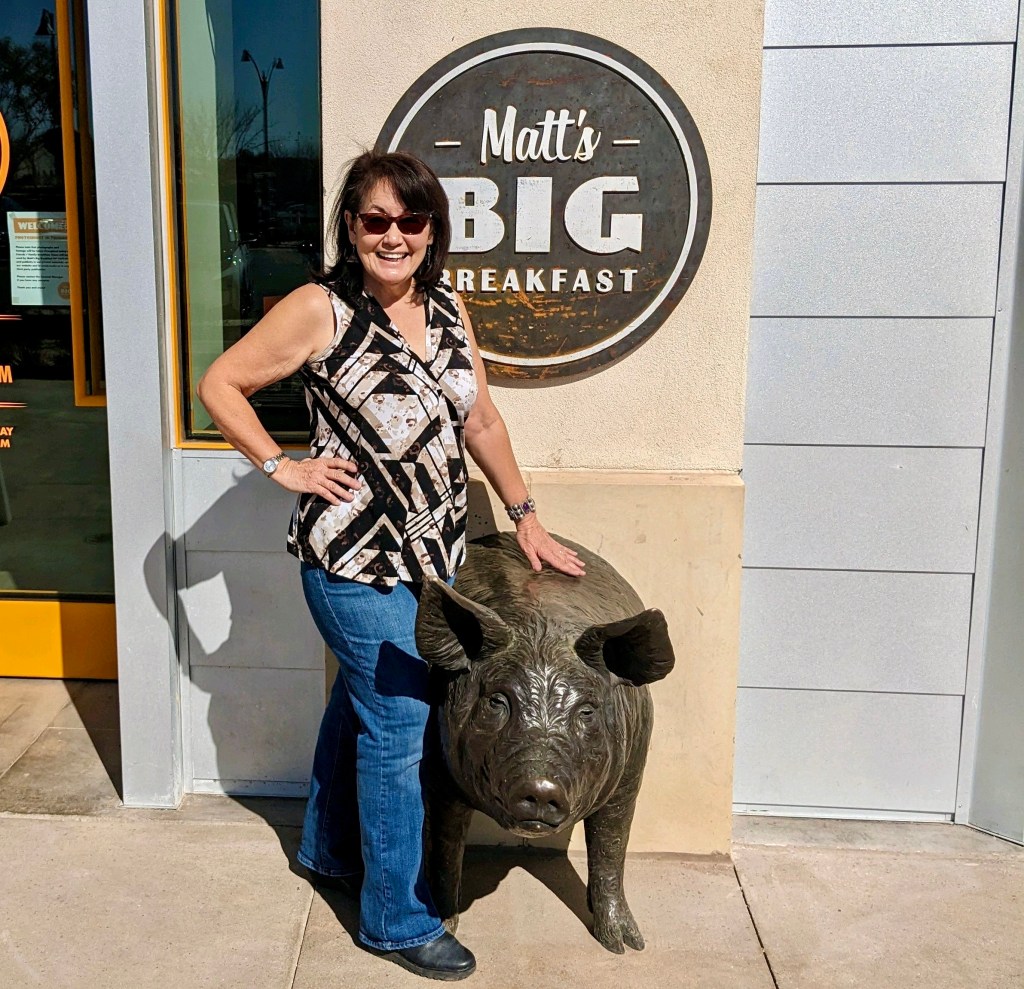
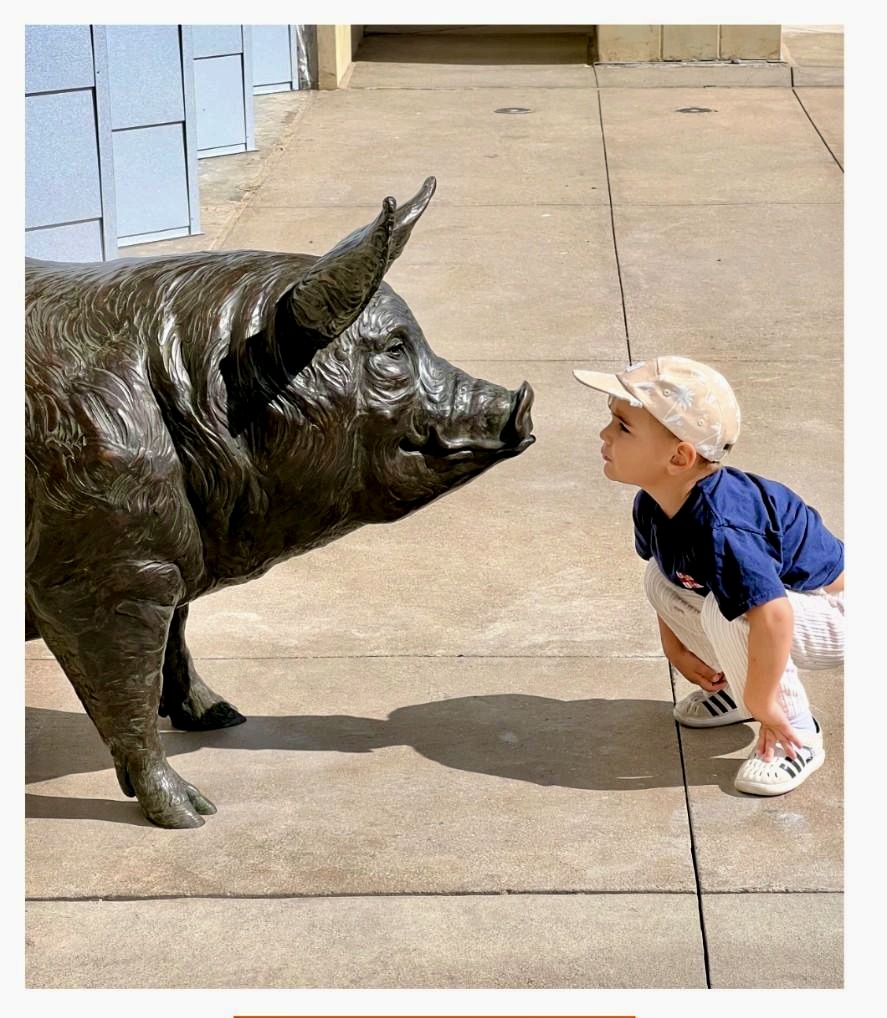
Jeff’s pig sculpture for a popular breakfast spot.

Jeff does all of this with a smile, offering great ideas and delivering more than she promised.

Everyone enjoys Jeff’s sculptures!

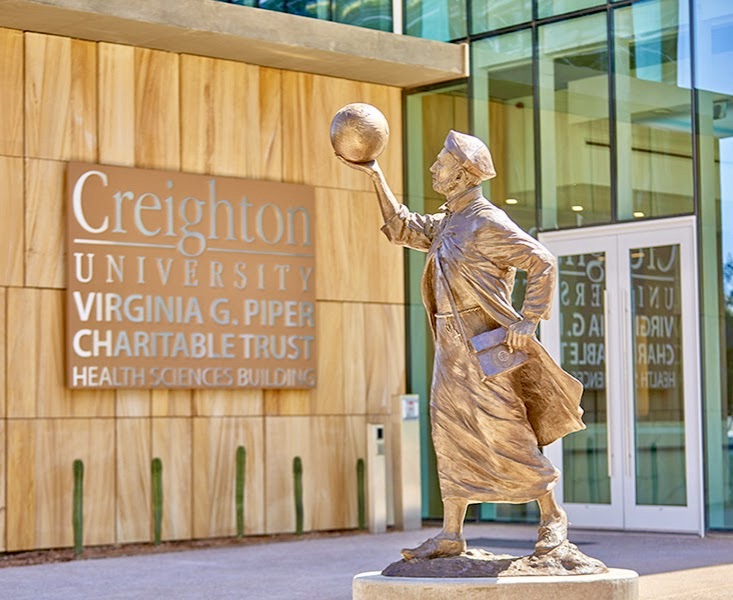
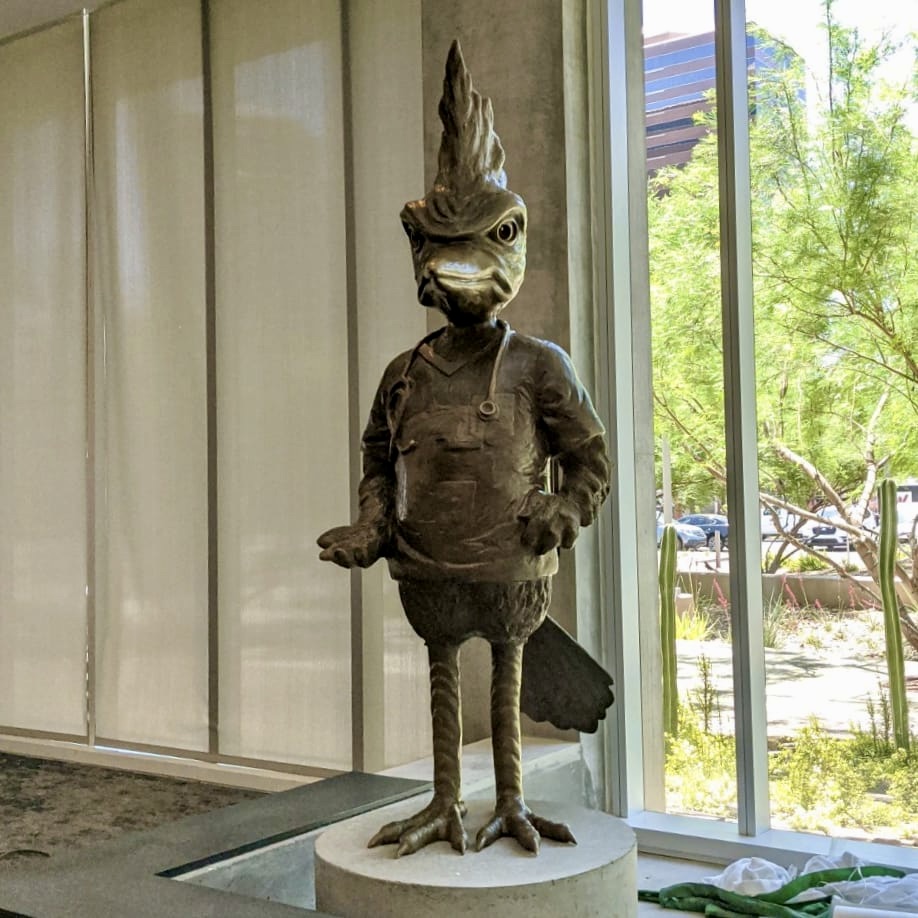
Jeff has created two sculptures for Creighton University, a Jesuit Catholic institution in Phoenix with a large focus on their nursing program. St. Ignatius was the founder of the Jesuits and his sculpture stands at the university’s entrance. 

Jeff’s sculpture of St. Ignatius at Creighton University in Phoenix.
Jeff Sculpture of Billy, Creighton’s mascot, on their campus in Phoenix.

As a sculptor, Jeff has much to recommend her for any size projects. And that’s just her sculpting. She is as talented in her other artistic pursuits.

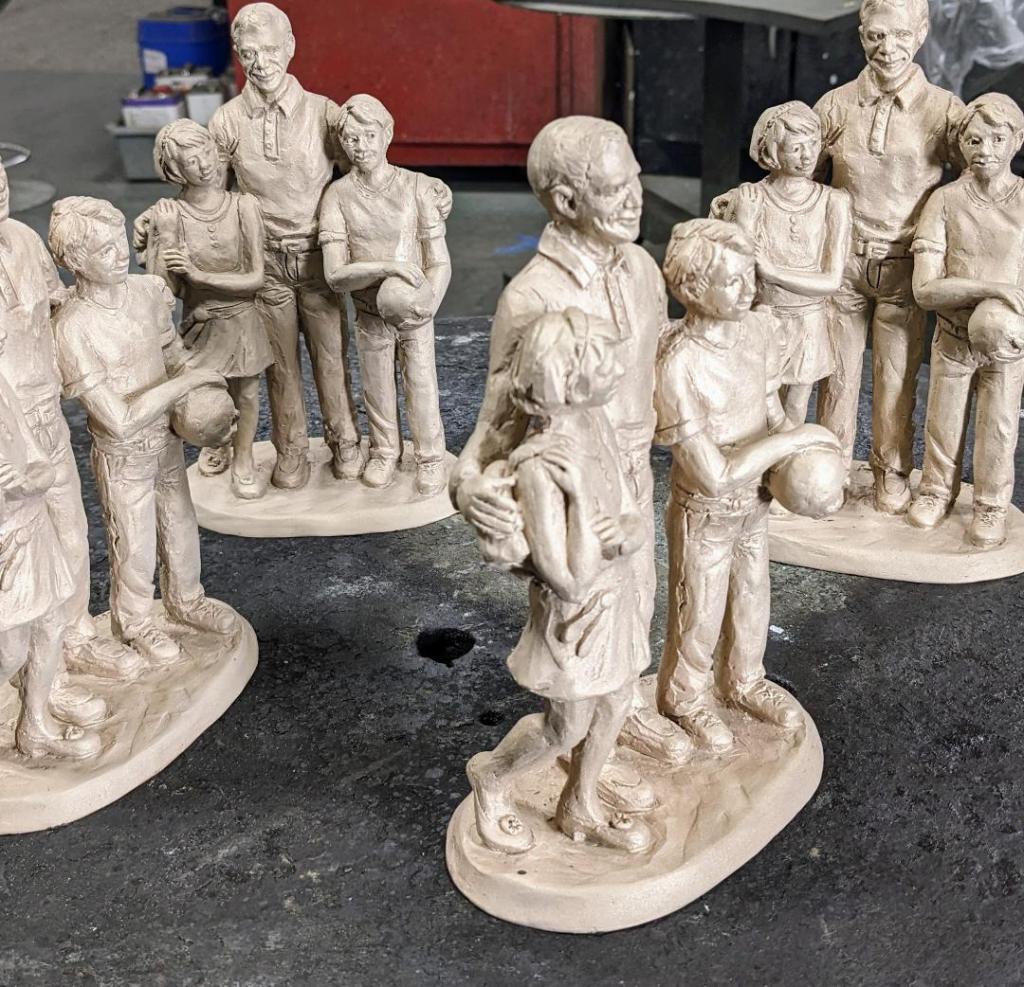
The Boys and Girls Club of Flagstaff commissioned Jeff to
create this sculpture as an award. 

Popular by Vote

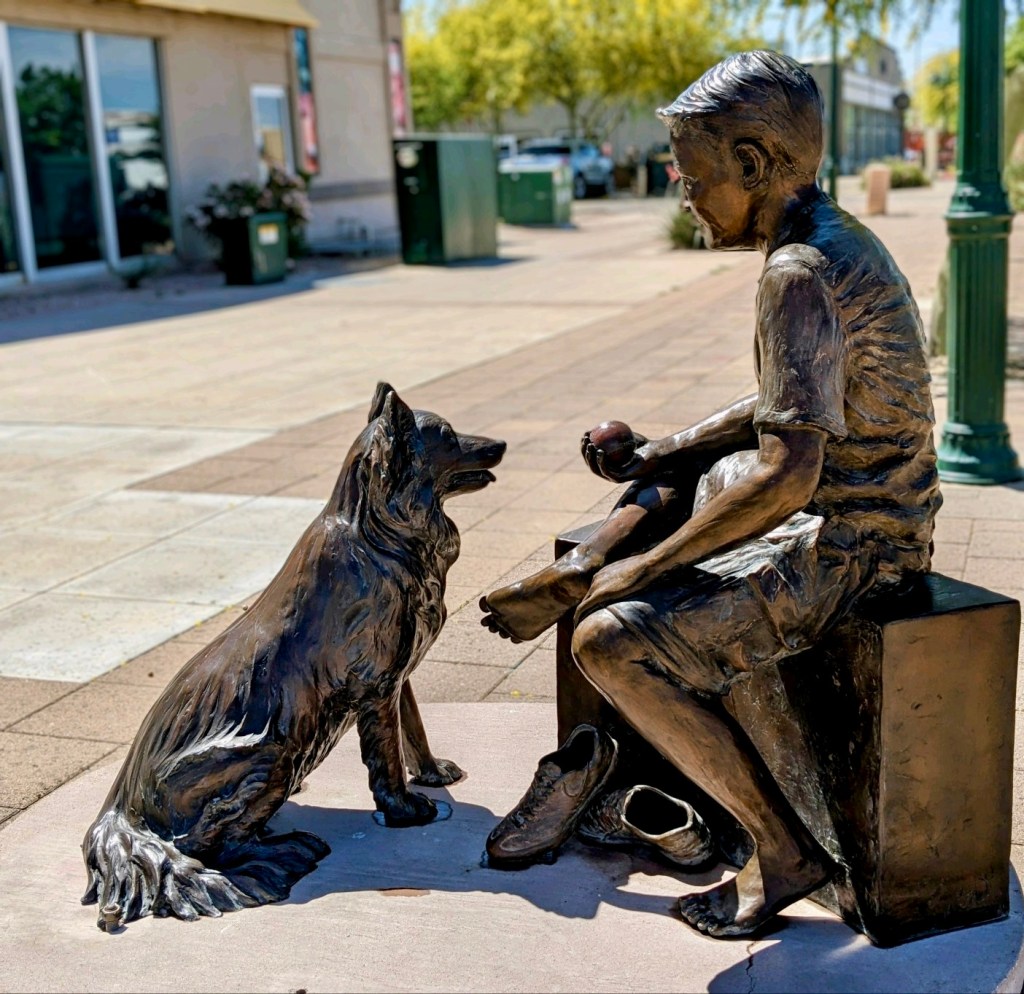
Jeff’s sculptures often capture the public’s imagine and take on a life of their own. For instance, she created Learning Together, a sculpture of a boy and his dog, modeling the figures off of her son, Jeff, and their family pet, Cisco.

Jeff’s sculpture Learning Together was modeled on her son, Jeff, and pet Cisco.

“We got Cisco as a rescue,” Jeff says, “and in the sculpture you can feel his anticipation of Jeff throwing the ball. My son was known for taking his shoes off wherever he went, so to add to the story I placed his shoes at the base of the sculpture. Also, if you look in the eyes of the dog, you can see the reflection of the boy.”

Three of these sculptures stand in Arizona; in Oro Valley, Prescott Valley and Mesa.

“The Learning Together sculpture in Prescott Valley at the Civic Center overwhelmingly won the Public Choice Award with the purchase agreement for the city,” Jeff says. “The one in Mesa also won the public choice award.”

So add “award-winning sculptor” to Jeff’s resume!

WOODFIRE WORKSHOP

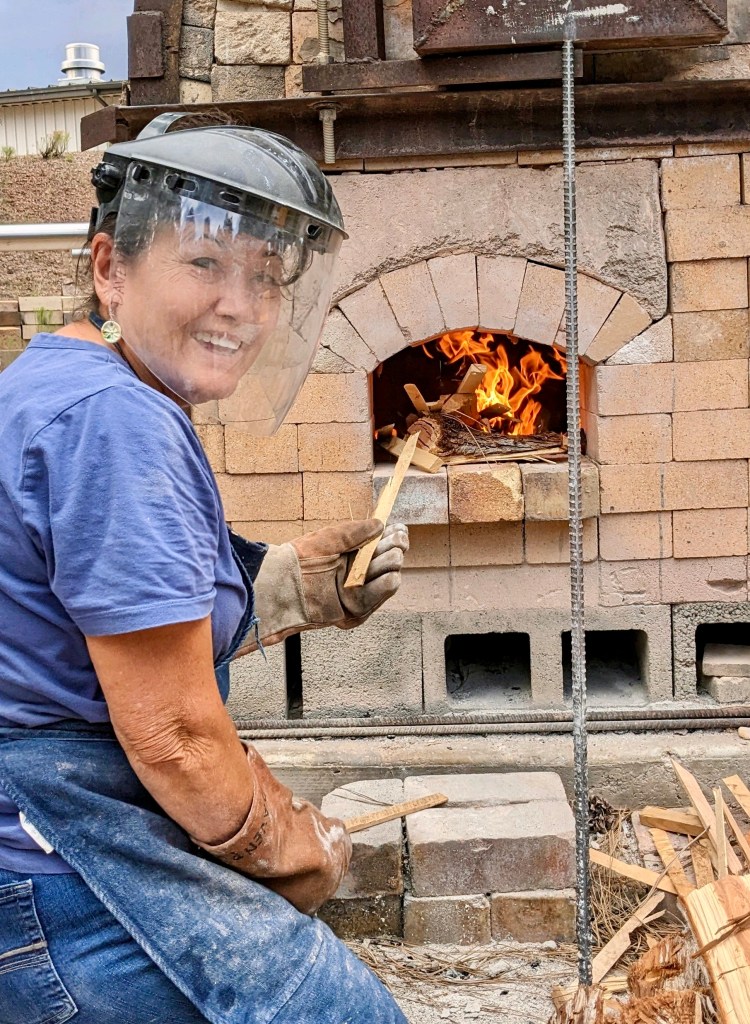
For the last five summers, Jeff has made her way up I-17 to Flagstaff and the Northern Arizona’s ceramic workshop comprised of a series of wood-fired kilns set beneath towering Ponderosa pines. She attends the two-week class, working from sunup to sundown every day, ready to fire as many pieces as possible in the large kilns.

All workshop participants pull together, taking turns to load and unload the various brick kilns day in and day out to ensure everyone’s complete collection is fired by closing day. Participants create all types of pieces, from dish ware to vases and everything in between, when they’re not tending to the kiln.

Jeff made a promise to herself that she would sculpt one small animal every day of the year to take to Flagstaff.

“I’m known for my animals in the kiln,” Jeff says. “I started out just wanting to make a quick clay sketch but then started spending an hour a day on each one, so I’ve slowed down on them and plan to pick out my top 50 to take to Flagstaff in the summer.”

Those small sculptures could be the start of something bigger. “I can scan each one and enlarge it to make something big, like a bronze statue,” Jeff says.

Jeff keeps the “living” wood-fired kiln breathing.

Often it seems like the older people put in the most effort, but maybe that’s just because inexperienced students are surprised by the amount of physical work it takes to fire a piece in a wood-fired kiln, which is much different than using an electric kiln.

People have to physically load the kilns, crawling inside to stack pieces just right, and folks must also stay throughout the night to keep the temperature up.

“Working with a wood-fired kiln is enormous work,” Jeff says. “A kiln is a living thing. It must have oxygen and wood. A kiln might stall in the middle of the night and you have to get it back to breathing.”

Many workshop participants have been attending for years, some longer than Jeff, and this group of returnees have the process down. They know what needs to be done and they make it happen.

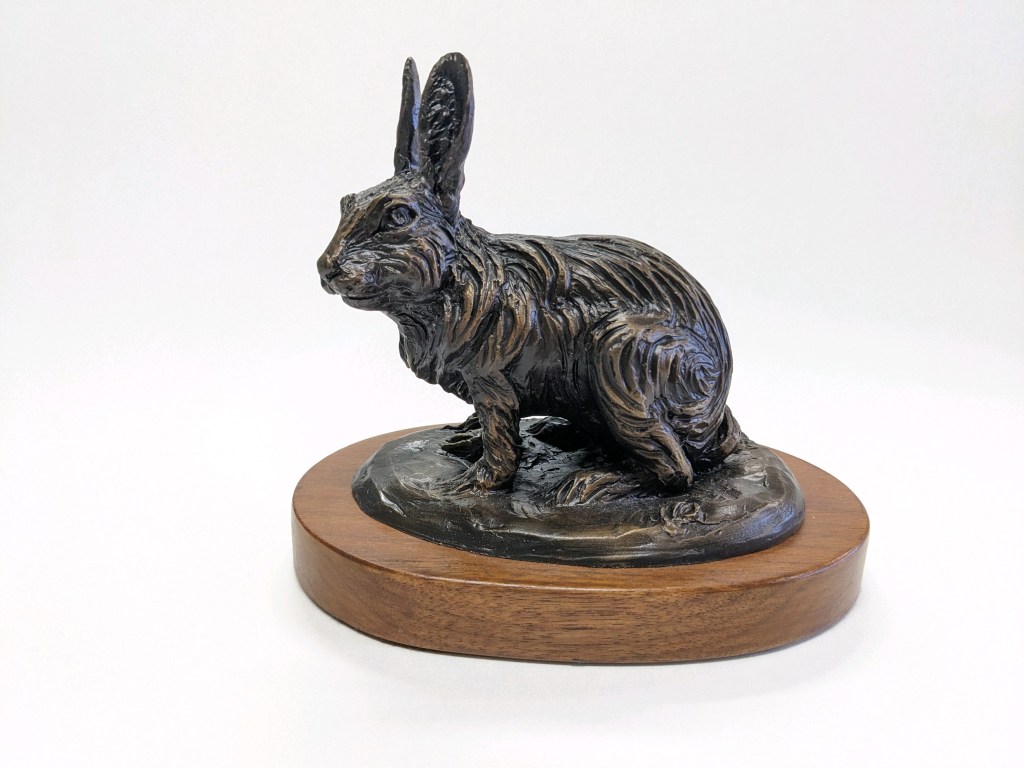
Jeff’s small rabbit as sculpture.

“We have a big chart on the wall of what we need to load, unload, bisque fire, etc.,” Jeff says. “There’s nothing worse than someone not having fired all their pieces by the end.”

Jeff prepares ceramic items for months in advance to take to the workshop, and she brings home a good many beautiful pieces, but she’s also simultaneously making other items in other mediums.

BOUTIQUE WARES

Bee earrings sculpted by Jeff.

Sharron Brenning, an artist friend of Jeff’s known for her lovely paintings of Native American children, opened a boutique in Verde Valley, taking over space in her son’s adjacent gun shop, “Deuces & Aces.”

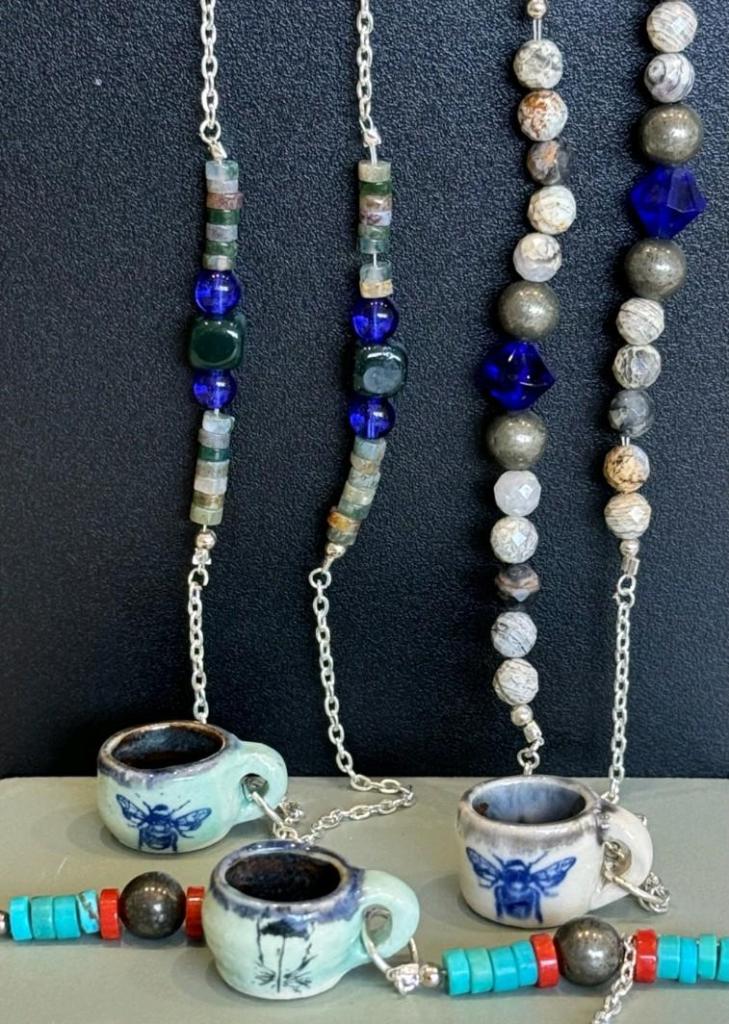
Sharron’s little shop is cleverly called “On the Softer Side” and has a flower-and-bee theme. Sharron asked Jeff to make tiny coffee cups with a Bee motif to use as necklace pendants. And little bee medallions for earrings. Sharron offers handmade soaps in her shop and asked Jeff to make ceramic soap dishes to pair with the soaps. To complement the gun shop’s theme, Jeff makes a ring holder with a large-gauge bullet as the center post.

Tiny ceramic coffee cups.

“Sharron and I are just starting out with this collaboration,” Jeff says, “and we’re learning what sells and what prices to charge. She’s trying to make a go by offering unique handmade products as a draw for customers.”

Display of Jeff’s coffee cups made into pendants.

the PAINTed desert

Jeff has been painting for years, though it sometimes takes a backseat to ceramics and sculpting. There are only 24 hours in a day, after all.

Sadly, one massive Saguaro on Carefree Highway in Cave Creek went down a few months after Jeff painted it. It can takes hundreds of years for a cactus to grow to that size. Saguaro cacti are only found in the Sonoran Desert, nowhere else in the world, and they are a protected species. In this case, the cactus’ demise is even more sad because Jeff suspects it was possibly removed to make room for power lines.

Jeff painted/captured this beauty’s image before it sadly went down after 100s of years.

If a Saguaro must be removed, it is usually carefully uprooted, gently transported and then planted elsewhere, as part of the laws to protect them, but moving a cactus as large as this one must be impossible, hence its treatment.

“All the arms were cut off,” Jeff says, “and were left piled up next to the road.”

Thank goodness Jeff preserved the cactus’ image before it went down.
“I feel by painting the cactus, I’ve documented it in history, in a way. To think of all the years and progress that saguaro had lived through. It’s sad.”

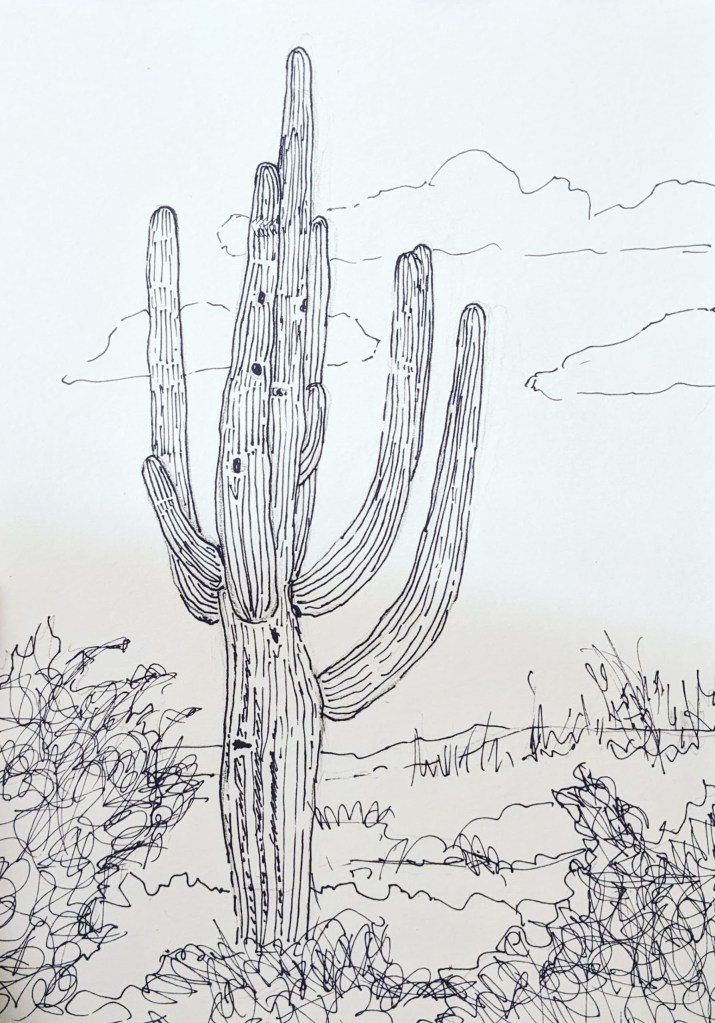
This cactus lives on 16th Street just north of carefree highway.
And here’s the painting from the sketch.

BELLS atolling

How did Jeff come up with the idea of making the ceramic bells, one of her more recent and popular inventions? She received a wedding invitation from two former students who had met in her class. After much thought, Jeff decided the bell would be a perfect ceramic gift to represent how the couple had met.

“We’re going to their wedding next month so I made the bell and inscribed their names and wedding date on it. I also made one for my son Cori who married Rachel in July. People love these bells, and every time I post them on social media, they’re bought up quickly.”

Perhaps people want a piece of affordable art made by the great sculptor Jeff Carol Davenport, who is making a name for herself through her public sculpture commissions. Plus, Jeff prices her work so reasonably, charging only $40 for one of her handmade bells; a true bargain for a handmade piece of art.

OFF-GRID VACATION HOME

Several years ago, Jeff and Mike bought a lot in a remote neighborhood near Ramah, New Mexico. Regulations allow only “sheds” on-sight; a “shed” is a building of 200-square-feet or less. Jeff and Mike have made trips to the lot and built an off-grid 12 x 16-foot shed/cabin/bungalow from scratch, and they love how it’s cozy enough for them plus their dogs Eli and Maya.

“It’s like a hunter’s cabin,” Jeff says of the little space outfitted in blue pine walls and rustic flooring, and made comfortable with a large bed and pretty decor. “We bought another property up there and will build another little place so friends and family can come visit.”

When Jeff says they’ll build another hunter’s cabin, she’s gleefully saying that she can’t wait to get up there and cut boards, build the walls, put on a roof, outfit a porch, etc. She’s eager to build the new shed/cabin with her own hands.

DAD, WADE HOFFMAN

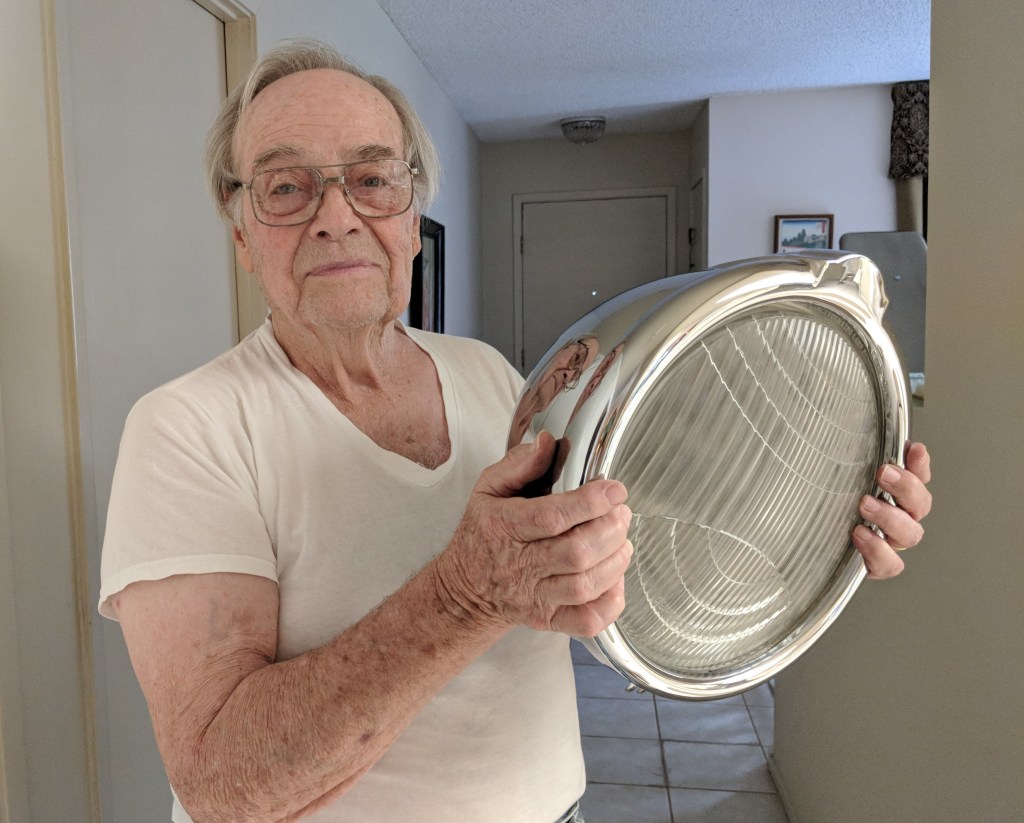
Jeff’s Dad, Wade Hoffman, holding a headlight from his 1930 Packard.

If Jeff’s dad, Wade Hoffman, is any indication of her potential longevity, she could have many more years of good health in which to create things. Born in 1932 in North Carolina, Jeff’s dad is 92 years old and still working two days a week as a security guard.

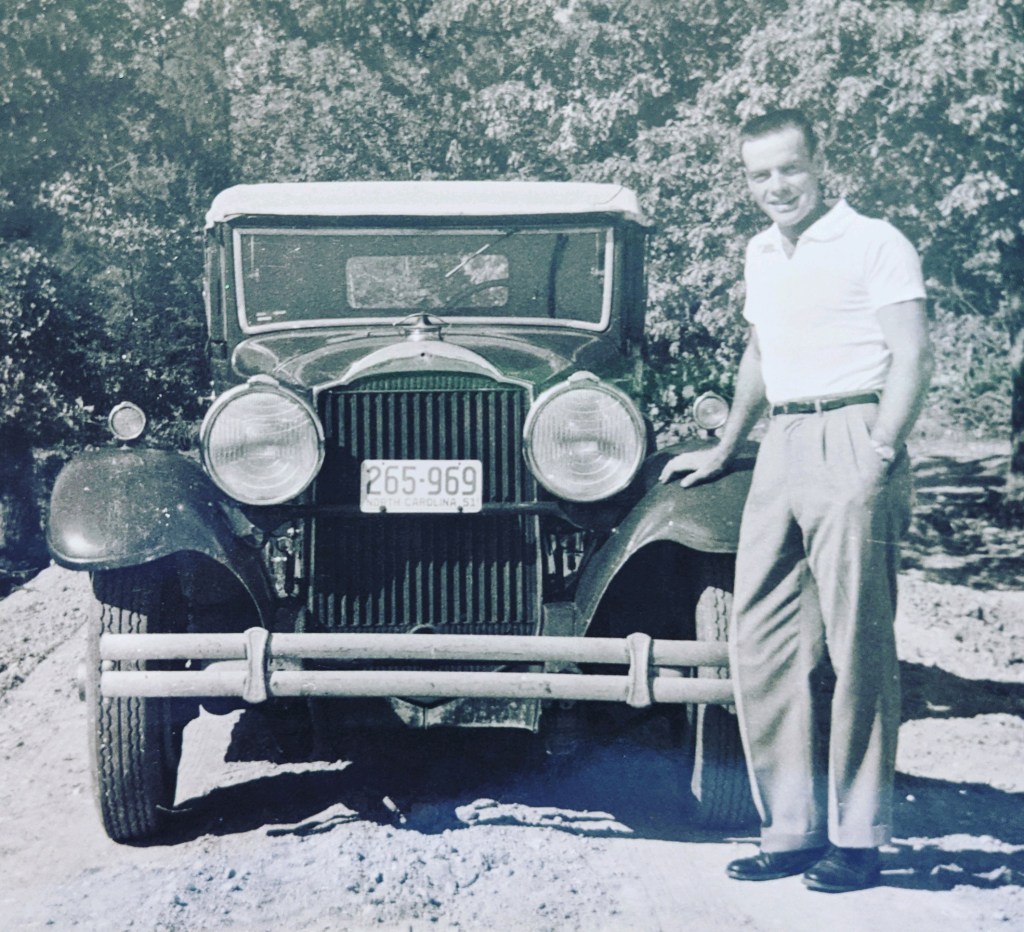
Mr. Hoffman and the 1930 Packard he’ll restore with Jeff.

“We want to put a 35 x 40-foot building in our backyard,” Jeff says, “to act as an apartment for my dad and a garage where we can restore his 1930 740 Roadster Packard, which he’s owned since he was 17 years old. I’m looking for a civil engineer to get the building started.”

Mr. Hoffman, a veteran of the Korean war, has all the parts for the Packard and has restored individual pieces over the years. Eventually they’ll transport the car and its parts to Jeff’s house so she and her father can restore it.

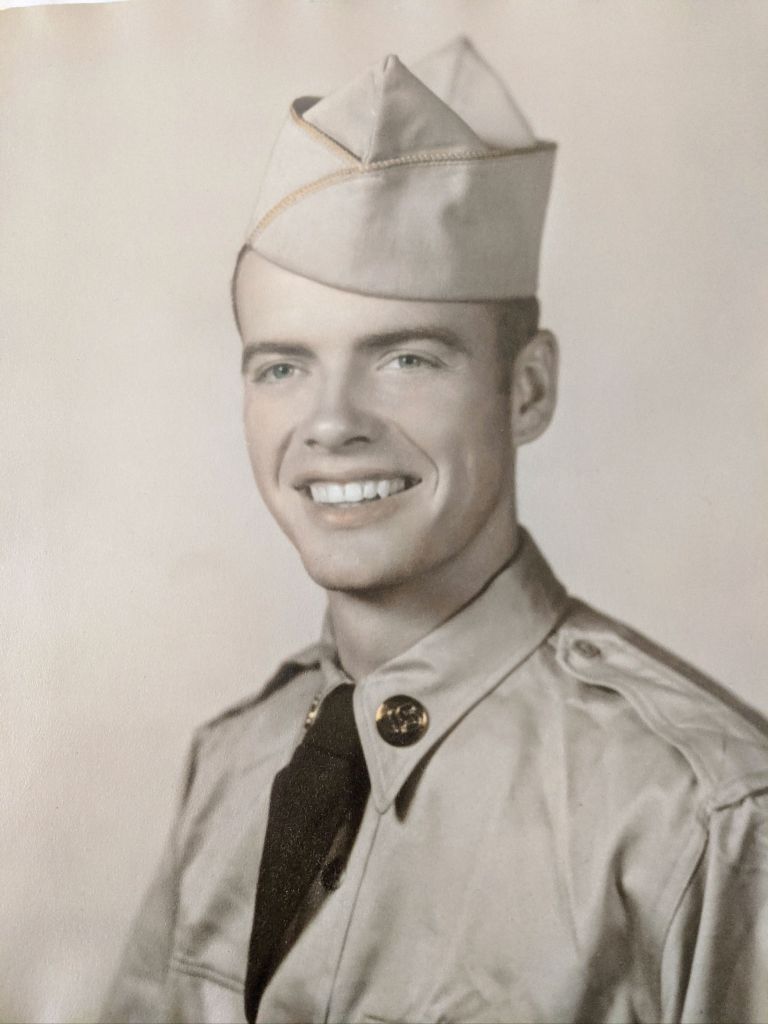
Mr. Hoffman as a serviceman.

“My dad bought a travel trailer to live in as we’re building his apartment and garage,” Jeff laughs. “Parked in our yard, he says he’ll be our onsite security guard.”

PETS aplenty

Also onsite at Jeff and Mike’s house, in addition to their dogs Maya and Eli, are chickens in a coop and their two aged turtles, Indi and Tony, who live under a Paolo Verde tree in the front yard. Indi and Tony love a lettuce snack and an occasional spraying with the water hose.

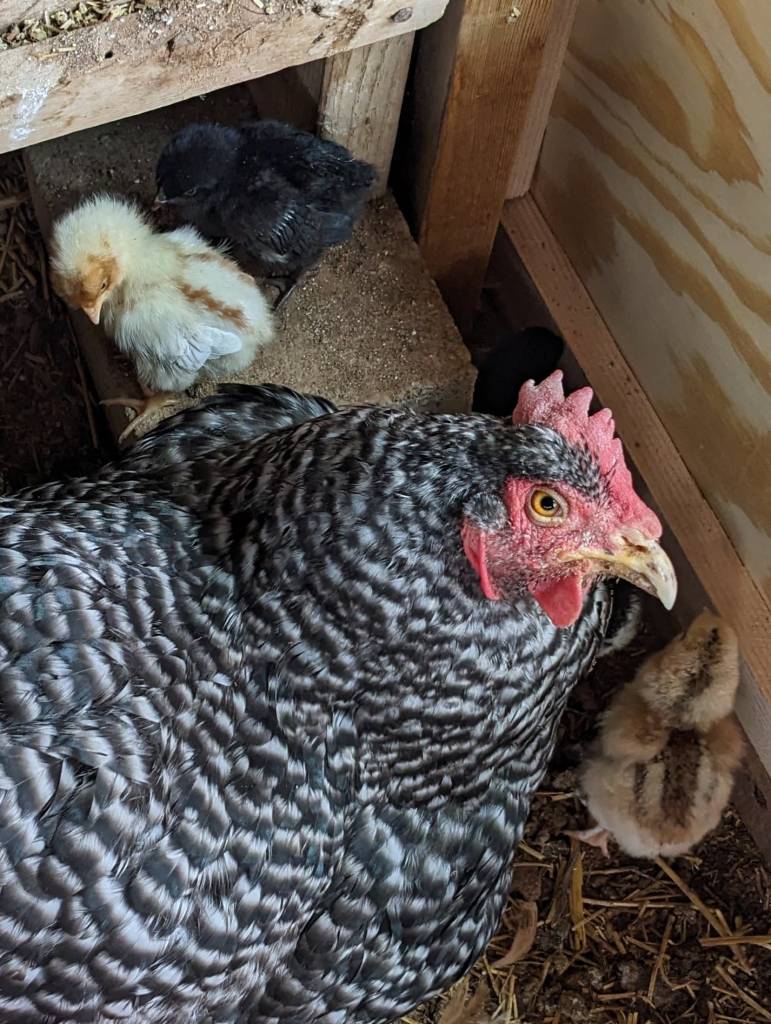
Jeff has had chickens for years and one of her hens recently hatched two rooster chicks.

“I felt badly that only two of her eggs hatched,” Jeff says, “so I ordered four baby chickens and snuck them under her in the middle of the night. When she woke up she thought she had six babies.”

Mama and chicks.

Jeff manages to care for her husband, her grown children and grandchild, her turtles, dogs, and chickens, all while producing great amounts of great art. And enjoying life with a big laugh throughout it all.

the FUTURE’s so bright

In between sculpting, painting, ceramic projects, building “sheds,” assisting her father, encouraging other artists, tending to her animals with lots of love and caring for her extended family, Jeff has begun experimenting with making jewelry. She took a course in college and has now taken a local refresher course.
“I made four silver rings, one with a cabochon, and then came home and made turquoise rings,” she says of her refresher course experience.

Jeff plans to grow her jewelry-making skills while also pursuing participation in local art shows and maybe getting her work into a gallery in Cave Creek, a popular western-themed town near Jeff’s home.

“At this stage of my life,” Jeff says, “I’m comfortable because I don’t need the money. If money comes, that’s good. But I don’t make art for the money. If I was doing it just for the money, I simply would not be doing it. There’s something deeper than financial gain for me.”

Hear, hear!

And there’s something deeper for the folks lucky enough to experience Jeff and her art… in all its many forms.


RESOURCES

Website: jeffcaroldavenport.com
Instagram: @jeffcaroldavenport

JoAnne Meeker, Painter

JoAnne Meeker returns to painting 50 years later!

From Painter to Illustrator to Photographer and back to Painter

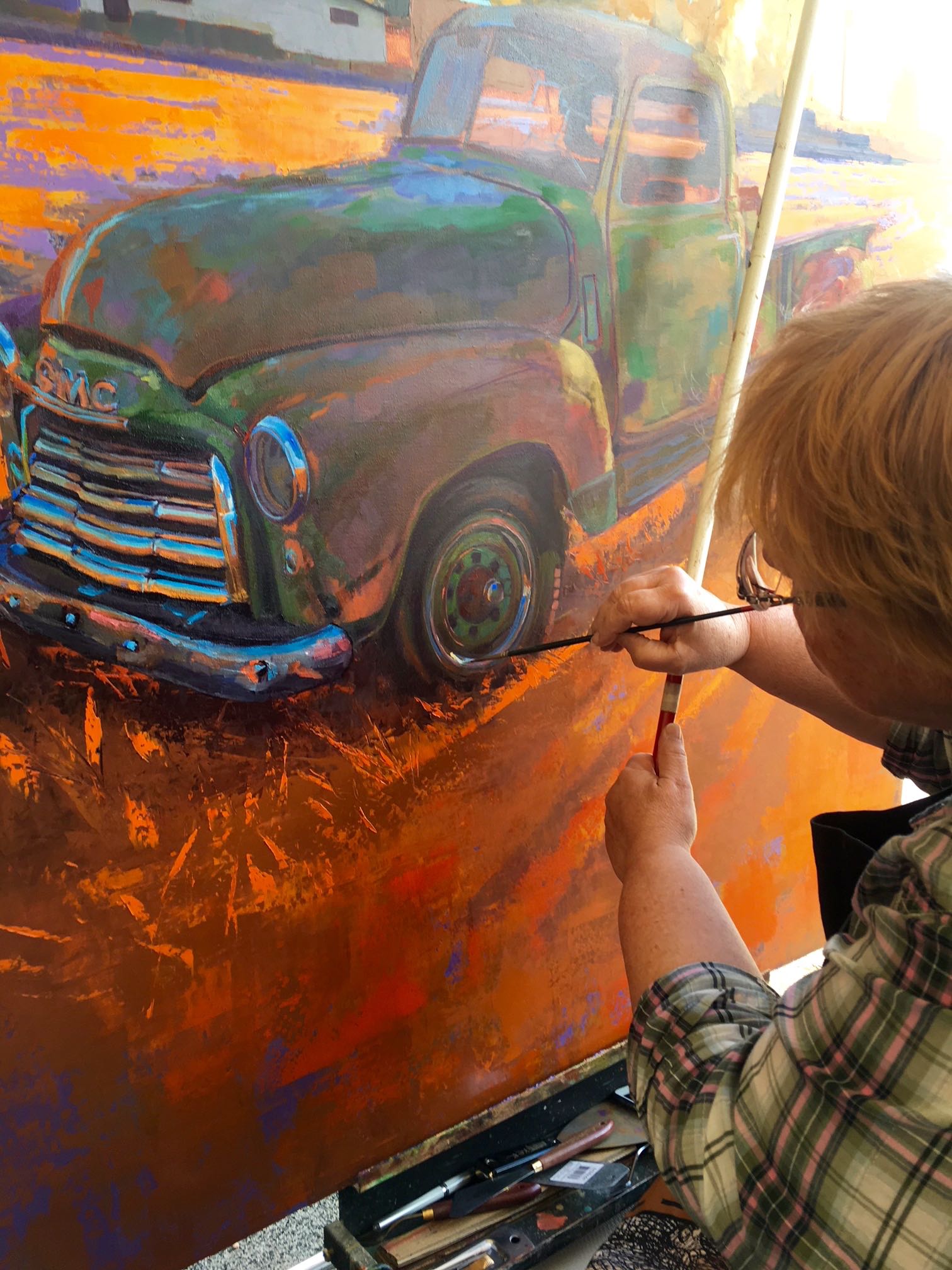
JoAnne Meeker, at 60, has the fresh-scrubbed face of a teenager, complete with a freckle-splashed nose and enough youthful ambition to take on oil painting after a professional career as a photographer and advertising agency owner.

IMG_3141

JoAnne proves we can reinvent ourselves at any time, as long as we’re willing to study, work hard and make mistakes. She began her training as a painter at the age of 11 in Destin, Florida, with private lessons and her mother’s encouragement.

“I always knew I’d be an artist,” JoAnne says. “And more specifically, a painter.”

Now, she’s picked up brushes again and is seeking her groove.

arizona-tags 9 x 12
Arizona Tags, 9 x 12 inches, oil on canvas

“Learning to paint is like learning a new language,” JoAnne says. “I’m trying different techniques, which often feel awkward, just like learning new words and pronouncing them wrong. People might laugh, but I keep going.”

After attending the University of Kansas School of Fine Art, the Kansas City Art Institute and the Art Institute of Southern California, JoAnne started her career in advertising as an illustrator in her 20s. She moved to California to be in the movie business. When that didn’t pan out, she started her own design agency at the age of 26 and called it “Kaos & Harmony.” Her firm specialized in marketing for the retirement industry.

Turquoise Beauty
Turquoise Beauty, 35 x 38 inches, oil on canvas

As Art Director, JoAnne would visit retirement communities and scout out photographic locations and angles in advance, so the real photographer could step right in and get to work. Her photographs, shot as prototypes, were actually good enough to be the real thing, so she began photographing more projects for her clients.

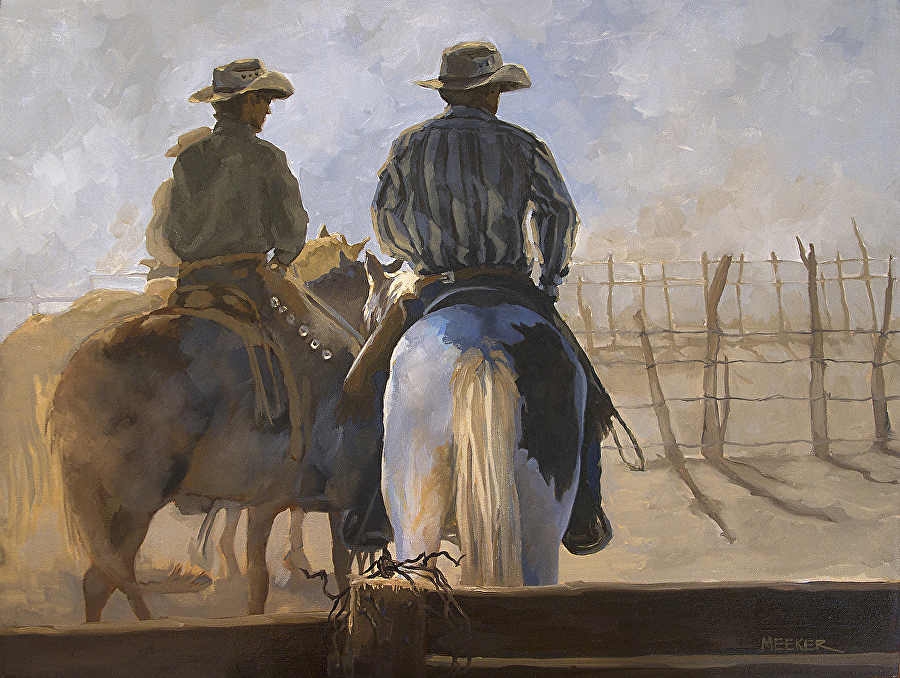
In 2001, JoAnne transitioned back into the arts as a fine art photographer. For 15 years, her cutting-edge photography broke new ground in capturing the western lifestyle… because she saw the world through the “eye of a painter.”

Established Western photographers began copying her style!

sparky
Sparky

In 2015, JoAnne transitioned back to her roots as a full-time oil painter. She is studying with renowned Wildlife painter Greg Beecham, Landscape painter Phil Starke and Equine painter Adeline Halvorson.

“When I wanted to get back into painting,” JoAnne says, “an old man told me I’d be miserable and frustrated. He was right. When I started painting again two years ago, it was frustrating. I tried to draw and it was awful. I had to regain eye-hand coordination after doing illustrations with a mouse on a computer my entire career. During my first workshop, I was embarrassed. It’s taken a lot of work and time to find my own style.”

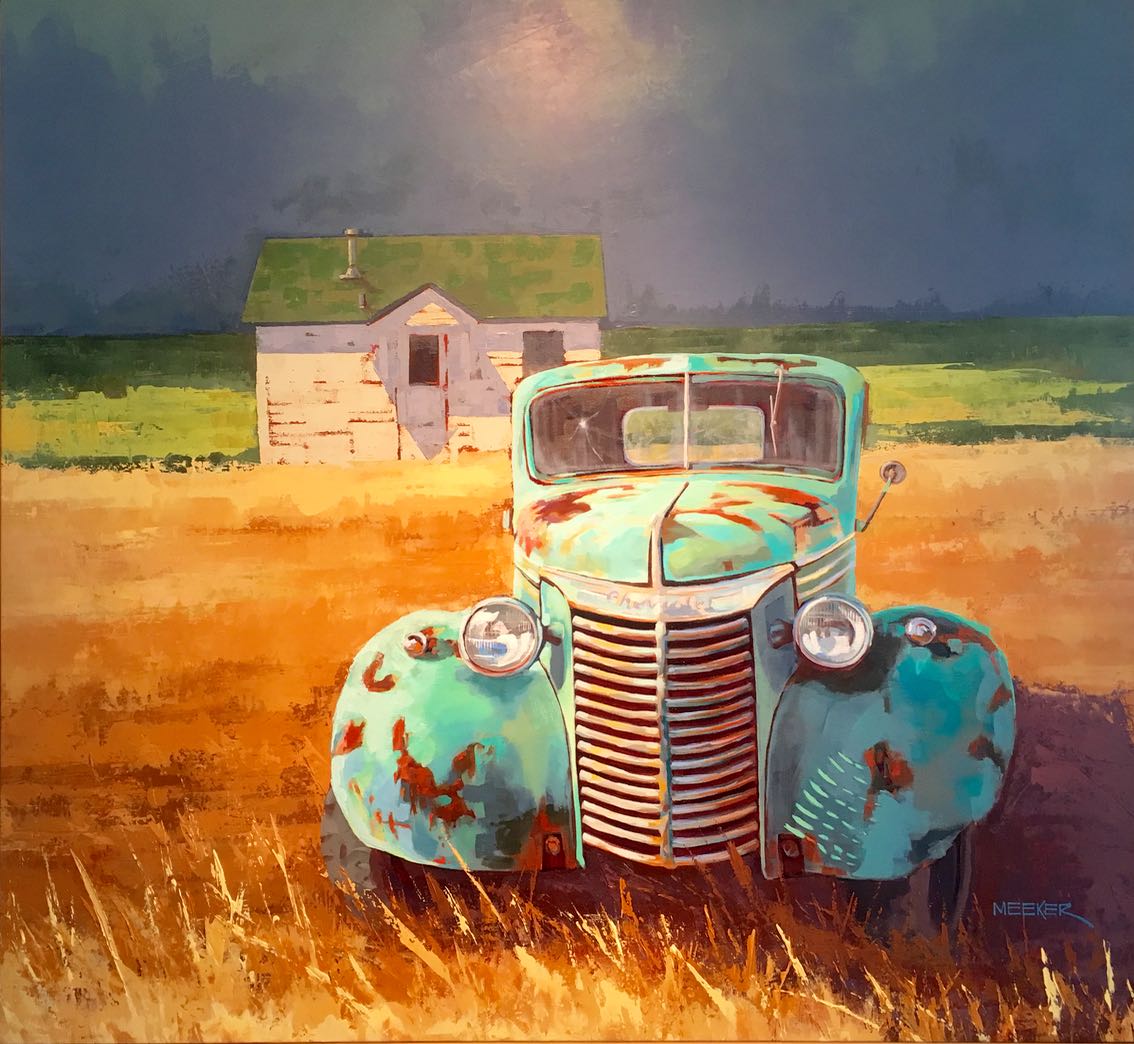
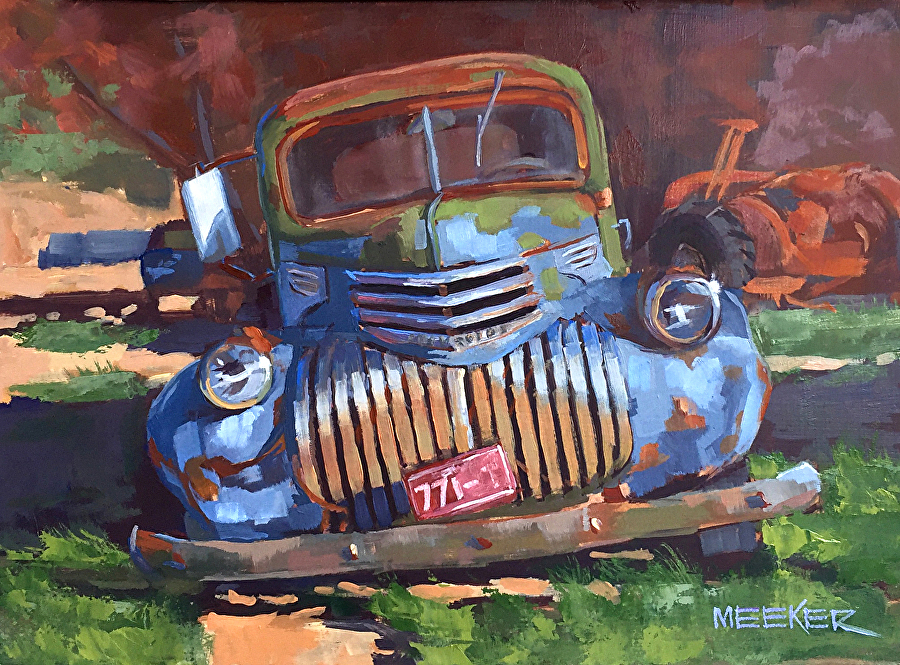
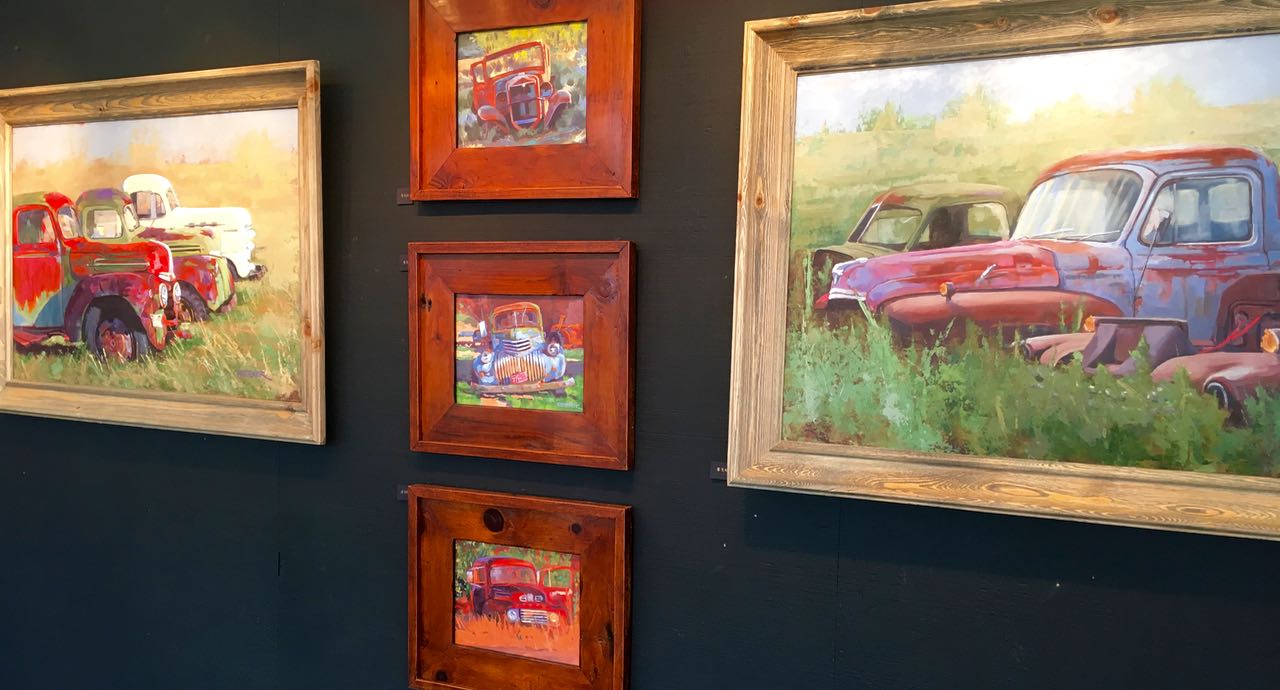
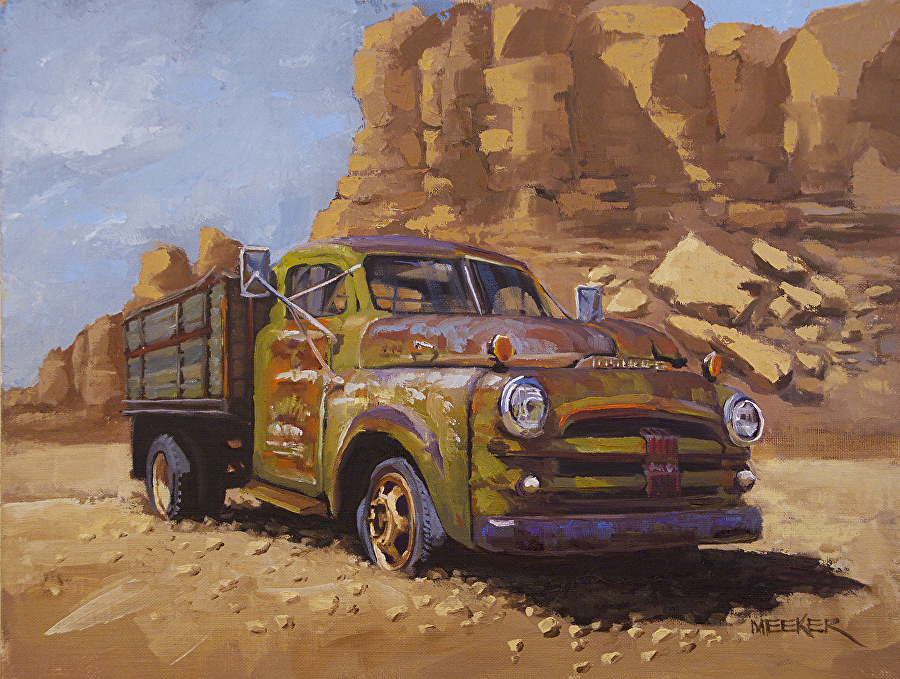
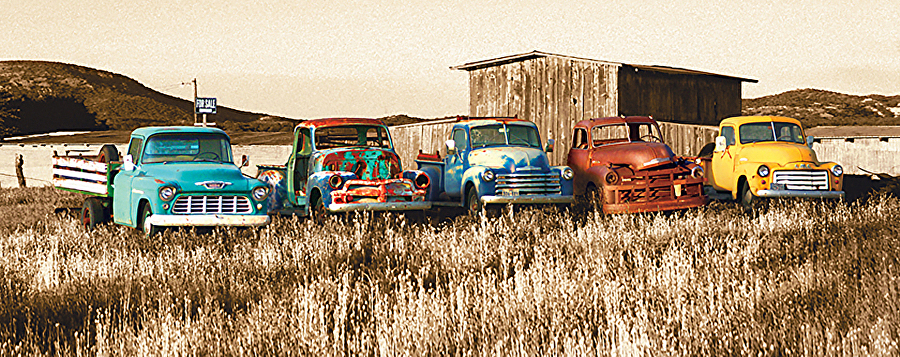
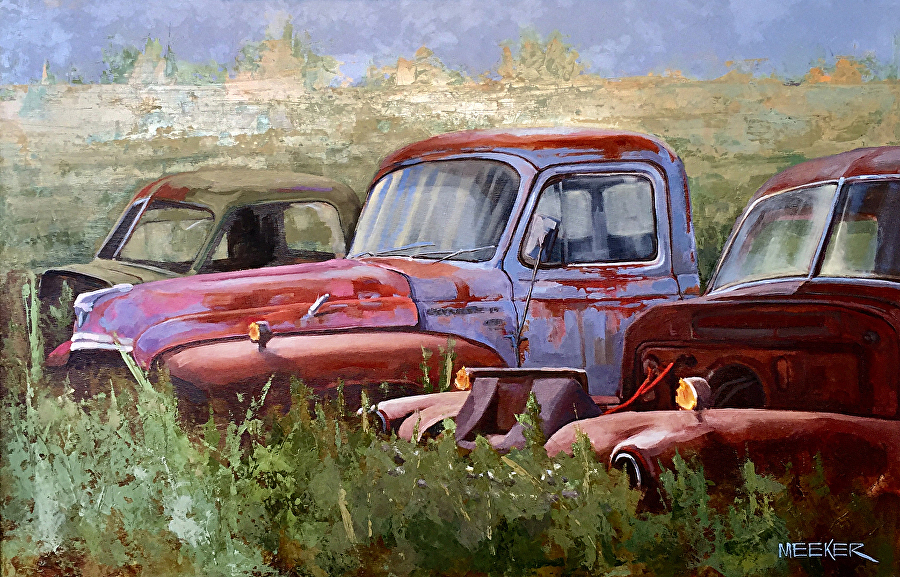
As a natural cartoonist and animator, JoAnne loves to create characters. Her favorite subjects these days, however, are dilapidated trucks left rusting in fields all across the west.

stolen-car 8 x 10
Stolen Car, 8 x 10 inches, oil on canvas

“I used to paint portraits of people and animals,” JoAnne says. “Now I paint portraits of trucks. They’re classics with a life of their own and a unique story to tell. I like to imagine who owned each truck, where they lived and how they ended up abandoning the truck.”

JoAnne finds most of the trucks she paints on the road. She divides her time between Dubois, Wyoming, near Yellowstone, and Scottsdale, Arizona. She spent the winter of 2018 in Scottsdale, Arizona, as an artist exhibiting at the Arizona Fine Arts Expo, which runs from mid-January to the end of March every year. This was JoAnne’s first year at the Expo and she hopes to return next year.


IMG_3134

IMG_3136


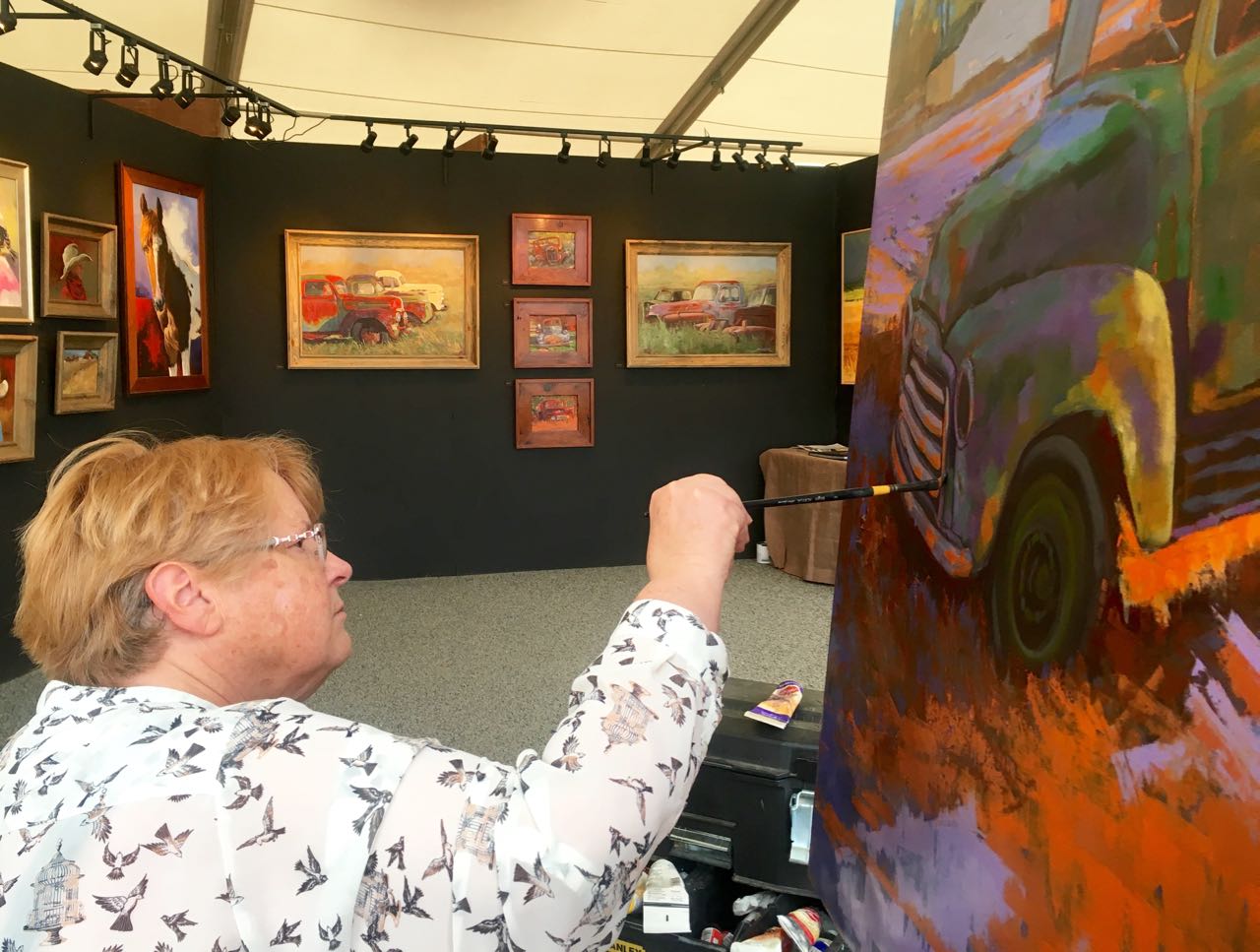
In Wyoming, JoAnne’s art studio is on the second floor of her house with north-facing windows. She also has a workspace downstairs and a Giclee printer that produces works up to 44 x 90 inches.

When JoAnne retired in the late 90s from her design agency at the age of 40, she went to Europe. In Italy, she rode a horse through a marble mine, the first time she had ever ridden a horse and she was instantly hooked, though her love of horses actually started when she was a child.

simon-says
Simon Says

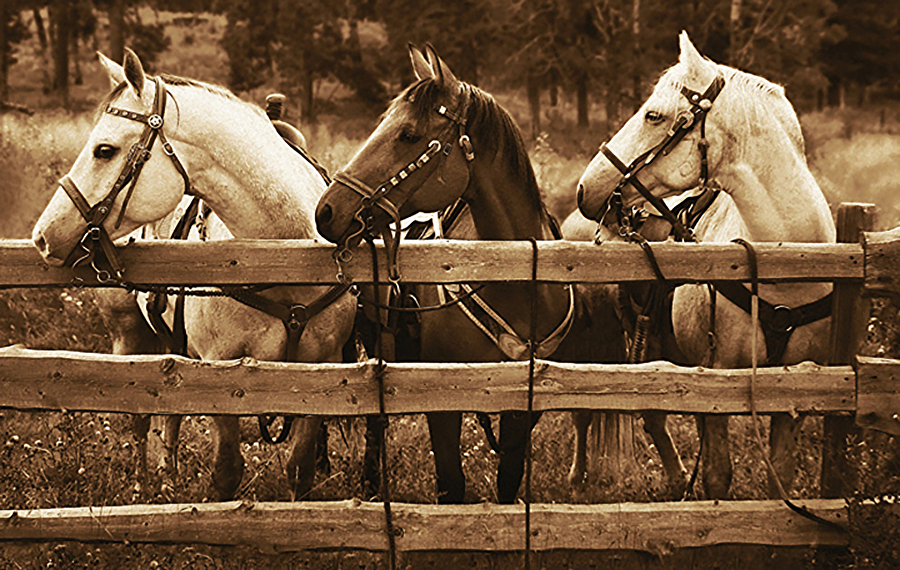
A Cape Cod city girl with an air force pilot as a father, JoAnne wanted to be a country girl living on a ranch. Every Christmas she asked for a horse but it just wasn’t practical to own a horse and move so regularly; JoAnne attended 15 elementary schools between the first and sixth grades.

“After riding the horse in Italy, I began wondering how I could make a living riding a horse,” JoAnne laughs.

She eventually owned a horse and bought her own house in the wild country of Wyoming.

On a trip to a ranch in New Mexico, JoAnne spent a day photographing the branding of the ranch’s cattle. She printed the photos on really big canvases, when folks weren’t doing that yet. Her printed photographs sold well.

blue-bonnet-longhorn
Blue Bonnet Longhorn

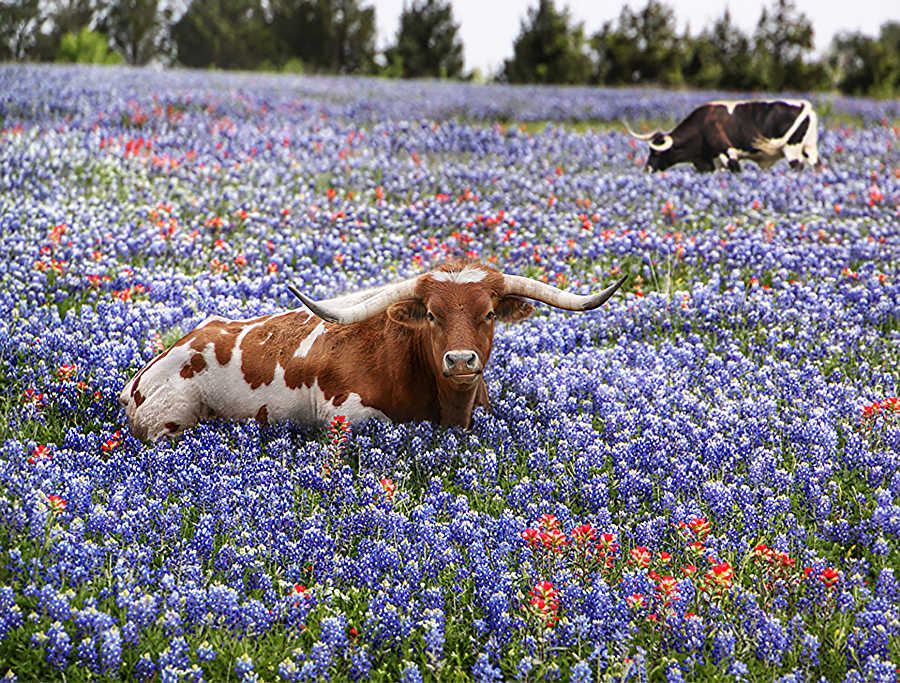
That’s when she knew the Western lifestyle would be her photographic genre. At art shows in Calgary and Texas, where the oil industry was strong, her work was in high demand. Between 2012 and 2014, oil was doing so great, overnight millionaires were building big houses with lots of wall space to fill with original artwork.

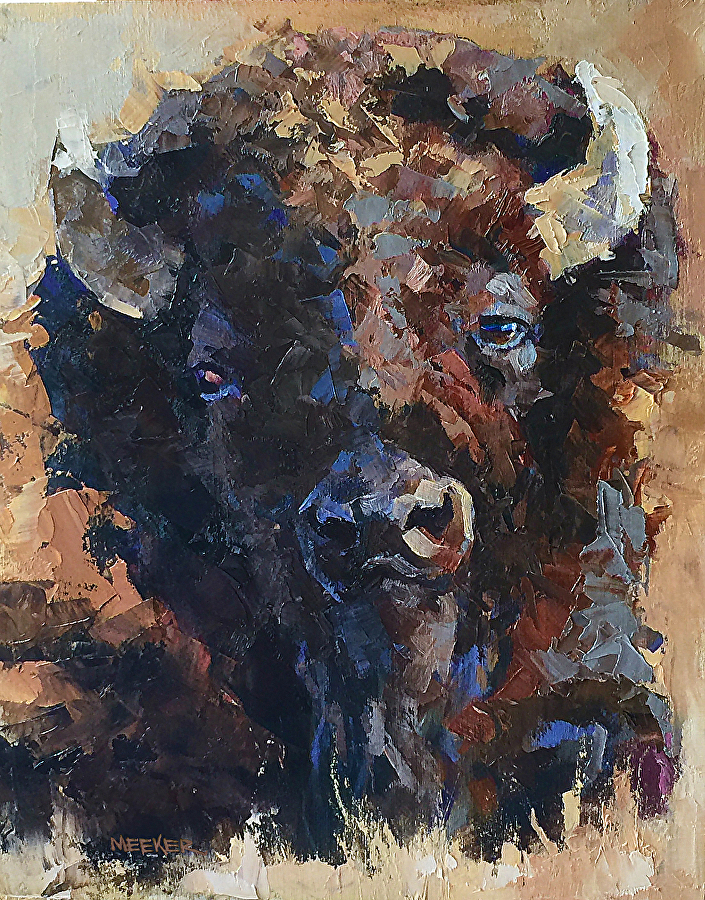
bison 8 x 10
Bison, 8 x 10 inches, oil on canvas

FORMAL ART STUDIES

JoAnne received a scholarship at 16 to attend art school. Back then, they used live models, and on her first day, a live male model was on display. She could barely look at him. Later, when she went to art school in 1976-77, she learned about the Law of Chance, as depicted in Jackson Pollack’s method of slinging paint.

“The instructors had students shredding brown paper for two weeks. It was monotonous and didn’t teach us art. When the shredding was done, the fragments were dropped from a high spot and left where they randomly fell. That wasn’t art! I wish they had taught me to paint instead.”

in-the-pen 18 x 24
In the Pen, 18 x 24 inches, oil on canvas

JoAnne believes painting can be taught. Some people may have a natural ability, but it takes practice for everyone.

For aspiring artists in the Phoenix, Arizona, area, JoAnne recommends the Scottsdale Artist School. Students can study with specific artists, according to their preferred genre. Additionally, twice a week they hold an open studio with a hired model and students can sit in and paint or draw.

JoAnne has successfully reinvented her art persona several times. But she also learned that reinvention doesn’t mean reinventing techniques. Learning from others is key.

“During the Expo, I was inspired by the creative environment, and being surrounded by artists of every medium. I welcomed their coaching. And painting every single day helped me advance my skills. Anyone wanting to improve as an artist can’t go wrong by painting every day, being open to suggestions from other artists and actually seeking out the company of other artists.”

reliable - 11 x 14
Reliable, 11 x 14 inches, oil on canvas

JoAnne’s next reinvention of herself? She wants to get into plein air painting, and in a big way. She wants to go to France and Italy and paint plein air like the impressionists.

“I love it when I try to do something and it turns out exactly like I wanted,” JoAnne says.

Awards & Recognition

  • 2016 Feature Poster Artist, San Antonio Stock Show and Rodeo
  • 2015 Feature Poster Artist, San Antonio Stock Show and Rodeo
  • 2014 Feature Poster Artist, San Antonio Stock Show and Rodeo
  • 2014 Best of Show, San Antonio Stock Show and Rodeo
  • 2013 Feature Poster Artist, San Antonio Stock Show and Rodeo
  • 2013 Commission, 100-page book “The Life is Art – A Photographic Journey of Ranching in Western Alberta”
  • 2012 Feature Poster Artist, San Antonio Stock Show and Rodeo
  • 2010 Feature Artist, Rodeo Austin, Texas
  • 2009 Best of Show Artisan, Western Showcase – Calgary Stampede, Alberta Canada

Resources

Website: http://jmeeker.com/

Photo Gallery

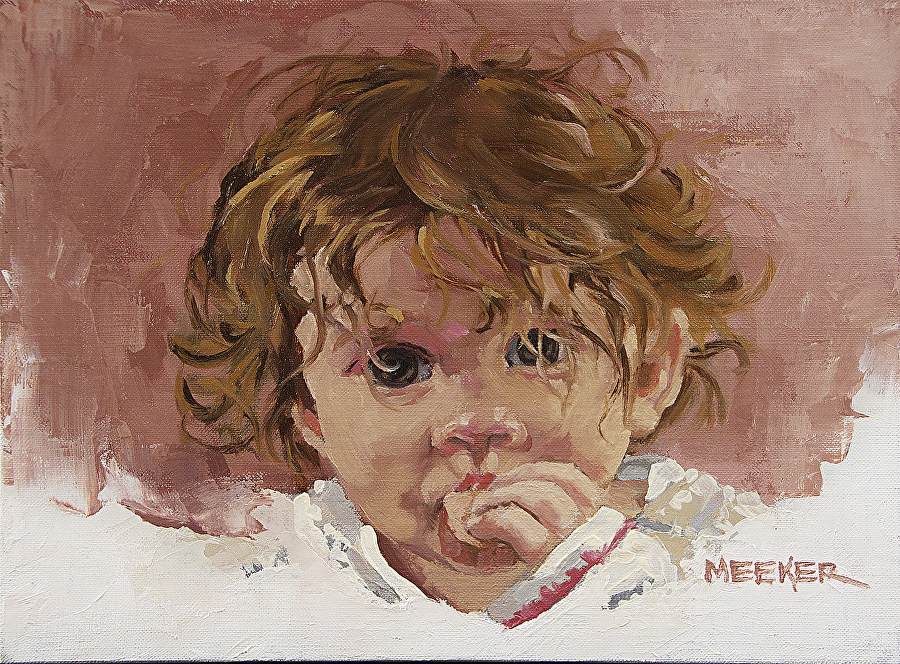
IMG_3159

sadie-commission 9 x 12
Commission, 9 x 12 inches, oil on canvas

OLYMPUS DIGITAL CAMERA
Classical Gas

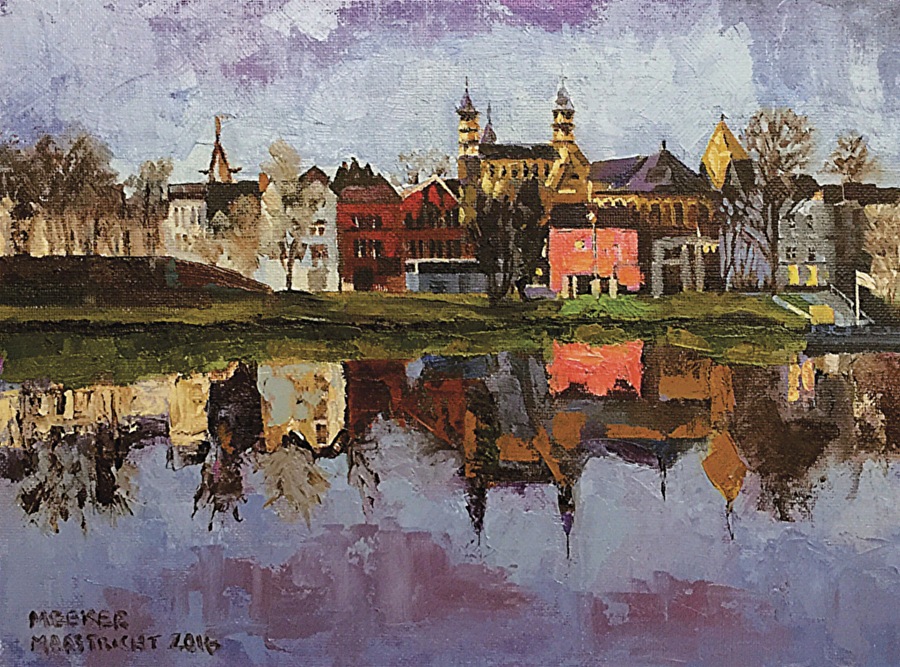
maastricht 9 x 12
Maastricht, 9 x 12 inches, oil on canvas

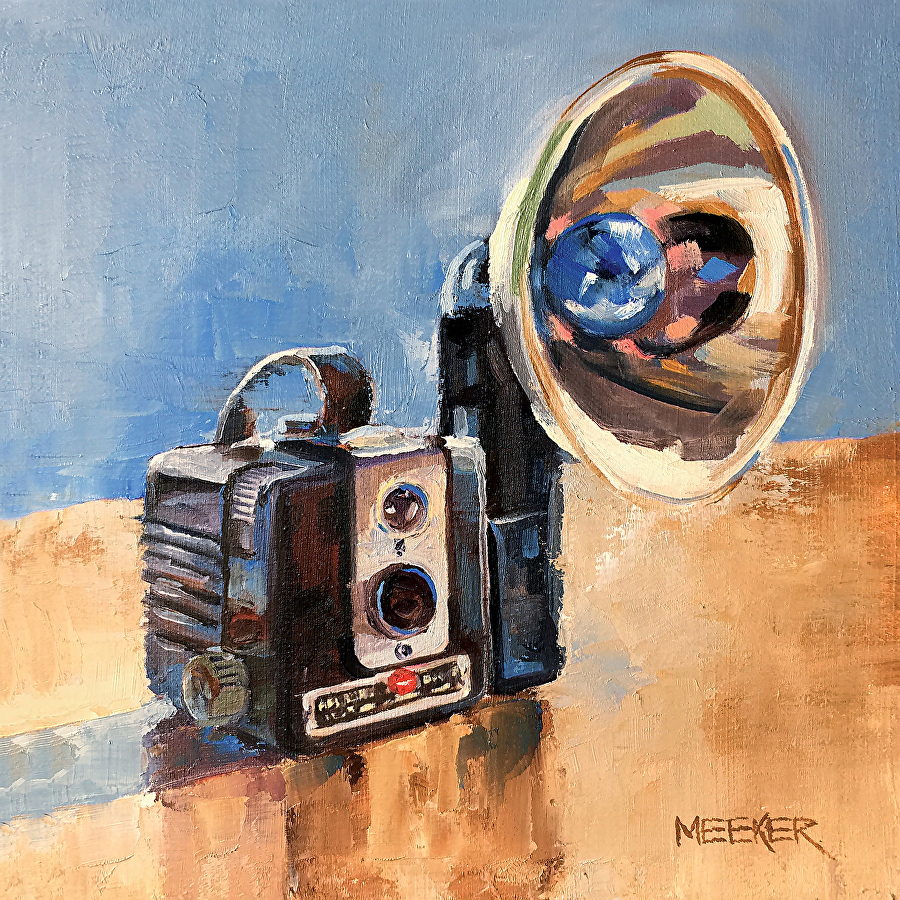
brownie-hawkeye 8 x 8
Brownie Hawkeye, 8 x 8 inches, oil on canvas

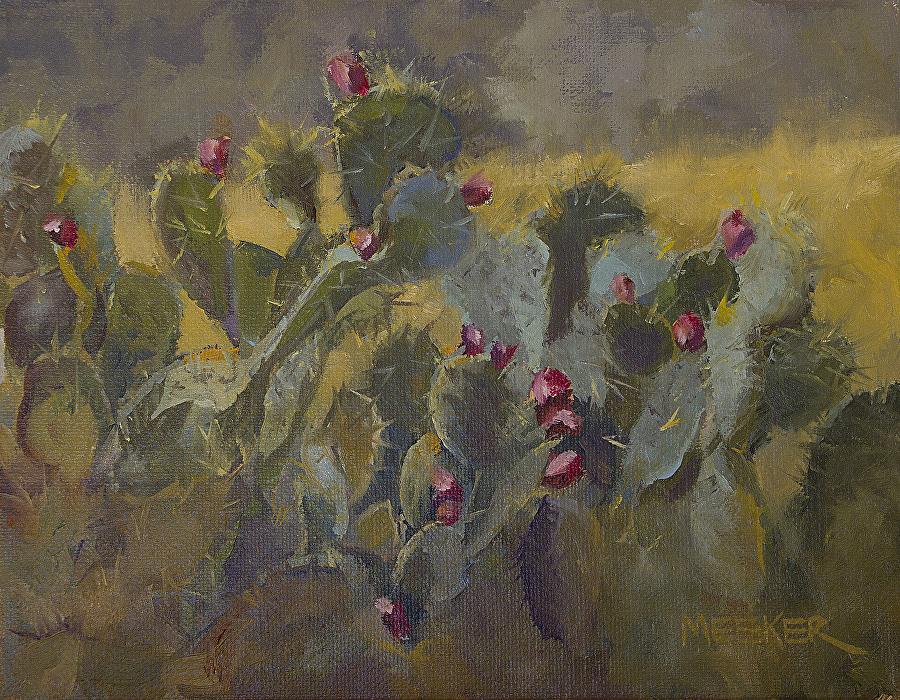
prickly-pear 8 x 10
Prickly Pear, 8 x 10 inches, oil on canvas

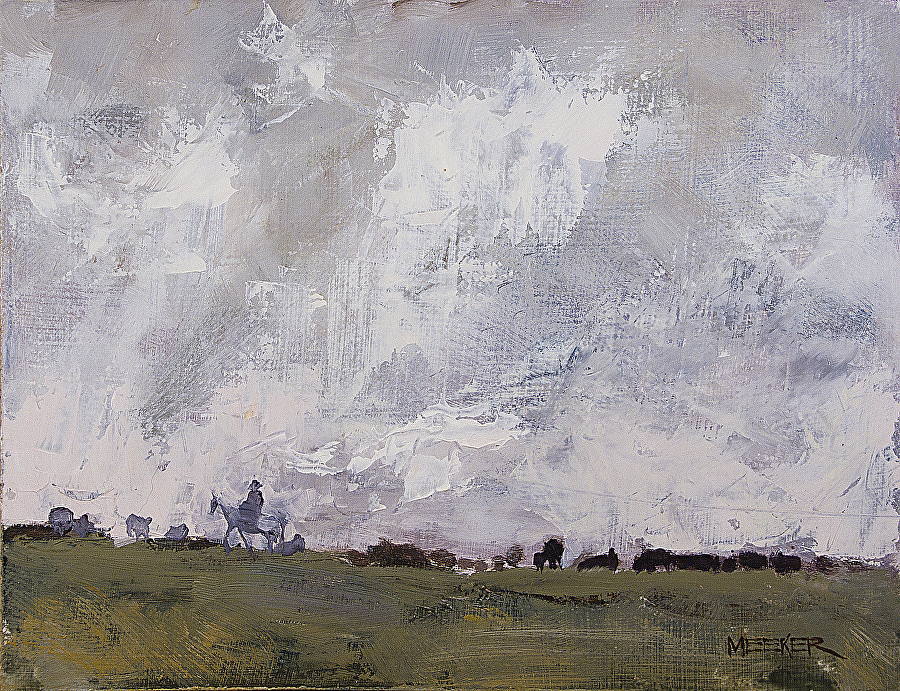
moving-cows 8 x 10
Moving Cows, 8 x 10, oil on canvas

domesticated 24 x 36
Domesticated, 24 x 26 inches, oil on canvas


Dominic Bourbeau, Painter

Dominic car

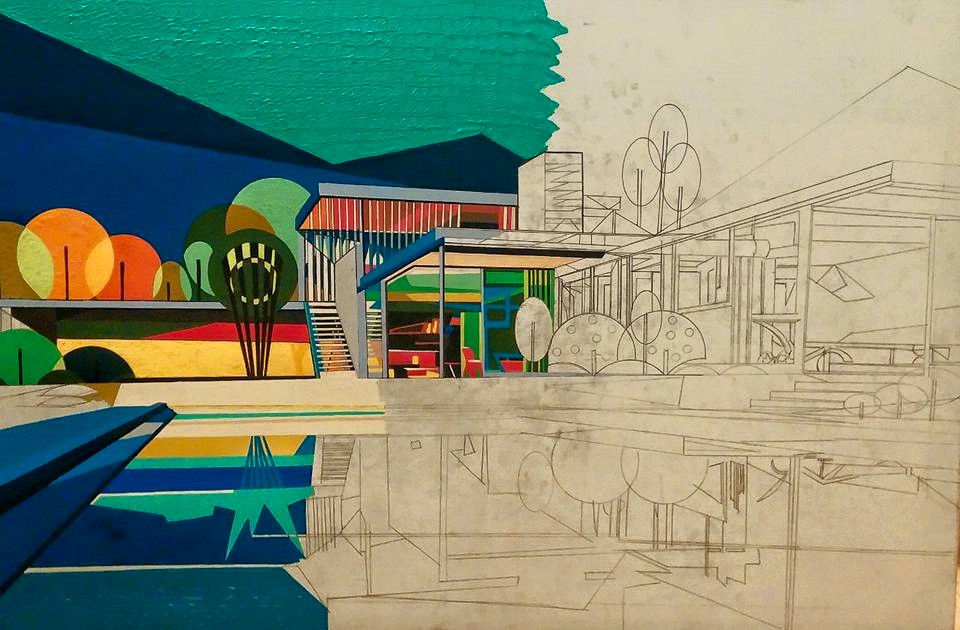
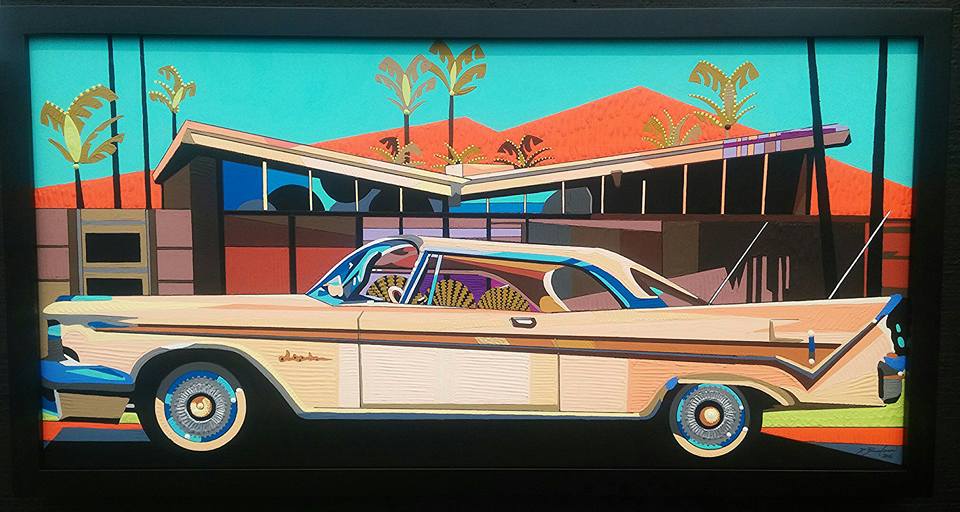
Mid-Century Madness

Dominic Bourbeau doesn’t realize what a great painter he is.

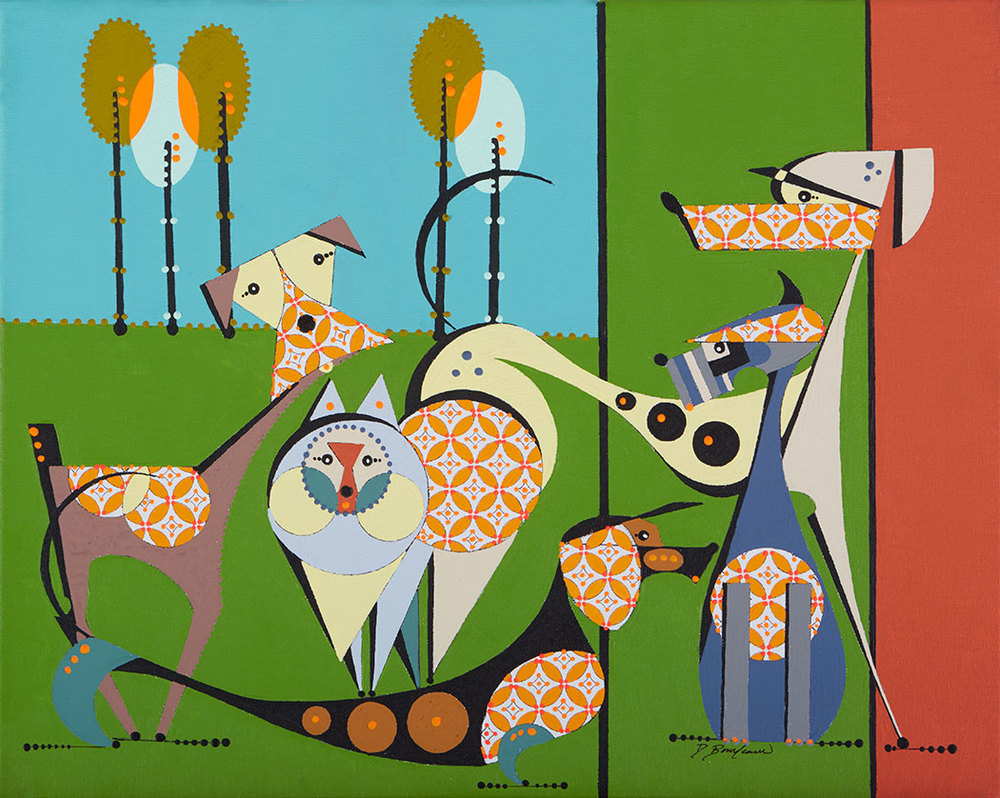
Soft-spoken, Dominic is Minnesota nicer-than-nice. His unassuming nature shows up in his humble view of his work, which is colorfully geometric and stunning.

During last year’s Arizona Fine Art Expo in Scottsdale, Dominic’s artwork was tucked into a corner with little traffic flow, but I saw his work and was stopped cold by it.

Dominic+Bourbeau2

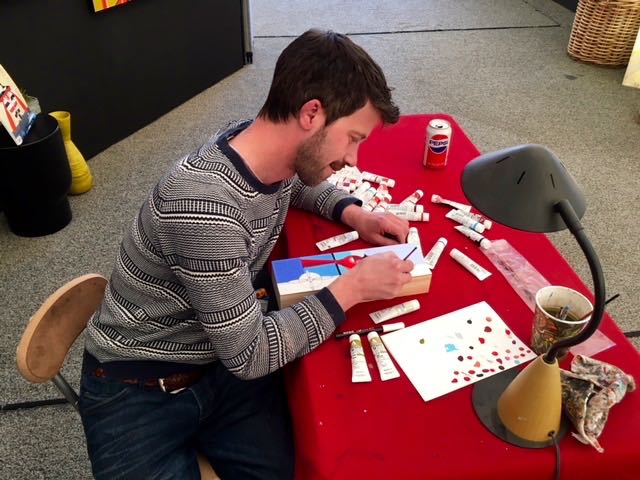
In fact, his mid-century modern-style paintings intimidated me. How do you approach a genius? Especially one who is always painting, canvas lying flat on the table, head down? But it turned out that Dominic is highly approachable and generous with his time in explaining his supplies and techniques.


IMG_3099


At this year’s Expo (January to March 2018), Dominic’s booth was in a high-traffic area near the cafe so his wall of art could be seen from the main hallway. Again this winter, Dominic kept his head down and painted constantly, but was as approachable and responsive to visitors as ever.

Dominic+Bourbeau+4

Hopefully, after hearing so many folks see his art for the first time and say “Wow!,” Dominic will realize how special his painting is.

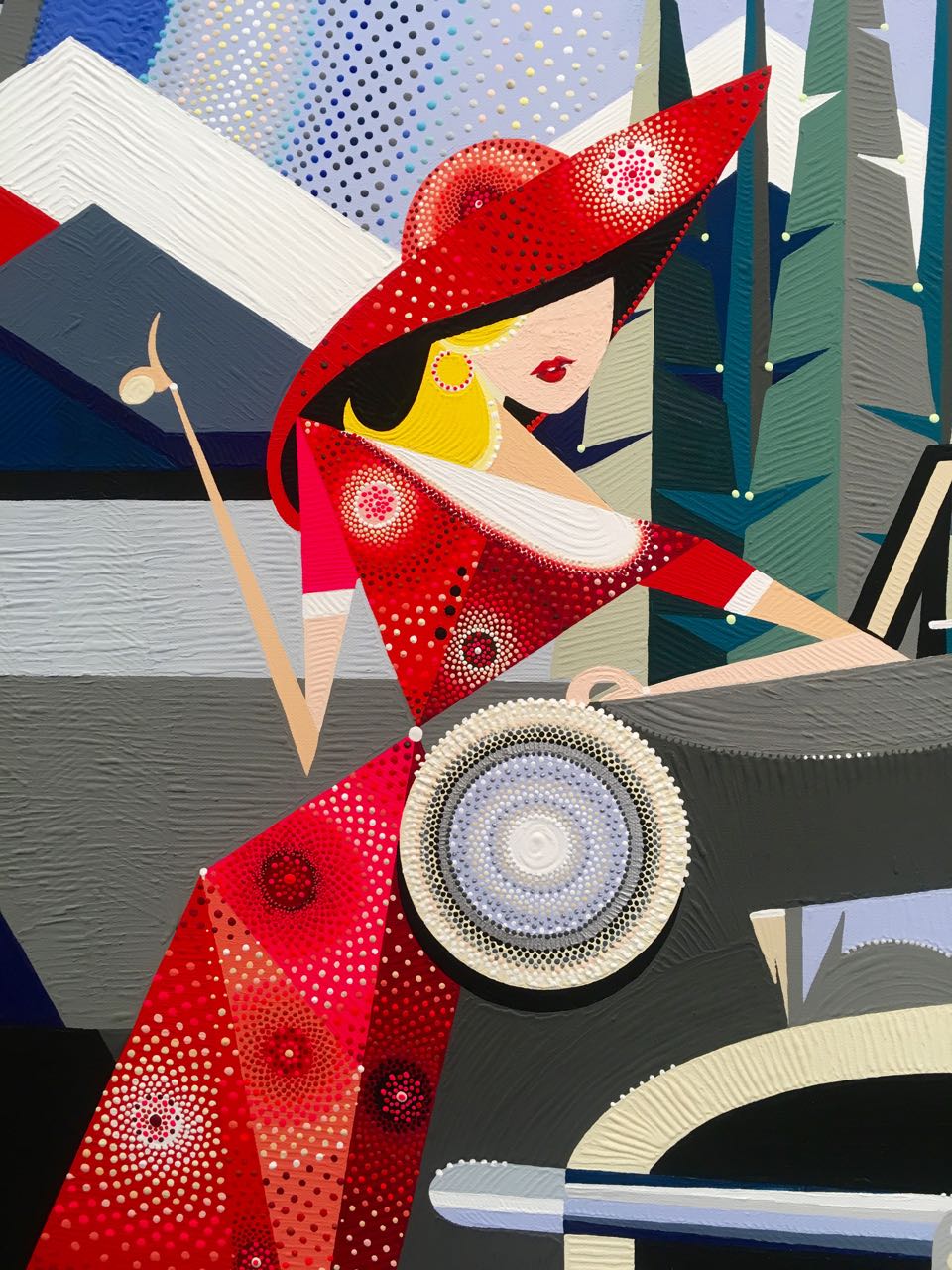
Dominic’s Aubrey Hepburn-esque painting ran on the December 2017 cover of Modern Luxury Scottsdale magazine, and his sassy mid-century portrait of a well-dressed woman in red was used on all the Expo passes.

Scottsdale mag cover

During the Expo, Dominic had to paint all day, every day, seven days a week, because everything he hung on his booth wall sold. Instantly.

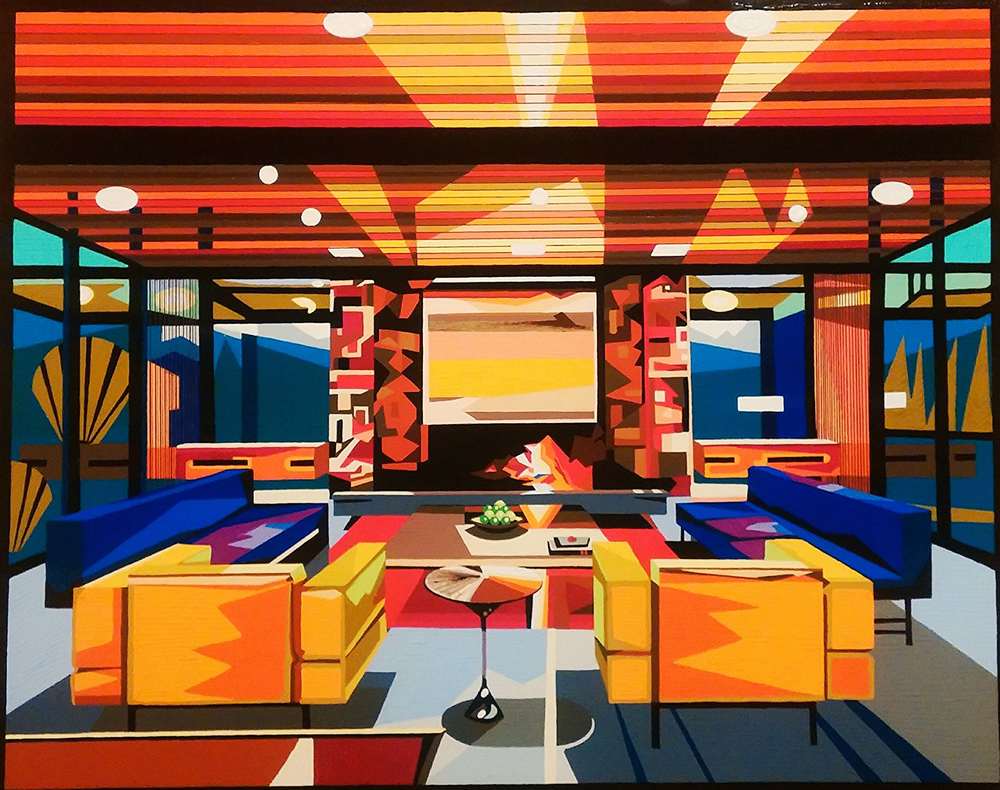
Or, he was asked to paint one of his classics, like Frank Sinatra’s Living Room, five times. Maybe six. Maybe seven.

“This was the year of commissions,” Dominic says, laughing. “I finally lost count.”

Luckily, not every client wanted to take possession of their painting before the Expo closed on March 25, allowing Dominic to return to Minneapolis and complete all his unfinished commissions.

One day at Kinko’s in Scottsdale, Dominic was scanning his painting of Frank Sinatra’s Living Room when an architect from Palm Springs saw the painting and asked about it. Dominic told the guy he painted it and the man instantly pulled out his check book and commissioned the painting for his home.

“That was unbelievable,” Dominic says to me the day it happened, and he’s shaking his head, like it shouldn’t have happened.

But it’s totally believable that someone saw his artwork and instantly wanted it. Dominic’s style is infectious.

IMG_3103 (1)

His brother, Martin Bourbeau, is also an artist at the Expo. Martin uses cake frosting tubes to pipe paint onto magnificent landscapes on huge canvases, layering and layering the lines of paint to create 3-D art. They’re gorgeous and impressive and expensive.

Domnic women cats

“I originally struggled with how to price my paintings,” Dominic says, echoing every other artist. Pricing is always tricky. With advice from his fellow artists, Dominic has charged slightly more for his work lately, particularly when a subject is selling well, but psychologically it’s still hard for him to increase his prices.

Dominic House

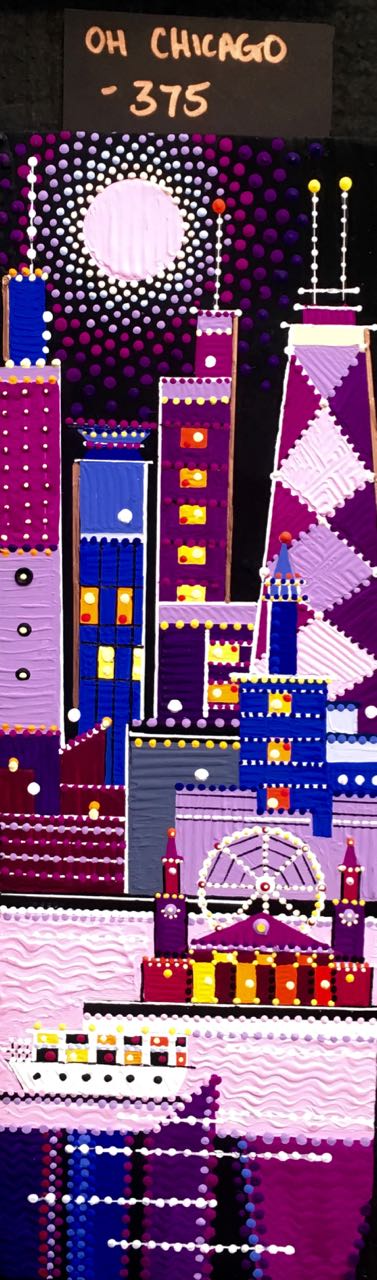
This winter, he began to paint cityscapes depicting well-known landmarks, making them smaller than his usual paintings, and they all sold.

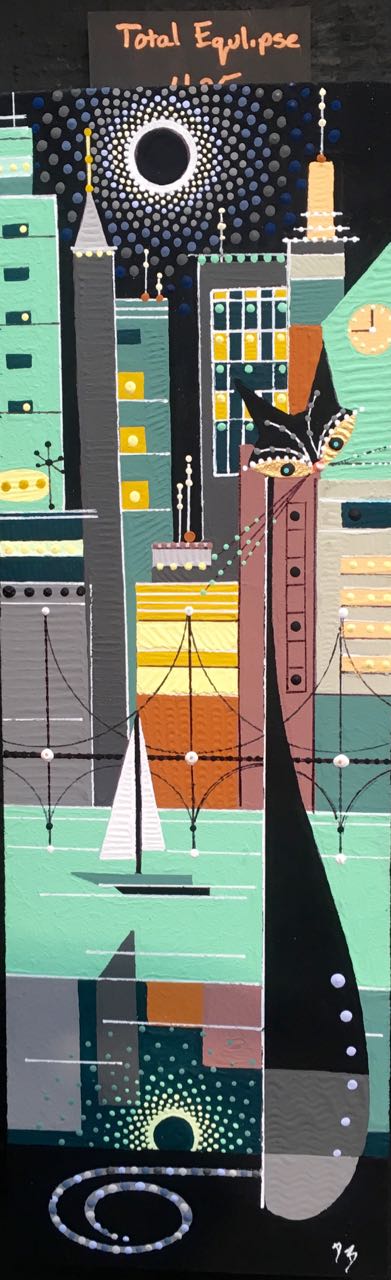
He painted a cat, then more cats, and the paintings sold before he could even hang them on the wall.

IMG_3101 (1)

Gouache is Dominic’s medium of choice. Pronounced “gwash,” the medium is another type of watercolor, though it remains opaque rather than translucent and it dries matte. It’s fitting that Dominic uses Gouache because the medium was first used in creating Medieval Illuminated manuscripts and then became popular with French and Italian painters in the 18th century.

Also, before digital design, gouache was commonly used by Mid-20th century commercial artists because the medium made crisp images and letters possible, and it photographed well.

“I draw out the design in pencil, sketch over it in pen,” Dominic says, “and when all the details are done, I’ll start painting, which is the fun part.”

He smiles big.


11781756_882802348465594_5254602029413689313_n

Blue House complete


His technique is to texture different blocks of color by adding wavy or squiggly lines, or dots. His dots are amazing and appear to be machine-made, but he produces each one with absolute focus and precision.

While attending a boarding school in Michigan, Dominic studied iconology and followed the tradition of mixing his own tempura paints, including using a beetle to produce red.

IMG_3057

In Iconology, every line has a purpose, nothing is used simply for the sake of being ornate. The strong geometry and symbolism of iconology are present in Dominic’s style.

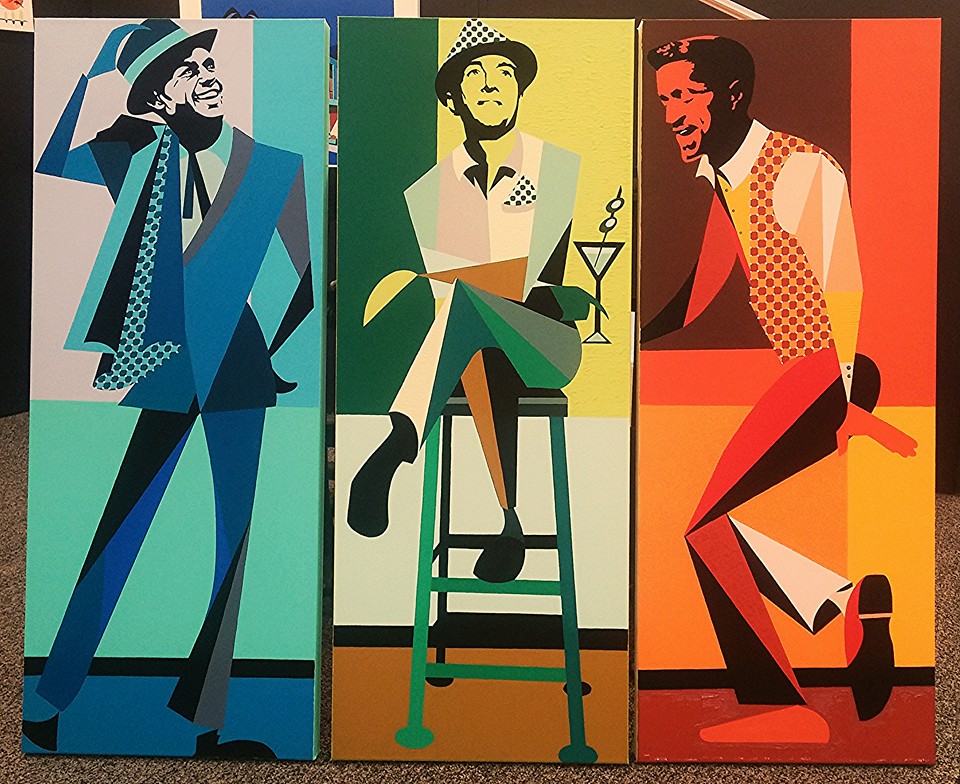
Rat PackDominic’s artistic experiences also include throwing pottery, drawing portraits and painting murals for Shakespearean stage sets. He greatly admires artists such as Eames, Frank Lloyd Wright and Charley Harper, and is captivated by their use of simple, yet bold, design based on sophisticated, yet minimalist, geometry.

“I was able to pull from each of my past artistic experiences a segment of its beauty and technique,” Dominic says. “The geometry of iconography, the simple shapes of pottery, the puzzle-like composition of stained glass windows, the details of a portrait drawing, and the intensity especially in color of a mural painting.”

Dominic+Bourbeau+6

Frank Sinatra’s Living Room

Dominic, at 38, is the oldest of 11 children.

“All eight boys are artistic,” Dominic says. “My three sisters are not artistic. One brother, Peter, has a Master’s in Art and teaches art in a boarding school.”

Their mother, a school teacher, always brought art projects home for the kids to play with.


IMG_3104 (1)


Dominic almost completed his Master’s in Art, so he could teach, but decided against teaching when he noticed students were using it as an elective and weren’t serious about learning.

Instead he got a degree to be a Surgical Technician and for 12 years now has specialized in assisting orthopedic surgeons in mostly hip and knee replacements.


98c07f21b72aea6e97cb6c1db641ac1d


With his “casual” employment, Dominic is hired to be the personal assistant of a physician and can work when he wants. That’s how he’s been able to take off three months for the last three winters to exhibit at the Expo in Scottsdale. Being a surgical assistant is a great gig; as long as Dominic is attached to a surgeon and keeps his medical qualifications current, he gains seniority in his position with the hospital.

Fours years ago, Dominic’s artistry was discovered by his hospital co-workers when he was drawing on sterile paper towels in the operating room. He then received commissions to create pen and ink portraits of his colleagues’ kids and families, or portraits of pets wearing sunglasses. Dr. Santos, a co-worker, asked Dominic to create anatomy illustrations for a book, including sketches of a spine and spinal implant.

At home in Minneapolis, Dominic paints in his kitchen, which does double-duty as his art studio.

Dominic is on his careful way to ultimately making a living solely as an artist.

In the meantime, he keeps his head down and paints for hours every day, in addition to doing all his own marketing and accounting… when he isn’t assisting in surgeries or exhibiting in Scottsdale.

I predict he’ll hit it big one day.

Maybe then he’ll realize just what a great artist he is.

Resources

Facebook: http://www.facebook.com/colbyandfriends/

Photo Gallery

IMG_3123
Detail of painting showing gouache textures

IMG_3113 (1)


Dominic cat couch

Dominic car

IMG_3097

Domini car 2

IMG_3122

IMG_3121

Caroline Kwas, Painter

Caroline Kwas lives in her RV full-time and pursues her art wherever she lands, connecting with her little families everywhere.

Feisty & Focused

With her high intelligence and private school education, Caroline’s family expected her to be a medical doctor. However, while working on her bio-chem major, she added an elective drawing class and, soon, med school dropped from her horizon.  

Caroline’s father didn’t respond favorably to her new artistic aspirations. She was feisty, though, and found a work-around; moving in with her sister and sticking to her vision of pursuing art.

IMG_0483

Three decades later, Caroline is still just as feisty and still sticking to her vision.

Back then, the father of her childhood friend, Nancy, talked with Caroline’s father and helped him see his way to supporting Caroline’s art studies. She then went to the Fashion Institute of Technology and earned an undergraduate degree in Illustration. She went on to earn a graduate degree in Literacy Education. 

For a while on Long Island, Caroline catered food for fishing boats that would go out for weeks at a time. With four or five boats to cook for, she was gainfully employed and poured her creativity into food preparation.

Eventually, she put her degrees to use teaching Reading and English in New York before moving to Florida to teach corrective reading to seventh and eighth graders.  

“They ate me alive,” Caroline says of the middle schoolers. She was an excellent guide and champion for the students who appreciated her attention and encouragement. Otherwise, she hated the job. Hated it. And she was terribly homesick, so she went back home to Montauk, New York, to teach.

“Unfortunately, I never took any time off,” Caroline says, “and, basically, was committing psychological suicide.” Even painting and exhibiting in weekend art shows wasn’t enough to compensate for the stress. Something had to change. 

IMG_3126 (1)
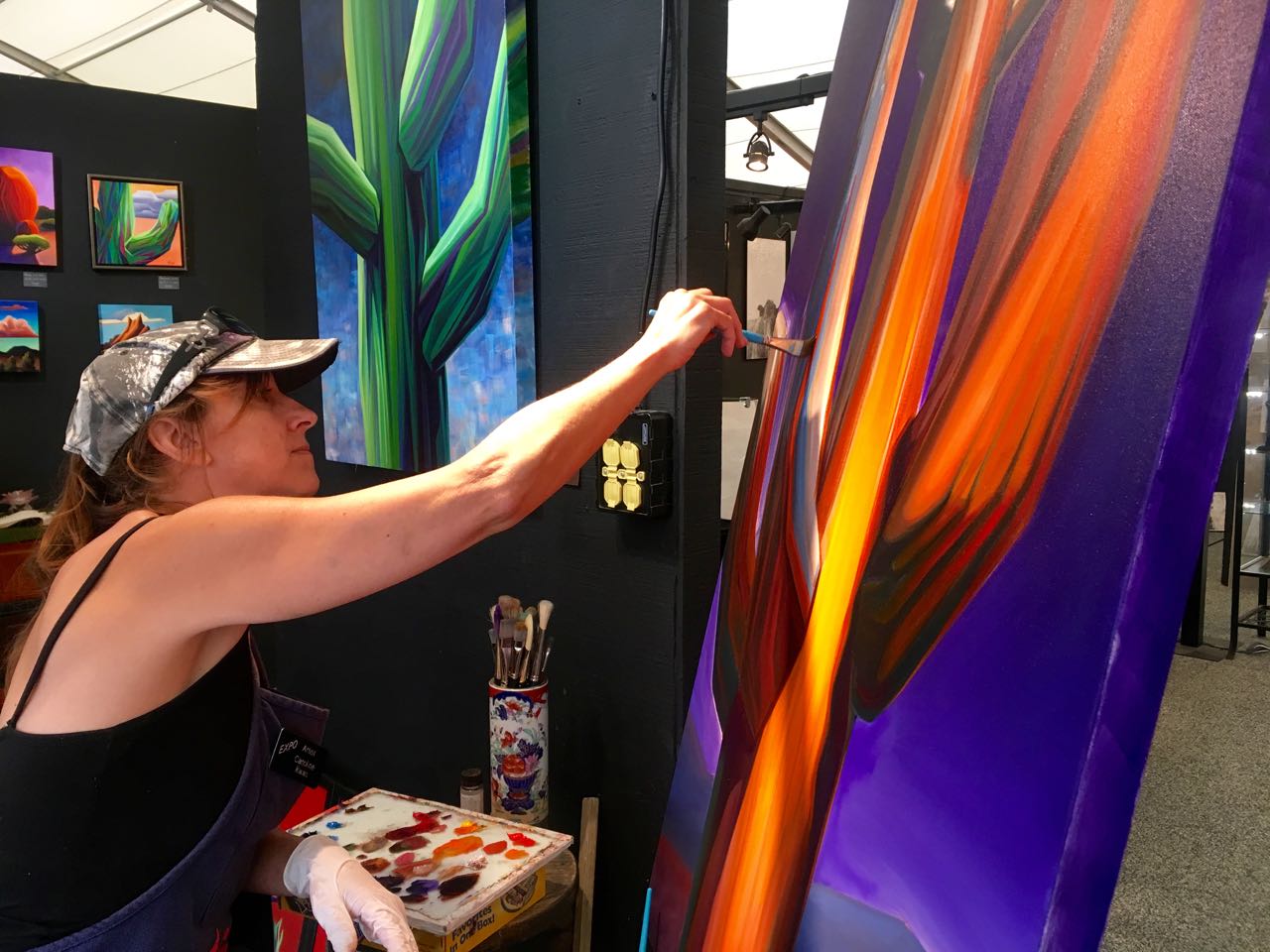
Caroline painting in her booth at the Arizona Fine Art Expo

In 2010, while she was still teaching, Caroline researched art shows for the following spring and found the Arizona Fine Art Expo, an annual juried artist show held in Scottsdale, Arizona, from mid-January through March. She applied, was accepted and resigned from her teaching job around Christmas 2010. The next month, Caroline was in Scottsdale exhibiting in the 2011 Arizona Fine Art Expo. 

By the time she returned to the show in 2012, Caroline had bought a fifth wheel toy-hauler RV pulled by a Chevy diesel dually.

“My boyfriend at the time said I needed a big rig,” Caroline says, making it clear the RV and truck were too much for her handle. In fact, her partner never allowed her to drive her own rig.

When she got rid of the boyfriend, she got rid of the big rig and bought a 29-foot C class Winnebago and a cargo trailer. Now comfortable and perfectly mobile, Caroline began crafting a nomadic lifestyle, spending winters in Arizona and then heading to wherever she chose for the summer.

Caroline & Bubbles
Caroline and Bubbles

For six years, Caroline has lived out of her RV and pursued art. 

In 2012 and 2013, she returned east to work out of her own gallery in the Rocky Neck Art Colony located in Gloucester, Massachusetts. Rocky Neck is the oldest working art colony in the country, having brought artists together for more than 150 years. Her photorealism paintings from that time were influenced by the rocky shores, shells and fallen leaves of New England. 

OnTheRocks-8x11-72dpi-web
On the Rocks, a photorealism painting by Caroline

“The gallery had a loft and that’s where I slept,” Caroline says. “Three times a year we had very high tides and the water would come up to within a foot of my gallery door.”

Every winter, she returned to Scottsdale and the Expo.

Caroline’s nomadic life allows her to be where she wants to be, when she wants to be there and with the people of her choosing. 

“I have little families everywhere,” Caroline smiles.

Her blog posts show her mastery of living full-time in Bubbles, her RV. Friends tease Caroline for only washing her hair in rain water. But why wouldn’t she? It’s free. Yet rain is scarce in the desert. When it does rain, Caroline has her 5-gallon buckets ready. She sets them against the big white tent that covers the Expo and catches the silty water. When the dirt settles, Caroline has rain-fresh hair. 

Sonoran-Sentinel
Sonoran Sentinel

Beyond posting about her life as an RVer, Caroline writes poignant blog posts about her perceptions, seen through the eyes of an artist. A perfect example is her blog post titled Why is the Sky Purple? where she answers the question asked by a bored male patron:

Because when I stood at the base of this giant saguaro two weeks ago and it was lit up by the rising orange full moon, there was more to that scene than a blue-black night sky and a dimly lit cactus. There was a gentle majestic giant in front of me, soaring into a velvet sky, and he deserved to be lit up in gold and crimson like the king of the Sonoran Desert that he is. He needed that deep royal violet sky to complement him, to surround him, and most of all, he deserved a lot of color.

Be sure to read her post about Harry, a magnificent saguaro friend. I won’t give away Harry’s fate, but will share the post’s opening:

Like many people, the saguaro cactus was always the first thing I thought of when I thought about the desert. It’s the epitome of the desert, proud, distinct, and vaguely humanoid. But have you ever thought about the life of a cactus? Go up to a big one around midnight in the desert, and the hair on your arm just might rise a little. They loom there, stark dark silhouettes against a speckled sky, full of silent stories. Consider: for almost a century, it huddled in the shade of an ironwood nurse against the harsh desert summers as it began its life. An inch a year. It began growing arms; it grew into its role as the giver of life in the desert. Quiet centuries are spent keeping sentry over a forbidding landscape, the long shadows of its arms the last to unfold its embrace each sunset. Spend some time walking in the Arizona sun, and you’ll appreciate water. Spend some time walking in the Arizona moonlight, and you’ll understand mysticism.

“Little Girl” is the van Caroline pulls to drive on local errands. Recently, she launched a Facebook page and Instagram account for Little Girl, who narrates the blog and describes life on the road with Caroline from her unique vehicular perspective. Little Girl’s popularity is growing fast. 

14322314_10208761270882576_775431505315879823_n (1)
Caroline and Little Girl

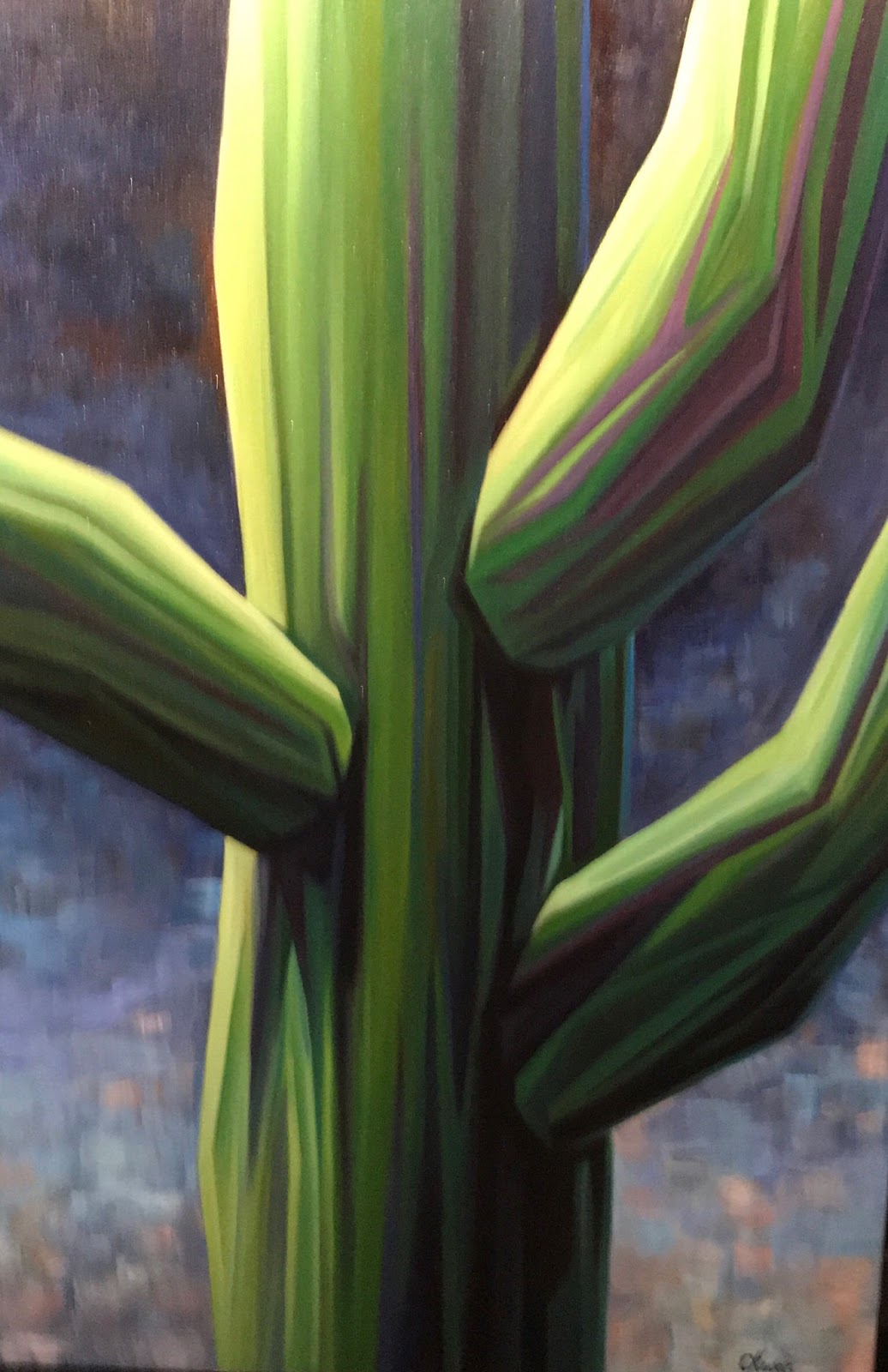
Leaving photorealism behind, Caroline has been painting cacti in a contemporary abstract style for a few years. She’s still an avid art student and laments not learning about color patterns and paint mixing when in college.

Caroline took matters into her own hands (as usual) and sought out a mentor. At the Expo, she approached Sam Thiewes, a fellow artist who lives in Prescott Valley and also exhibits his western paintings at the Arizona Fine Art Expo. He readily agreed to be Caroline’s coach and guide. 

IMG_3148
Caroline with Sam, her mentor, in his booth at the Expo

Each day during the Expo, they would regularly check in with each other. Sam would study Caroline’s latest painting to advise on composition, perspective or color. She listened to his wise counsel. 

“I’ve learned so much from Sam,” Caroline says. “And from watching other artists for the last two months at this show.” This temporary artist colony in the desert grows into a tight community of creatives who naturally learn from each other, whether by observation or conversations. 

Not having a house or apartment payment eases financial burdens. With her catering background and enjoyment of cooking, Caroline also works at the Expo Cafe while in Scottsdale and at the Great American Fish Company while in California, her usual summer place.

I’ve seen Caroline hustling during lunch at the Expo Cafe, running between the indoor counter and outdoor patio where she grills burgers and cooks soup on a two-burner gas-powered stove. Between preparing wholesome, locally-sourced breakfasts and lunches in the cafe and manning her Expo booth during the show, Caroline’s tenacity kept her going until she could finally put brush to canvas in the afternoons.

me working

In 2016, Caroline received a much-needed validation for her artistic aspirations when she was selected as Artist-in-Residence at the Mojave National Preserve. Along with a boost to her national reputation, she also found a spiritual home in the vast, silent expanses of the Mojave Desert and takes every opportunity to return there for a few days and recharge.

“There’s nothing like the absolute silence of the desert at night,” Caroline says. “Feels like the universe is close at hand when viewing more stars than I ever knew existed. I unplug from civilization and am forced to live in the moment. It’s utterly head cleaning.”

During the Expo, in her spare time, Caroline would paint, paint, paint on her mission to get better and better, whether in her booth or in Bubbles. She’s completed plenty of paintings sitting at her compact dining table and admits to being at peace living with paints smears on her counter, table and even bed sheets.

When Caroline moves her RV to a new place, she’ll wake-up in her familiar, paint-dappled home, but often temporarily forgets where she is. But that’s okay. She figures it out quickly.

Waiting-for-the-Monsoon
Waiting for the Monsoon

“Change has always been my life,” Caroline says. 

That’s true. The view from her front door changes, her painting style may change and the people she’s surrounded by change with the seasons, but Caroline will always find time to paint, paint, paint. Nothing gets in the way of her artistic vision.

She’s feisty and tenaciously focused that way.

Resources

Website – https://www.carolinekwas.com

Facebook – https://www.facebook.com/caroline.kwas

Instagram – https://www.instagram.com/carokwas/

Little Girl Instagram – https://www.instagram.com/littlegirlvan/

Photo Gallery

IMG_0492

IMG_3108

IMG_3105

Christine Hauber, Photographer

Christine is an introvert, and it works very well for her. She’s calm. Centered. No drama. While she relishes her solitude, she doesn’t shy away from being with people. And she gets people. As a portrait photographer, she nails the core of their being in her  photographs.

Courageous Christine

Christine is an introvert, and it works very well for her. She’s calm. Centered. No drama. While she relishes her solitude, she doesn’t shy away from being with people. And she gets people. As a portrait photographer, she nails the core of their being in her  photographs.

In the early 2000s, Christine traveled the byways of America meeting people in villages and communities, documenting their professions by capturing them in their work element. Her book “Working in the USA” is a love letter to working folks, a fascinating study of people ordinary and extraordinary, all the more poignant because she shot each one in black and white.

IMG_3156 (1)
A spread from Christine’s book, “Working in the USA”

I dare you to open her book and try to close it after a few pages. I sure couldn’t. Its width straddled my lap and I turned page after page, unable to stop looking at the next person — a firefighter, a Cajun accordion maker, a gold miner, a shrimper – each with their earnest face surrounded by the tools of their trade. Proud people. Humble people. Dignified.

IMG_3155 (1)
More USA workers photographed by Christine

For an introvert, Christine excelled at traveling in her RV and meeting all kinds of people along the way. She stills lives in that same RV… since 2001. These days, she winters in Scottsdale, Arizona, and summers in Santa Fe, New Mexico.

IMG_3154 (1)
Even more USA workers photographed by Christine from all lower 48 states

From Denver to Daring

Growing up in Denver, Christine enjoyed spending solitary time drawing and coloring when she wasn’t out being “one of the boys” with her two older brothers. From an early age, she was immediately attracted to pencil and charcoal drawings, which formed the basic artistic thread running through her life; producing works in black and white.

Christine also loves animals and had planned to be a veterinarian, until one summer when her mother arranged for her to work on a pig farm in South Dakota. “I realized I didn’t like seeing animals in pain,” Christine says.

These days, she photographs portraits of rescued and protected animals, like donkeys, horses, goats and sheep, and transfers their black and white images onto wood panels that she embellishes with white tissue paper, textures and paint or encaustic.

IMG_3142
Christine in her booth at the Arizona Fine Art Expo, transferring a cow print onto canvas

Christine’s animal faces are charming. But photography and mixed media pieces aren’t her only creative outlets. She also cooks. Each winter, she exhibits at the Arizona Fine Art Expo and also runs the Expo Cafe with her assistant, Caroline Kwas, also an exhibiting artist. Together, they prepare breakfast and lunch seven days a week for visitors and resident artists.

Each summer, Christine hosts multiple Art Spas in Santa Fe. While her business partner teaches painting classes, Christine prepares their meals and demonstrates cooking. She focuses on healthy vegetarian foods while explaining the cooking process. In a recent Art Spa, she taught everyone how to create and roll their own spring rolls.

Christine’s Expo gig in Scottsdale goes beyond just showing her art and cooking wholesome foods (which keeps her busy for 80 hours each week). She is also part of the crew that erects the giant u-shaped white tents for the Expo.

IMG_2976
The entrance to the Arizona Fine Art Expo

The show launches mid-January and she arrives from Santa Fe in November to get the Expo up and running, along with the show managers and facilities team. When the Expo closed on March 25, Christine spent April leading the crew in dismantling and packing up the massive tent for storage until next year.

IMG_3133
Christine’s booth and artwork

During the Expo, Christine stays busy painting, running the cafe and then walking to her RV out back each evening where she continues to make her art.

Many people dream of pulling up roots and following their passion, living an endless summer in mild climates. Christine is doing it, though she admits it’s not as freeing as it might sound. The hours are long, the work hard and the pressure is on to make a living from her art.

“You can do anything for 10 weeks,” Christine laughs. That’s her motto for this year’s Expo.

IMG_3129
Christine with her new elk mixed media work

Though her location changes, Christine’s focus on producing art never does. She continually learns from customer feedback, what’s selling and what’s not, to try new things. “I’m always chasing that carrot,” she says, laughing. Making a living from art drives Christine each day to discover new ways to market what she does.

Working in the USA

Christine received her college degree in psychology and worked for a year counseling troubled youth for $6 an hour, which was minimum wage. Working with the kids was fine but after a year, Christine realized her co-workers were the ones with the more severe issues. To compensate for work stress, she took a class on darkroom techniques and promptly fell in love with it.

She also took a couple of pre-med courses for genetic counseling but soon determined speaking with pregnant women about potential baby problems would be too taxing. When her father pointed out how passionate she was about her hobby of photography, and encouraged her to consider turning professional, she took his advice.

Christine chose commercial art photography over her pre-med studies and started her own Portrait studio in Denver. She liked to experiment, to stretch her creative muscles, and worked with infrared film, which plays off of the red spectrum to produce ethereal photos.

littlegirl

For six years, Christine ran her business and also spent two of those years caring for her aged grandmother. Soon, feeling stifled by traditional portraiture and her home life, she longed to follow her creative urges to travel and take pictures.

Always a traveler at heart, Christine had taken solo trips to China, Singapore and Hawaii. She knew her new dream of traveling the U.S. and taking photos was doable, with proper preparation. She talked about her project with a purpose. She dreamed about it. Finally Christine’s dad convinced here there was no time like the present to chase a dream.

Farmers2

Again, she listened to her dad and set her departure date for one year ahead.

Heeding the wanderlust call, Christine bought a 29-foot RV and converted the main bedroom into a compact custom darkroom. In April, she set out to visit all 48 lower U.S. states and photographically document workers of all professions. Her project, called Working in the USA, was a way for Christine to show people in other countries what real Americans look like, as opposed to those seen on TV shows and in movies.

DEACON

“We’re a nation of diverse people who work hard,” Christine says, “and work is a common theme all over the world. The first thing we ask when meeting someone new is ‘what do you do?’”

For three-and-a-half years, Christine traveled 70,000 miles with her cat Ansel and her dog Gracie. When her travels were over, she worked on producing her book “Working in the USA,” which was published in 2006.
Taxidermists

Christine had finally burst out of traditional portrait methods and captured people from all walks of life. Along the way, she learned to avoid tornado alley in May and June, to avoid the north in the winter, to look for free RV lots, to lay low while parking overnight at truck stops and to overcome her natural shyness to approach people and learn their stories. She was traveling before people were actively blogging and before social media provided a platform for instant sharing. She wrote about the people she met, in addition to photographing them, and she still has many stories to tell about the people in her book. I’m looking forward to hearing those stories. And to seeing what Courageous Christine does next.

montanabarnfinal16x22

“There are no excuses to not travel,” Christine says. “Don’t wait for a traveling companion. Don’t wait to pursue any dream. Get out there. You’ll survive.”

Christine should know.

The name of her RV says it all: Dream Catcher.

Photo Gallery

IMG_3106

IMG_3132

Resources:

Christine’s Blog:

http://www.christinehauber.com/photo-and-travel-journal

Christine’s Website:

www.christinehauber.com

Podcast – Keep Your Day Job: Radical Sabbatical

http://www.keepyourdaydream.com/radical-sabbatical/

Christine’s Book:

https://www.amazon.com/Working-USA-Christine-D-Hauber/dp/0976617013/ref=sr_1_1?ie=UTF8&qid=1440824407&sr=8-1&keywords=working+in+the+USA

Shawna Scarpitti, Collagist/Sculptress

She’s Wild at Art

When I first saw Shawna’s large, bright canvases from a distance, I had to get down there… and fast… even if it meant passing up many other artists’ booths. Up close, her bold, singing work did not disappoint and when Shawna came around the corner with her wild hair barely contained and her stride full of joy, I instantly knew her natural glee perfectly matched her art. And who wouldn’t be drawn to both!

As an undergraduate at Auburn, Shawna was a nude model for painters at the nearby Columbus Museum of Art in Georgia.

“It took some getting used to,” Shawna says, “ but I made $20 an hour, the most I’d ever made.”

Her body isn’t the only thing she’s bared for art.

This past December, Shawna quit her job as an art therapist, packed a van with art supplies and home furnishings, and drove from Jensen Beach, Florida, to Scottsdale, Arizona, to exhibit her tissue paper pieces at the Arizona Fine Art Expo, a 10-week show housed in a giant white, u-shaped tent.

IMG_3055
Shawna in her Expo booth, shared with her partner Gregory, a glassblower.

Every year from January to March, more than 100 artists occupy booths at the show and paint, sculpt, make jewelry, etc., in their spaces, sharing their work and techniques with guests seven days a week.

Shawna took a leap of faith to try her hand at being a full-time artist, encouraged by her boyfriend Greg Tomb, a masterful glass blower who has made a living from his art for years by traveling to shows around the country.

So, newish relationship, new “job,” new city, new condo… all at once. Hello, Overwhelm.

“January was a stinker of a month,” Shawna says, laughing. “Setting up a booth with a partner for the first time was stressful as we got used to each other. And traffic at the show was slow, so we naturally worried about money.”

By February, Shawna had made friends throughout the giant tent and she and Greg were grooving as a couple.

“I’m the type who has to be connected with people,” Shawna says. “If I’m making art, I must also be doing something to make a difference in other people’s lives.”

Pink Dragnfly

She’s a cheerful and kind spirit who gives and gives of herself. Her artwork, created by gluing colorful tissue paper onto canvases, is an outward sign of her inward joy. Full of happy, bright colors, her pieces cause continuous smiles.

After getting a Master’s degree in art therapy, Shawna has been a nationally board-certified art therapist for 20 years. She honed her skills working with tissue paper while showing clients how to express their emotions through their hands; even if it meant they used only black. The simple act of wanting to switch to a color other than black could signal a big breakthrough for a client.

How does someone help traumatized people day after day without succumbing to trauma themselves? Especially someone like Shawna who is sensitive and attuned to others’ feelings and energy.

“I’ve been lucky to work for companies that offer insurance with mental health benefits for employees, and really good self-care is a must,” Shawna says, with a chuckle. “Plus, helping people freely express in 2- and 3-dimensions while encouraging them to connect to their imaginations and innate creativity is very rewarding.”

Triptych

Shawna was born in Alliance, Ohio, but grew up in Jensen Beach, Florida, influencing the definite coastal feel in some of her work. From the age of 2, Shawna chose crayons and paint over dolls and TV. Her mother knew, even then, that Shawna was an artist.

Shawna used her therapy training to acclimate to her new nomadic life and the self-contained art community that pops up each winter in the Sonoran desert.

When people show interest in her work, she delights in telling them how she does it. Oftentimes, they want to learn to do it.

“After several women expressed interest in doing tissue paper art, I put up a class sign-up sheet in my booth and it filled up in less than a week!”

Palm

Shawna has given several classes during the show in a classroom available to artists for just such activities, and she’s an excellent teacher/coach/cheerleader. I was lucky enough to take her “Tissue Paper Art 101” class and admired how she put everyone at ease about being creative.

“First thing we’re going to do is take off our judgement hat and throw it out of this room,” Shawna says.

Animated, she tosses her imaginary hat like a frisbee and smiles big. Her long hair, extra curly and full, moves when she does, accentuating her vibrant personality.


This slideshow requires JavaScript.

The room we’re in has walls but no ceiling, except for the big white tent overhead. We can hear cars on Scottsdale Road, but Shawna can easily be heard telling us about the nature of Bleeding Art tissue paper, the medium for her artwork. When the paper gets wet, colors bleed onto adjacent papers, creating unpredictable patterns.

Shawna then uses a sponge brush to gently apply a mixture of Elmer’s glue and water, adhering the paper to a canvas. Or she might use a bristle brush to smooth it into place. In this beginner’s class, our only objective is to experiment.

IMG_3118
In class with Shawna, fellow student Annie and a big mound of tissue paper!

“Cut it or tear,” she says, “there is no wrong way. You’re learning about the paper’s qualities with every piece of tissue you add.”

After working with tissue paper for decades, Shawna has mastered composing images, although she admits controlling how the colors bleed is nearly impossible. Coat hangers hold folds of tissue paper already splashed with water and fully dried. Working when the paper is wet can be difficult, so Shawna always has lots of dried, prepared paper on hand.

Greg’s talent isn’t limited to blowing remarkably beautiful glass bowls. He’s a good carpenter, too, and built Shawna a rolling cart to hold her art supplies, including glitter glue, paints, tiny canvases on wooden easels and all sorts of tiny sparkly notions to add to a completed piece of art. The cart even has a handy rail on one side for displaying her many coat hangers of inspiring papers.

Cart
The rolling cart that Gregory built to hold Shawna’s supplies and paper.

In class, we get very quiet as we experiment with collages of tissue on a thick piece of paper, to get a feel for how to handle the glue, paper and active colors. The moistened foundation papers tend to warp or curl.

“No worries about curling papers,” Shawna assures us. “Once it’s dry, simply put it inside a large coffee table book overnight and it will emerge flat.”

After experimenting, we tackle covering a canvas with tissue. Shawna has several canvas sizes available. I grab a 10-inch square and spot some prepared papers with orange, white, pink and yellow. The brighter the better is my motto. Plus, I have visions of Shawna’s art in my head. Using her prepared paper means my piece of artwork is a collaboration with her.

IMG_3119
The piece I made in Shawna’s class using her prepared paper. 

Two hours fly by. Shawna finishes our partially-dried artwork with a spray acrylic in either mat or gloss. It also provides UV protection.

I enjoy the class so much, I’m hoping to be able to take her Intermediate course before she packs up and goes back to Florida.

IMG_3087 (1)
One wall of Shawna’s booth holds the smaller items she collages and paints.

Canvases aren’t the only surfaces Shawna covers in tissue paper and paint. She makes one-of-a-kind notecards and decorates the covers on planning calendars and bound journals, turning them into useful works of art. I bought one of her journals to use in a writing workshop my daughter Jaime and I are taking in Paris this June.

“Art is integral to who I am,” Shawna says. “I find a natural flow between creating therapeutic space for the art-making process for others and for myself. I’m in constant connection to my creative core, even when addressing an envelope, cooking or starting a new art project.”

Lotus

Sculpture is another 3-D art form Shawna relishes as she uses organic materials to evoke the Divine Feminine. “Nature is rarely linear and my sculptures are a celebration of all that is feminine, soulful and passionate,” Shawna says.

As an undergraduate, she dove into sculpting with wood, clay and stone, and sometimes using found objects to create assemblage pieces. In fact, her senior thesis was based on a theme for nine large-scale assemblage sculptures. But when she started working, sculpting took a back seat, even to her collage work.

Two years ago, Shawna’s best friend, Susannah, fell in love with the carved wood, alabaster and marble pieces Shawna had created in early 90s. “Susannah asked me who had done the carvings and she couldn’t stop touching them,” Shawna says. “When I described how I carved them, she nearly flipped because she’s only known my tissue paper collages. She emphatically told me I must, must, must get back into sculpture as soon as possible. In fact, she made me promise I would.”Sculpture

The Expo, a creative place to the max, is the perfect spot for Shawna to sculpt, paint, and, most importantly, make good on her promise to Susannah.

Shawna is wise to acknowledge her need for being emotionally connected with the people around her. We all have that need to some extent, yet some of us don’t always honor it… and we’re the poorer for it.

A giver, Shawna has created a new life and a new relationship that gives back. She credits Greg with evoking the courage she needed to embark on this current desert adventure. In fact, he convinced her to see the possibility of taking a two-month hiatus from her job last summer and travel to New York where he would rent an apartment, giving Shawna the freedom to produce her large-scale pieces for two art shows in which she and Greg would participate.

Shawna’s employer did not offer anything like a hiatus and she expected a big fat “no.” But when she asked, they said yes!

Greg believed in her work enough to know she could pursue it, and they could share a life on the road as partners in every sense of the word. He also believed in her talent enough to hand-build the large canvases for her work.

LadyBugs

“It was amazing and scary to wake up each day and only have to make art,” Shawna says. During those two months, she learned a lot about art, about Greg, about herself and about the public’s reaction to art.

When Greg suggested they both apply to exhibit at the Arizona Fine Art Expo, Shawna saw the stars aligning. That’s when she made the decision to leave her job of nearly four years and dive head first into being a professional artist. These last four months have been eye-opening, frightening and a catalyst for her next stage.


Recently, Shawna scheduled an art therapist job interview for early April back home. “I’m  hopeful to go back to work full-time in South Florida,” Shawna says. “I will definitely continue to do my art on the side, and exhibit at shows.”

Greg has a few shows lined up for the remainder of 2018, giving them an opportunity to flex and strengthen their intermittent long-distance relationship with FaceTime and other technological wonders to stay connected. 

Shawna sounds at peace with their future. “We have plans to join forces down the road,” she says.

I’ll miss Shawna when she’s back in Florida, but I have no doubts she’ll brighten the lives of her clients through art therapy and retail art therapy.

Dragonfly

Shawna’s extraordinary parents, Jim and Melody, taught her to always be kind. She takes kindness one step further and is always loving, even with people she doesn’t know.

On a daily basis, Shawna bares her soul to those who are lucky enough to be near her, and she gives us permission to open our souls and be creative, be vulnerable, be colorful, be loved and see the joy in life.

Shawna shows us how to throw our judgement hats out the window, and we’re the richer for it.

DragonflyDetail
Detail of the dragonfly above.

Education

Bachelor of Fine Arts with a concentration in sculpture from Auburn University.

Master of Arts in Art Therapy from Ursuline College, Cleveland, Ohio.

Resources

http://www.shawnscarpitti.com

Facebook – http://www.facebook.com/ShawnaScarpittiFineArt

Pixels – http://pixels.com/profiles/shawna-scarpitti.html

Instagram – @shawnamariescarpitti

Twitter – @seascarp

Photo Gallery

Poppies2

Sunset

IMG_3088 (1)


Mike Padian, Watercolorist

Mike Padian’s watercolor abilities were the best kept secret in Black Canyon City… until now. He’s mastered the medium, and life.

Watercolor Wizard

I met Mike last spring at a cooking class taught by Matt, French chef and owner of Nora Jean’s Koffee Kitchen; the second-best kept secret in Black Canyon City.

Mike’s talent as a watercolorist was the best kept secret.

IMG_1008

During the monthly classes, where a group of wanna-be chefs try our hands at classic French dishes crafted with Matt’s imaginative twists, I’m always drawn to Mike, his sunny nature, quick smiles and absolute delight in the color, texture and chemistry of veggies, oils, meats and spices.

Delight. That’s Mike.

When I learned Mike painted watercolors, and asked him about it during class, he was standing behind a chair, hands resting on its back. Folks at our table were busy shoving haricots cooked with slivered almonds and garlic mashed potatoes into our mouths as Mike modestly said, “Yes, I paint watercolors.”

He mentioned being mystified by people who master oil painting. Soon, I’d learn just how modest Mike was being.

Last November, Black Canyon City hosted its third annual Hidden in the Canyon self-guided art studio tour. The weekend event included six artist studios in the small city. Each studio hosted multiple artists working in various mediums. When my husband Brent and I learned of the artist tour, we were in!

Most importantly, whatever studio Mike was exhibiting in would be our first stop.

Mike, along with a jewelry maker, glass artist and ceramicist, was showing his work in Lori M’s beautiful home, practically a museum of paintings, sculptures, ceramics, multi-media pieces and furniture by many artists; all tasteful and arranged for living with, not just looking at.

Lori is Black Canyon City’s patron saint of art patrons and she’s a huge Mike Padian fan.

“Wow,” Brent said when we first saw Mike’s watercolors, set up in Laura’s dining room, just off the patio. “Who knew he was this good?”

I had suspected Mike’s talent was great. But, the details… the colors. How was he able to so deftly manipulate colored water, the slipperiest of all media?

We immediately selected a small, rectangular landscape in a complementary frame and bought it. Fast. Before someone else did.

Lori, the homeowner, is a pretty woman, dark shiny hair, who was adorned in eclectic necklaces, bracelets and earrings made by local artists, each piece revealing her taste and personality.

“Since you bought a painting from Mike,” Lori said, “I want to show you something.”

She turned and removed a chair that blocked visitors from entering her living room. I felt like we had won the lottery as we followed Laura on our mysterious journey through her treasure-filled home. I found it difficult to walk forward because my head was constantly turning to take in each large painting, or sculptured figure or carved wall-hanging. Surprisingly, I didn’t bump into Lori, and Brent didn’t bump into me, when Lori stopped outside the closed door to her bedroom.

Drum roll, please. My head was actually buzzing with anticipation when we stepped into her room and our eyes immediately went to the mural over Lori’s metal bed, a faux window filled with a colorful Sonoran Desert scene.

IMG_2807
Mike’s mural in Laura M’s bedroom

“What?!” is all I could say. Vaguely, I sensed Mike’s presence, but all my attention was on the gorgeous, red-blooming Ocotillo, white-tipped wildflowers and stately Saguaros showing through the optical illusion of a deep-set window.

Brent leaned over the bed to put his hand on the fake window sill and exclaimed, “I thought it was a real window ledge!”

The entire wall was painted to look like plaster, cracked in some places. Right then, I knew I had to feature Mike on this blog.

Lori beamed, clearly proud and in awe of Mike’s extraordinary talent. There was a hint of tears as she said, “The only reason I agreed to host artists in my home today is because of Mike.”

Lori knew something that would take me a little longer to figure out. Mike’s entire life had been spent making art, in one physical way or another, and sharing its beauty with people.

DSCN0620

On a Saturday afternoon in December, I visited Mike in his home and began to put the pieces together, the ones Lori was already intimately familiar with, the ones that could bring tears of sadness and joy.

Mike’s home behind Ron’s Market is wooden, narrow and deep, reminiscent of shotgun houses found in the Deep South where I’m from. Cozy and inviting, each room is well-appointed and a reflection of Mike; his interests, his passions.

“I like my house,” he says simply.

His “Happy Wall” in the dining room has a kayak and paddles resting in a corner, a row of carefully arranged beer glasses, and a long, perfectly-executed oil painting, one of Mike’s masterpieces, of the Dirty Devil River, a tributary of Lake Powell. “The Dirty Devil only gets enough flow for kayaking five days out of the year,” Mike said. “We had a blast for a week on this river.”

IMG_0980

Mike likes his beer/ale/lager dark and stout. In fact, he finishes a pint as we begin our tour of his home, and pours a new one.

“Would you like one?” he asks. A beer is tempting, but I say no. I must remain sharp and focused so I can remember everything he says.

Next to the refrigerator is a mound of empty beer bottles tucked into cases stacked one on the other. I stare at the pile.

“Don’t judge,” Mike says.

“I’m not judging,” I say. “Brent plans to build a greenhouse with walls of colored bottles. He’s not interested in brown bottles, so I’m just checking out how many clear and colored bottles you have.”

“I didn’t just drink all of those,” Mike says, still concerned I’m judging. “I’ve been saving them for a while.”

I’m truly not judging Mike, about anything. In fact, as we talk through the afternoon and explore his watercolors of all shapes and sizes, framed on the wall or tucked into boxes under tables, my high estimation of him steadily and steeply rises.

As we talk about his life, and painting, we pull out more and more pieces, each distinct and breath-taking. Mike knows the geographic location of each landscape, even those from his imagination. I feel like a gold miner striking a vein and can’t get enough. “Bring it on,” I say, when he remembers another stash.

DSCN0632

Some of the framed watercolors reflect light from windows, which can be seen in the photographs we’re taking. Instead of going through the trouble of taking the paintings out of their frames, we pull them off the wall, prop them up and Mike stands across the room with a giant piece of cardboard, moving it up or down, right or left, according to my directions, attempting to block light from over the kitchen sink or through the sliding glass doors. It’s rather comical and the photos don’t turn, of course. They look like stars shooting out of desert rocks.

But that’s okay. Mike hands me a CD labeled “MIKE PADIAN’S PAINTINGS” and I happily discover these very framed masterpieces are quality jpegs on the CD.

IMG_1019

IMG_1003

In his studio, Mike and I excitedly arrange his library of unframed watercolors, one by one, on a white background and take photographs, me feeling like an amateur photographer next to the master. Like the guy who washed Michelangelo’s paint brushes, or brought him a sandwich.

‘Don’t judge,’ I think as I try to capture each piece of artwork with just the right light at just the right angle.

Distortions would be bad; I want to be true to Mike’s art. And to Mike.

++++++++++++++++++++++++++++++++++++++++++++++++++++++++++++++++++++++++

Mike created his first painting at the age of nine. “It was large,” Mike says, “and Mother still has it.”

For 23 years, painting billboards 48-feet long was all in a day’s work for Mike. He painted 10-foot tall Big Macs, giant portraits of Phoenix newscasters and naked women. Well, he only painted naked women on Fridays as a practical joke for his boss, Don Weber; on Monday, Mike would paint clothes on the women before the billboards were hung in public.

IMG_2947
10-Foot tall Big Mac sitting in the workshop

Mike admits that at 5′ 4″, he’s not a big man, so it’s ironic he created such massive artwork. “We used a projector,” Mike says, “to create enlarged sketches that I then painted in with detail. We had to paint quickly, too, because time was money.”

After billboard painting, Mike began a mural painting business in 2003. One day in 2004, he found out he needed a heart transplant… right away.

“In the emergency room, the doctor asked how many heart episodes I’d had, and I told him two. He said, ‘most people die on the third one,’ so I immediately went on the donor list, knowing that my small heart cavity meant I’d need the heart from a small woman or child.” The doctors gave Mike seven days to live.

A heart became available on Day Five.

These days, if you ask Mike how he’s doing, his face lights up as he says, “Great! Can’t complain.” If anyone has a right to complain, it’s Mike. The medicines necessary these many years to keep his body from rejecting the donor heart have damaged his health in significant ways. However, Mike chooses laughter over the alternative; curling up in a fetal position and dropping out.

Besides, Mike is too busy preparing for art shows and spending time with his brother Ron, who lives nearby, and crafting exquisite culinary dishes for his mother and stepfather; like Madeira sauce with tarragon and mushrooms.

While Mike focuses on watercolor painting, folks continue to fall in love with him and his work… it’s simply impossible not to!

In the short time Mike painted murals around Phoenix, he was kept busy by quite a few customers. For his favorite client, Mike painted Davinci’s Last Supper on the man’s dining room wall, a John Force funny car mural in his home office and a movie-themed mural of vintage film posters surrounded by popcorn and movie reels on the wall over his TV.

IMG_2951
Mike poses with his “Last Supper” mural

“My client called me this past December and told me he painted over the Last Supper mural,” Mike chuckles. “I mean, it was his to paint over. Now he wants me to paint a scene with the Ten Commandments’ stone tablets, maybe with Mt. Sinai in the background.”

Mike’s mural work, like the one in Laura’s bedroom, is stunning and often contains T’rompe-l’oeil (French for “deceive the eye”), imagery that creates an optical illusion of objects existing in three dimensions. In homes, Mike has painted windows with desert scenes, extended hallways, floral trims and scroll work. He even painted a space-themed mural for a phone store.

IMG_2958
The real hallway ends just after the hanging lamp. Everything beyond that point is illusion.

IMG_2954

IMG_2952

IMG_2953

LEARNING TO PAINT ON A LARGE SCALE

Mike grew up in Phoenix and graduated from Moon Valley High School in 1976. He started painting billboards and signs one year later.
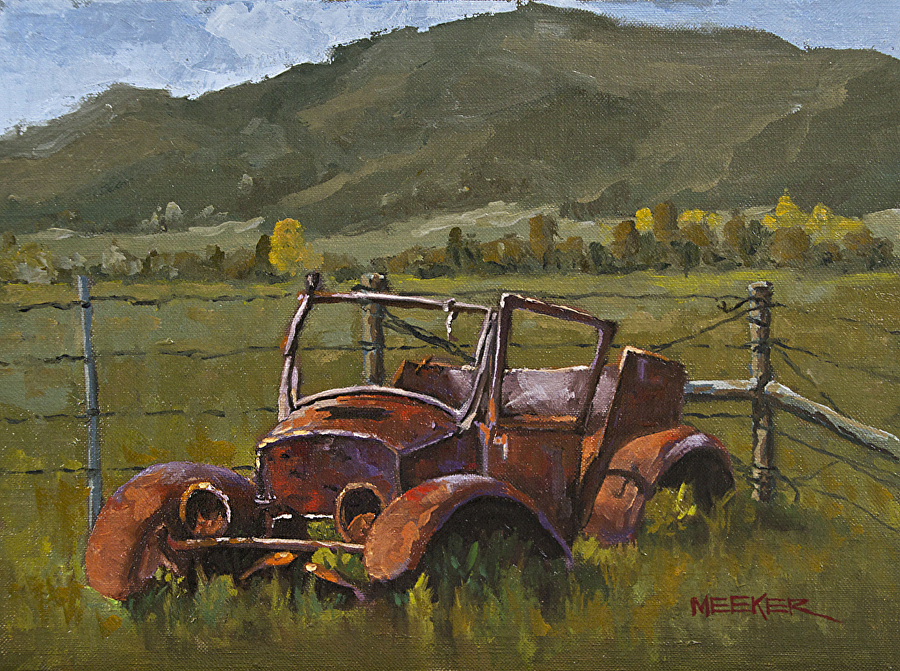
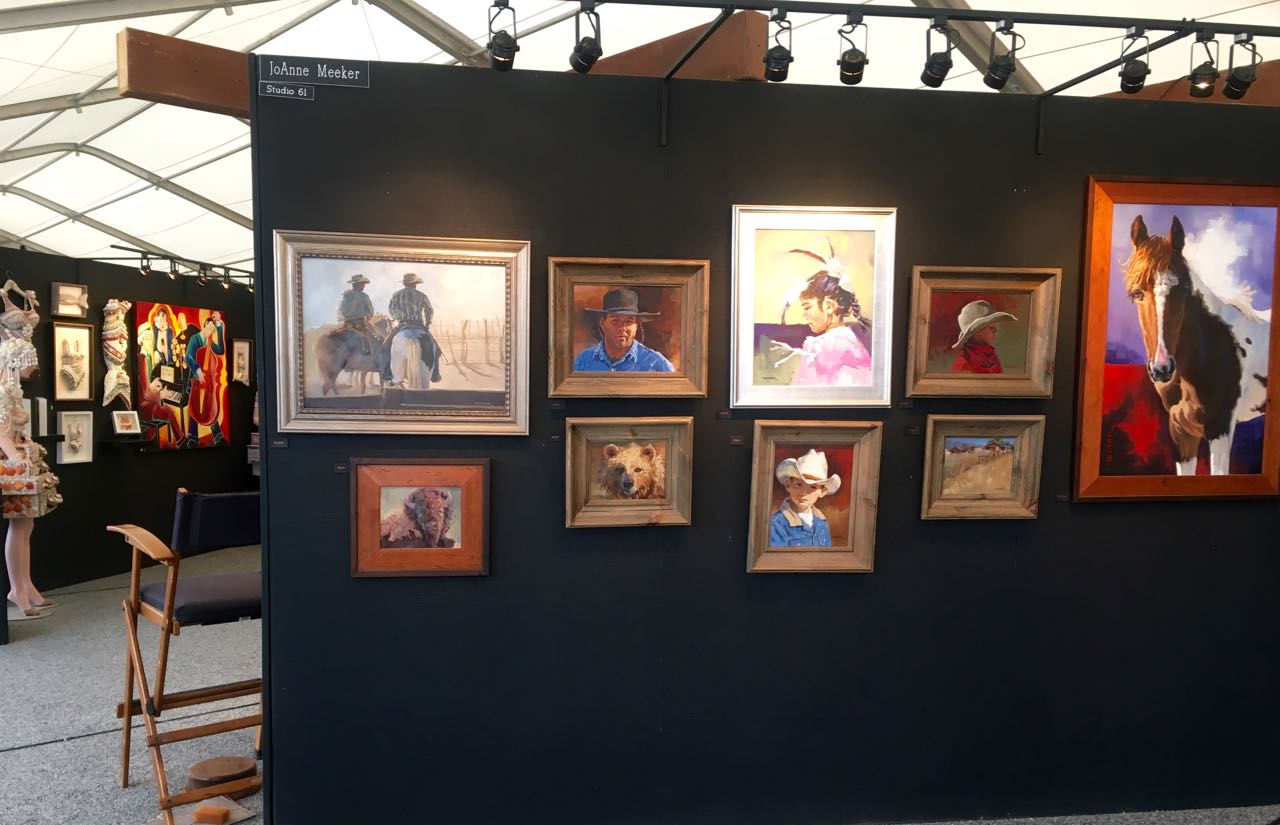
“At first, I was sloping panels and cleaning up messes. My boss said I should learn how to draw letters to scale, and once I had experience doing letters, I could paint billboards.”

Mike took a lettering class at Maricopa County College. Back then, all lettering was drawn out by hand using math to determine spacing, letter widths and heights. Every step was manual, no computers. After a year of lettering, Mike began painting his own billboards and over the next two decades, learned on-the-job.

Painting giant faces on billboards was difficult because Mike was too close to see the entire face. To compensate, he developed a system of dotted lines to identify where he was on the face.

IMG_2949
Mike’s dotted lines on a billboard face from the 80s.

“A line of long dashes meant a long blend,” Mike says. “Shorter dashes meant a short blend of colors and shadows, and dots represented things I needed to change. For instance, I would outline eyes in dots and knew I needed to go outside of those lines.”

Mike educated himself in the Venyetti effect, a phenomenon that causes proportions to distort when an image is enlarged. “Venyetti effect is especially critical when painting large objects on billboards,” Mike says. “A one percent distortion, or difference in size, can change the entire face.” Painting a huge face might have taken Mike an entire day. He didn’t want to have to redo the whole thing by not taking potential distortions into account.
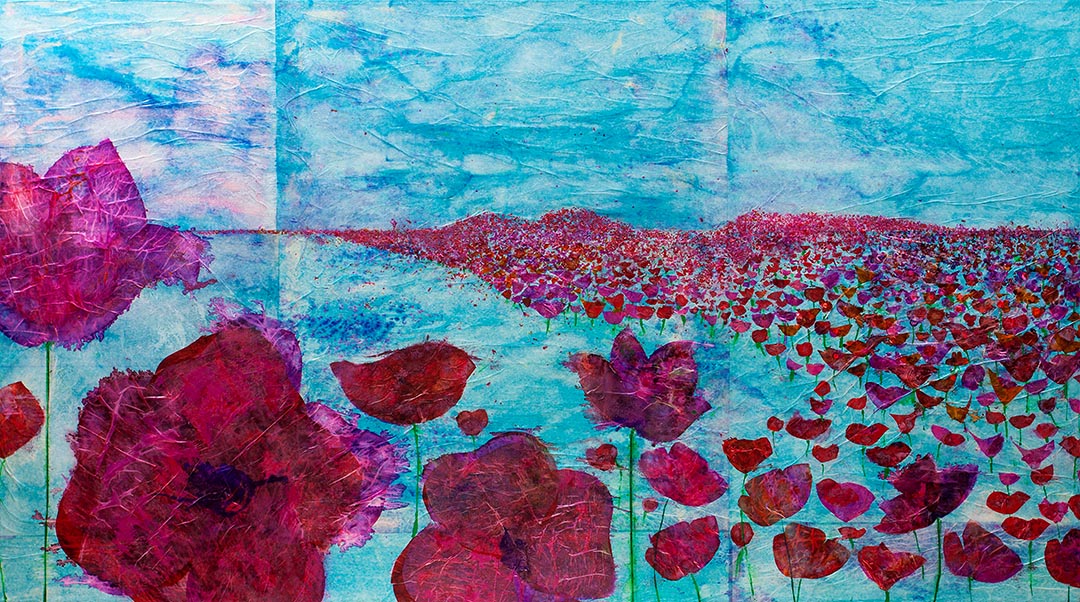
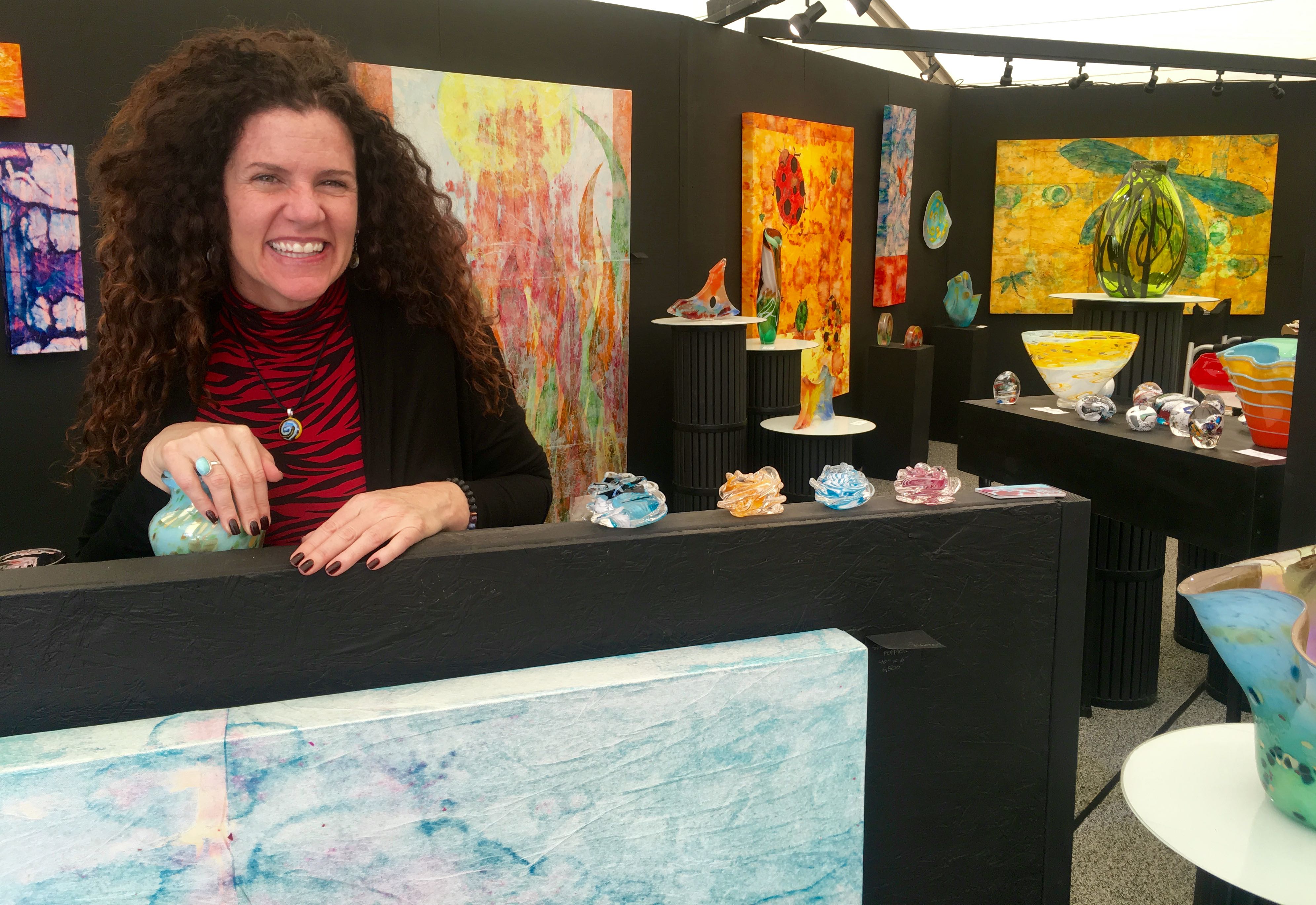
Mike mostly painted billboards on the ground in a giant studio, though sometimes he would need to climb up on the catwalk and paint from there, which was dangerous for obvious reasons. While most billboards were 14-feet high and 48-feet long, some had 16- or 17-foot high extensions, making them mega-tall billboards.

IMG_2946
Mike paints high in the air, under the desert sun.

Not only could rain ruin the paint on an outdoor job, the chance of falling was ever-present. In fact, Mike fell twice. Once when working with his boss, Don, on a billboard on Grand Avenue near the train tracks. They were standing on the catwalk when a board snapped and they both fell 15 feet. Mike landed in a barbed wire fence and got hung up. Don hit a truck and bounced onto Mike, then walked away unscathed, saying, “That’s what a good apprentice is for. Thanks, Mike.”

Even while bloodied with mud packed in his nose, Mike climbed back up and continued the job.

IMG_2950

IMG_2948

In the early 1990’s, with the advent of computers and big ink printers capable of producing large vinyl pieces, printing raced to overtake hand-painting. Within a decade, hand-painting would be gone.

“In the early days of printed billboards, the inks were inferior,” Mike says, “and our clients thought it looked awful. They would ask us to fix it. I had to match the dot matrix with a solid paint color, which was very difficult to do, all the while standing on the catwalk. To check my work, I’d have to climb down, run back to look at it, and then climb back up again.”

Around 1999, Mike decided he no longer wanted to be a billboard monkey, stretching vinyl, fixing bad print jobs and climbing up and down. It was simply too dangerous.

WORDS AND IMAGES

Mike’s artistic skills are broader than painting. He has always written poetry, lyrics and articles for magazines. During the 1980s and 1990s, while Mike painted billboards, he also ran his own stock photography company. Drawn to recreational sports and the outdoors, Mike took photos of models while kayaking, snow skiing, mountain biking and hiking. He catalogued the photos for use by publications and also sent monthly submissions to outdoor magazines and visitor guides.

In addition to publishing photos, Mike occasionally wrote pieces for Bike magazine, Mt. Bike magazine and National Geographic Explorer magazine. He honed his writing chops with Sweat Magazine.

Here’s an excerpt from an article Mike photographed and wrote for Bike magazine about the Five Miles of Hell (5MOH) trail system in Utah. The intro reads, “In this part of Utah, west and north of Moab’s storied red rocks, there’s a trail with a cruel name and a brutal reputation. To ride it, torture is salvation, punishment the prize.”

“What 5MOH lacks in epic length, it makes up for in the fatigue per mile it doles out. While it might not have breathtaking vistas, traveling among the tightly sculpted sandstone creases has an almost mystical appeal. There are no zen-inducing climbs or vision-blurring descents, but 5MOH holds the needle in the red on the pucker-meter by requiring the rider to show utter conviction in the two simplest of disciplines… letting the bike do everything it is built to do and forcing the bike to do what it needs to do.”

IMG_2961
A spread of Mike’s article with photos of his model.

Mike’s ex-wife, Jill, published a piece in Bike magazine about Mike’s stock photography adventures titled People Who Ride. Here’s an excerpt:

“Then there was the time he came home two hours late and parked his truck in front of the house but didn’t get out. He just sat there. I kept working at my desk, figuring he was jamming to a song on the radio. Finally, a plaintive bleating of the truck horn awakened me to the fact that all was not right in the world of Kodachrome.

I found him naked except for a beer in his hand. That position was all the better for the setting sun to glint off the cactus prickers stuck all over his legs and buttocks, allowing me to find and pluck them from his body with tweezers. As I performed the delicate surgery, he of course fumed about the shots he’d missed.”

Mike doesn’t take up a lot of space in this world. He doesn’t push his ways on those around him. He’s gentle, unless conquering a river or landscape, either in kayaks, on bikes or with watercolors. He’s thoughtful. For instance, as a stock photographer, he would sometimes urge his clients to give their business to another stock photographer, one who was making a living at it, unlike Mike, who had his full-time job of painting billboards. Mike is considerate of others, sometimes to his own deprivation. But that’s who Mike is.

In 2005, Mike donated 4,000 of his stock photos of Downtown Phoenix to the city archives. He estimates 12,000 slides of outdoor recreational photos are currently stored in his art studio. “They’re outdated,” Mike says. I try to convince him publications would find value in those scenes, which could be considered vintage by now. Everything vintage is “in” these days. Besides, shot through his artistic eye, and on film nonetheless, these thousands of photos are pure Mike Padian Art.

WATERCOLOR

Watercolor is Mike’s medium of choice, and desert landscapes are his forte.

DSCN0633

“Some people don’t like working with watercolors because they’re hard to manipulate,” Mike says. “People get frustrated at how difficult it can be to place the color exactly where they want it. But that’s what I love about it. It’s such a thrill when the colors go into place and turn out as I’d imagined.”

The “imagining” is Mike’s favorite part of the process. He uses an engineering approach to carefully plan exactly how he’ll apply colors in layers to create the image in his head. He will spend time thinking and strategizing before ever putting brush to paper.

DSCN0640

Once his strategy is in place, Mike can create a painting in a day, including time for drying between layers. “I’ll paint the sky,” Mike says, “then I’ll wash dishes while it dries.”

“I’m self-taught,” Mike says. “I’ve learned from a lot of people by listening. I’m never too proud to attend a demonstration or a class. And I’ve studied light my whole life.”

DSCN0635

In one class, Mike had an epiphany. “You must look past what you’re looking at to see the true colors,” Mike says. “An instructor in Sedona showed us how to look through a small hole punched into cardboard to view the object and see the colors as they really are.”

Nature can be a powerful teacher, too. “I hadn’t understood hot and cool in colors until one day I was hiking, not really thinking about painting, when I saw the sun burn around—and appear to nearly burn through—a saguaro. I was able to then see the orange and red, purple and blue in the rocks.”

IMG_0982

Mike uses his knowledge of photography to enhance his eye for painting. “In photography, you must trick the camera into seeing the colors in the shadows, make lighter spots more light, and it works with painting, too.”

Years ago, Mike used black in his watercolors. “I don’t use black as a darkening agent anymore,” Mike says. “I’m able to manipulate my color pallet to get good dark colors without black.”

IMG_0984

Mike had always painted from photographs, but after his heart transplant, he began to make up images in his head. Eventually, he began plein air painting, which is now his preference. Attending the Moab Plein Air Festival in Utah is one of his favorite past-times.

“They have competitions within a certain geographic area and you’re given a time frame for completing a painting and framing it,” Mikes says. He’s won several awards for various competitions, including Plein Air. 

Mike’s Awards

  • First Place – Water media, 2014 Escalante Plein Air
  • Second Place – Water Media, 2013 Moab Plein Air Festival
  • First Place – Water Media, 2012 Moab Plein Air Festival
  • Honorable Mention – 2011, 36th Annual Western Federation of Watercolor Societies
  • Award of Excellence, 2011 AZ Watercolor Association Spring Exhibit
  • Purchase Selection – 2010 Watercolor West Juried Exhibit
  • Merchant Award – 2009 AZ Watercolor Association Spring Exhibit
  • Award of Excellence – 2008 AZ Watercolor Association Fall Exhibit

IMG_0987

He enjoys the process of painting, it makes him happy, especially when he tries a new technique and it works. “It feeds my soul,” Mike says.

“You know, one painting represents four paintings, because three other paintings didn’t turn out exactly right. They had some glitch, but that happens working with any medium. Just the process itself, many times a painting doesn’t work out.”

Mike keeps the ones that don’t turn out and he’ll use the back for experimenting with colors. “I’ll rip up the really bad ones, though,” he admits, laughing.

IMG_0988

His work space is simple and not crowded with paints, paper or other supplies. He works with only a few small tubes of paint or watercolors. “I’m not a supply hoarder. It’s funny to have so few supplies because when I was painting murals, I bought paints by the pint or gallons.”

One raised drawing table, a work table and shelving occupy Mike’s creative space. Here he sketches and paints with his film cameras snugly stored in a nearby closet. Mike’s studio is at the back of his house. Soft light filters through the blinds. It’s quiet. A perfect spot to contemplate/engineer his paintings.

IMG_1007

Mike sells his paintings through art shows, word of mouth, Sho ‘N Tell retail space in Rock Springs, and in the upstairs gallery at the Rock Springs Cafe. He has a devoted following, which now includes me and Brent. To give back, Mike donates paintings for various fundraisers around Phoenix.

Painting and preparing gourmet meals hasn’t been Mike’s only creative outlets, though. He’s also built a house and drummed.

Starting in 2000, for 53 weeks Mike and his then-wife of 25 years, Jill, built a home in Black Canyon City. Mike took a year off of work and acted as general contractor. He also did much of the on-hands work, including drywall, finishing, installing windows and logging his own timber from the Mogollon rim to hewn into vegas for his patio. Vegas are logs used as posts on patios or as architectural features indoors, perhaps to emphasize entry space between rooms.

Unfortunately, Mike went into the hospital for the heart transplant in 2004.

IMG_0999
Mike built this gate in his backyard.

In his younger days, Mike played the drums, preferring to perform progressive rock by groups like Gentle Giant, Gong and Yes. But a couple of times, he was asked to sit in with a Country & Western band to play for residents of Shangri La, the famous nudist resort that’s been in New River, Arizona, for at least 50 years.

“I prefer rock music,” Mike says, “so I faked half of the Country & Western songs. But the crowd didn’t care. They were all just dancing in their natural glory on the tennis court, having a good time. After the first set, they started yelling for the band to take off our clothes, but we didn’t,” he laughs.

The second time the band played at Shangri-La, the bass player and guitarist dropped acid. “The guitarist went into a Jimi Hendrix riff and all these naked people stopped dancing to look at him like he was crazy.”

Most of his gigs were with professional bands and Mike even recorded in a studio; back then, it would have been on a reel-to-reel or tape cassette.

IMG_0991

Mike’s life has always been about making art, beginning at the age of eight with painting, then as a billboard painter right out of high school, and eventually as a stock photographer, writer, drummer, gourmet cook, mural painter and watercolorist.

Mike has consistently brought beauty into the world.

IMG_0992

“As I age,” Mike says, “I don’t need to paint every day like I used to. But I do have two compositions in my head right now and I need to draw them out, get them down on paper.”

In the last year, Mike’s painting has been overshadowed by other priorities, like going to dialysis three days a week for three-hour sessions each time.

“Dialysis isn’t awful,” Mike reassures me, “but it’s not great, either. Usually I put in ear plugs and just try to sleep through it.”

How considerate of Mike to make me and others feel better about what he has to endure. Just like he urged his clients to give other photographers their business, Mike thinks about not taking from others to give to himself. That’s why he is hesitant to seek donor kidneys; he speculates there’s a chance he might only live for two more years with new kidneys, which would take kidneys away from someone else who might live longer. I try to argue the point but Mike is following a deeply-ingrained moral imperative. That’s who he is. And that’s why I respect him.

“I have to make a decision, though,” Mike says. “I need to decide soon if I’m going to move forward with kidney transplants.”

One thing’s for sure, Mike is ready to crank up his painting again, dialysis sessions and moral dilemmas be damned!

IMG_0994

“With everything I’ve studied, I haven’t mastered any of it, just figured things out. I was never a great biker or kayaker or skier or photographer. I’ve done everything half-assed, except for painting. I think I’ve finally mastered watercolor.”

Indeed, he has.


GALLERY

los

Version 3


IMG_0996

IMG_0997

IMG_1001

IMG_2928

Version 2