“If they don’t have a glass-blowing class this morning,” I ask Brent, “are you going to be disappointed?
We’re headed to The Edge Art Gallery on Highway 101 in Newport, Oregon after killing an hour with breakfast at the Pig n Pancake.
The Edge opens at 10:00 a.m. and Brent is hoping he can make something in glass. We enter at 10:15, the only customers in the store. The glass-blowing equipment is in the next room, fully visible through a glass wall.
Amanda confirms they have a class starting at 11:00.
“Great,” said Brent. “I’m in! Are you, Cindi?”
“Absolutely!”
“Pick the item you want to make,” Amanda instructs, “and three colors from those hanging up there.”
We pick our colors. Both Brent and I want to make a float bowl. It’s a float ball, famous in seaside towns on the West coast where Japanese glass float balls have historically washed ashore. But instead of keeping it as a globe shape after blowing it up, we’ll suck back a little air, causing the ball to fold in on itself, creating a bowl; a much more practical object then a glass ball.
“Let’s get started,” Amanda says, though it’s only 10:35.
I go first. She describes each step of the complex process, physically demonstrating where we’ll stand or sit, and showing each tool for each job.
I’m nervous!!
Amanda picks on us, good-naturedly. She pretends to leave the room just as my large ball of glass looks especially soupy and apt to fall off the stick inside the burner (or “glory hole” as it’s called). She stays behind, though, signaling to Brent to not let on.
“Oh, no,” I say, spinning the stick so the bowl doesn’t go off-center, hoping she returns… and fast! But Amanda steps up and takes over, laughing. Brent is snapping photos and I do the same when it’s his turn.
“Slow down, Turbo,” she tells Brent several times. “If you spin too fast you’ll make a plate.”
Amanda won’t allow us to ruin our bowls. Brent places his colored glass in rows and it turns out quite elegant; black at the bottom, a little white, tan around the lip and orange in the bowl. (Amanda seemed a little enamored of Brent and gave in to his request for an extra color).
The bowls must cool down overnight and because we’re headed to Sun River for the week, they’ll ship the bowls to our home in Arizona.
On the way to Sun River, we travel through Willamette National Forest with winding roads and snow on the ground. It rains most of the way and the scenery is so breathtaking it hurts.
Brent takes curves and ascents so hard, I notice steam coming from under the hood when we stop to take a photo of the trees and snow.
I have an obsession with self-taught African-American artists, those from the deep South who use visuals and words and found objects in their works.
The Souls Grown Deep Foundation is dedicated to supporting many of these artists, and they provide an explanation of “The Tradition” on their website.
The following statement was once on the foundation’s website, but I can’t it find there now. Short and sweet, it overviews the genesis of the African American art forms the foundation seeks to preserve.
“In the African American South, over the course of three hundred years, there has evolved a highly sophisticated and abstract system of creative expression and cultural preservation. Operating in the woods, the cemeteries, the fields and churches, made in secrecy and privacy, this system gave rise to a cultural language that would ultimately become music such as gospel, blues, jazz, and rock n’ roll—now acknowledged to be perhaps the most popular and influential music in history. The music could be heard, recorded, and transported. But there was also a system of visual arts, made by the same population for the same purposes, and qualitatively equal to the music, that was intentionally abstracted, symbolic, and metaphorical. This secret language of visual arts stayed hidden for centuries in the woods and in the cemeteries, places of privacy and safety. It was only when the Civil Rights Movement in the 1960s began to provide African Americans with the freedom and security to express themselves publicly that the art came out into the open. It is now beginning to gain recognition as some of the most innovative and important art of modern times.”
William S. Arnett, an art historian, scholar and patron, discovered the quilters of Gee’s Bend, created the Souls Grown Deep foundation and publishes books about self-taught African-American artists.
The LA Times series written by J. R. Moehringer in 1999 won a Pulitzer Prize and masterfully captures the story of the quilters.
One of several signs painted as replica quilts and posted throughout Gee’s Bend. Some are in need of repair.
After Brent and I visited Gee’s Bend in May 2014, those quilters and that landscape remain in my soul. Gee’s Bend looks much like South Georgia, where I was born, especially in the rural areas where wild brush is tamed only to build roads or homes. My Granny lived about 300 yards from the Ocmulgee River, so we’re used to seeing water and bridges everywhere.
One big difference is that in South Georgia, the river didn’t cut us off from nearby towns, it connected us. Certainly there were racists, though, who would have done (and did do) just about anything to keep blacks from voting, like the white folks in Camden, Alabama, did when they stopped the ferry between Gee’s Bend and Camden during the Civil Rights Movement, just to keep the residents in isolation and away from the voting booths.
It’s hard to separate modern-day Gee’s Bend from its beginning as a home to hundreds of slaves. And it’s hard for me personally to separate from the white guilt I grew up with. So hard, in fact, I have difficulty putting into words what I feel as a welcomed guest at the Gee’s Bend cooperative.
The Alabama River from Gee’s Bend looking south toward Camden. “My soul has grown deep like the rivers.” — Langston Hughes.Inside the cooperative’s quilt showroom.Brent looks around the work space at Gee’s Bend Cooperative while Mary Ann Pettway plays with the placement of quilt pieces.Holding up a quilt with Mary Ann. If only I could afford a large quilt like this one; they’re in the $10,000 range. Recharging on the front steps of the cooperative.A typical scene in rural south Alabma.
Completing the two-volume set, Souls Grown Deep, Vol. 2 takes the visual and historical presentation of the first volume to a richer level, offering an even broader array of artistic styles and media.
They are each about $100. Yikes! But I’m sure they’re are worth the price.
Mary Jo perfected the art of hair styling before she plunged into painting with all her heart.
Mary Jo Strauss, Artist
Her mediums: oil, acrylics, charcoal, pencil
Her website: maryjofinearts.com
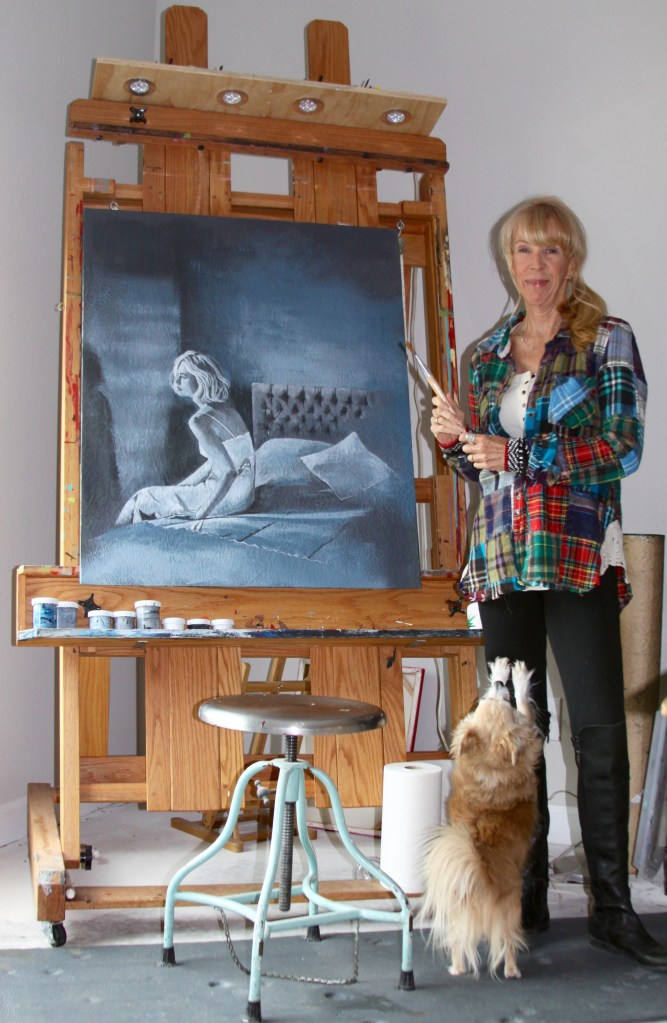
Mary Jo with her latest work-in-progress and little Topo yearning to be petted.
Human hair was Mary Jo’s artistic medium-of-choice for 30 years. She didn’t card human hair like wool and knit animal sweaters; the hair was always attached to the human. Instead, she used her design skills, color sensibilities and shears to transform the coiffure of thousands of Manhattan women for nine years, and then for hundreds of Steamboat, Colorado, women as proprietress of “The Gallery” for 20 years.
Mary Jo retired from being a hair dresser in 2013 and lives with her electrical engineer husband, Hans, in New River, Arizona, on a dirt road that climbs past their home and meanders up the base of Apache Peak. Raw desert views surround and city noises do not penetrate, just silence marked by the occasional rooster crow, propeller plane or all-terrain vehicle. Hans, originally from Norway, can often be found in the yard, spreading gravel, and building walls and botanical gardens designed by Mary Jo. Their shared vision has manifested in little niches of delight.
A small zen area made peaceful by Mary Jo’s wall and colorful planters.
Mary Jo sketched and painted for most of her life. At age 8, she was invited to attend a summer program at the Art Institute in Dayton, Ohio, where she was born and raised. “I was naturally drawn to painting,” Mary Jo said, “and always gravitated toward painting models in magazines like Seventeen and Glamor. My paternal grandfather was a chemist who painted portraits and landscapes as his creative outlet. When I visited, he’d play Opera and we’d discuss the art of painting.” Mary Jo had seven brothers and sisters, so support for her passion from her parents wasn’t strong, even with a grandfather who painted.
Mary Jo bought her first paint-by-number set at age 12. She saved the paint and brushes so she could paint on paper plates or on paper her father brought home from his paper salesman job. In the 6th grade, she won a safety poster contest, beating all other entries from across Dayton, Ohio, and was awarded $15, in addition to having her poster printed. Affirmations of her artistic talents continued over the years, with the exception of an episode with a nun in her Sophomore year of high school.
Departure 48″ x 36″ oil on canvas.
The assignment was to paint a landscape picture. “I actually painted from a photograph I had taken,” Mary Jo said. “My instructor, a nun, saw the photo on my desk, took my painting up to the front of the room and ripped it up in front of the entire class. She then said, ‘Mary Jo will grow up to be a convict and will be thrown in jail because she copied from a photo.’”
“In that instant,” Mary Jo continued, “I knew I had to get out of that school. I forged the principal’s signature on some paperwork so they would expel me, which they did. When I switched to a public school, the art teacher encouraged me and I ended up winning an award in Cincinnati, Ohio, for a sculpture. He made me realize I could actually go to college even though the Catholic school insisted I wasn’t college material.”
Mary Jo studied painting at Ohio State for two years and later returned to college to study interior design. She also dreamed of becoming an architect, and a few years later found herself in jobs that used her creativity. She worked with a Denver architectural firm and was being trained in lettering and rendering. She also worked for a silk-screening company designing t-shirts. Eventually, while Mary Jo moved between Steamboat, Colorado, New York City and Scottsdale, she went to beauty school in New York.
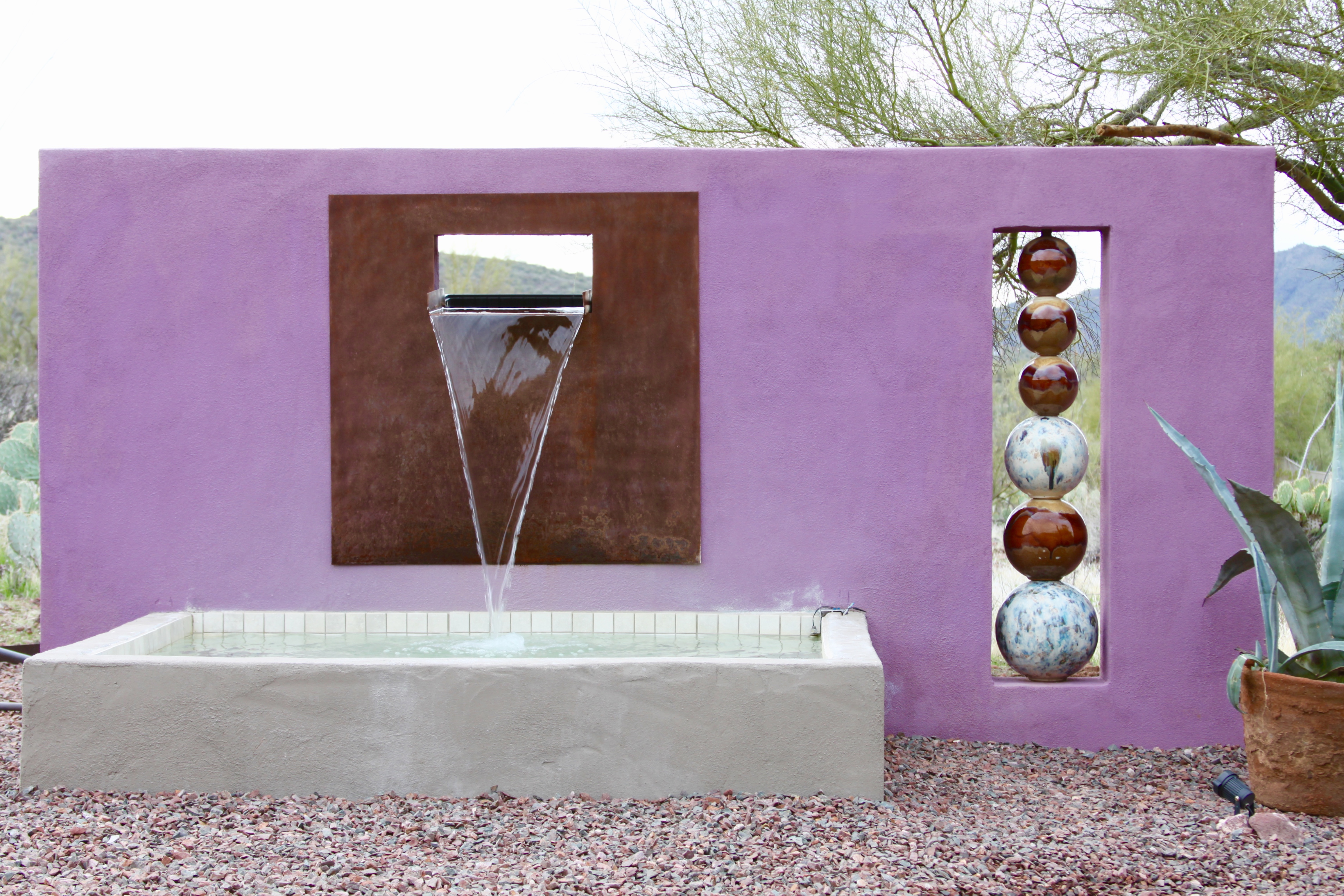
Gorgeous water feature and wall designed by Mary Jo and built by Hans.
“I was lucky to be hired at Henri Bendel,” said Mary Jo about the iconic 120-year-old women’s speciality store. “I worked at the salon of Jean Louis David in Henri Bendel. I received top-notch experience for nine years. It’s a famous store with famous clients, so working there was always interesting and fun. Also, in those days, Studio 54 was the place to be after hours in New York, and as a hairdresser we were always welcome to come right in.”
Life happened while Mary Jo was making other plans. She married, her son Tyler, and later divorced. Back in Steamboat, Colorado, she opened “The Gallery.” Why call a hair salon a gallery? “I had an art studio in the building and sold my paintings. However, within six months I was so busy with hair styling I quit doing art, except for the occasional sketch.”
Lover Boy 48″ x 36″ mixed media.
My Countessa – 36″ x 48″ oil on canvas.
Blue Rhapsody – 30″ x 40″ oil on canvas.
Mary Jo may have quit doing “traditional” art during those years, yet it’s clear she simply channeled her artistic talents into being a hair designer… and many women benefitted!
There are a lucky few of us New Riverites who have the privilege of wearing Mary Jo’s artwork on our heads these days. Hans installed a professional salon sink and stool in her art studio, enabling Mary Jo to continue her hair artistry. It’s like going to a Henri Bendel’s hair dresser, but at a much lower price and only a short walk through our neighborhood.
In recent years, Mary Jo has created several large paintings, some of them multi-panels. A few pieces of her work are exhibited at Easy Street Galleria in Carefree, Arizona. In fact, one of her 8′ x 4′ foot paintings was chosen from among the gallery’s many offerings to be exhibited on the exterior of the gallery. One client commissioned a 9′ x 5′ foot painting, which Hans helped her build and install in the client’s Cayman Islands home.
On left Heart of Gold 36″ x 48″ and on right Heartfelt 48″ x 36″. Both are acrylic on canvas with gold leaf and 3 layers of clear acrylic resin.
Hans is as much a creative partner to Mary Jo’s painting career as he is her life and business partner. He moved to Steamboat to help Mary Jo when she started her wholesale company, Rodeo Cosmetics, and two retail stores, Cowgirls and Angels, and Yippie-I-O.
Hans builds the framework for many of her paintings and helps coat some of them with epoxy. He even encouraged her to go to Bali for two months in 2013 to study with an abstract master painter, Carja. Mary Jo had just retired from styling hair and was ready to get serious about painting. She ended up extending her Bali trip an extra month after adopting three baby monkeys and helping to raise them until they were placed in good homes.
Carja is known for his huge abstract paintings. “He didn’t teach us how to paint,” Mary Jo said. “He taught us how to paint from within. He’d tell us to close our eyes and mix paint colors, and feel it. He gave me permission to let go of rules and open up to painting from my emotions. He told me to just paint, every day if possible. ‘You’re style will come,’ he told me, ‘and you’ll be selling your work within three years.’”
Mary Jo began selling her paintings soon after returning to New York.
Glory of the Flower 24″ x 18″ oil on board.
Is Mary Jo a Feminist? Maybe not a politically active feminist, but her work has always centered on helping women feel good about themselves, and not just on the surface. While making and selling women’s beauty products, and styling hair, Mary Jo mastered the art of connecting with her clients on topics that matter. Topics that nurture the heart and mind, then work their way outward. People find it extremely easy to relate to Mary Jo and often feel immediately comfortable with her.
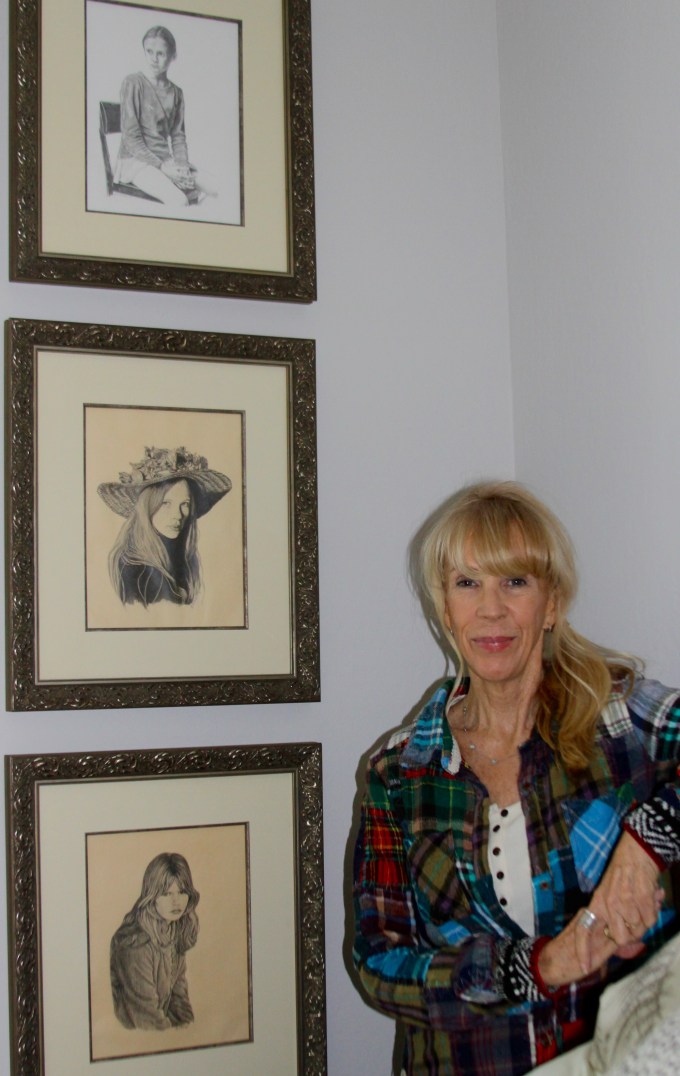
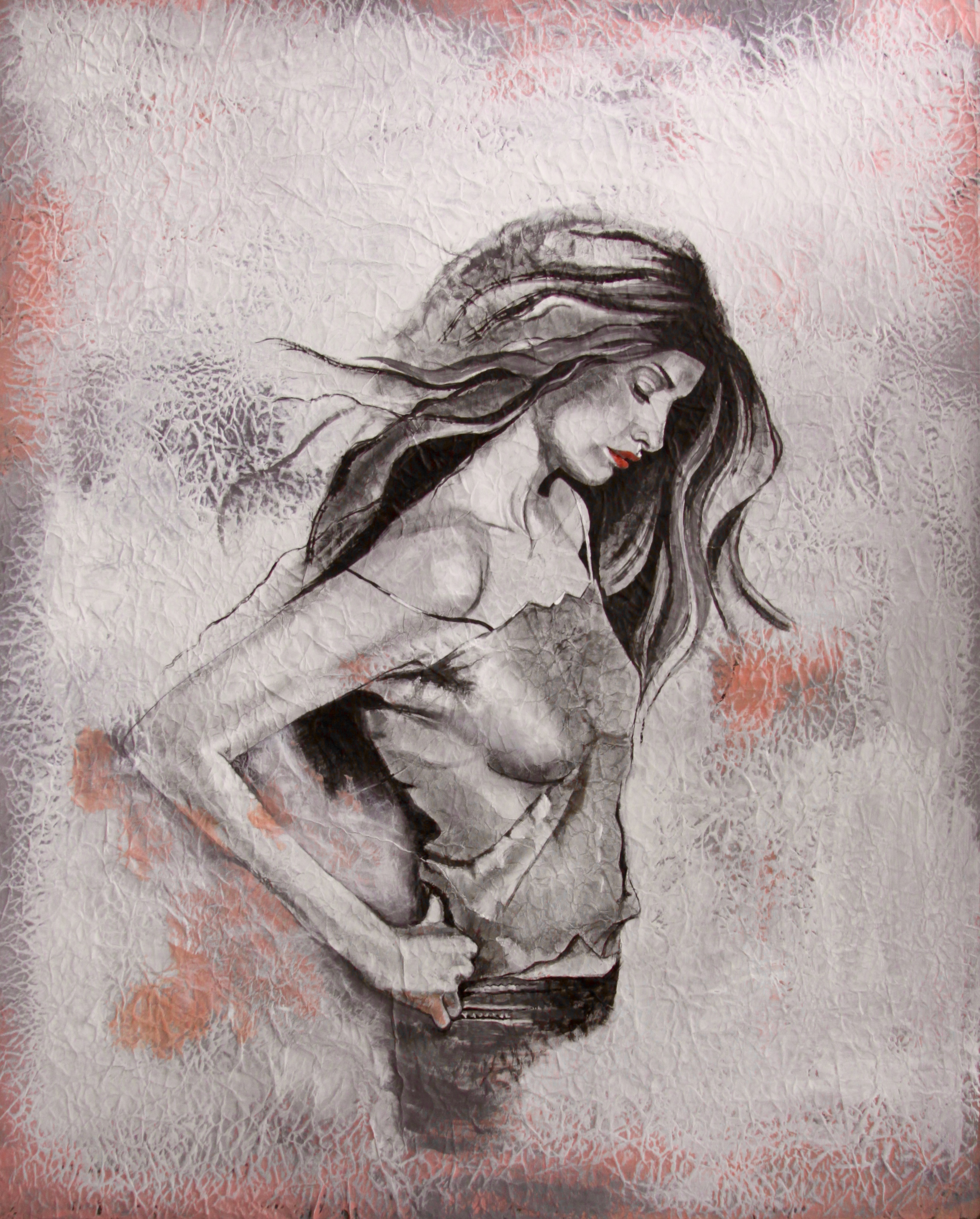
It’s no coincidence that from an early age, Mary Jo was compelled to draw women. She has three examples of early sketched portraits framed in her guest bedroom, and her latest project was inspired by the 2016 presidential election results. “I was at an appointment the day after the election and the technician, who was African-American, told me her little girls had asked at breakfast that morning, ‘Does this mean they will bring back lynching?’ She and I both cried, and I knew I had to portray in my art that emotional state of women and minorities. I went straight to my studio and started painting.”
Her focus on women has come full circle.
Mary Jo poses next to her earlier women’s portraits.
Mary Jo is painting the new women’s series on textured wallpaper given to her by her brother. She leaves the side edges raw. “I didn’t realize how difficult it would be to paint over the textures, but I was drawn to the paper for this series as a representation of life’s complexity. Plus, my brother, who gave me the paper, is a member of the LGBTQ community, and I’m painting to give expression to all minorities and groups often ignored or, worse, vilified.”
River of Tears 44″ x 35″ Mixed media: the first in Mary Jo’s women’s series.They Say I am a Dreamer 38″ x 28″ mixed media: the second in her women’s series.
Love is my Alibi 38″ x 32″ mixed media: Work-in-progress.
Mary Jo’s well seems bottomless as she focuses outward, listening like the professional she is after years of bonding with her clients. But Mary Jo has a rich inner life, the source of her creativity. And that’s what we’re here to talk about!
Q&A
Q: How do you describe your creative drive?
A: There’s a special feeling I get when I’m connected to my art. Like a high, or an adrenaline rush. I like to get some good music going and just lose time and get into the space. It’s the same feeling I get when I do something for someone else. I’m inspired by photographs and live entertainment. My response to learning more about elephants as endangered species was to paint them. My current project, a series of charcoal and oil paintings of women, came from watching Trump disparage and objectify women. My portraits emphasize the humanity in women.
Q: How have your life lessons contributed to your art?
A: I started out in life being a people pleaser and wanting to be loved. I wanted to prove to myself that I could be good at something, and that I was a survivor. It made me strong and brought me to this moment where art is central to my life.
Q: What is some good advice you can give creative people trying to start their own art thing?
A: Get a sketchbook and keep it with you, place it on the night stand next to your bed. Sketch before you fall asleep and when you wake up, and any time during the day. Close your eyes and sketch. Sketch your feelings. The more you create, the more comfortable you’ll become creating.
Q: Who influences your art style the most?
A: My brother’s partner, Sylvan, was an amazing artist before he died of AIDS. He taught me how to use leafing with gold, bronze or silver, and I still use leafing today. I also appreciate Georgia O’Keefe and never fully appreciated how similar our styles are until I moved West and began painting cow skulls and flowers.
Mary Jo’s Cre8-Space
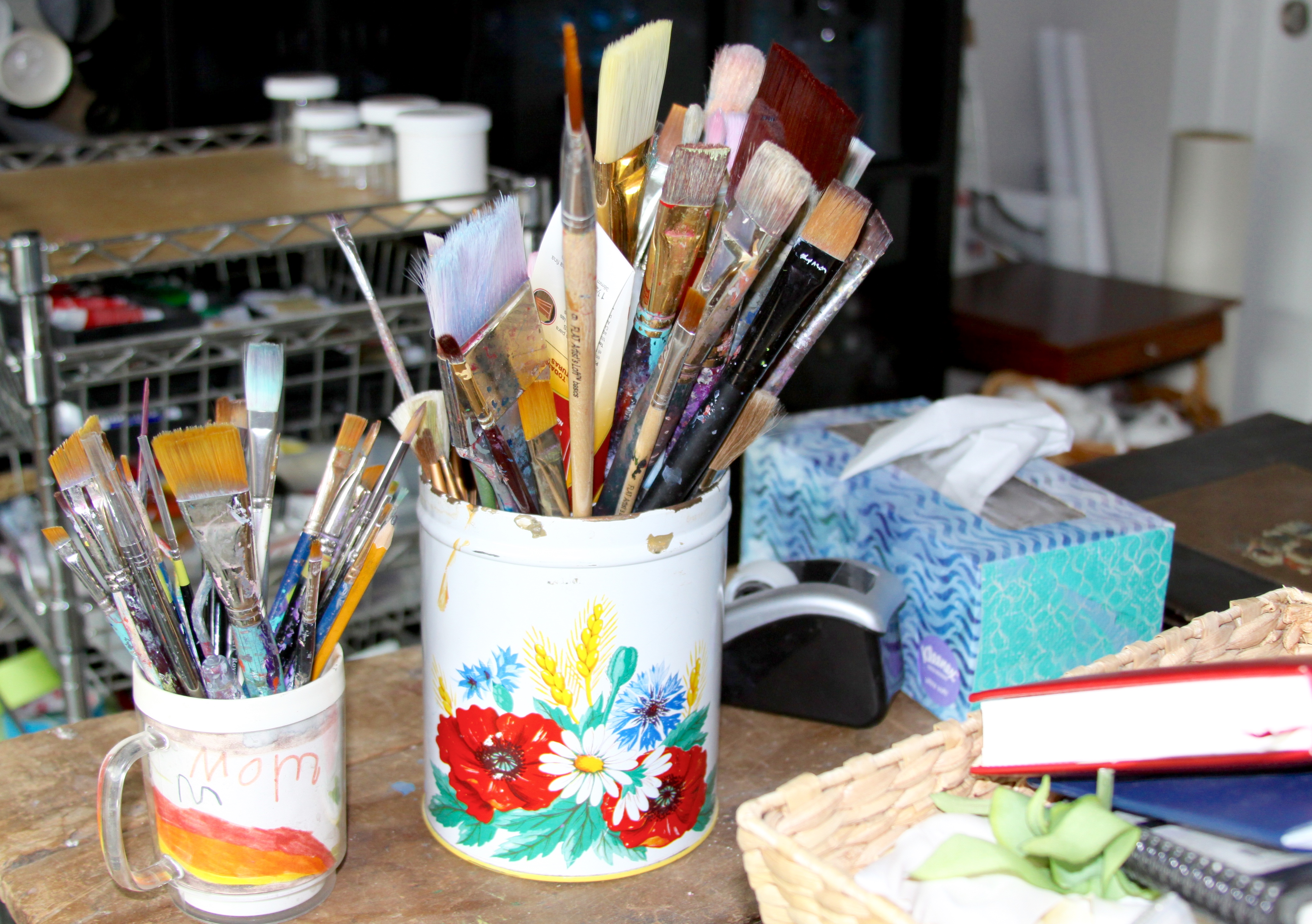
The essentials.
She uses the magnifying glass while painting details.
Mary Jo and Topo relax in her art studio’s salon chair.
More supplies easily at hand.
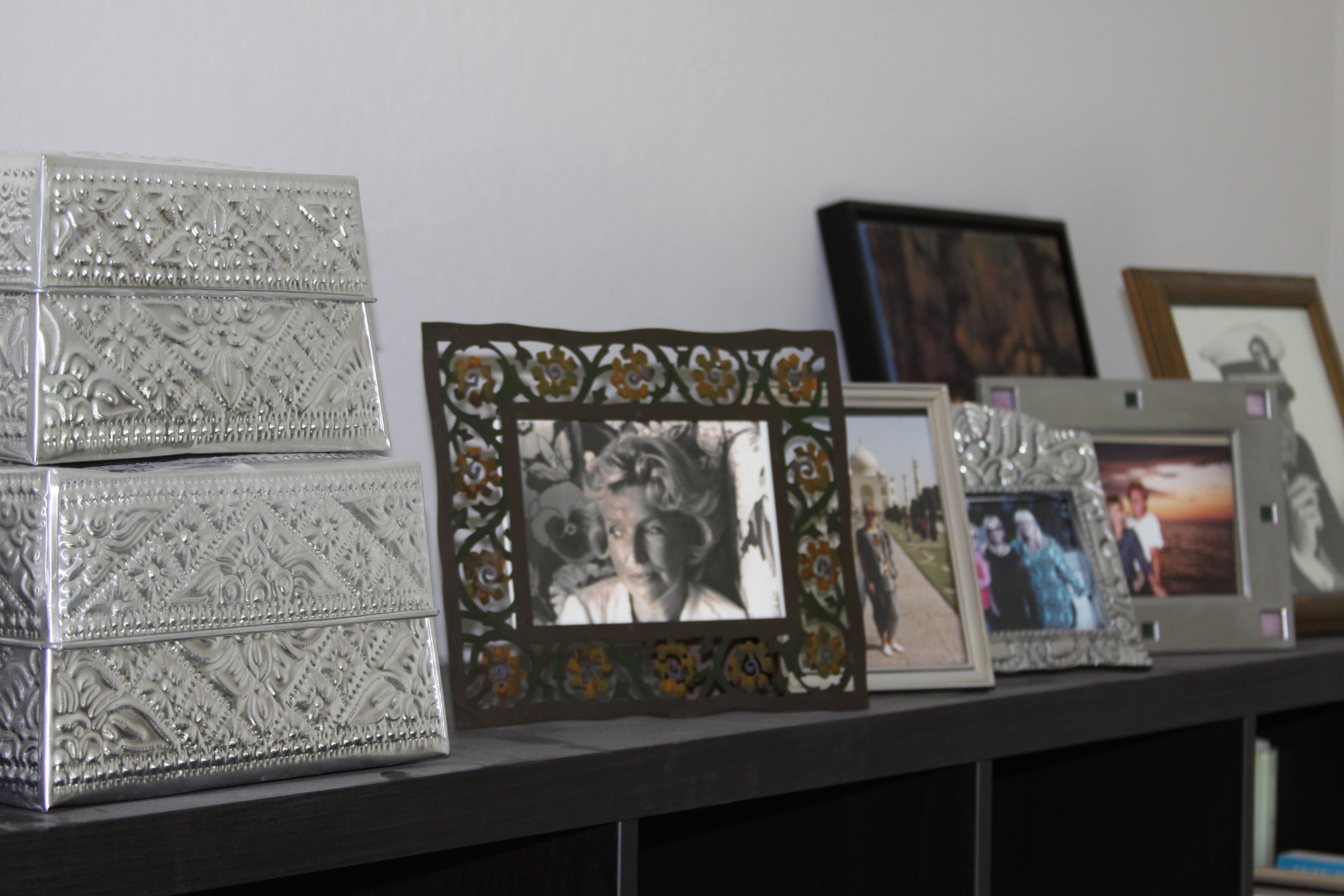
Mementos from her life, each with a story about someone or something she loves.
Mary Jo’s Cre8-space is organized!
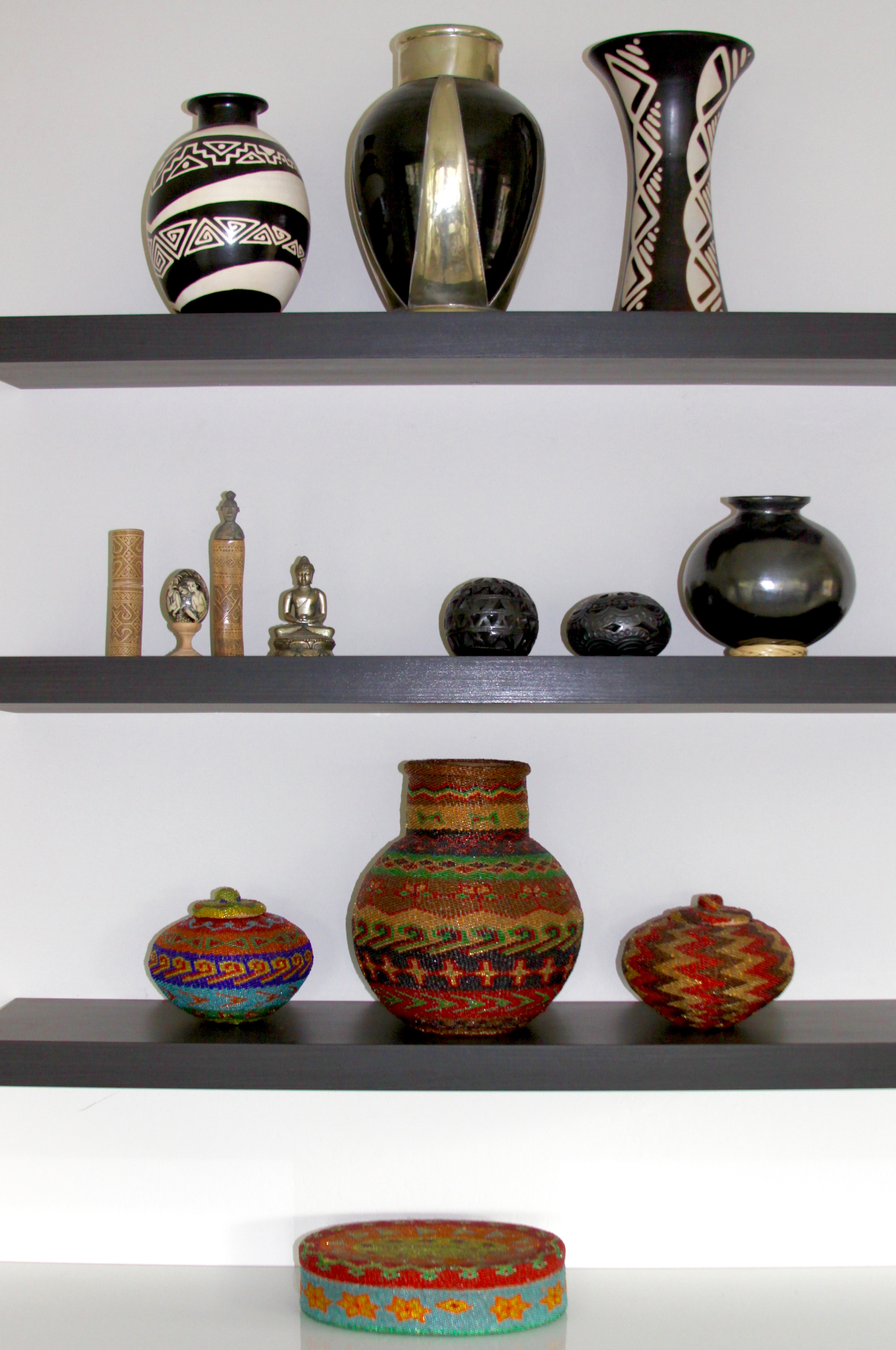
Inspirational pretties from Morocco (top shelf), Mexico (black pieces) and Bali (remaining items, including stunning beaded vessels).
Family photos keep family in her thoughts; her mother’s photo is most prominent.
An early work surrounded by clay vases.
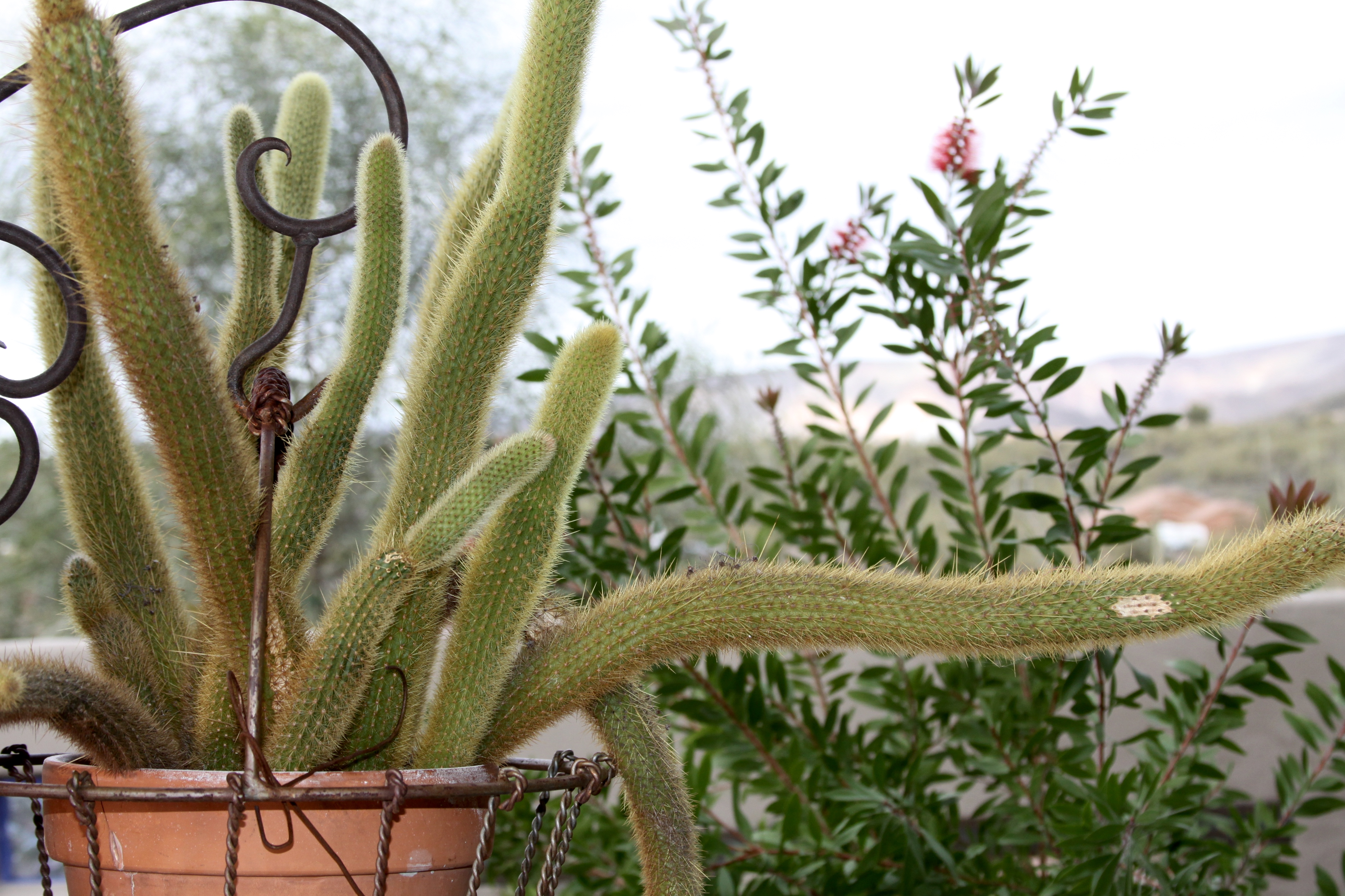
Succulents and other desert plants enliven Mary Jo’s dreamy back patio.
Tree jewelry is a favorite!!
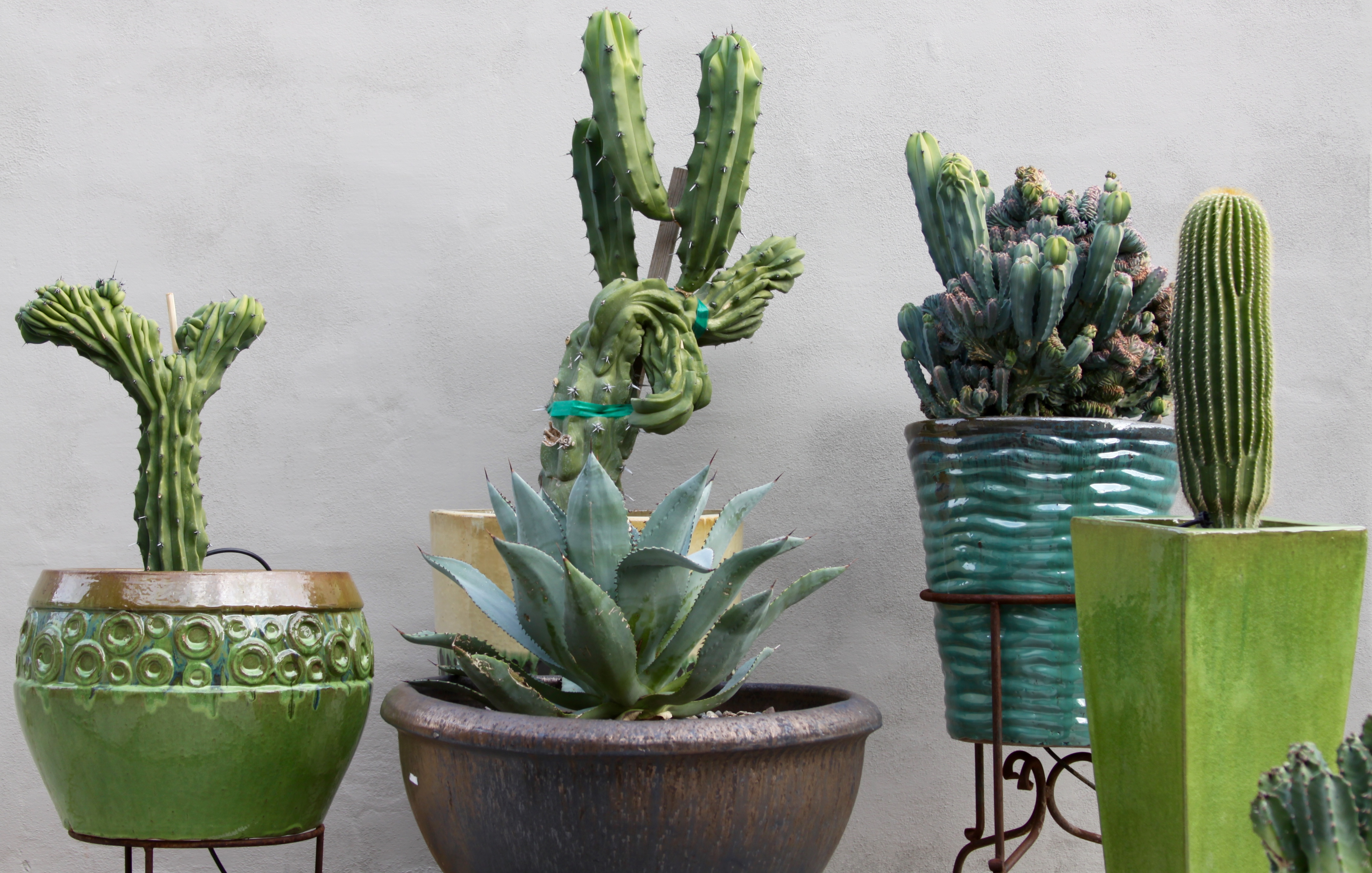
Placing cacti in elegant pots is an art unto itself.
Bright, living colors bring energy to Mary Jo’s Cre8-space.
Good mix of reverence and humor in her Patio decor.



















 Cre8-Space