Navigating the Art Institute of Chicago may be like navigating O’Hare airport for the first time, just without the crowds, but helpful guides are on hand to out you straight. PLUS, the museum allows visitors to photograph most works of art!!!
Even with plenty of signage pointing the way, and with a color-coded floor plan map as reference, I had difficulty locating several sections on a recent visit. Each time, Sandy was right there to graciously point me in the right direction, even saying, “I’ve been here a while and am still learning my way around.”
With only four hours to roam the museum, I focused on viewing paintings and started with the Impressionist section for which the Institute is know, and then moved to the special Rodin exhibit (they’re not paintings, but couldn’t pass up seeing the sculptures!).
The gallery of Modern paintings was my favorite, which surprised me. Abstracts, stark lines and dull or dark colors usually don’t move me. But not this time.
Below are some of the paintings that drew me in. All are oil on canvas unless otherwise noted. Dimensions are in inches. Sorry for the inconsistency in how each work is framed… I shot the pics with an iPhone. Happy Browsing!
Art Institute Photos
Louis Anquetin, An Elegant Woman at the Elysee Montmartre, 1888 (28 3/8 x 35 5/8).
This painting’s bright colors caught my eye, and then I noticed the unusual black outlines. Wikipedia writes, “Around 1887, Anquetin and Emile Bernard developed a painting style that used flat regions of color and thick, black contour outlines. This style, named Cloisonnism by critic Edouard Dujardin, was inspired by both stained glass and Japanese ukiyo-e.”
Claude Monet, Water Lily Pond,1900 (39 3/4 x 35 3/8).
Monet re-routed a river to create his marshy backyard specifically as a subject for his paintings… and to please his eyes. He created 18 Versions of this scene.
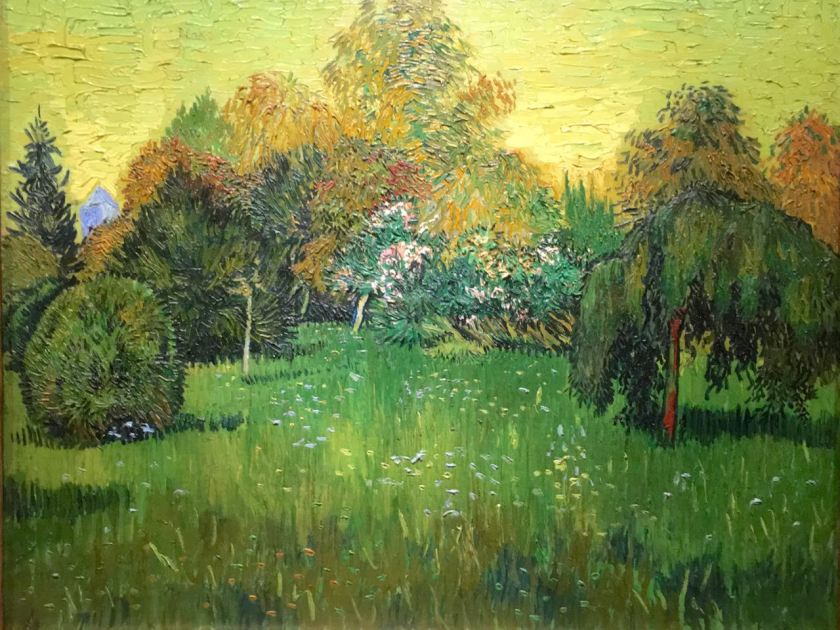
Vincent Van Gogh, The Poet’s Garden,1888 (28 3/4 x 36 1/4).
In a letter written around mid–September, van Gogh wrote that he had created a painting of “a corner of a garden with a weeping tree, grass, round clipped cedar shrubs and an oleander bush…there is a citron sky over everything, and also the colors have the richness and intensity of autumn.” This was the first of a four-painting series that would eventually hang in Gauguin’s house.
Van Gogh, The Bedroom, 1889 (29 x 36 5/8).
Van Gosh painted three similar pictures of his bedroom in the “yellow House” he rented in Arles, France. This was the second one, which he painted it while living at an asylum in St. Remy.
George Seurat, A Sunday on La Grande Jatte -1884. (81 3/4 x 121 1/4).
The La Grande Jatte, which means “the big platter,” was an island in the River Seine. Seurat used tiny brushstrokes of complementary colors next to each other so they blend at a distance but add dimension (and even a little sparkle). Art critics named this technique Divisionism, or Pointillism. His use of geometric shapes and accurate proportions contrasts with works of the Impressionists, making him a post-Impressionist.
Detail of A Sunday on La Grande Jatte -1884.
Claude Monet, Poppy Field (Giverny), 1890/91 (24 1/16 x 36 3/4).
Monet painted this poppy field four times, the same summer he started painting the stacks of wheat in 25 versions. It’s visually appealing.
Bonham Family Portraits, William Bonnell,1825 (12 x 9 14/16).
William Bonnell, an Amerian painter, painted William Bonham, his sonJ. Ellis Bonham from his first marriage, and Mrs. William Bonham (Ann Warford), his second wife. This queer, yet charming, little trio were completed in three successive days. I like the varied shading of the backgrounds, yet everything else is similar; biggish heads, smallish bodies made to recede even more in black, and each holding an object representing their interests. The man smokes a cigar, the boy reads a book and the woman holds a scarf.
Charles Biederman, American, Untitled, Paris,March 1937(45 5/8 x 35).
Biederman first studied painting at the School of the Art Institute of Chicago, then went on to study and paint in New York and Paris, where he was exposed to Cubists, Surrealists and other modern artists. Interestingly, he was dedicated to starting a new work each day.
Charles Sheeler, Western Industrial,1955 (22 7/8 x 29).
Sheeler was a painter and photographer known as a Precisionist. I love how the diagonal lines add movement to Inland Steel plant in East Chicago, Indiana.
Charles Sheeler, The Artist Looks at Nature,1943 (21 x 18).
Is he really looking at the disproportionate nature? Looks instead like he is drawing an antiquated stove based on a photograph he took in 1917. The museum says, “His self-portrait also relies upon a photographic self-portrait he took in 1931.” I like the lines.
Jacob Lawrence, American, The Wedding, egg tempera on hardboard, 1948 (20 x 24).
Lawrence painted from his every day life in Harlem and about the history of African-Americans in the U.S. This painting reflects a solemn wedding ceremony but also joy in the colorful flowers and, my favorite, the stained glass framing the scene.
Archibald J. Motley, Jr., Nightlife,1943 (36 x 47 3/4).
Motley depicts nightlife in Chicago’s Bronzeville neighborhood and paints diagonal lines and geometric shapes to represent jazz and motion.
Archibald J. Motley, Jr., Self-Portrait
Motley painted this self-portrait after the Chicago race riots of 1919. The museum says,”The violence convinced him that he should use his art to influence perceptions of African Americans in a positive manner.”
Thomas Hart Benton, Cotton Pickers, 1945 (32 x 48).
Benton painted this scene based on a trip he made to Georgia in the 1920s. It illustrates the dignity of sharecroppers, and how sharecropping kept agricultural laborers impoverished. The museum writes, “Benton held progressive views on race, social relations, and politics, and he believed ardently that African American history was central to the understanding of American culture.”
Grant Wood, American Gothic,1939. Oil on beaver board (30 3/4 x 25 3/4).
Wood publicly exhibited this painting for the first time at the Art Institute of Chicago, winning a $300 prize and instant fame. It’s still there! This photo is iconic, of course. Wood used his sister and dentist as his models.
Niles Spencer, Cape Cod,1926-27.
I was unable to find any details about this painting.
Georgia O’Keeffe, Spring,1923-24 (18 x 14).
O’Keeffe painted the building that held Alfred Stieglitz’s darkroom in Lake George, NY. Best known for her sensuous flower paintings, O’Keeffe portrays care and simplicity in this version of her husband’s humble studio.
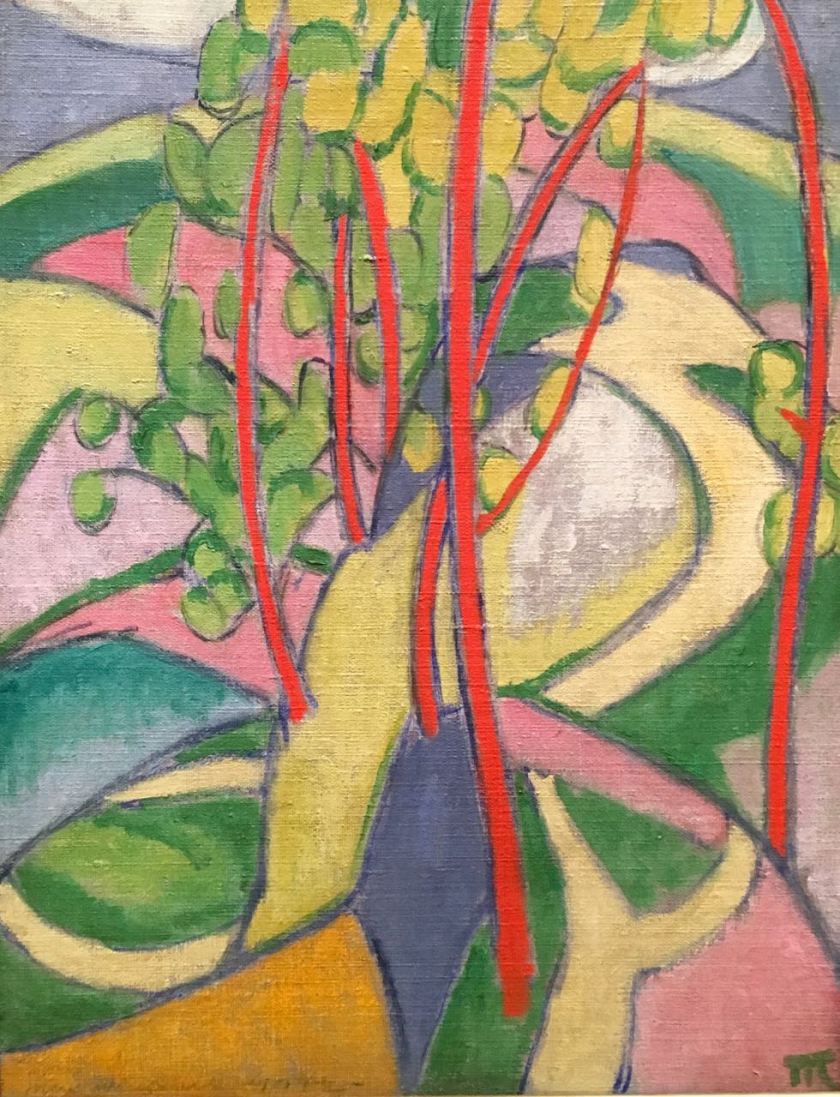
Marguerite Thompson Zorach, Landscape, 1911-12 (23 1/4 x 19 1/4).
The museum says, “Marguerite Thompson Zorach was one of the first Americans to embrace abstract art, and she exhibited her vividly colored canvases at some of the most important early exhibitions of modern art, including the 1913 Armory Show.”
Diego Rivera, Portrait of Marevna,c. 1915 (57 3/8 x 44 3/8).
Husband of Frida Kahlo and best known for his murals (and Socialist activism), Rivera early on studied in Paris and practiced Cubism. This is his Russian mistress,Maria Virobieff-Stebelaka, whom he called “a she-devil.”
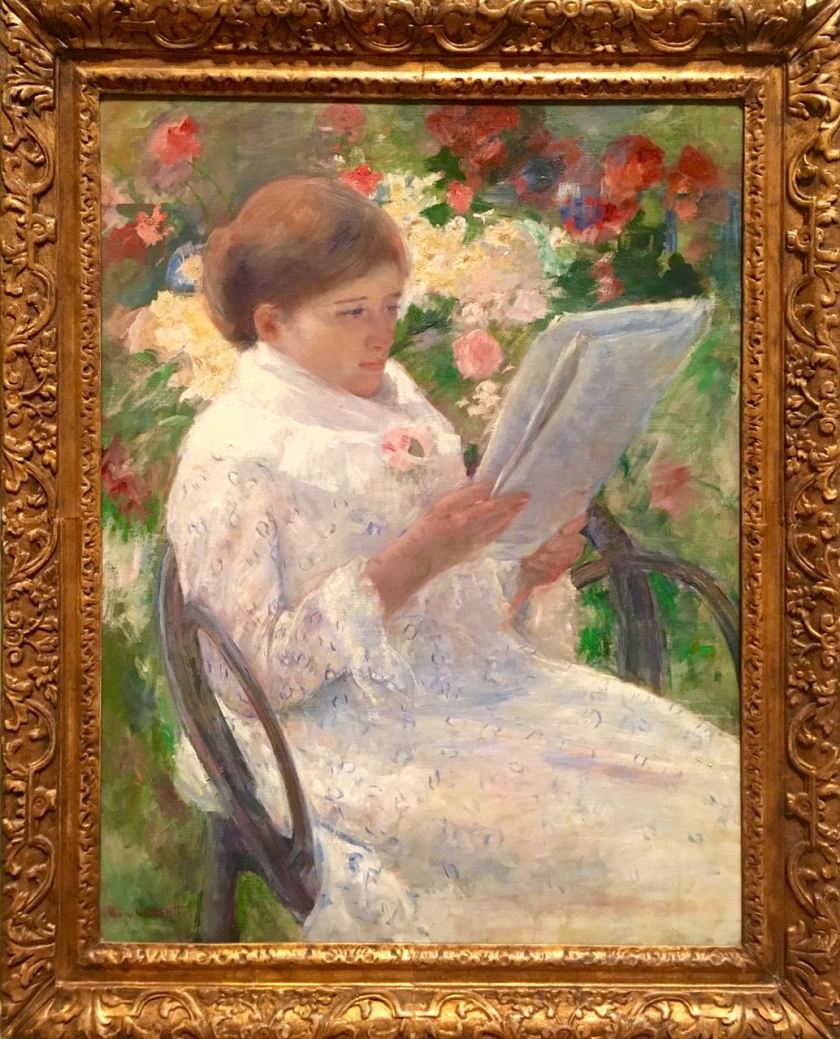
Mary Cassatt, On a Balcony,1878-79 (35 1/2 x 25 5/8).
One of Cassatt’s early Impressionist paintings. It’s pretty and shows the woman reading a newspaper rather than a novel. That’s a little progress for women.
John Singer Sargent, 1907, The Fountain, Villa Torino’s,Frascati, Italy (28 1/8 x 22 1/4).
All the international high society folks of his day wanted Sargent to paint their large portraits. Here he paints his friends,Wilfrid and Jane Emmet de Glehn, who are also artists.
John Singer Sargent, Rehearsal of the Pasdeloup Orchestra at the Cirque d’Hiver, c. 1879 (36 5/8 x 28 3/4).
Sargent painted this Impressionist piece as a student. Very different in perspective and technique from his well-known portraits of the global wealthy elite.
Shepard Fairey, Barack Obama Hope poster, 2008(24 x 36).
Willem de Kooning, Interchange,(sometimes called Interchanged), 1955 (79 x 69).
This painting sold at Sotheby’s of NY in 1989 for $18.8 million, the highest auction price ever paid for a contemporary artwork at that time. David Geffen privately sold the painting in 2015 for an estimated $300 million. I liked it for the powerful color bursts before learning about it’s value.
Alma Thomas, Starry Night and the Astronauts, 1972. Acrylic on canvas (60 x 53).
Thomas was the first fine arts graduate from Howard University. Born in Georgia, she taught art at a junior high school in Washington, D.C. for 35 years. Eventually, unfortunately, she stopped pursuing painting. The deep blue pulled me in, as did the brushstrokes and overall effect that reminds me of geometric quilts made by African-American women. This is one of my favorites!!
Roy Lichtenstein, Ohhh… Alright… 1964.Oil and manga on canvas (36.6 x 38).
This is relatively small compared to his usual giant pieces. Looking closely, it’s a marvel how he painted the dots so straight, like a machine.
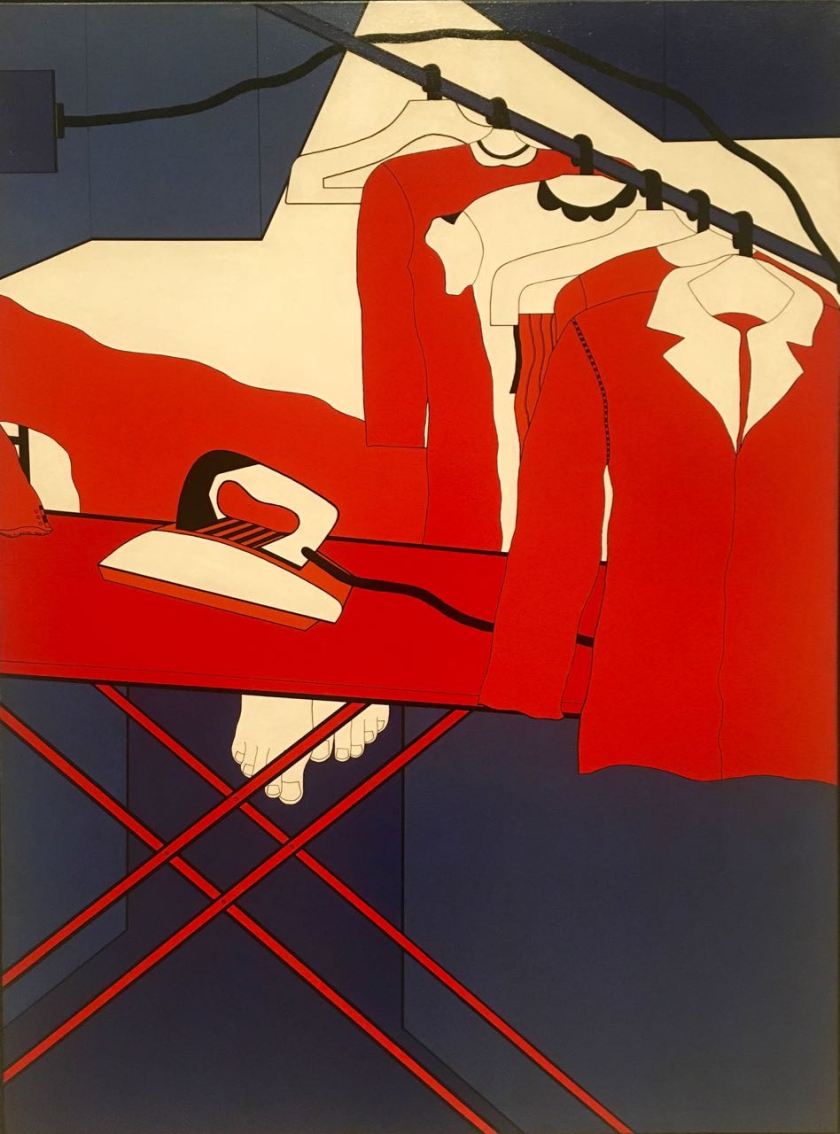
Roy Lichtenstein, Artist’s Studio: Foot Medication,1974 (96x 128).
Had to share this one because it involves an artist’s Cre8-space, and Lichtenstein modeled some features, like the plant and patterned wallpaper and tablecloth, on Matisse’s famously colorful home interiors.
Wanda Pimental, Brazilian, Involvement Series.1968-69 (51 1/5 x 38 3/5).
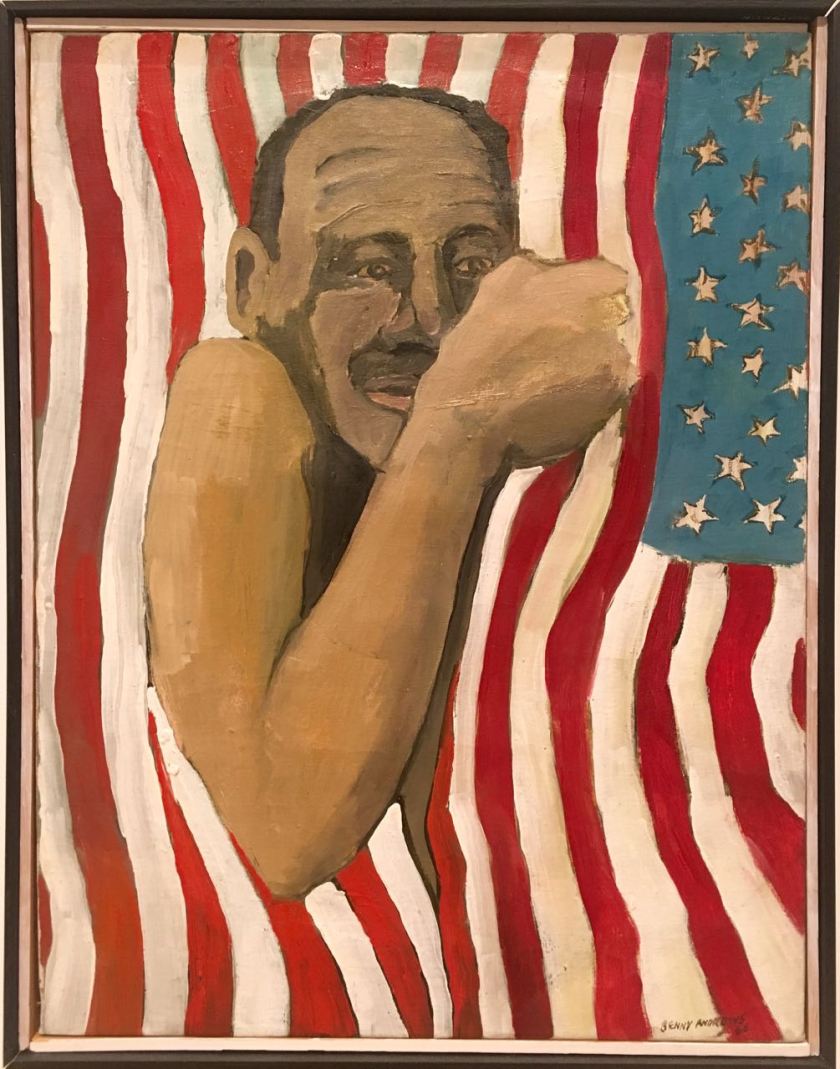
Benny Andrews, Flag Day,1966 (31 x 16 inches).
I love Benny Andrews’ art! With this painting, Andrews is believed to be making a commentary on how African American men are imprisoned; this gentleman is trapped in the stripes of the U.S. flag.
Robert Ryman, Untitled, 1962.Oil on Linen (69 1/2 × 69 1/2)
Ryman’s painting may seem white, which attracted me, but other colors pop up, along with the burlap-colored linen background around the edges. He painted a series of these large-scale works in 1962 .
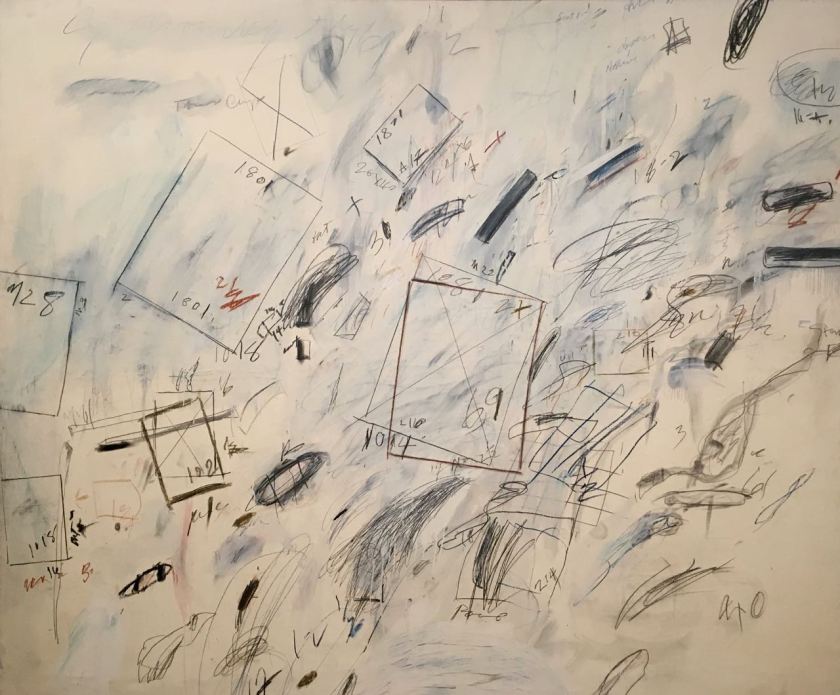
Cy Twombly, American, Untitled (Bolsena),1969. Oil-based paint, wax crayon and graphite on canvas (78 1/2 x 94 1/2).
Lots to look at here. Twombly has ardent fans, one of which is Ralph Rucci, the couture designer who collects Twombly’s works. Rucci has even used Twombly canvasses in playful French needlework on some of his clothing.
Andy Warhol, Four Mona Lisas,1978, acrylic and silkscreen ink on linen (50 x 40).
Well, I had to share at least one Warhol, and this one is based on the work of a master, rather than a soup company (not that there’s anything wrong with appropriating every day items for art).
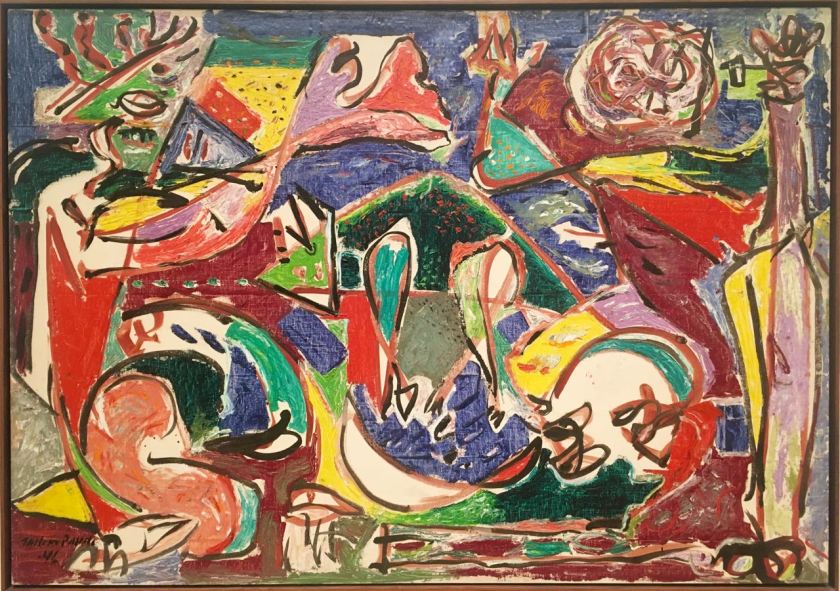
Jackson pollock, The Key,1946. Oil on linen (59 x 82 inches).
An expressive abstract, this work was painted in an upstairs bedroom and worked from all sides. It predates Pollock’s famous drip paintings, which were released the following year. The museum writes, “The Key belongs to Jackson Pollock’s Accabonac Creek series, named for a stream near the East Hampton property that he and his wife, the painter Lee Krasner, purchased in late 1945.”
One of Jeff’s earliest impulses to sculpt happened at Riazzi’s Italian Garden restaurant in Mesa, Arizona, circa 1964, when she was six years old.
Sculptress-in-Demand
One of Jeff’s earliest impulses to sculpt happened at Riazzi’s Italian Garden restaurant in Mesa, Arizona, circa 1964, when she was six years old.
“Our table had white candles,” Jeff said, “and I remember using my thumbnails to press the warm wax into shapes. Every time we ate there, I looked forward to playing with the wax. I always loved playing in the mud, too, because I could squeeze forms from the muck.” Sadly, Riazzi’s closed in August 2017 after 72 years in business, but Jeff continues to sculpt professionally and for fun.
“Over the Rainbow”
Growing up, Jeff stayed outdoors as much as possible, and claims to have been a Tom boy. “I was the perfect son for my father,” she laughs. Her father, Wade Hoffman, hailed from Gastonia, North Carolina. He’s the reason she has a masculine name. “I think he really, really wanted a son after they had my older sister, Patricia,” Jeff said. “And sometimes he says he named me after the actor Jeff Chandler. Then why didn’t he name me ‘Chandler?'” she laughs.
Wade started his career in the U.S. Secret service. Eventually, he was sent to Japan where he met Shizuko, a big-city girl brought up on the Ginza strip in Tokyo, what Manhattan is to NYC, with all the big-city accoutrements, including a fine education and an impeccable fashion sense.
When they married in the late 50s, Wade could no longer be in the secret service, so he brought Shizuko and Patricia to Rock Hill, South Carolina, where Jeff was born in 1958. Three years later, Shizuoka could no longer stand the injustice of a segregated south and insisted they move. After traveling throughout the U.S., Wade and Shizuko chose Phoenix to make a home for their family.
Jeff has spirit. She’s gentle and energetic, witty and considerate, and always creating something with her hands.
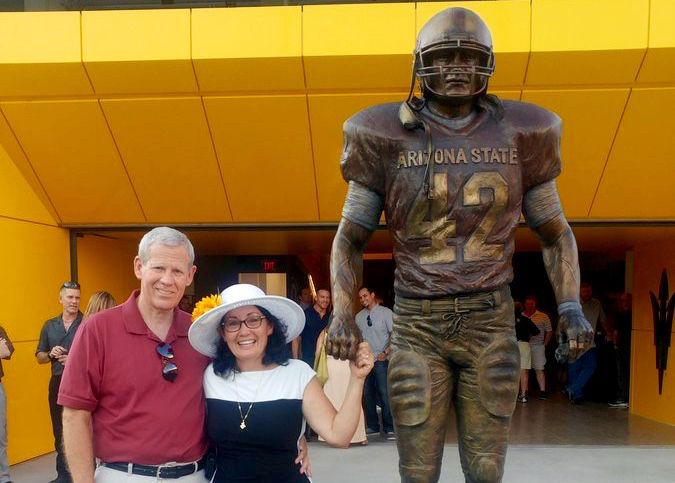
Jeff’s latest creation made the newspaper! She sculpted a life-size bronze statue of Pat Tillman posted at ASU’s Sun Devil stadium near the entrance of Tillman Tunnel. Arthur Pearce II provided funds for the statue and commissioned Jeff to do the piece.
Left: Jeff & Art Pearce at the Pat Tillman statue reveal, ASU Sun Devil Stadium, August ’17.
Tillman is remembered as a former Arizona Cardinals and ASU football player who enlisted in the U.S. Army in June 2002 in the aftermath of 9/11, and who, as an Army Ranger, was tragically killed in Afghanistan in 2004 by friendly fire.
Jeff sculpting the Pat Tillman maquette, or model.
Jeff sculpted the 16-inch maquette, or model, in clay from a photo of Pat with his long hair flowing and his ASU helmet in his hand. Officials at ASU however, asked to have Pat’s likeness crafted from photo of him wearing a helmet. She revised the model and re-submitted it to ASU.
In progress: Jeff’s maquette of Pat Tillman.
They approved the revised maquette and Jeff proceeded to work with local foundry Bollinger Atelier to digitize the model into a 3-D image, which was then enlarged to 1.1 times life size and cut out of foam to form the core of the statue. The foundry layered the foam with clay between 1/4 and 1/2 inch thickness all over.
Jeff later crafted the letters “ARIZONA” AND “TILLMAN” and laid them on the life-size clay sculpture. When she made the 16-inch maquette, it was too small to place raised lettering on the jersey.
The 6-foot, 400-pound statue was revealed in a dedication ceremony on Wednesday, August 30, 2017, and Jeff, her mother and husband Mike attended as special guests. With the statue’s unveiling, ASU’s new pre-game ritual involves players touching the statue as they run onto the field.
Jeff with the clay-covered core sculpture after the mold was made.
The entire process of producing the statue was emotional for Jeff, who, as an ASU graduate, followed Pat’s career and story.
How did a young Amer-Asian woman become a bronze sculptor?
After studying fine arts at Northern Arizona University (NAU) in Flagstaff, Jeff worked as a metal chaser at Beyond Bronze Foundry in Colorado, where she welded parts together, ground down metal to clean seams and other surface imperfections to make just-poured pieces look like one complete piece.
Back in Tempe, though, her parents had opened a Japanese restaurant and asked Jeff to come help out, which she did. Next, she began her 25-year stint at Arizona Bronze (now Bollinger Atelier), a foundry in Tempe, Arizona, where she worked as a metal chaser, then switched to wax works when the pneumatic tools caused her hands to hurt. Jeff used dental tools to take down wax seams and design the gating system that feeds the bronze into a mold. She also learned the art of mold making.
Miscellaneous pieces Jeff crafts as demos at school for her students.
“I love making molds!” Jeff said. “You must be methodical and plan everything out. It’s an engineering feat in mixing the rubber, brushing it on and them pulling the rubber as it sets.”
The one thing Jeff has never done at either foundry was pour the bronze. She also did not work on patinas for foundry clients, however, she occasionally adds patinas to her own works.
“To add a red patina to Pat Tillman’s ASU jersey, and a hint of gold to his pants,” Jeff said, “I brought in Aiya Jordan from San Francisco. Aiya is also an ASU grad and one of the best patina artists I know.”
Aiya Jordan adding patina
Preparing the surface for patina
There are at least 12 steps to producing a bronze sculpture and Jeff became intimate with them all during those 25 years. Here’s a five-minute video of a “How It’s Made” episode showing the lost-wax casting technique.
“I did the fine detail work on projects,” Jeff said. “If a piece required detailed precision, I’d have the stamina and small motor skills to make it right.”
Jeff with Zebulon Pearce statue in Mesa, Arizona.
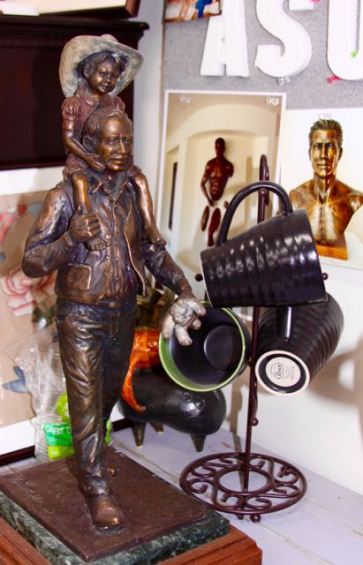
Having Art Pearce as a client means Jeff went from being a long-time employee of the foundry to being their valued customer. Before Pearce commissioned the Tillman statue from Jeff, he had asked her to create a bronze statue of his grandfather, Zebulon Pearce, a former Mesa mayor who owned the local Feed & Grain store on Main Street located at 155 W. Main Street. Zeb Pearce is also known for bringing Coors beer to the valley.
Like most folks, Jeff’s life hasn’t been all work. She married, had two sons Jeff and Cori, divorced and then married Mike, a retired NAU police officer, 21 years ago. Mike also has adult children; Michael, Lisa and Kyla.
During her annual performance review 11 years ago, the foundry owner told Jeff her salary had topped out; if she wanted more money, she needed to work elsewhere.
“Like many people who hit a dead-end in their job,” Jeff said, “I considered going back to school to learn new skills.”
Art Studio inspiration.
A Friend suggested Jeff teach art; the pay is okay and benefits are really good, especially having summers off! Jeff applied to an education program offered by the Deer Valley Unified school district and Arizona State University. Having a bachelors degree was a pre-requisite. Of the 22 students accepted into the program, Jeff was one of 11 who made it all the way through.
She started teaching 10 years ago, initially instructing 4th graders. Four years ago, she went to Sandra Day O’Connor High school to teach art and ceramics.
“I enjoy building relationships with the kids, and I learn so much from them, Jeff said.”
Jeff challenges herself to make something every day. In class, as the kids work on their sculptures, Jeff molds earthenware clay into small animals or abstracts.
“Sometimes, the little thing I’m sculpting becomes the inspiration for a statue, like the boy playing soccer, called ‘Over the Rainbow.'”
“Learning Together” won first place in the Prescott Valley art show and now sits in public spaces of Prescott Valley, Mesa, and Oro Valley. Jeff has other public sculptures, including the “K9 Police Memorial” at Wesley Bolin Plaza in Phoenix and Vancouver, Canada, “Charlie” at Wickenburg Ranch, and the “Scottsdale Police Memorial.”
Boy’s head from “Over the Rainbow” sculpture, plus forms for making animals.
“Learning Together” won the people’s choice award and features a boy with a ball and a dog ready to fetch. Jeff has a knack for making her subjects appear weightless and buoyant, even though they’re cast in bronze. And her style touches hearts, as evidenced by the connection between the boy and his dog while playing catch.
“Learning Together”
Charlie was Merv Griffin’s dog, and Merv donated the land in Wickenburg that became the Dog Park where Charlie watches over the visitors.
“When my students see my sculptures in a public place,” says Jeff, “they come up to me with eyes wide, asking for my autograph, and I remind them I’m still the teacher they’ve always known. I’m me.”
Even on the days when Jeff sculpts at work, she still arrives home and sculpts or paints. Usually, she works in her detached art studio, which she and Mike built in 2016. Their house in New River sits on a hill and their backyard looks out toward hills and into a valley.
“I look around and am amazed at how much I’ve produced,” Jeff said. “I was in a local gallery one day and admired a little bronze piece, an alligator bag on the back of a horse sculpture, and I said, ‘how would they do that?’ The gallery owner said, ‘Don’t you remember, you made that?’”
Jeff laughs at having made so many tiny bronze items and not being able to remember them all. If an artist needed a small item for their sculpture, they would ask her if she would create it. She’s made everything from that small alligator bag for a horse, to guns, holsters, rabbits, cats, and even a cowboy riding an armadillo. The last item was for an artist from Texas.
Musical instruments called ocarinas made by Jeff.
When Jeff’s students complain about not being creative, she asks them if, when they play video games, do they go through all levels the first day. “Of course not,” Jeff said, “the more you play, the better you get. It’s the same with sculpting, or anything you do. I’ve been sculpting for 40 years, which is why my students think it looks easy.”
Her advice for anyone who wants to make a living doing the creative work they love is to “keep with it. That’s what I was told by my professor. The artists who make it are the ones who don’t quit. Work, work, work. You get a little bit better each time.”
GALLERY OF STUDIO AND PUBLIC ART PIECES
K9 Police MemorialScottsdale Police StatueJeff playing her handmade ocarina.Charlie, Merv Griffin’s dog, at Wickenburg Ranch Dog Park.
Mary Jo perfected the art of hair styling before she plunged into painting with all her heart.
Mary Jo Strauss, Artist
Her mediums: oil, acrylics, charcoal, pencil
Her website: maryjofinearts.com
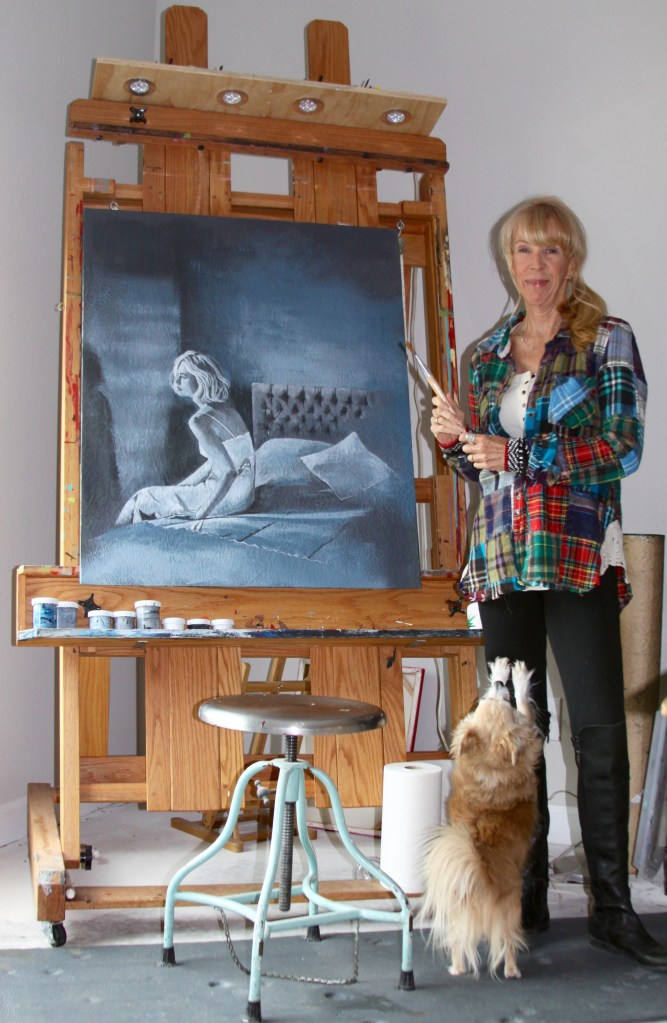
Mary Jo with her latest work-in-progress and little Topo yearning to be petted.
Human hair was Mary Jo’s artistic medium-of-choice for 30 years. She didn’t card human hair like wool and knit animal sweaters; the hair was always attached to the human. Instead, she used her design skills, color sensibilities and shears to transform the coiffure of thousands of Manhattan women for nine years, and then for hundreds of Steamboat, Colorado, women as proprietress of “The Gallery” for 20 years.
Mary Jo retired from being a hair dresser in 2013 and lives with her electrical engineer husband, Hans, in New River, Arizona, on a dirt road that climbs past their home and meanders up the base of Apache Peak. Raw desert views surround and city noises do not penetrate, just silence marked by the occasional rooster crow, propeller plane or all-terrain vehicle. Hans, originally from Norway, can often be found in the yard, spreading gravel, and building walls and botanical gardens designed by Mary Jo. Their shared vision has manifested in little niches of delight.
A small zen area made peaceful by Mary Jo’s wall and colorful planters.
Mary Jo sketched and painted for most of her life. At age 8, she was invited to attend a summer program at the Art Institute in Dayton, Ohio, where she was born and raised. “I was naturally drawn to painting,” Mary Jo said, “and always gravitated toward painting models in magazines like Seventeen and Glamor. My paternal grandfather was a chemist who painted portraits and landscapes as his creative outlet. When I visited, he’d play Opera and we’d discuss the art of painting.” Mary Jo had seven brothers and sisters, so support for her passion from her parents wasn’t strong, even with a grandfather who painted.
Mary Jo bought her first paint-by-number set at age 12. She saved the paint and brushes so she could paint on paper plates or on paper her father brought home from his paper salesman job. In the 6th grade, she won a safety poster contest, beating all other entries from across Dayton, Ohio, and was awarded $15, in addition to having her poster printed. Affirmations of her artistic talents continued over the years, with the exception of an episode with a nun in her Sophomore year of high school.
Departure 48″ x 36″ oil on canvas.
The assignment was to paint a landscape picture. “I actually painted from a photograph I had taken,” Mary Jo said. “My instructor, a nun, saw the photo on my desk, took my painting up to the front of the room and ripped it up in front of the entire class. She then said, ‘Mary Jo will grow up to be a convict and will be thrown in jail because she copied from a photo.’”
“In that instant,” Mary Jo continued, “I knew I had to get out of that school. I forged the principal’s signature on some paperwork so they would expel me, which they did. When I switched to a public school, the art teacher encouraged me and I ended up winning an award in Cincinnati, Ohio, for a sculpture. He made me realize I could actually go to college even though the Catholic school insisted I wasn’t college material.”
Mary Jo studied painting at Ohio State for two years and later returned to college to study interior design. She also dreamed of becoming an architect, and a few years later found herself in jobs that used her creativity. She worked with a Denver architectural firm and was being trained in lettering and rendering. She also worked for a silk-screening company designing t-shirts. Eventually, while Mary Jo moved between Steamboat, Colorado, New York City and Scottsdale, she went to beauty school in New York.
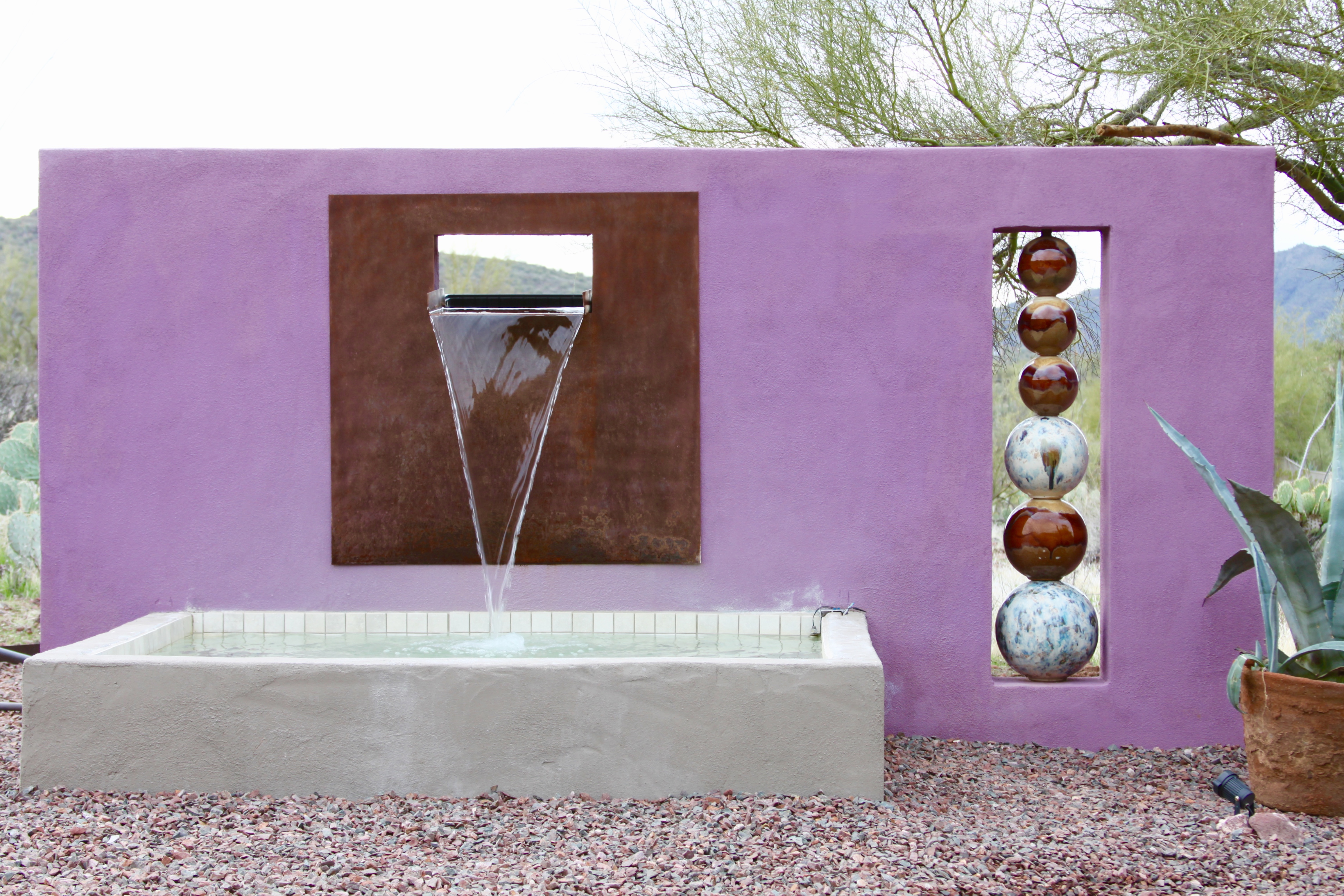
Gorgeous water feature and wall designed by Mary Jo and built by Hans.
“I was lucky to be hired at Henri Bendel,” said Mary Jo about the iconic 120-year-old women’s speciality store. “I worked at the salon of Jean Louis David in Henri Bendel. I received top-notch experience for nine years. It’s a famous store with famous clients, so working there was always interesting and fun. Also, in those days, Studio 54 was the place to be after hours in New York, and as a hairdresser we were always welcome to come right in.”
Life happened while Mary Jo was making other plans. She married, her son Tyler, and later divorced. Back in Steamboat, Colorado, she opened “The Gallery.” Why call a hair salon a gallery? “I had an art studio in the building and sold my paintings. However, within six months I was so busy with hair styling I quit doing art, except for the occasional sketch.”
Lover Boy 48″ x 36″ mixed media.
My Countessa – 36″ x 48″ oil on canvas.
Blue Rhapsody – 30″ x 40″ oil on canvas.
Mary Jo may have quit doing “traditional” art during those years, yet it’s clear she simply channeled her artistic talents into being a hair designer… and many women benefitted!
There are a lucky few of us New Riverites who have the privilege of wearing Mary Jo’s artwork on our heads these days. Hans installed a professional salon sink and stool in her art studio, enabling Mary Jo to continue her hair artistry. It’s like going to a Henri Bendel’s hair dresser, but at a much lower price and only a short walk through our neighborhood.
In recent years, Mary Jo has created several large paintings, some of them multi-panels. A few pieces of her work are exhibited at Easy Street Galleria in Carefree, Arizona. In fact, one of her 8′ x 4′ foot paintings was chosen from among the gallery’s many offerings to be exhibited on the exterior of the gallery. One client commissioned a 9′ x 5′ foot painting, which Hans helped her build and install in the client’s Cayman Islands home.
On left Heart of Gold 36″ x 48″ and on right Heartfelt 48″ x 36″. Both are acrylic on canvas with gold leaf and 3 layers of clear acrylic resin.
Hans is as much a creative partner to Mary Jo’s painting career as he is her life and business partner. He moved to Steamboat to help Mary Jo when she started her wholesale company, Rodeo Cosmetics, and two retail stores, Cowgirls and Angels, and Yippie-I-O.
Hans builds the framework for many of her paintings and helps coat some of them with epoxy. He even encouraged her to go to Bali for two months in 2013 to study with an abstract master painter, Carja. Mary Jo had just retired from styling hair and was ready to get serious about painting. She ended up extending her Bali trip an extra month after adopting three baby monkeys and helping to raise them until they were placed in good homes.
Carja is known for his huge abstract paintings. “He didn’t teach us how to paint,” Mary Jo said. “He taught us how to paint from within. He’d tell us to close our eyes and mix paint colors, and feel it. He gave me permission to let go of rules and open up to painting from my emotions. He told me to just paint, every day if possible. ‘You’re style will come,’ he told me, ‘and you’ll be selling your work within three years.’”
Mary Jo began selling her paintings soon after returning to New York.
Glory of the Flower 24″ x 18″ oil on board.
Is Mary Jo a Feminist? Maybe not a politically active feminist, but her work has always centered on helping women feel good about themselves, and not just on the surface. While making and selling women’s beauty products, and styling hair, Mary Jo mastered the art of connecting with her clients on topics that matter. Topics that nurture the heart and mind, then work their way outward. People find it extremely easy to relate to Mary Jo and often feel immediately comfortable with her.
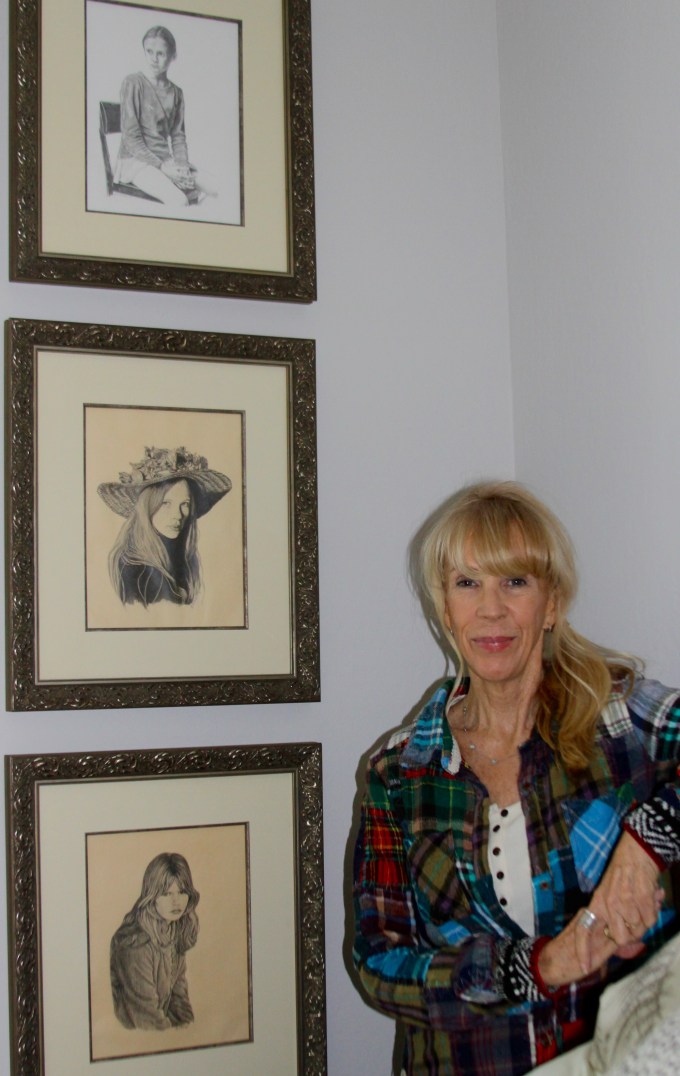
It’s no coincidence that from an early age, Mary Jo was compelled to draw women. She has three examples of early sketched portraits framed in her guest bedroom, and her latest project was inspired by the 2016 presidential election results. “I was at an appointment the day after the election and the technician, who was African-American, told me her little girls had asked at breakfast that morning, ‘Does this mean they will bring back lynching?’ She and I both cried, and I knew I had to portray in my art that emotional state of women and minorities. I went straight to my studio and started painting.”
Her focus on women has come full circle.
Mary Jo poses next to her earlier women’s portraits.
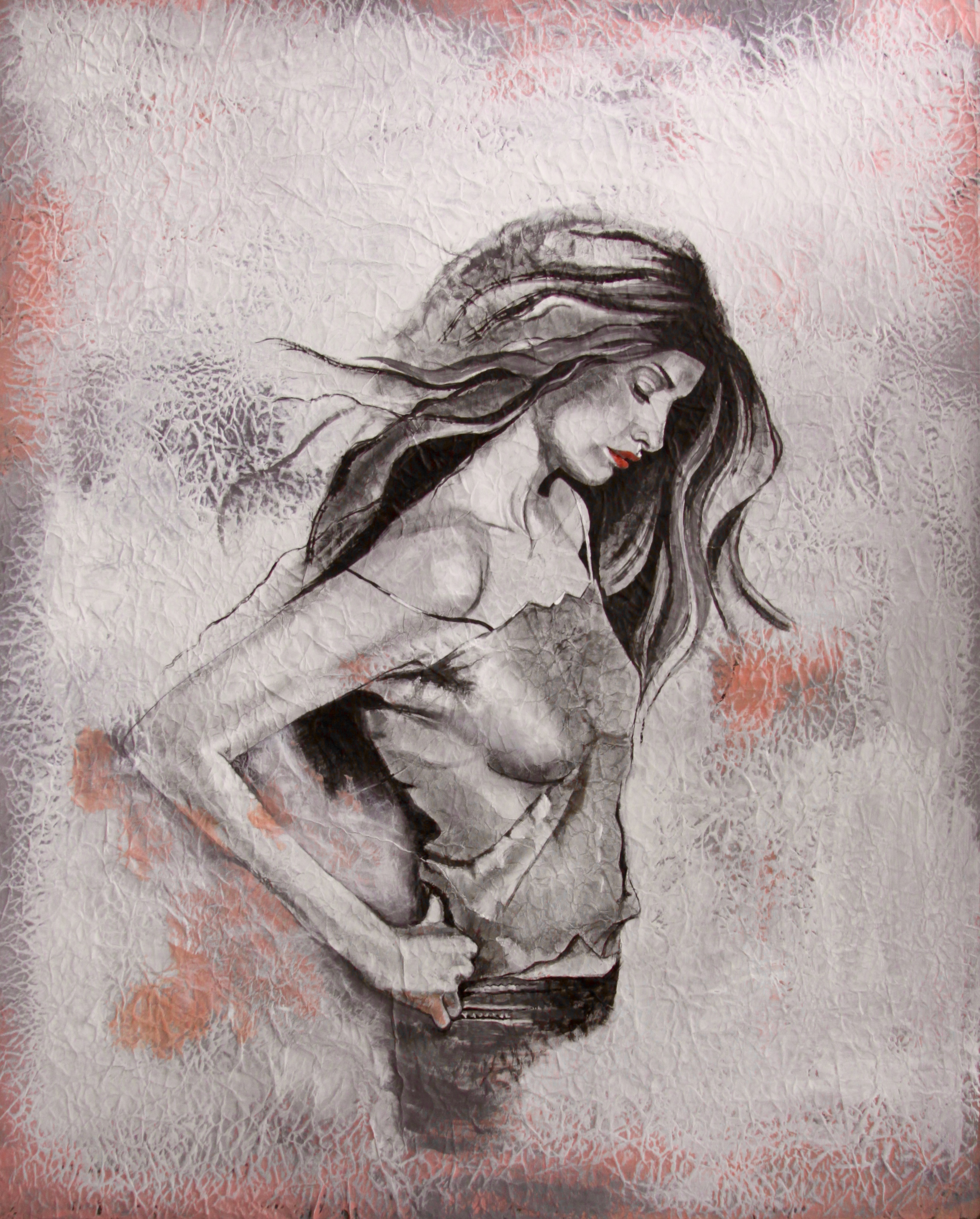
Mary Jo is painting the new women’s series on textured wallpaper given to her by her brother. She leaves the side edges raw. “I didn’t realize how difficult it would be to paint over the textures, but I was drawn to the paper for this series as a representation of life’s complexity. Plus, my brother, who gave me the paper, is a member of the LGBTQ community, and I’m painting to give expression to all minorities and groups often ignored or, worse, vilified.”
River of Tears 44″ x 35″ Mixed media: the first in Mary Jo’s women’s series.They Say I am a Dreamer 38″ x 28″ mixed media: the second in her women’s series.
Love is my Alibi 38″ x 32″ mixed media: Work-in-progress.
Mary Jo’s well seems bottomless as she focuses outward, listening like the professional she is after years of bonding with her clients. But Mary Jo has a rich inner life, the source of her creativity. And that’s what we’re here to talk about!
Q&A
Q: How do you describe your creative drive?
A: There’s a special feeling I get when I’m connected to my art. Like a high, or an adrenaline rush. I like to get some good music going and just lose time and get into the space. It’s the same feeling I get when I do something for someone else. I’m inspired by photographs and live entertainment. My response to learning more about elephants as endangered species was to paint them. My current project, a series of charcoal and oil paintings of women, came from watching Trump disparage and objectify women. My portraits emphasize the humanity in women.
Q: How have your life lessons contributed to your art?
A: I started out in life being a people pleaser and wanting to be loved. I wanted to prove to myself that I could be good at something, and that I was a survivor. It made me strong and brought me to this moment where art is central to my life.
Q: What is some good advice you can give creative people trying to start their own art thing?
A: Get a sketchbook and keep it with you, place it on the night stand next to your bed. Sketch before you fall asleep and when you wake up, and any time during the day. Close your eyes and sketch. Sketch your feelings. The more you create, the more comfortable you’ll become creating.
Q: Who influences your art style the most?
A: My brother’s partner, Sylvan, was an amazing artist before he died of AIDS. He taught me how to use leafing with gold, bronze or silver, and I still use leafing today. I also appreciate Georgia O’Keefe and never fully appreciated how similar our styles are until I moved West and began painting cow skulls and flowers.
Mary Jo’s Cre8-Space
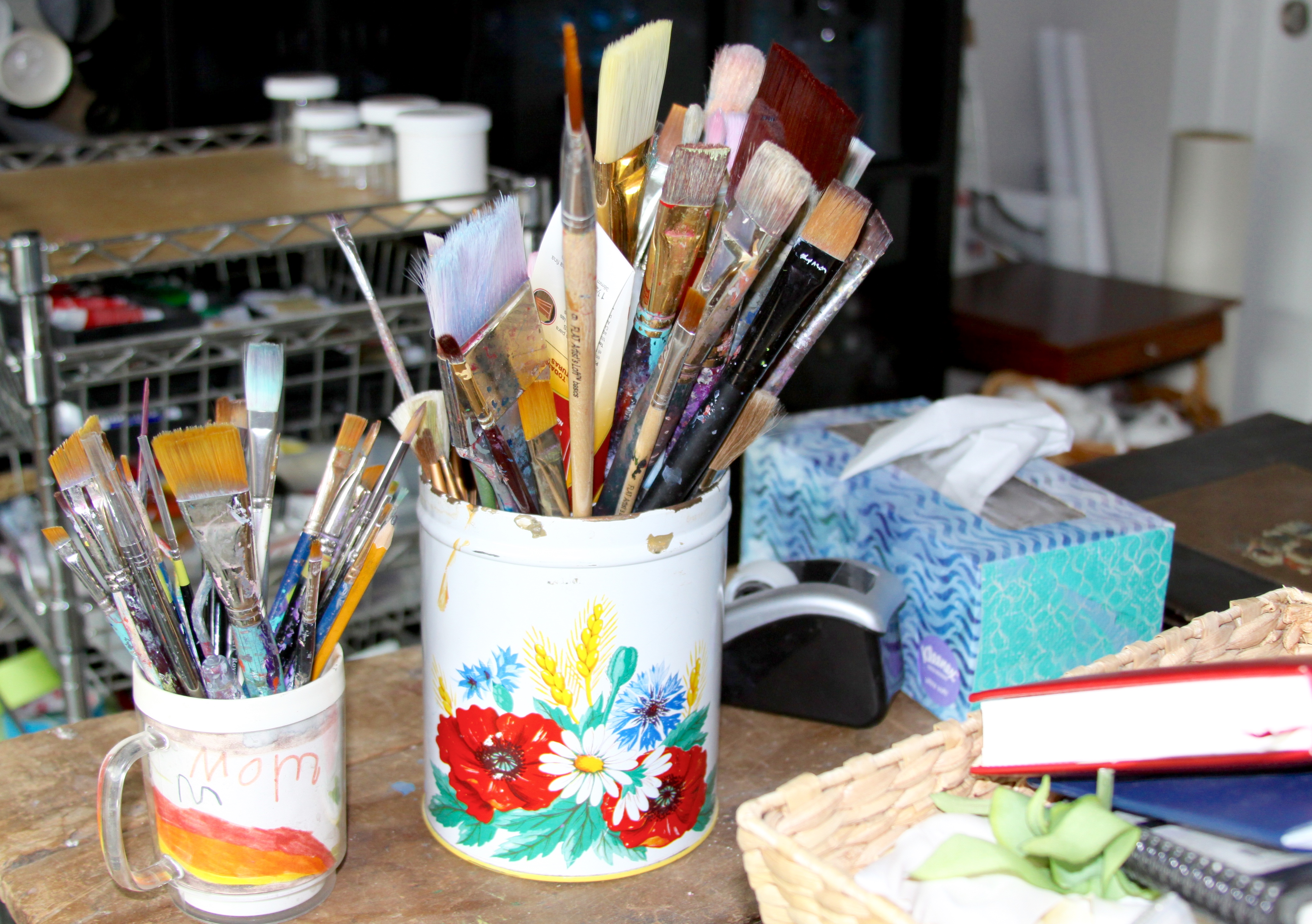
The essentials.
She uses the magnifying glass while painting details.
Mary Jo and Topo relax in her art studio’s salon chair.
More supplies easily at hand.
Mementos from her life, each with a story about someone or something she loves.
Mary Jo’s Cre8-space is organized!
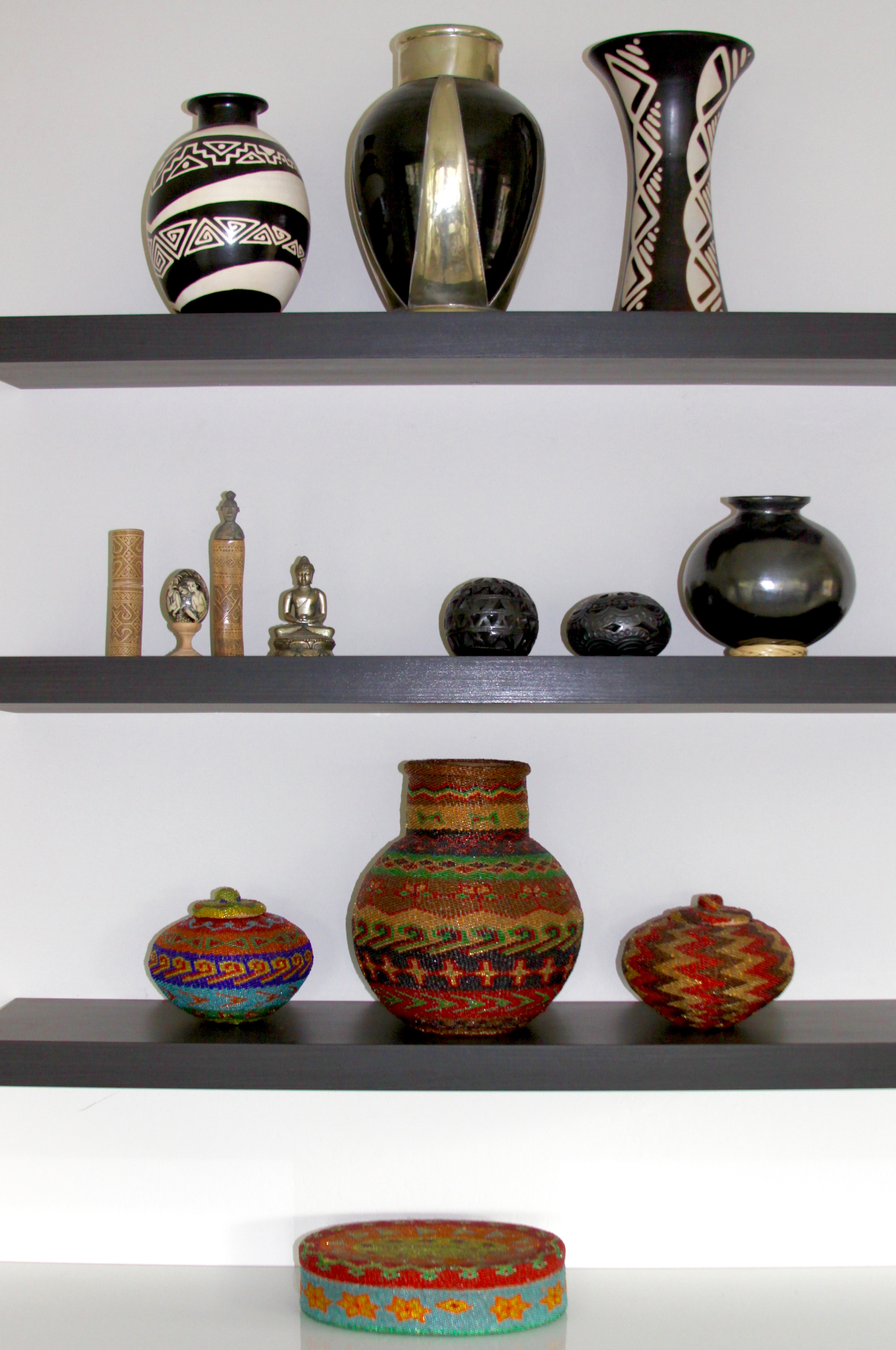
Inspirational pretties from Morocco (top shelf), Mexico (black pieces) and Bali (remaining items, including stunning beaded vessels).
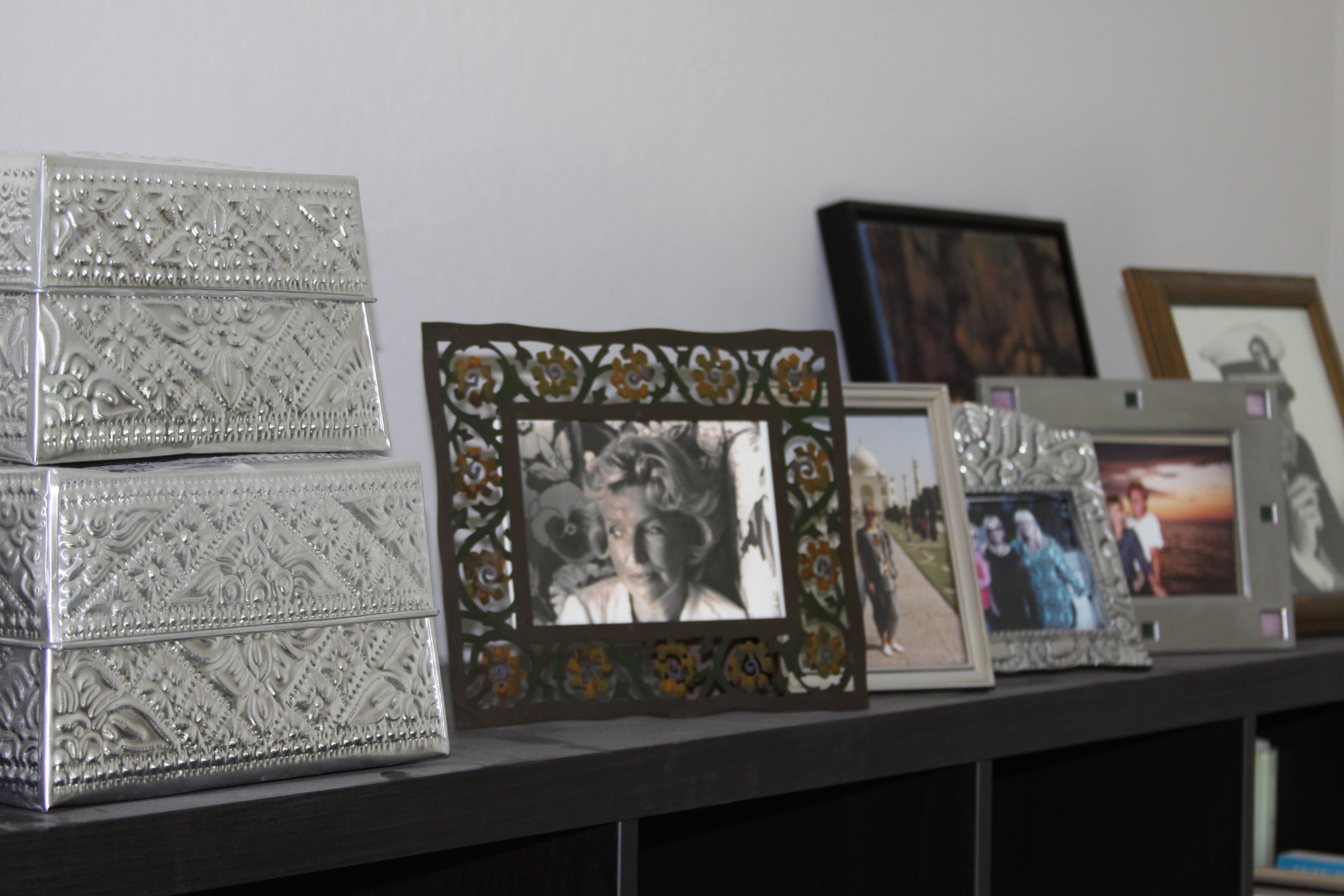
Family photos keep family in her thoughts; her mother’s photo is most prominent.
An early work surrounded by clay vases.
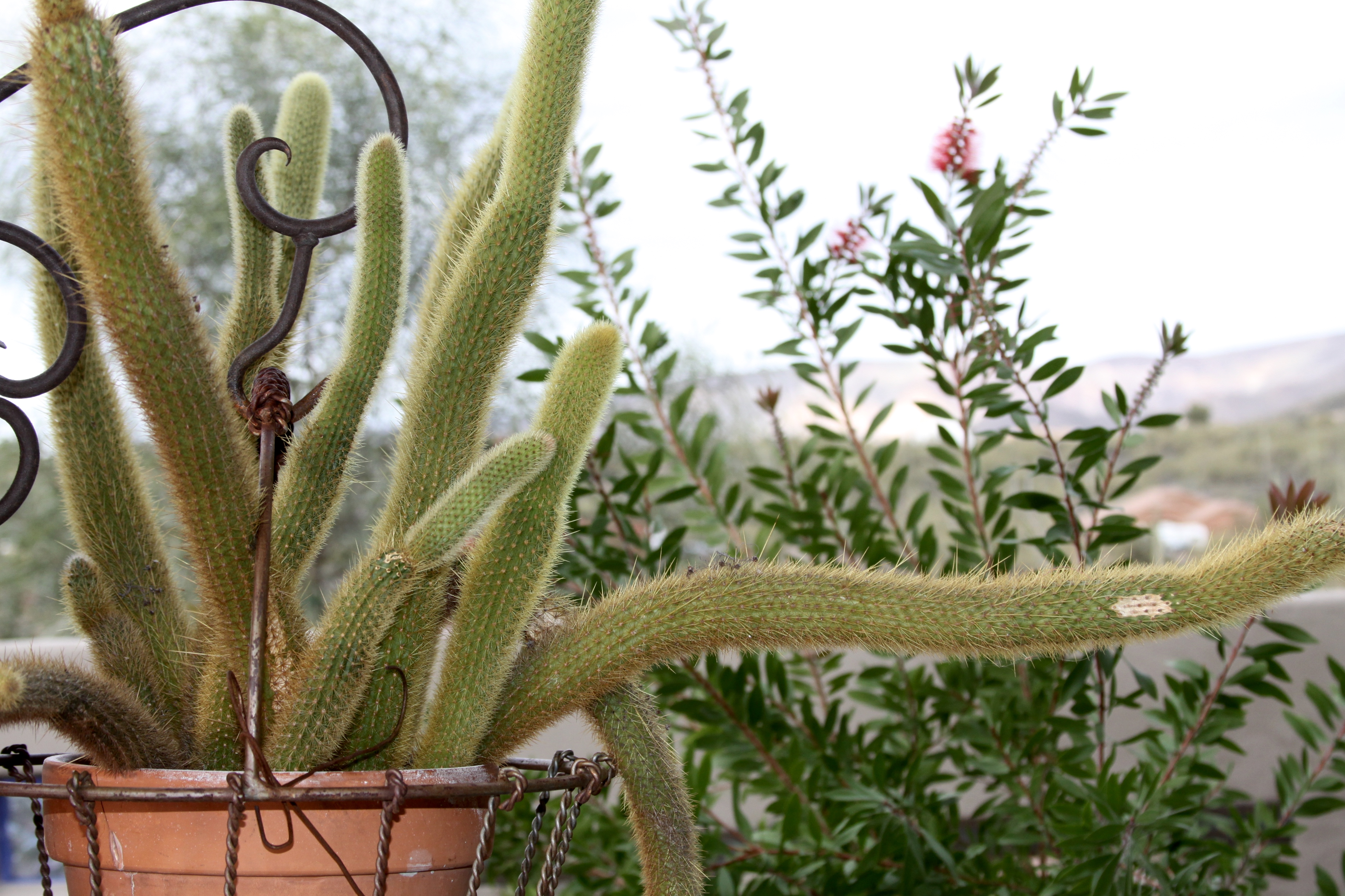
Succulents and other desert plants enliven Mary Jo’s dreamy back patio.
Tree jewelry is a favorite!!
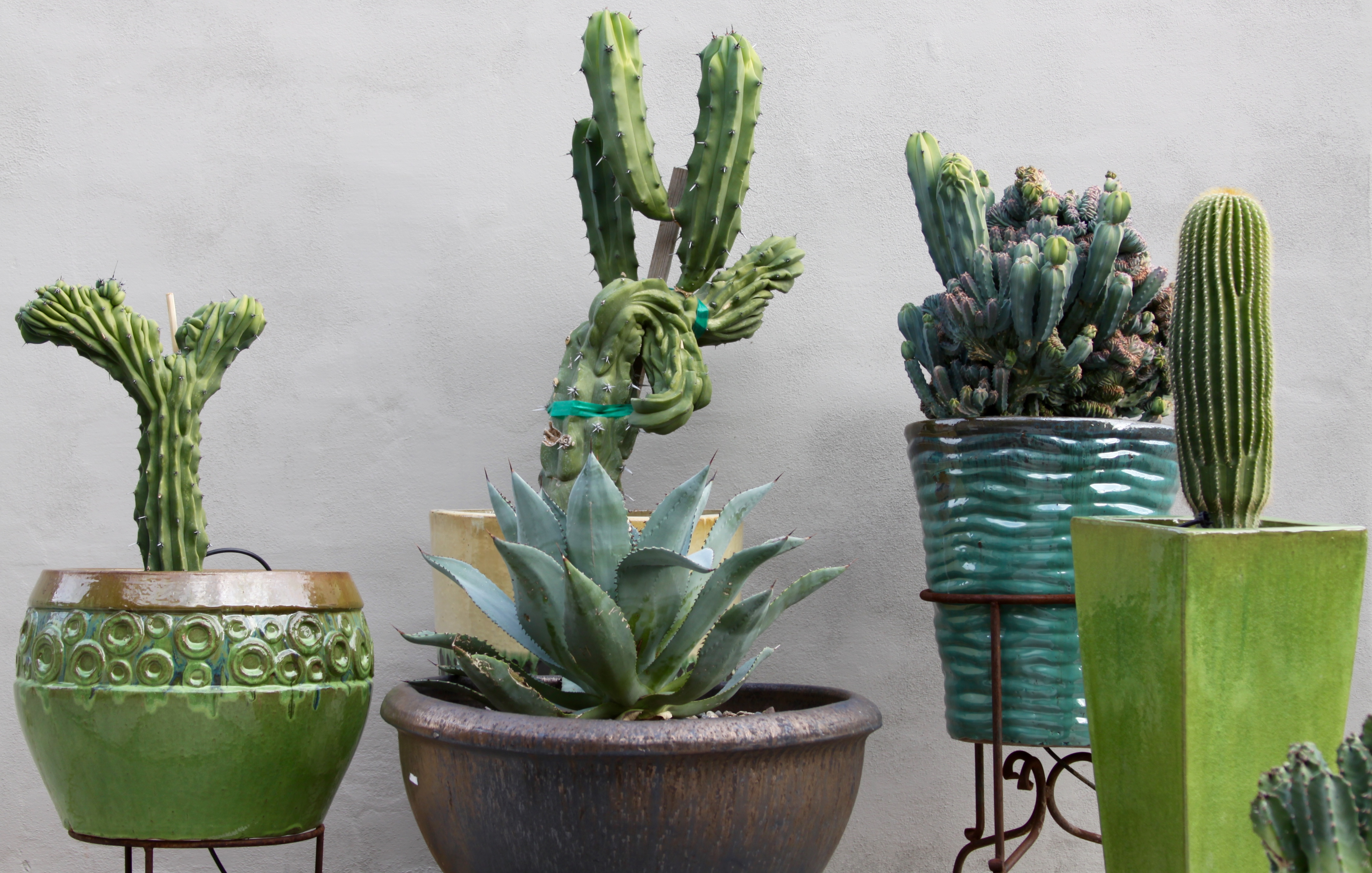
Placing cacti in elegant pots is an art unto itself.
Bright, living colors bring energy to Mary Jo’s Cre8-space.
Good mix of reverence and humor in her Patio decor.































 Cre8-Space