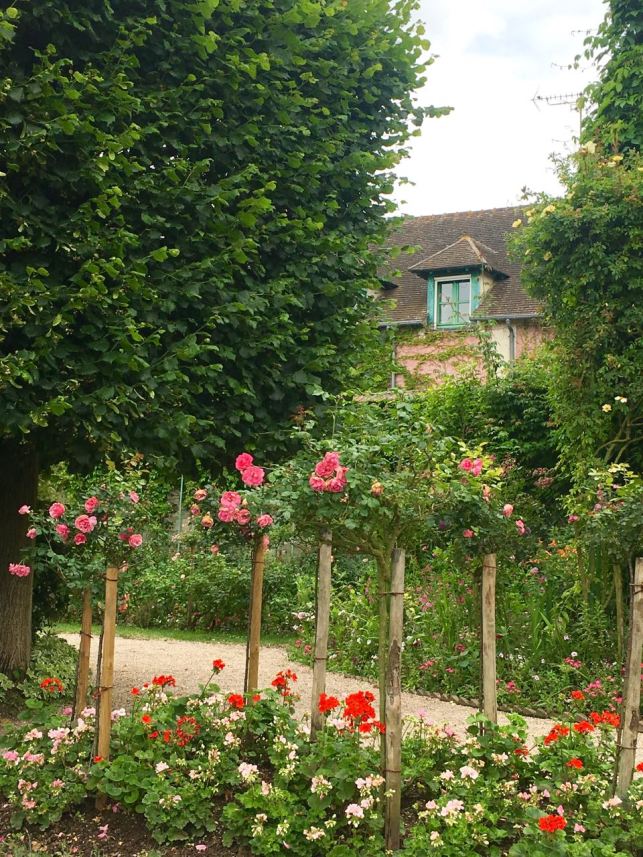
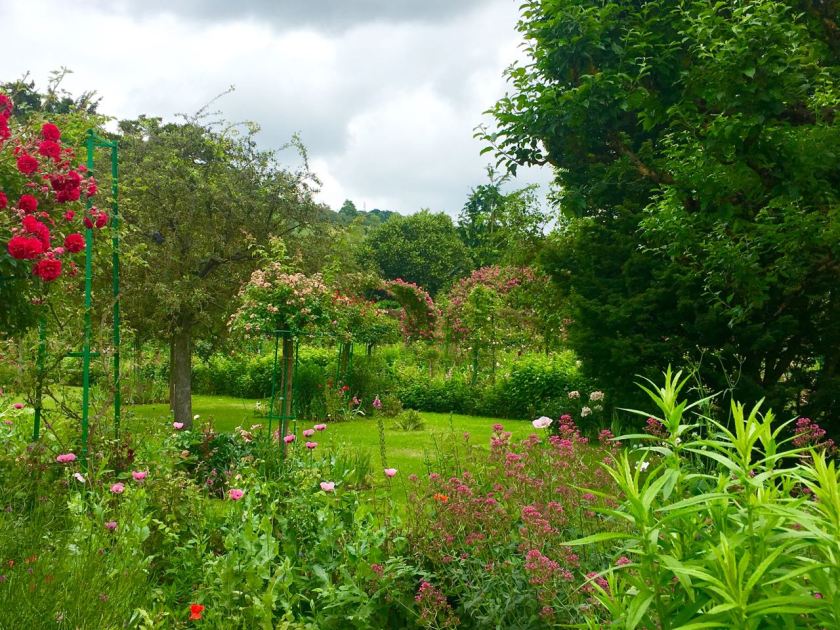
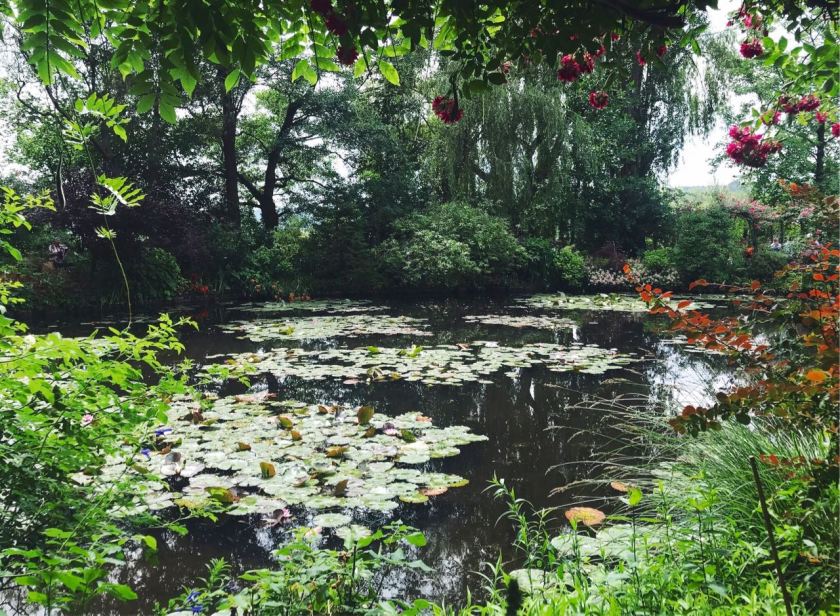
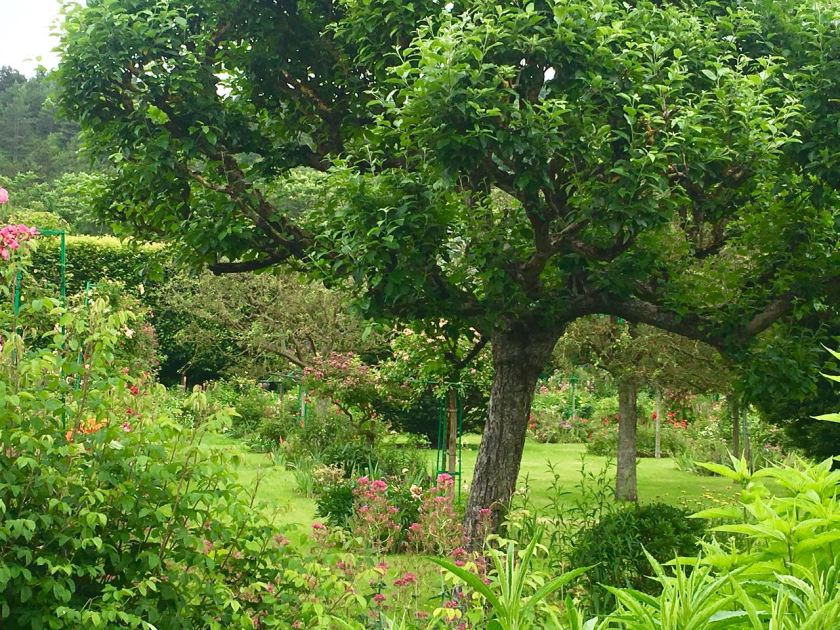
Claude Monet (1840 -1926) is known around the world for his impressionist paintings, especially of his garden and waterlily pond, but he also strategically planted specific-colored flowers in his gardens, essentially “painting” the landscape in front of his home in the tiny village of Giverny, France, about an hour’s drive northwest of Paris.
Monet grew his flower garden like a florist arranges a vase of flowers, based on colors and shapes, carefully choosing flowers for spring, summer and autumn. For winter, he got his fill of flowers by visiting orchids in his greenhouse.
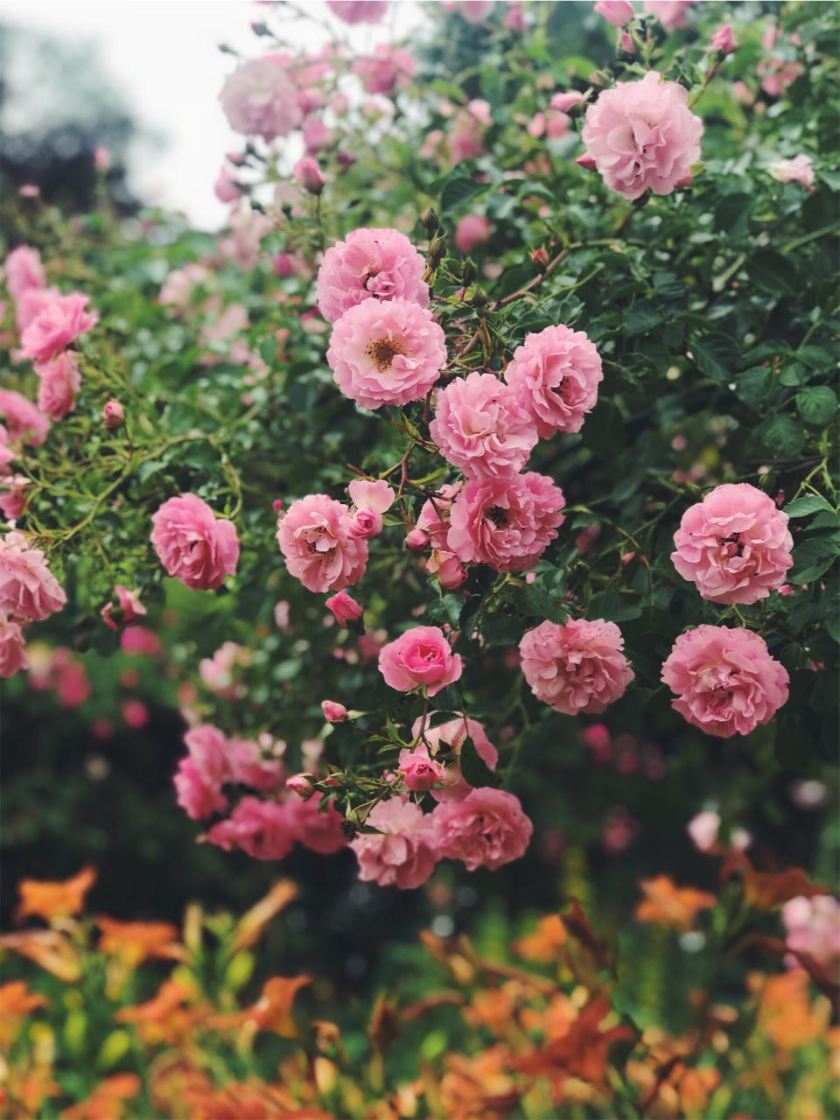
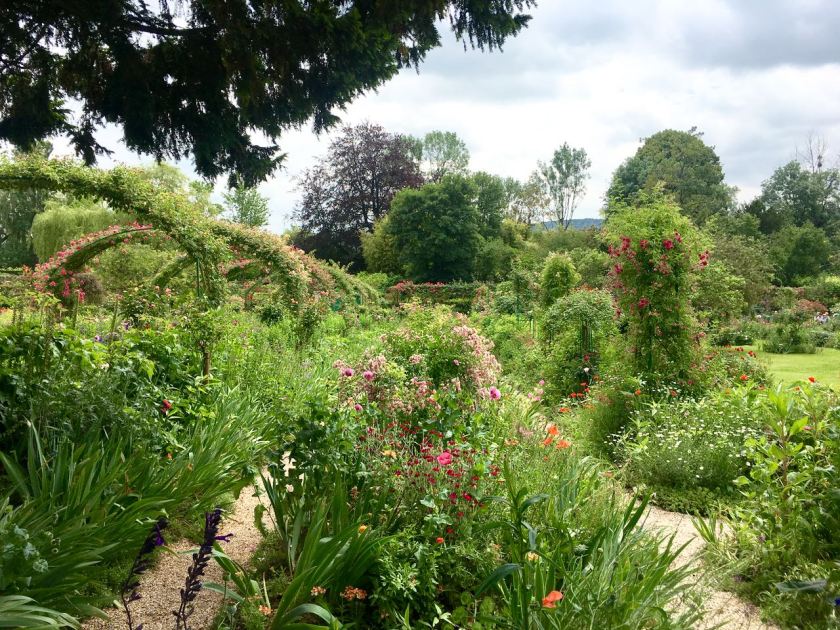
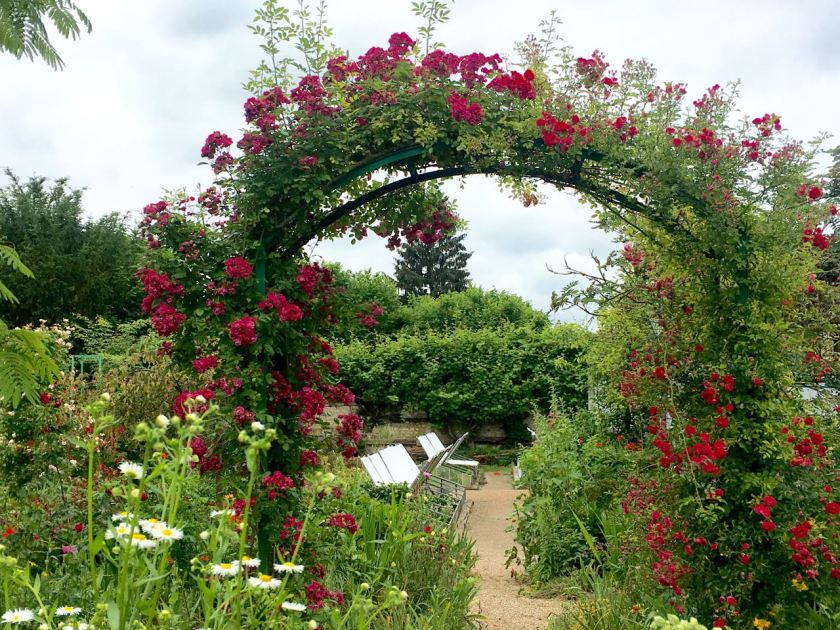
The Grande Allee flower tunnel with rambling rosesMonet in the Grande Allee
From the age of 43 until his death 40 years later, Monet obsessed over the garden and pond which, combined, comprised nearly five acres of common and exotic plants from around the world. (Monet favored single flowers and his favorite of all was the single-flowered “mermaid” rose in yellow, which he grew under his bedroom window.)
Eventually six gardeners would be on hand to help Monet “paint” his landscape with flowers. His gardens became his living studio, so he no longer had to trek into the countryside to paint plein air, which is what made the Impressionist painters and their paintings unique.
Monet’s Garden at Giverny, 1900, oil on canvas, 31 5/8 x 35 7/8 inches; Musee d’Orsay, Paris
“Impressionist paintings take a fleeting moment and wrap it in light and mood and emotion,” writes Matt Brown in Everything You Know about Art is Wrong. The fuzzy paintings of early French Impressionists like Monet, Degas (1834-1917), Pissarro (1830-1903), Renoir (1841-1919) and Sisley (1839-99) were roundly criticized and mocked with descriptions of “intolerable monstrosities,” “ridiculous and horrible” and “victims of an unlucky disease.”
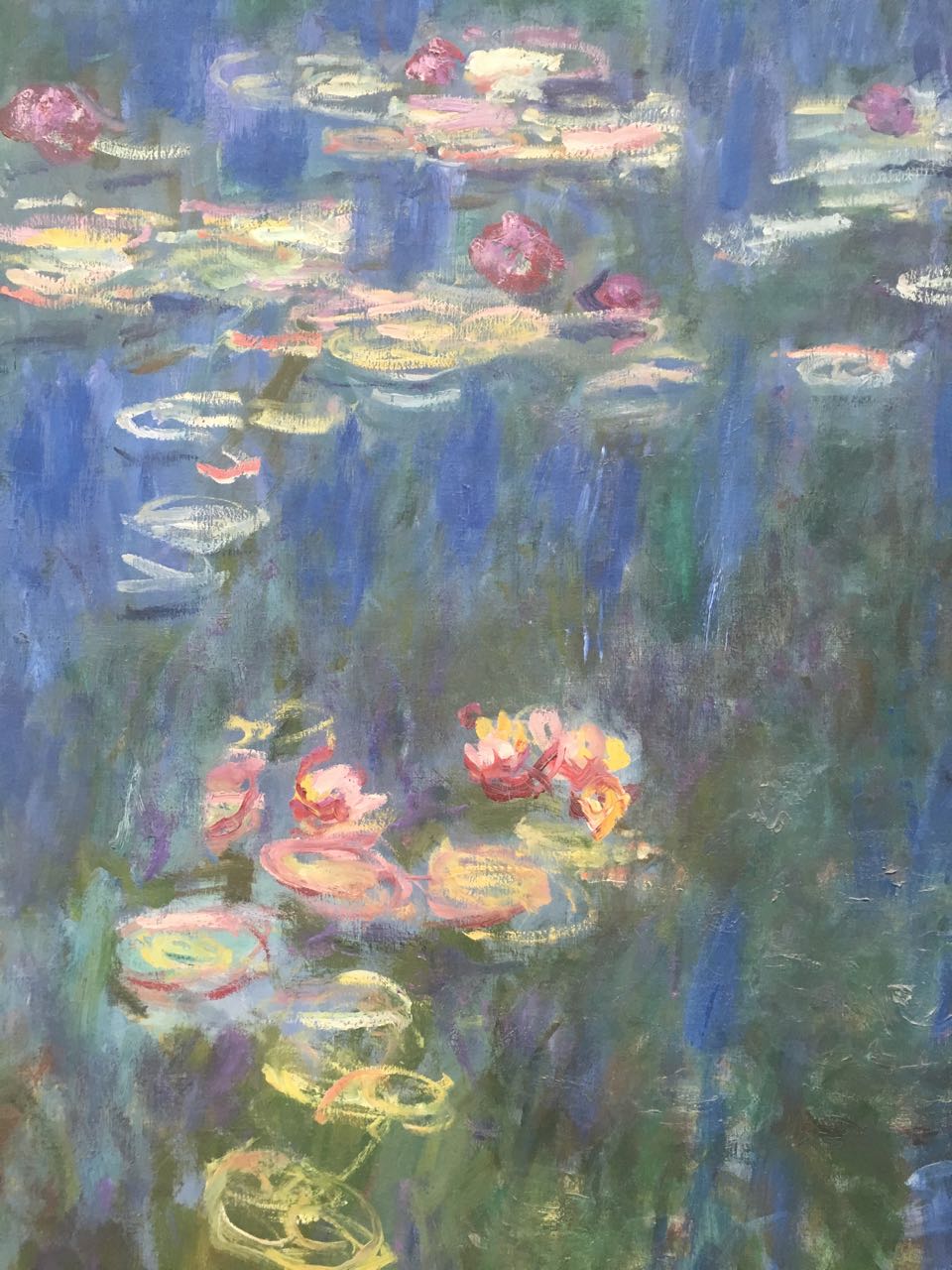
A detailed close-up of one of Monet’s giant waterlily paintings at Musee de L’Orangerie
Matt Brown believes impressionist paintings are now so respected and loved “they might even be considered among the finest achievements of our species.”
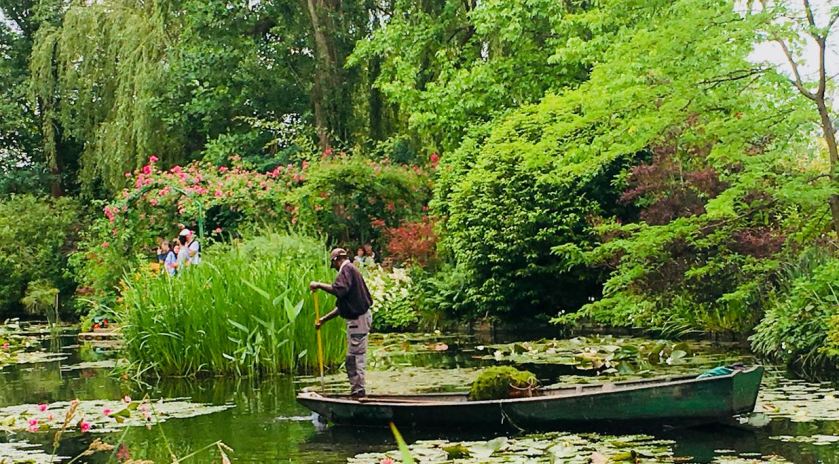
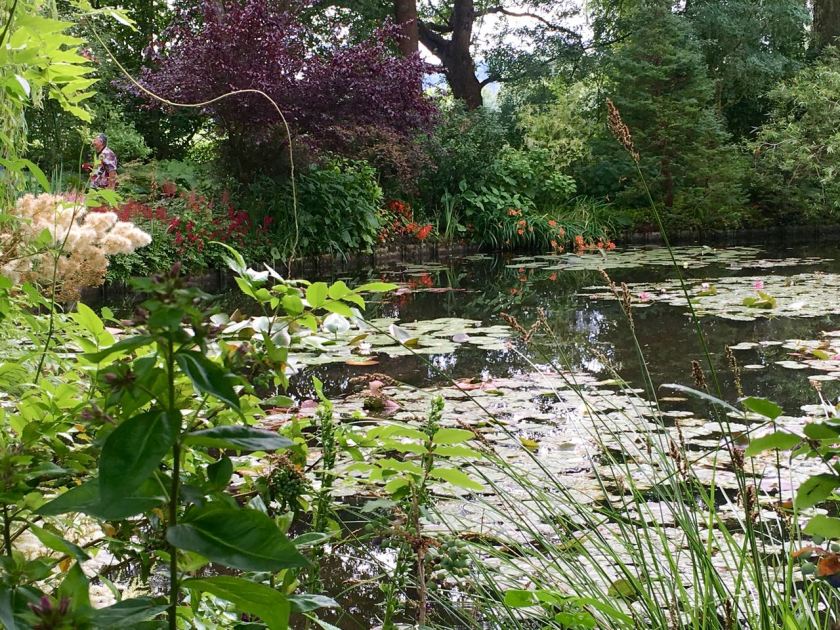
As for the pond, Monet hired a special gardener who would row a little boat around early in the morning (before Monet started painting) to clean up algae and groom the lily pads to grow in visually-pleasing circular clumps.
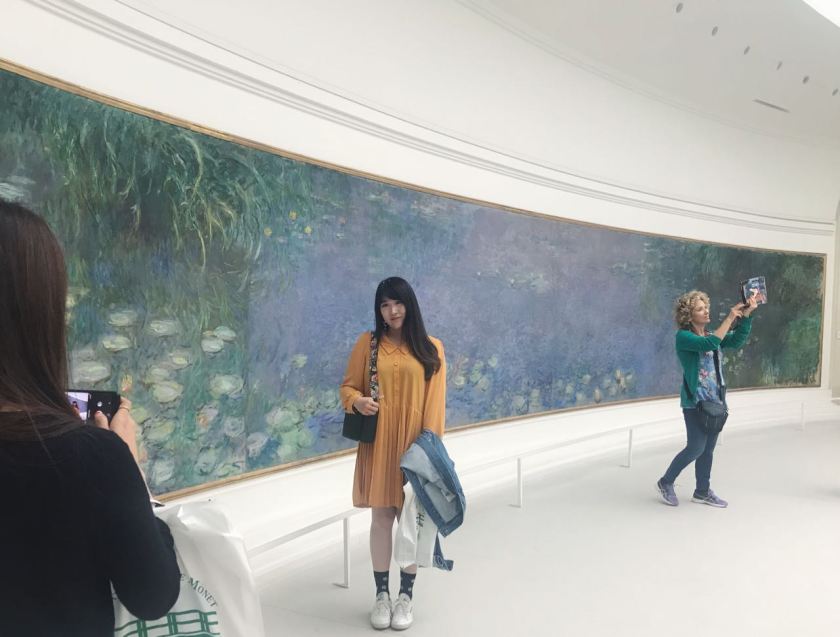
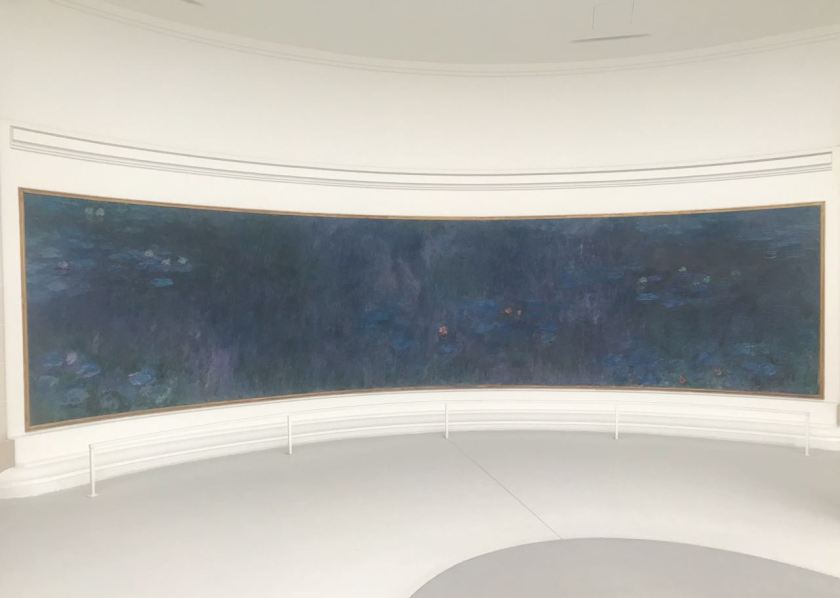
His waterlily paintings blew the minds of folks in his day. They were used to tranquil pastoral settings composed as seen; land and sky. Monet’s waterlily paintings had no setting, no pond’s edge or sky to compose a nature scene. He simply put his pond border to border and rocked the art world.
Monet considered his gardens his greatest masterpiece. In 1907, Marcel Proust wrote:
“If I can someday see M. Claude Monet’s garden, I feel sure that I shall see something that is not so much a garden of flowers as of colors or tones, less an old-fashioned flower garden than a color garden, so to speak, one that achieves an effect not entirely nature’s, but it was planted so that only the flowers with matching colors will bloom at the same time, harmonized in an infinite stretch of blue or pink.”
That’s exactly what Proust would have seen.
These days, the little country road that separates the front yard from the pond has a tunnel underneath so guests can easily and safely move between the two distinct gardens.
On the June 2018 day we visited, a gardener was quietly rowing around the pond, skimming debris and making the surface of the water like a mirror, just as Monet would have liked. In front of the house, men and women were putting out plants and grooming others in a never-ending homage to Monet for visitors from all over the world to enjoy.
People speaking many languages mingled around the garden and pond paths, posing on the arched, green Japanese bridge. Groups of school children, some as young as four or five, were led through the house, garden and around the pond. Perhaps one day these little ones will be inspired to become gardeners, landscape architect or even artists. After all, culture and the arts are France’s most prized possessions.
Gardeners at work in Monet’s garden; the house roof is in the distance
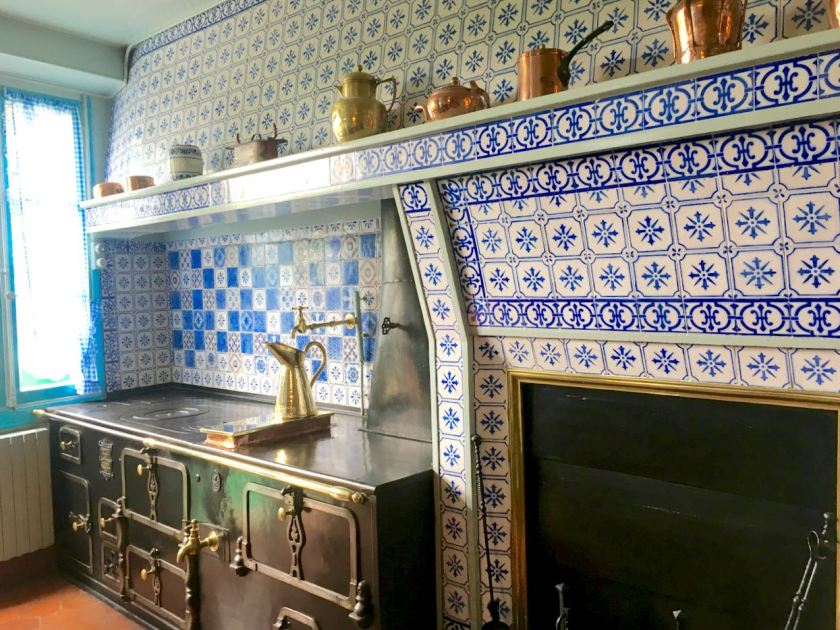
The house, with a verdant hill sloping up behind, is very wide, but only one room deep, and Monet’s use of color throughout seems whimsical, which is why photos of the home’s interior are included below.
The Village of Giverny
Musee de L’Orangerie
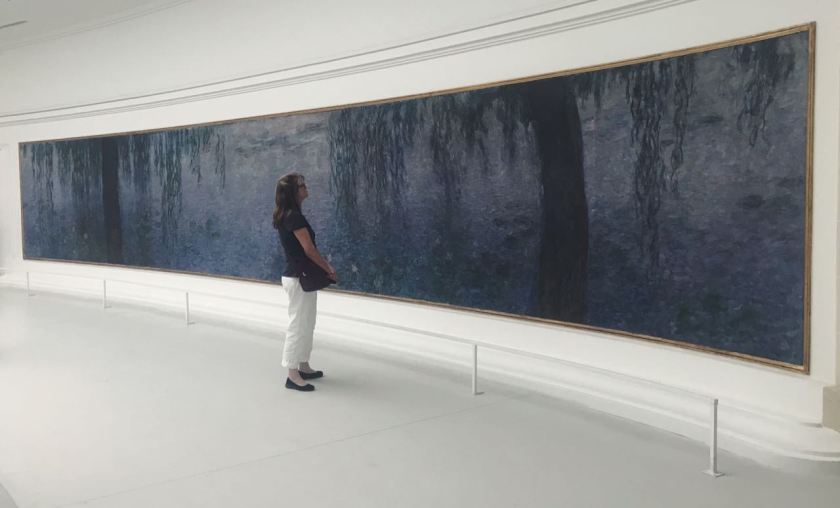
Before his death, Monet worked with the Musee de L’Organgerie in Paris, very close to the Louvre, to create the perfect display for eight of Monet’s massive waterlily paintings. He finally decided on elliptical walls. Here are a few excellent photos taken by my daughter Jaime of the giant paintings on display in two elliptical-shaped rooms at Musee de L’Orangerie.
That’s me, contemplating the pond we had just seen the day before
Monet in Motion
Watch Monet at age 74 painting at his lily pond. The only known footage of Monet, the film was shot in the summer of 1915 by French activist and dramatist Sacha Guitry.
New Orleans is celebrating its 300th birthday this year and the entire city continues to be the ultimate creative space. Dripping with history, NOLA is often thought of as a party town, especially along Bourbon Street in the French Quarter. But there is much, much more to New Orlean’s culture than alcohol.
Foremost, it’s the birthplace of Jazz and hometown of Louis Armstrong and Fats Domino… and Harry Connick, Jr., … and many other amazing musicians from the right and left banks of the Mississippi River.
Though it’s a strong one, Jazz isn’t the only draw to the Crescent City. There’s the food, cajun and creole and stuffed with fresh seafood. And beignets anytime of the day. Yes, BEIGNETS!
Like most grown-up cities, New Orleans also appreciates visual artists. On a recent trip to NOLA, I couldn’t resist visiting the Ogden Museum of Southern Art and the New Orleans Museum of Art (NOMA), both of which allow patrons to photograph their art!
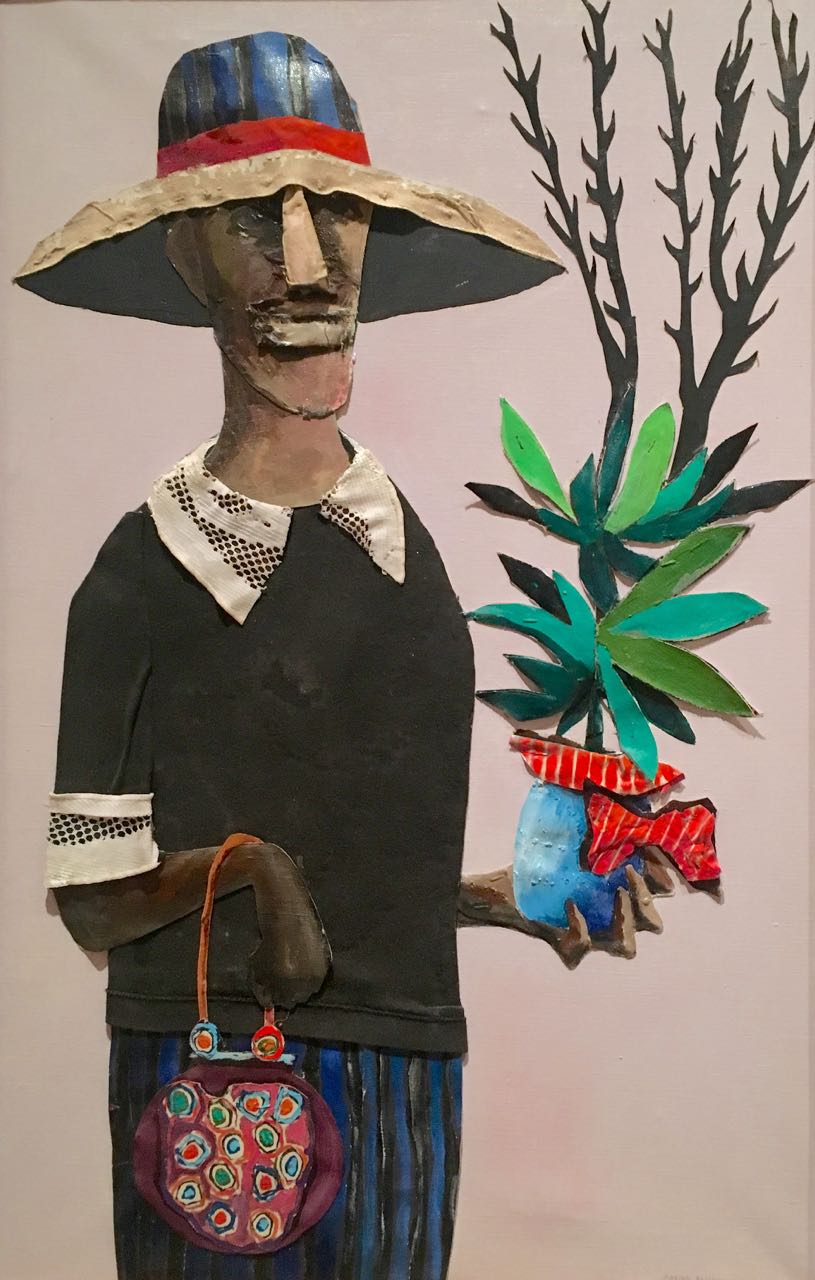
At the Ogden, I was thrilled to find a wing of “Southern Vernacular Art” featuring many oil and collage works by Benny Andrews. I can’t recall where I first saw a painting by Benny Andrews, but I liked his style and subjects and was hooked. When I researched Benny, not only did I find out Benny was from Georgia (like me), but he also attended Fort Valley State College (like me)! While I didn’t graduate from Fort Valley State College, I’m proud to have spent the academic year 1983-1984 at this remarkable historically black college in the heart of Georgia.
Benny was born in Plainview, Georgia, in 1930, and his father, George Andrews, was a sharecropper and a self-taught artist. (Both of my maternal grandparents, and their parents, were sharecroppers in South Georgia). After graduating high school, the first in his family to do so, Benny joined the service and later used his G.I. Bill to study at the the Art Institute of Chicago (the article “240 Minutes at the The Art Institute of Chicago” features a Benny Andrews painting!).
Benny was an activist and advocate for African-American artists. To my delight, the Ogden had several of his collages made using fabric and wallpaper. Some of the collage features are so 3-D, they cast shadows, as do some of the deep frames.
Following are Benny’s collages, plus other works that caught my eye at the Ogden and NOMA. Enjoy!!
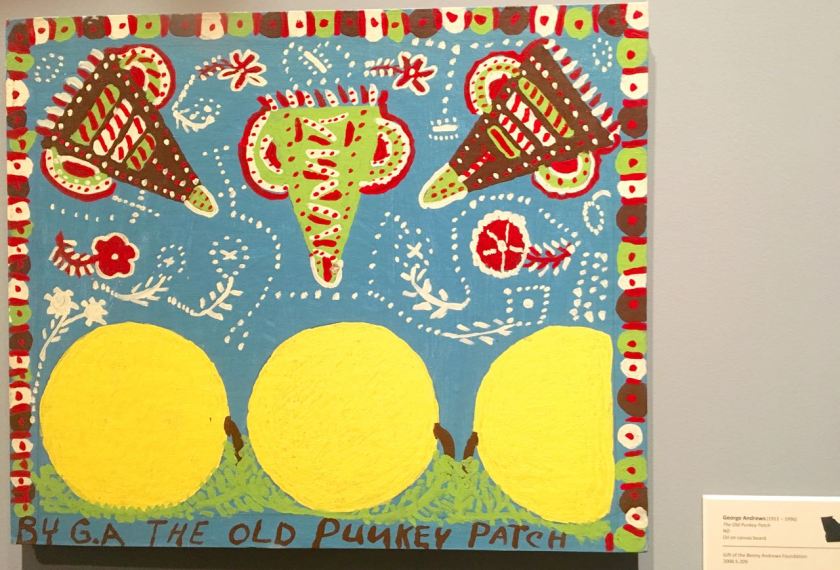
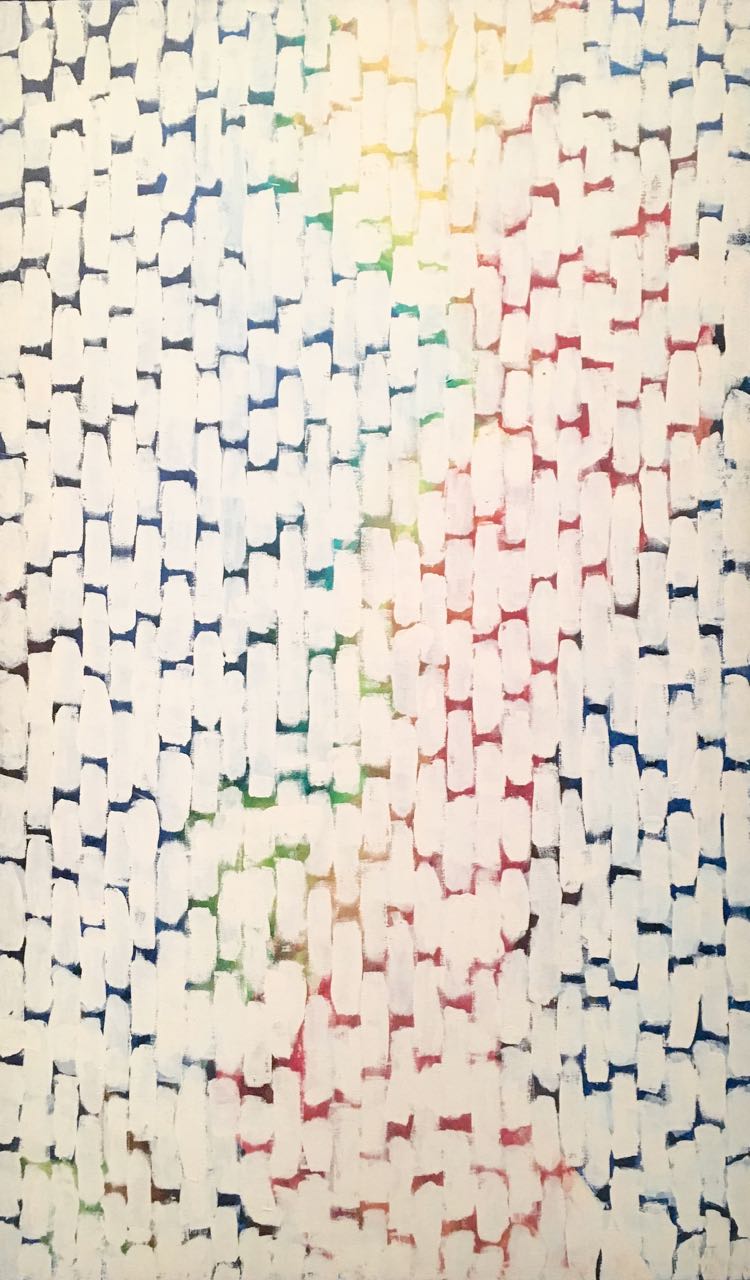
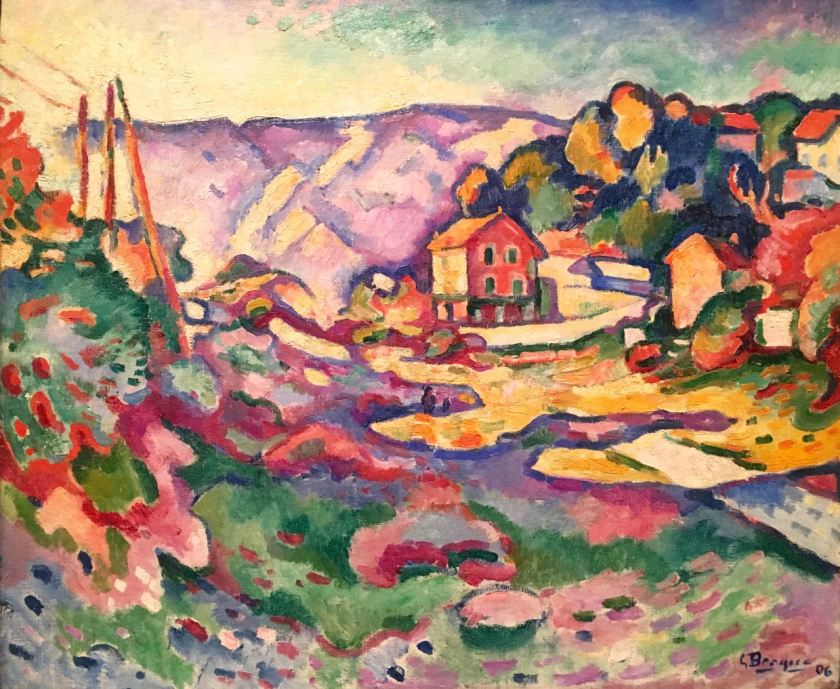
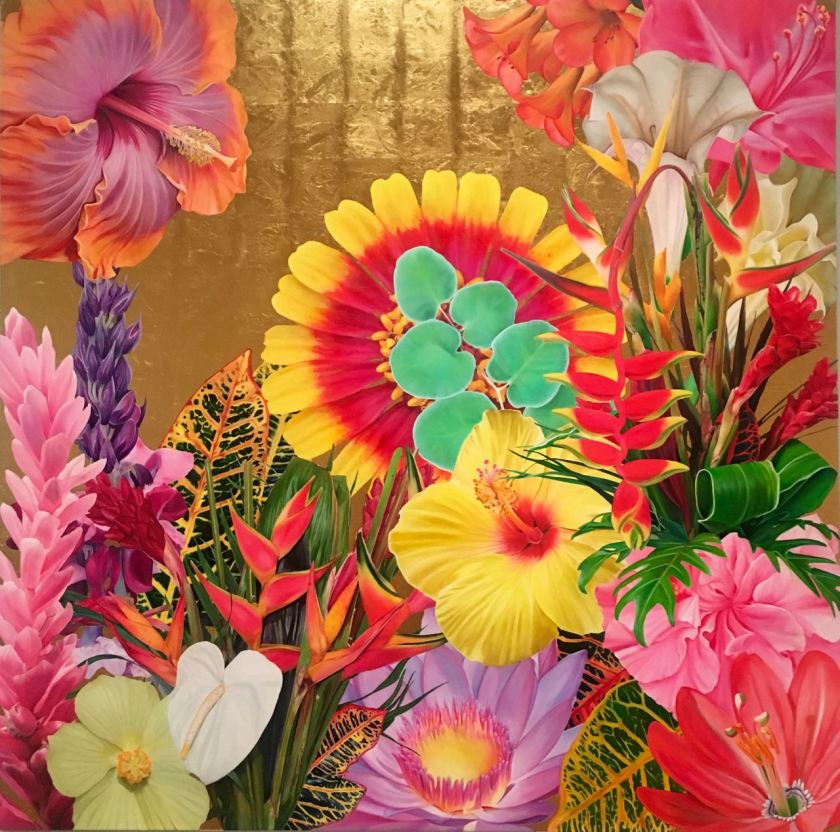
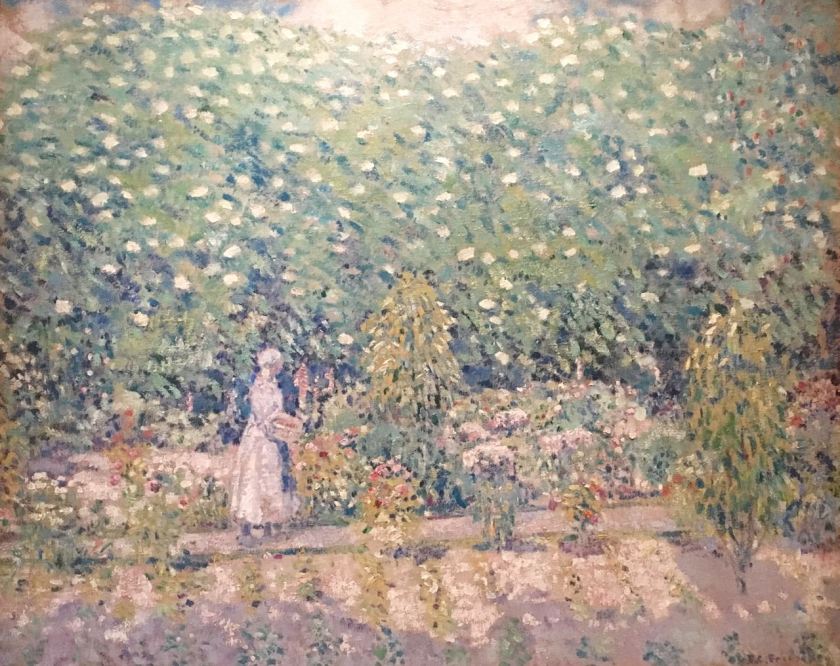
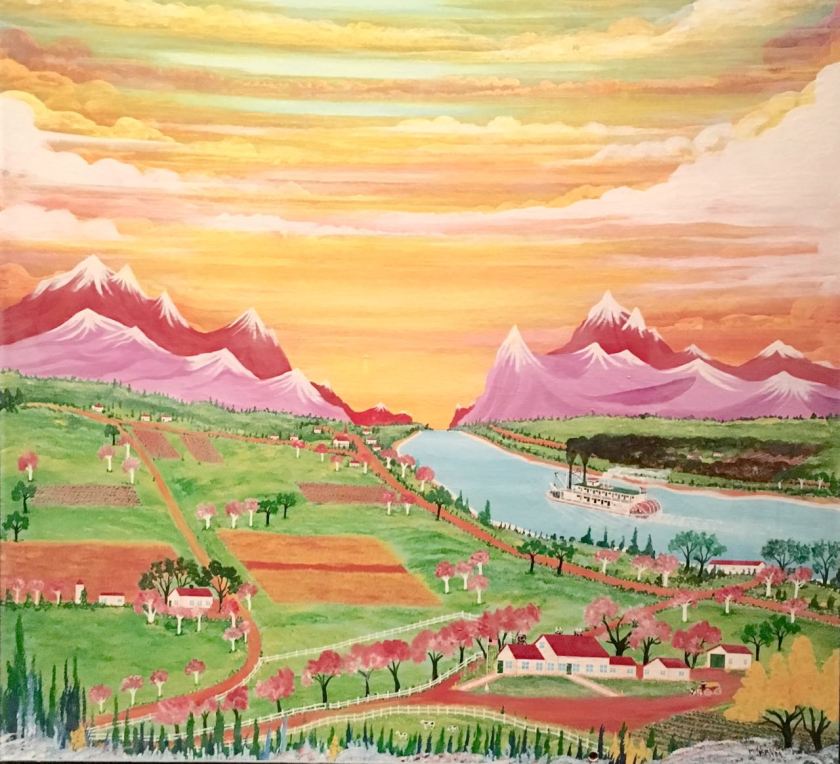
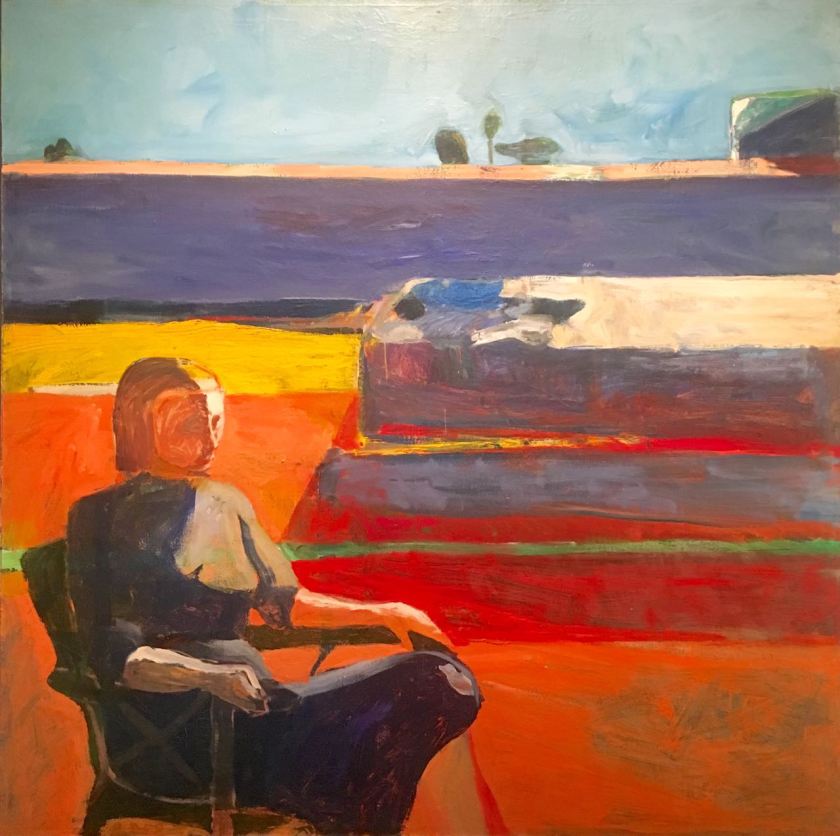
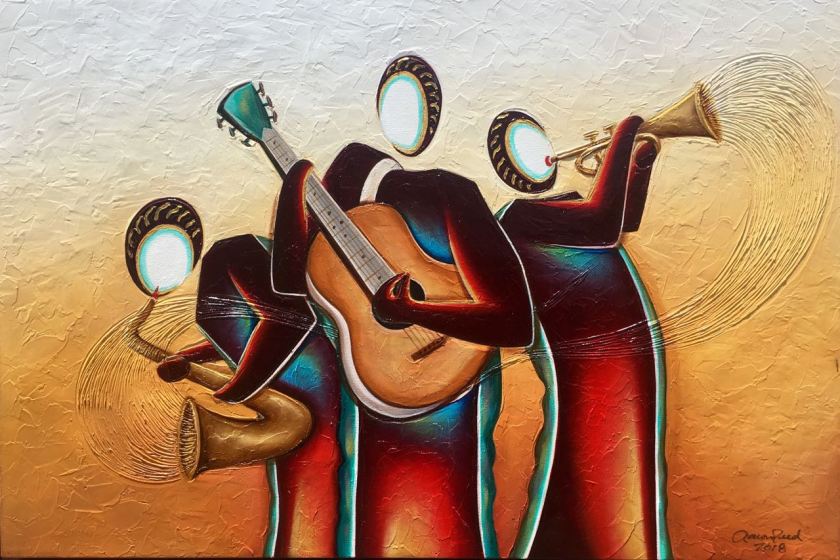
Benny Andrews, Alice, 1966, oil and collage (Ogden)Benny Andrews, Death of the Crow, 1965, oil and collage (Ogden)Benny Andrews, Dottie, 1981, oil and collage (Ogden)Benny Andrews, Eudora, 1978, oil and collage (Ogden)Benny Andrews, Mannerisms, 1962, oil and collage (Ogden)Benny Andrews, Mother Death, 1992, oil and collage (Ogden)Benny Andrews, 1989, Plower, oil and collage (Ogden)Benny Andrews (title and date unknown), oil and collage (Ogden)Painted by either George or Benny Andrews (title and date unknown) (Ogden)George Andrews, The Old Punkey Patch, date unknown, oil on canvas board (Ogden)John Hardy, Portrait of Benny Andrews, 1976, oil on canvas (Ogden)Caroline Durieux (1896-1989), Acolytes, 1935 (Ogden)Hans Hofmann, Abstraction of Chair and Mirror, 1943, oil on canvas (NOMA)Robert Gwathmey, Asleep at the Table, 1945, oil on Canvas (Ogden)Alma Thomas, Dogwood Display II, 1972, acrylic on canvas. Alma is one of my favorites and her painting Starry Nights and the Astronauts is featured in the Chicago Institute of Art article. (NOMA)Lee Krasner, Breath, 1959, oil on Canvas. Lee, a fine artist in her own right, was married to Jackson Pollock from 1945-1956. (NOMA)Shawne Major, Eating Cake, Quilt detail (Ogden)John William Godward, Far Away Thoughts, 1892, oil on canvas (NOMA)Gustavo Caillebotte, French Bouquet of China Asters and Sunflowers in Vase, c. 1887, oil on canvas (NOMA)Georges Braque, French Landscape at L’ Estaque, 1906, oil on canvas, 20 x 23 1/4 in. (NOMA)Carlos Rolon, Gild the Lily: Decadence Upon Decadence, oil, ink and 24-karat gold leaf on canvas (NOMA)Frederick Frieseke (1900-1995), In the Garden, Giverny, oil on canvasClementine Hunter (1886-1988), Panarama of Baptistm on Cane River, oil on window shade, 36″x67″ inches (Ogden)Joan Miro, Persons in the Presence of Metamorphosis, 1963, egg tempura on masonite, 19 3/4 x 22 5/8 inches (NOMA)Joan Miro, Portrait of a Young Girl, 1935, oil with sand on canvas, 41 3/8 x 29 3/8 inches; 49 x 37 inches (framed) (NOMA)Joan Miro, The Red Disk, 1960, oil on canvas (NOMA)Giovanni Boldini, Portrait of a Young Woman in Profile, c. 1895, oil on canvas (NOMA). The blurred brushstrokes and aqua accents in the lower left quadrant caught my eye and drew me to this large painting. Amadeus Modigliani, Portrait of a Young Woman, 1918, oil on canvas. 24 x 18 inches; 33 x 27 x 3 inches (framed with acrylic glass) (NOMA). Modigliani is one of my all-time favorites!!Wayne Thiebaud, Salmon Rose, 1966 (NOMA)Michael Frolich, Steamer New York, STeaming Upriver, 1989, oil on masonite (Ogden)Eddy Mumma, Untitled c. 1978-1986, oil on board (Ogden)Thornton Dial (1928-2016), Struggling Tiger in Hard Times, 1991, oil, tin, carpet and industrial sealing compound on canvas mounted on wood.Richard Diebenkorn, Woman on Porch, 1958, oil on canvas, 72 x 72 inches (NOMA)I ran across this art installation on the street, not in a museum. Artist Sally Heller, Scrap House. One of 20 “Art in Public Places” commissioned by the Art Council of New Orleans. An homage to Hurricane Katrina’s damage.Saw this artist, Aaron Reed from Albany, Georgia, at his booth at this year’s New Orleans Jazz & Heritage Festival.
Dominic Bourbeau doesn’t realize what a great painter he is.
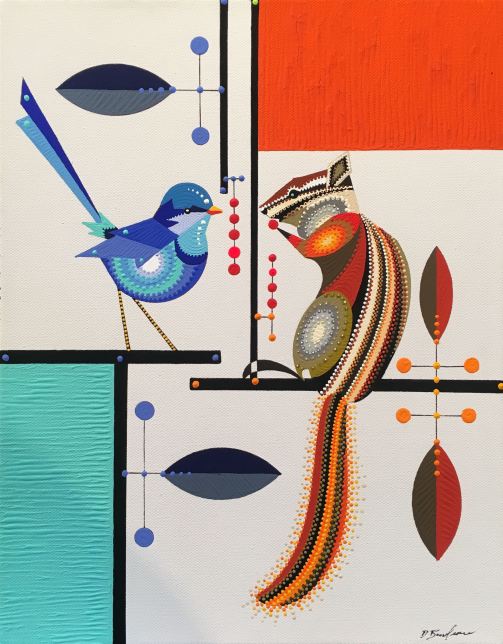
Soft-spoken, Dominic is Minnesota nicer-than-nice. His unassuming nature shows up in his humble view of his work, which is colorfully geometric and stunning.
During last year’s Arizona Fine Art Expo in Scottsdale, Dominic’s artwork was tucked into a corner with little traffic flow, but I saw his work and was stopped cold by it.
In fact, his mid-century modern-style paintings intimidated me. How do you approach a genius? Especially one who is always painting, canvas lying flat on the table, head down? But it turned out that Dominic is highly approachable and generous with his time in explaining his supplies and techniques.
At this year’s Expo (January to March 2018), Dominic’s booth was in a high-traffic area near the cafe so his wall of art could be seen from the main hallway. Again this winter, Dominic kept his head down and painted constantly, but was as approachable and responsive to visitors as ever.
Hopefully, after hearing so many folks see his art for the first time and say “Wow!,” Dominic will realize how special his painting is.
Dominic’s Aubrey Hepburn-esque painting ran on the December 2017 cover of Modern Luxury Scottsdale magazine, and his sassy mid-century portrait of a well-dressed woman in red was used on all the Expo passes.
During the Expo, Dominic had to paint all day, every day, seven days a week, because everything he hung on his booth wall sold. Instantly.
Or, he was asked to paint one of his classics, like Frank Sinatra’s Living Room, five times. Maybe six. Maybe seven.
“This was the year of commissions,” Dominic says, laughing. “I finally lost count.”
Luckily, not every client wanted to take possession of their painting before the Expo closed on March 25, allowing Dominic to return to Minneapolis and complete all his unfinished commissions.
One day at Kinko’s in Scottsdale, Dominic was scanning his painting of Frank Sinatra’s Living Room when an architect from Palm Springs saw the painting and asked about it. Dominic told the guy he painted it and the man instantly pulled out his check book and commissioned the painting for his home.
“That was unbelievable,” Dominic says to me the day it happened, and he’s shaking his head, like it shouldn’t have happened.
But it’s totally believable that someone saw his artwork and instantly wanted it. Dominic’s style is infectious.
His brother, Martin Bourbeau, is also an artist at the Expo. Martin uses cake frosting tubes to pipe paint onto magnificent landscapes on huge canvases, layering and layering the lines of paint to create 3-D art. They’re gorgeous and impressive and expensive.
“I originally struggled with how to price my paintings,” Dominic says, echoing every other artist. Pricing is always tricky. With advice from his fellow artists, Dominic has charged slightly more for his work lately, particularly when a subject is selling well, but psychologically it’s still hard for him to increase his prices.
This winter, he began to paint cityscapes depicting well-known landmarks, making them smaller than his usual paintings, and they all sold.
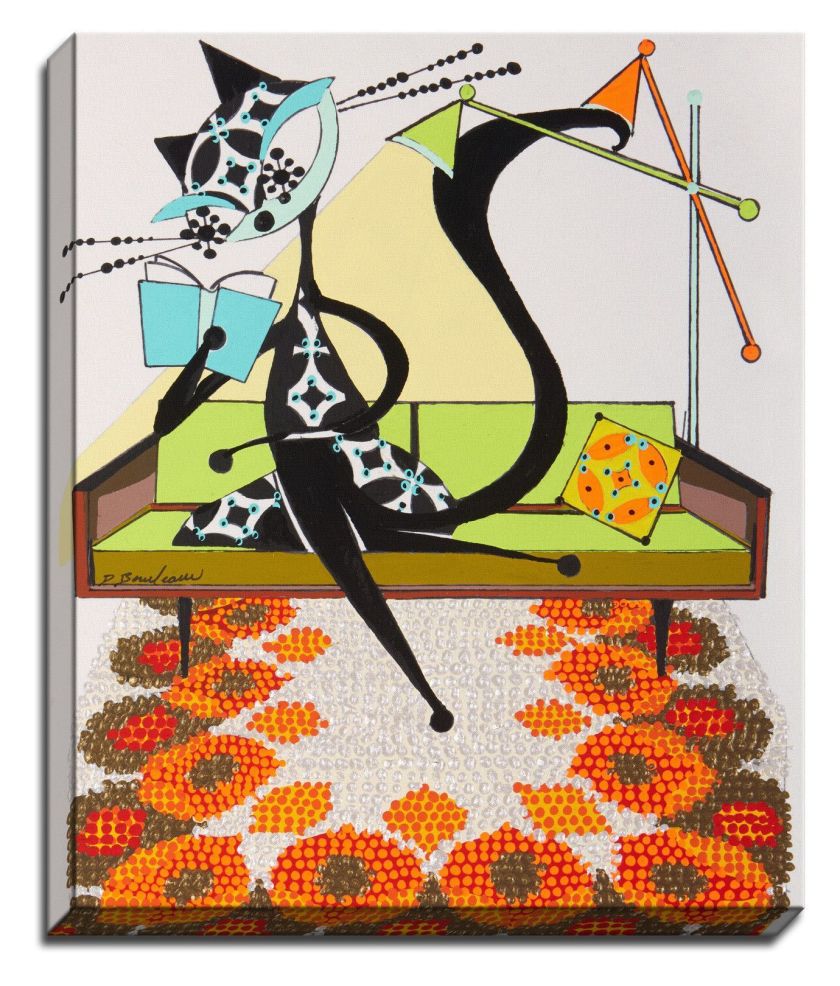
He painted a cat, then more cats, and the paintings sold before he could even hang them on the wall.
Gouache is Dominic’s medium of choice. Pronounced “gwash,” the medium is another type of watercolor, though it remains opaque rather than translucent and it dries matte. It’s fitting that Dominic uses Gouache because the medium was first used in creating Medieval Illuminated manuscripts and then became popular with French and Italian painters in the 18th century.
Also, before digital design, gouache was commonly used by Mid-20th century commercial artists because the medium made crisp images and letters possible, and it photographed well.
“I draw out the design in pencil, sketch over it in pen,” Dominic says, “and when all the details are done, I’ll start painting, which is the fun part.”
He smiles big.
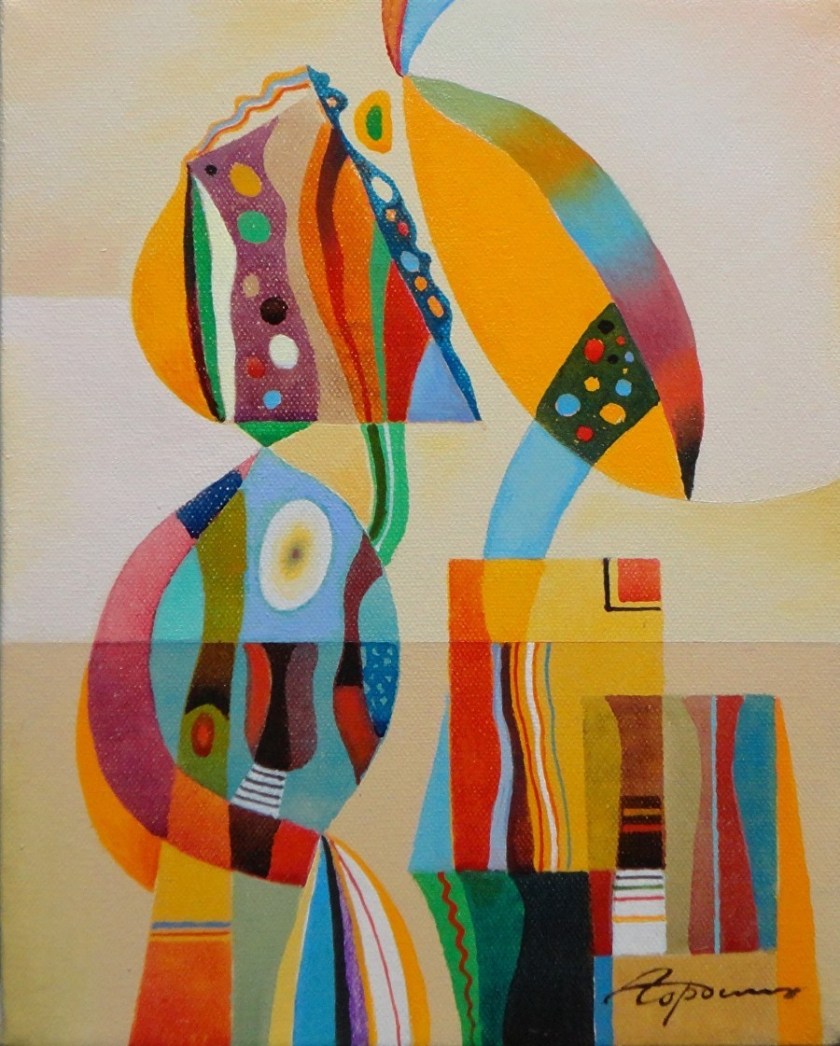
His technique is to texture different blocks of color by adding wavy or squiggly lines, or dots. His dots are amazing and appear to be machine-made, but he produces each one with absolute focus and precision.
While attending a boarding school in Michigan, Dominic studied iconology and followed the tradition of mixing his own tempura paints, including using a beetle to produce red.
In Iconology, every line has a purpose, nothing is used simply for the sake of being ornate. The strong geometry and symbolism of iconology are present in Dominic’s style.
Dominic’s artistic experiences also include throwing pottery, drawing portraits and painting murals for Shakespearean stage sets. He greatly admires artists such as Eames, Frank Lloyd Wright and Charley Harper, and is captivated by their use of simple, yet bold, design based on sophisticated, yet minimalist, geometry.
“I was able to pull from each of my past artistic experiences a segment of its beauty and technique,” Dominic says. “The geometry of iconography, the simple shapes of pottery, the puzzle-like composition of stained glass windows, the details of a portrait drawing, and the intensity especially in color of a mural painting.”
Frank Sinatra’s Living Room
Dominic, at 38, is the oldest of 11 children.
“All eight boys are artistic,” Dominic says. “My three sisters are not artistic. One brother, Peter, has a Master’s in Art and teaches art in a boarding school.”
Their mother, a school teacher, always brought art projects home for the kids to play with.
Dominic almost completed his Master’s in Art, so he could teach, but decided against teaching when he noticed students were using it as an elective and weren’t serious about learning.
Instead he got a degree to be a Surgical Technician and for 12 years now has specialized in assisting orthopedic surgeons in mostly hip and knee replacements.
With his “casual” employment, Dominic is hired to be the personal assistant of a physician and can work when he wants. That’s how he’s been able to take off three months for the last three winters to exhibit at the Expo in Scottsdale. Being a surgical assistant is a great gig; as long as Dominic is attached to a surgeon and keeps his medical qualifications current, he gains seniority in his position with the hospital.
Fours years ago, Dominic’s artistry was discovered by his hospital co-workers when he was drawing on sterile paper towels in the operating room. He then received commissions to create pen and ink portraits of his colleagues’ kids and families, or portraits of pets wearing sunglasses. Dr. Santos, a co-worker, asked Dominic to create anatomy illustrations for a book, including sketches of a spine and spinal implant.
At home in Minneapolis, Dominic paints in his kitchen, which does double-duty as his art studio.
Dominic is on his careful way to ultimately making a living solely as an artist.
In the meantime, he keeps his head down and paints for hours every day, in addition to doing all his own marketing and accounting… when he isn’t assisting in surgeries or exhibiting in Scottsdale.
I predict he’ll hit it big one day.
Maybe then he’ll realize just what a great artist he is.
Caroline Kwas lives in her RV full-time and pursues her art wherever she lands, connecting with her little families everywhere.
Feisty & Focused
With her high intelligence and private school education, Caroline’s family expected her to be a medical doctor. However, while working on her bio-chem major, she added an elective drawing class and, soon, med school dropped from her horizon.
Caroline’s father didn’t respond favorably to her new artistic aspirations. She was feisty, though, and found a work-around; moving in with her sister and sticking to her vision of pursuing art.
Three decades later, Caroline is still just as feisty and still sticking to her vision.
Back then, the father of her childhood friend, Nancy, talked with Caroline’s father and helped him see his way to supporting Caroline’s art studies. She then went to the Fashion Institute of Technology and earned an undergraduate degree in Illustration. She went on to earn a graduate degree in Literacy Education.
For a while on Long Island, Caroline catered food for fishing boats that would go out for weeks at a time. With four or five boats to cook for, she was gainfully employed and poured her creativity into food preparation.
Eventually, she put her degrees to use teaching Reading and English in New York before moving to Florida to teach corrective reading to seventh and eighth graders.
“They ate me alive,” Caroline says of the middle schoolers. She was an excellent guide and champion for the students who appreciated her attention and encouragement. Otherwise, she hated the job. Hated it. And she was terribly homesick, so she went back home to Montauk, New York, to teach.
“Unfortunately, I never took any time off,” Caroline says, “and, basically, was committing psychological suicide.” Even painting and exhibiting in weekend art shows wasn’t enough to compensate for the stress. Something had to change.
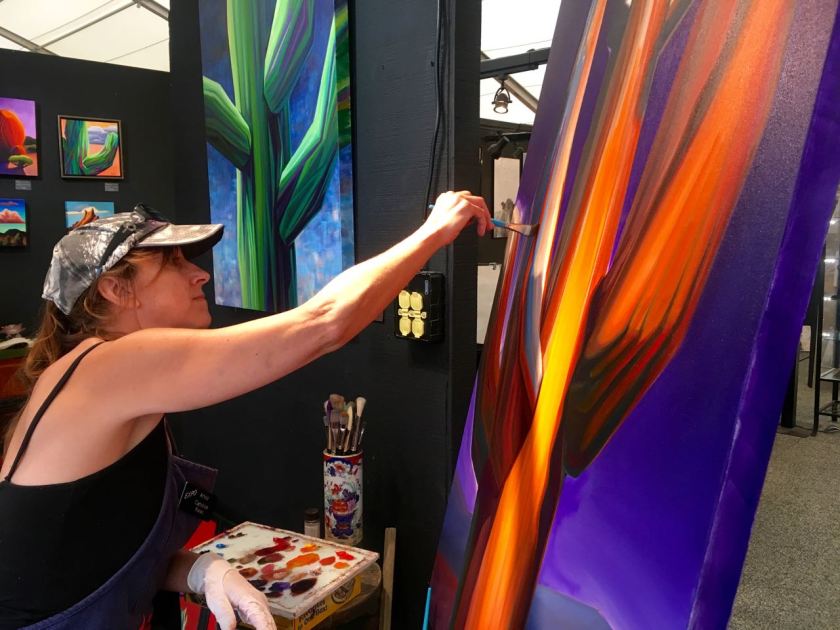
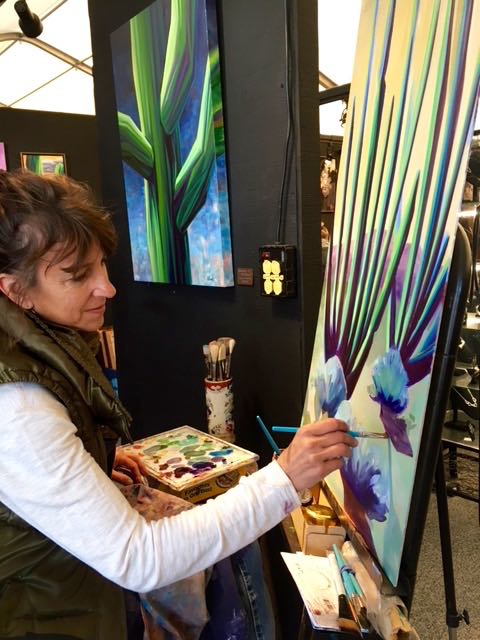
Caroline painting in her booth at the Arizona Fine Art Expo
In 2010, while she was still teaching, Caroline researched art shows for the following spring and found the Arizona Fine Art Expo, an annual juried artist show held in Scottsdale, Arizona, from mid-January through March. She applied, was accepted and resigned from her teaching job around Christmas 2010. The next month, Caroline was in Scottsdale exhibiting in the 2011 Arizona Fine Art Expo.
By the time she returned to the show in 2012, Caroline had bought a fifth wheel toy-hauler RV pulled by a Chevy diesel dually.
“My boyfriend at the time said I needed a big rig,” Caroline says, making it clear the RV and truck were too much for her handle. In fact, her partner never allowed her to drive her own rig.
When she got rid of the boyfriend, she got rid of the big rig and bought a 29-foot C class Winnebago and a cargo trailer. Now comfortable and perfectly mobile, Caroline began crafting a nomadic lifestyle, spending winters in Arizona and then heading to wherever she chose for the summer.
Caroline and Bubbles
For six years, Caroline has lived out of her RV and pursued art.
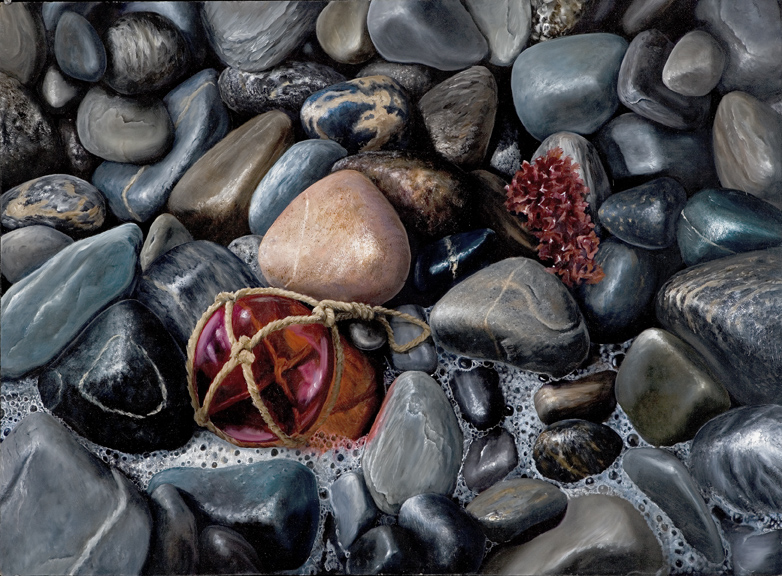
In 2012 and 2013, she returned east to work out of her own gallery in the Rocky Neck Art Colony located in Gloucester, Massachusetts. Rocky Neck is the oldest working art colony in the country, having brought artists together for more than 150 years. Her photorealism paintings from that time were influenced by the rocky shores, shells and fallen leaves of New England.
On the Rocks, a photorealism painting by Caroline
“The gallery had a loft and that’s where I slept,” Caroline says. “Three times a year we had very high tides and the water would come up to within a foot of my gallery door.”
Every winter, she returned to Scottsdale and the Expo.
Caroline’s nomadic life allows her to be where she wants to be, when she wants to be there and with the people of her choosing.
“I have little families everywhere,” Caroline smiles.
Her blog posts show her mastery of living full-time in Bubbles, her RV. Friends tease Caroline for only washing her hair in rain water. But why wouldn’t she? It’s free. Yet rain is scarce in the desert. When it does rain, Caroline has her 5-gallon buckets ready. She sets them against the big white tent that covers the Expo and catches the silty water. When the dirt settles, Caroline has rain-fresh hair.
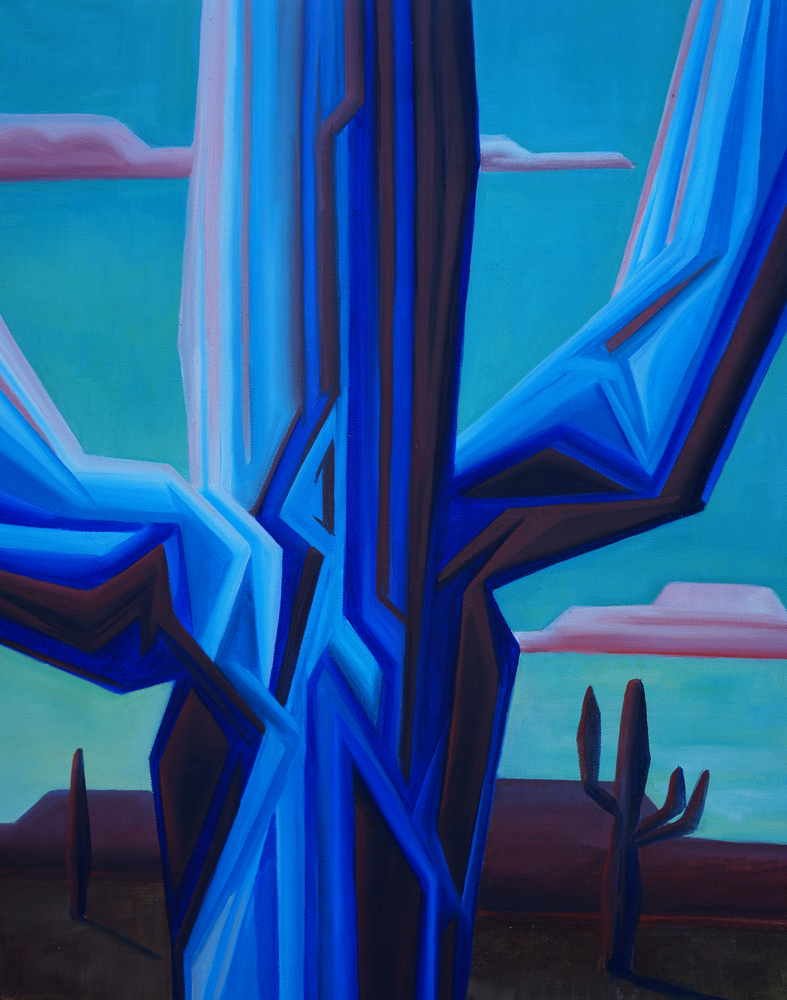
Sonoran Sentinel
Beyond posting about her life as an RVer, Caroline writes poignant blog posts about her perceptions, seen through the eyes of an artist. A perfect example is her blog post titled Why is the Sky Purple? where she answers the question asked by a bored male patron:
Because when I stood at the base of this giant saguaro two weeks ago and it was lit up by the rising orange full moon, there was more to that scene than a blue-black night sky and a dimly lit cactus. There was a gentle majestic giant in front of me, soaring into a velvet sky, and he deserved to be lit up in gold and crimson like the king of the Sonoran Desert that he is. He needed that deep royal violet sky to complement him, to surround him, and most of all, he deserved a lot of color.
Be sure to read her post about Harry, a magnificent saguaro friend. I won’t give away Harry’s fate, but will share the post’s opening:
Like many people, the saguaro cactus was always the first thing I thought of when I thought about the desert. It’s the epitome of the desert, proud, distinct, and vaguely humanoid. But have you ever thought about the life of a cactus? Go up to a big one around midnight in the desert, and the hair on your arm just might rise a little. They loom there, stark dark silhouettes against a speckled sky, full of silent stories. Consider: for almost a century, it huddled in the shade of an ironwood nurse against the harsh desert summers as it began its life. An inch a year. It began growing arms; it grew into its role as the giver of life in the desert. Quiet centuries are spent keeping sentry over a forbidding landscape, the long shadows of its arms the last to unfold its embrace each sunset. Spend some time walking in the Arizona sun, and you’ll appreciate water. Spend some time walking in the Arizona moonlight, and you’ll understand mysticism.
“Little Girl” is the van Caroline pulls to drive on local errands. Recently, she launched a Facebook page and Instagram account for Little Girl, who narrates the blog and describes life on the road with Caroline from her unique vehicular perspective. Little Girl’s popularity is growing fast.
Caroline and Little Girl
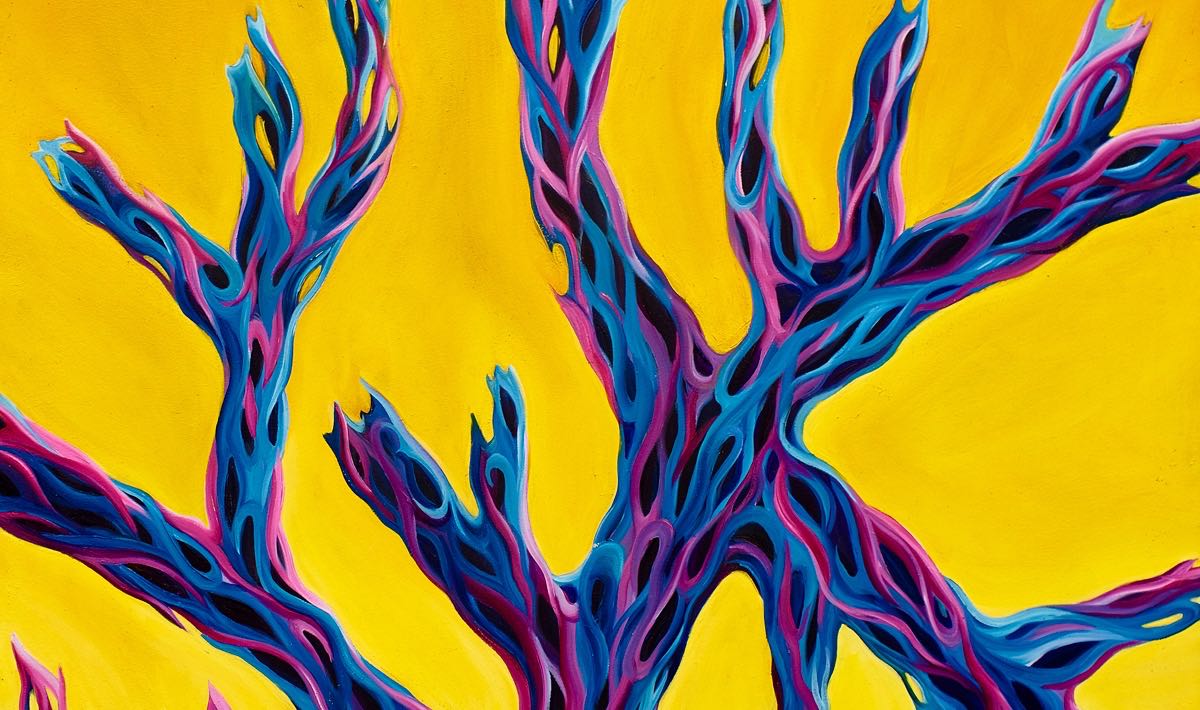
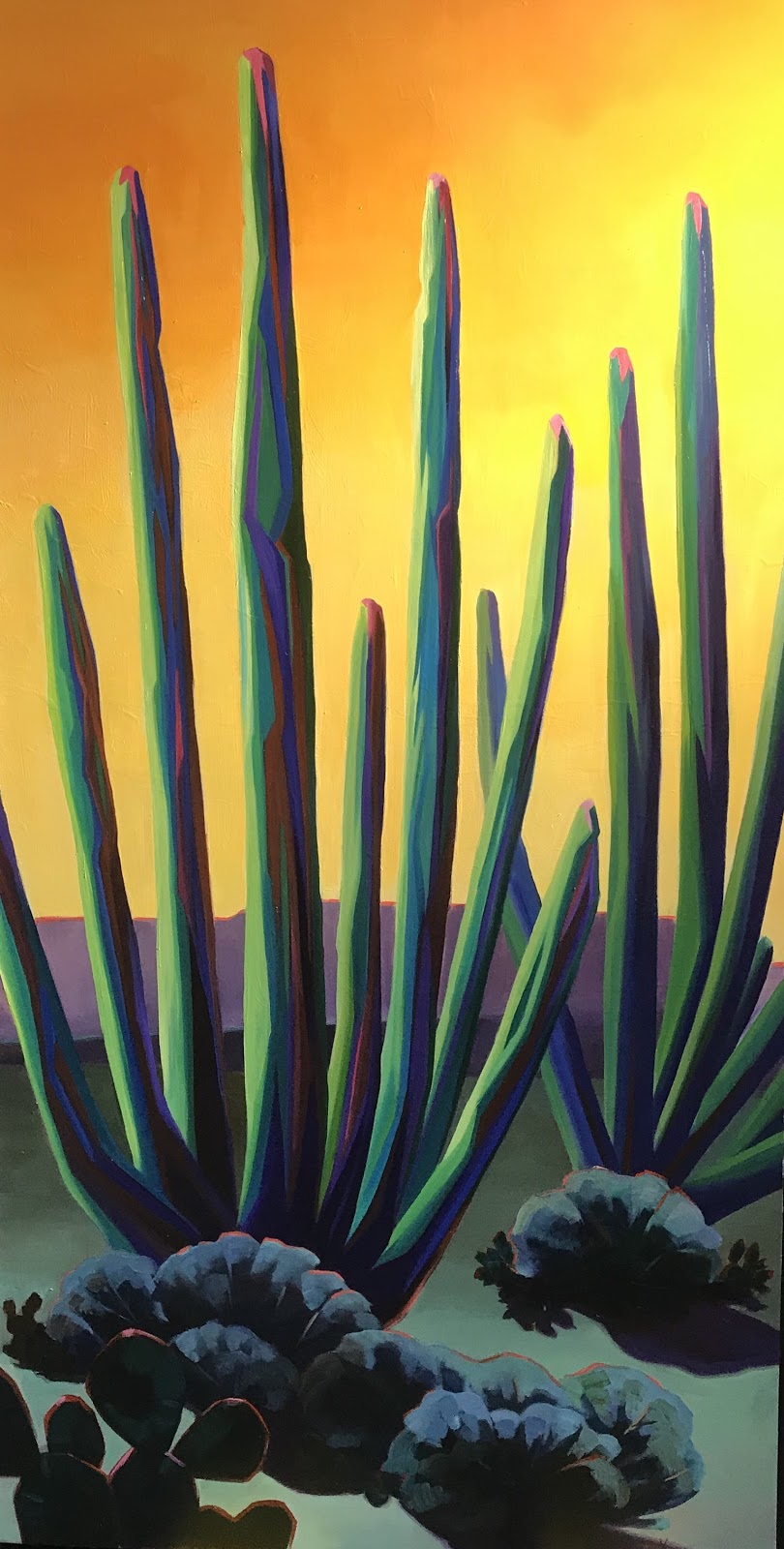
Leaving photorealism behind, Caroline has been painting cacti in a contemporary abstract style for a few years. She’s still an avid art student and laments not learning about color patterns and paint mixing when in college.
Caroline took matters into her own hands (as usual) and sought out a mentor. At the Expo, she approached Sam Thiewes, a fellow artist who lives in Prescott Valley and also exhibits his western paintings at the Arizona Fine Art Expo. He readily agreed to be Caroline’s coach and guide.
Caroline with Sam, her mentor, in his booth at the Expo
Each day during the Expo, they would regularly check in with each other. Sam would study Caroline’s latest painting to advise on composition, perspective or color. She listened to his wise counsel.
“I’ve learned so much from Sam,” Caroline says. “And from watching other artists for the last two months at this show.” This temporary artist colony in the desert grows into a tight community of creatives who naturally learn from each other, whether by observation or conversations.
Not having a house or apartment payment eases financial burdens. With her catering background and enjoyment of cooking, Caroline also works at the Expo Cafe while in Scottsdale and at the Great American Fish Company while in California, her usual summer place.
I’ve seen Caroline hustling during lunch at the Expo Cafe, running between the indoor counter and outdoor patio where she grills burgers and cooks soup on a two-burner gas-powered stove. Between preparing wholesome, locally-sourced breakfasts and lunches in the cafe and manning her Expo booth during the show, Caroline’s tenacity kept her going until she could finally put brush to canvas in the afternoons.
In 2016, Caroline received a much-needed validation for her artistic aspirations when she was selected as Artist-in-Residence at the Mojave National Preserve. Along with a boost to her national reputation, she also found a spiritual home in the vast, silent expanses of the Mojave Desert and takes every opportunity to return there for a few days and recharge.
“There’s nothing like the absolute silence of the desert at night,” Caroline says. “Feels like the universe is close at hand when viewing more stars than I ever knew existed. I unplug from civilization and am forced to live in the moment. It’s utterly head cleaning.”
During the Expo, in her spare time, Caroline would paint, paint, paint on her mission to get better and better, whether in her booth or in Bubbles. She’s completed plenty of paintings sitting at her compact dining table and admits to being at peace living with paints smears on her counter, table and even bed sheets.
When Caroline moves her RV to a new place, she’ll wake-up in her familiar, paint-dappled home, but often temporarily forgets where she is. But that’s okay. She figures it out quickly.
Waiting for the Monsoon
“Change has always been my life,” Caroline says.
That’s true. The view from her front door changes, her painting style may change and the people she’s surrounded by change with the seasons, but Caroline will always find time to paint, paint, paint. Nothing gets in the way of her artistic vision.
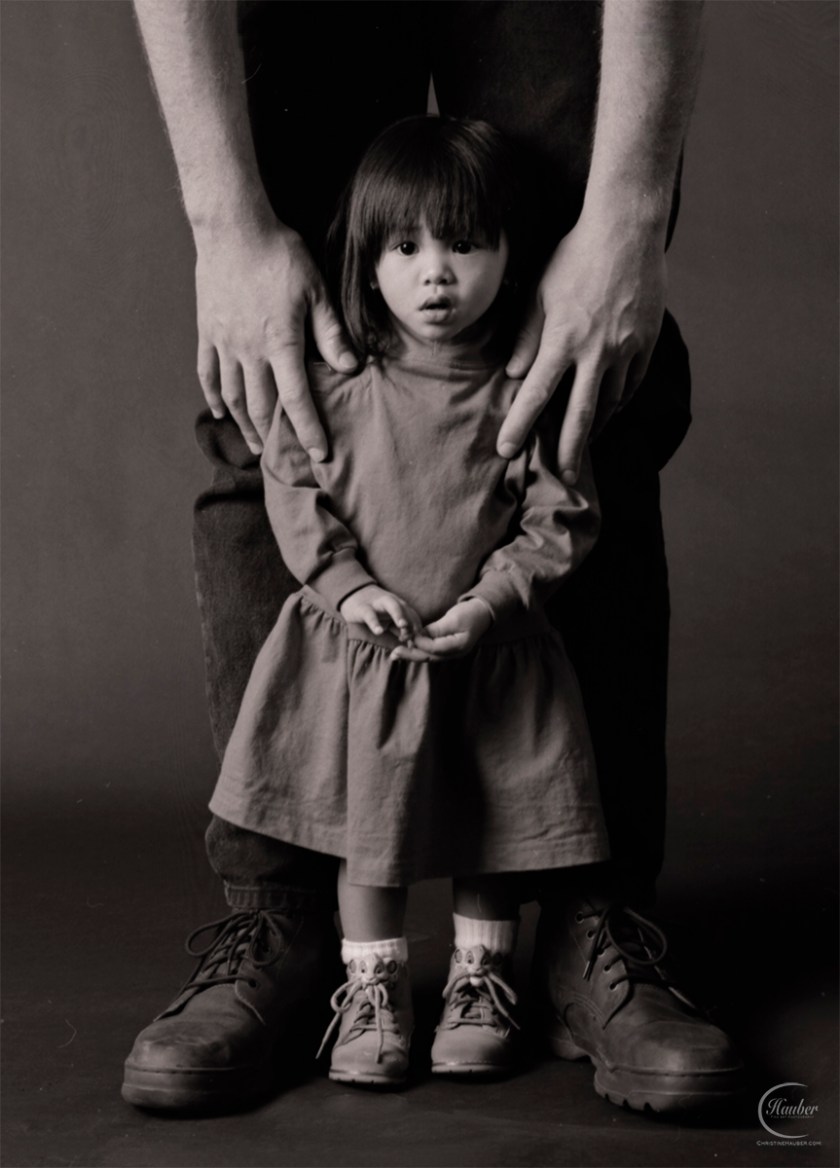
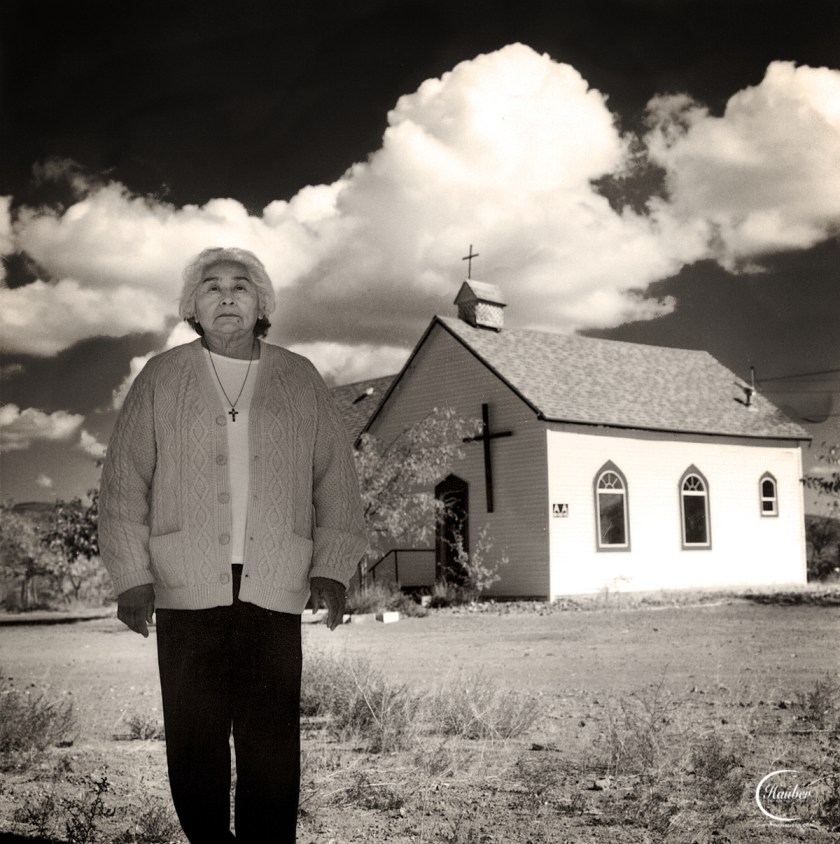
Christine is an introvert, and it works very well for her. She’s calm. Centered. No drama. While she relishes her solitude, she doesn’t shy away from being with people. And she gets people. As a portrait photographer, she nails the core of their being in her photographs.
Courageous Christine
Christine is an introvert, and it works very well for her. She’s calm. Centered. No drama. While she relishes her solitude, she doesn’t shy away from being with people. And she gets people. As a portrait photographer, she nails the core of their being in herphotographs.
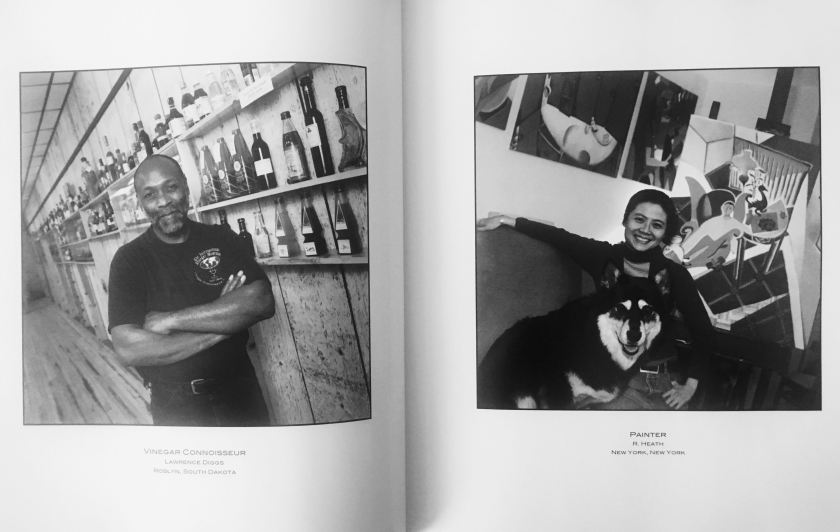
In the early 2000s, Christine traveled the byways of America meeting people in villages and communities, documenting their professions by capturing them in their work element. Her book “Working in the USA” is a love letter to working folks, a fascinating study of people ordinary and extraordinary, all the more poignant because she shot each one in black and white.
A spread from Christine’s book, “Working in the USA”
I dare you to open her book and try to close it after a few pages. I sure couldn’t. Its width straddled my lap and I turned page after page, unable to stop looking at the next person — a firefighter, a Cajun accordion maker, a gold miner, a shrimper – each with their earnest face surrounded by the tools of their trade. Proud people. Humble people. Dignified.
More USA workers photographed by Christine
For an introvert, Christine excelled at traveling in her RV and meeting all kinds of people along the way. She stills lives in that same RV… since 2001. These days, she winters in Scottsdale, Arizona, and summers in Santa Fe, New Mexico.
Even more USA workers photographed by Christine from all lower 48 states
From Denver to Daring
Growing up in Denver, Christine enjoyed spending solitary time drawing and coloring when she wasn’t out being “one of the boys” with her two older brothers. From an early age, she was immediately attracted to pencil and charcoal drawings, which formed the basic artistic thread running through her life; producing works in black and white.
Christine also loves animals and had planned to be a veterinarian, until one summer when her mother arranged for her to work on a pig farm in South Dakota. “I realized I didn’t like seeing animals in pain,” Christine says.
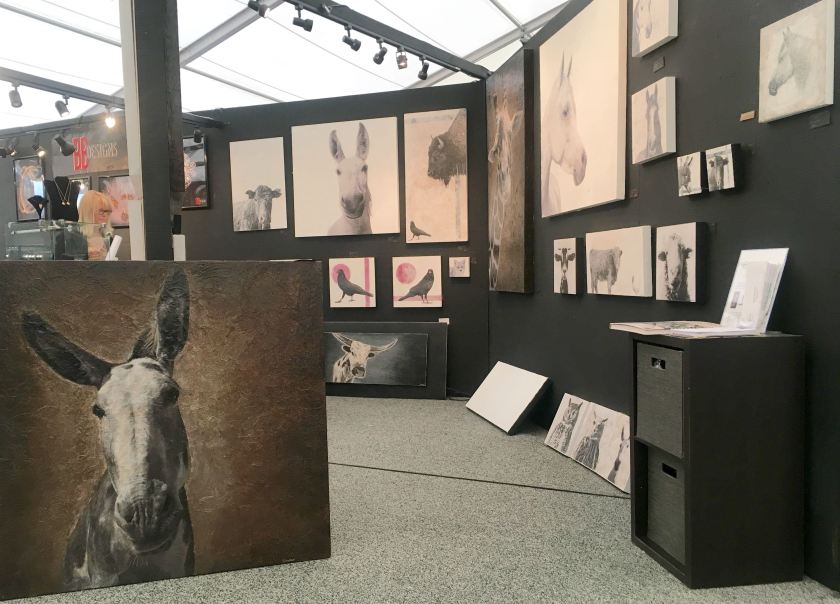
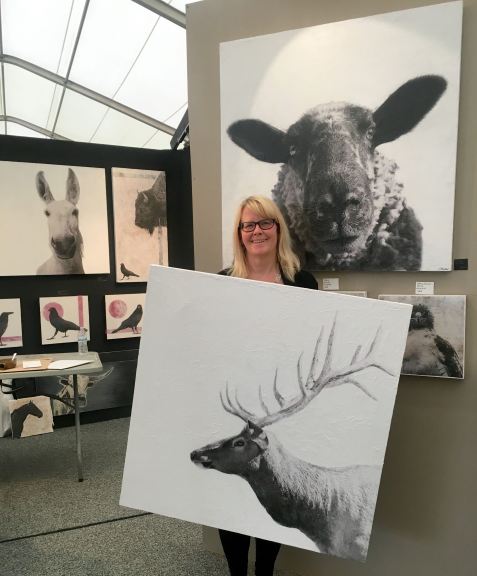
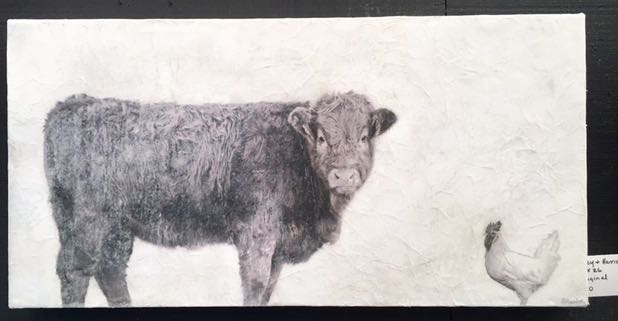
These days, she photographs portraits of rescued and protected animals, like donkeys, horses, goats and sheep, and transfers their black and white images onto wood panels that she embellishes with white tissue paper, textures and paint or encaustic.
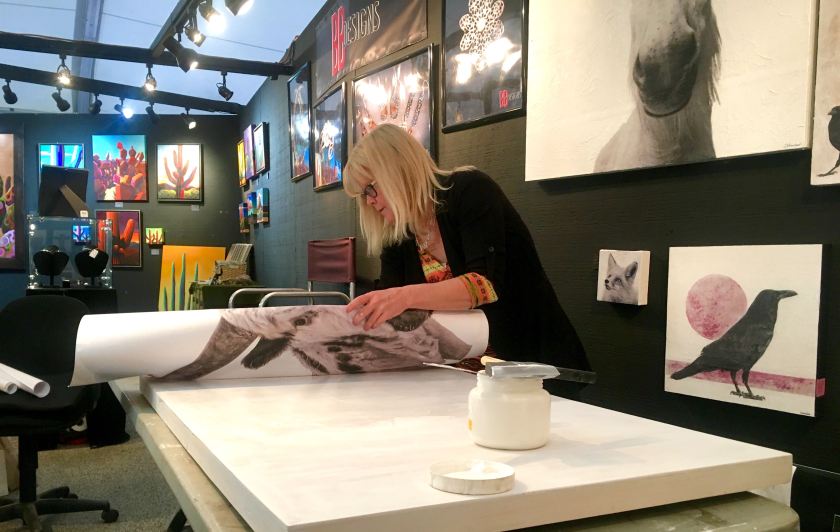
Christine in her booth at the Arizona Fine Art Expo, transferring a cow print onto canvas
Christine’s animal faces are charming. But photography and mixed media pieces aren’t her only creative outlets. She also cooks. Each winter, she exhibits at the Arizona Fine Art Expo and also runs the Expo Cafe with her assistant, Caroline Kwas, also an exhibiting artist. Together, they prepare breakfast and lunch seven days a week for visitors and resident artists.
Each summer, Christine hosts multiple Art Spas in Santa Fe. While her business partner teaches painting classes, Christine prepares their meals and demonstrates cooking. She focuses on healthy vegetarian foods while explaining the cooking process. In a recent Art Spa, she taught everyone how to create and roll their own spring rolls.
Christine’s Expo gig in Scottsdale goes beyond just showing her art and cooking wholesome foods (which keeps her busy for 80 hours each week). She is also part of the crew that erects the giant u-shaped white tents for the Expo.
The entrance to the Arizona Fine Art Expo
The show launches mid-January and she arrives from Santa Fe in November to get the Expo up and running, along with the show managers and facilities team. When the Expo closed on March 25, Christine spent April leading the crew in dismantling and packing up the massive tent for storage until next year.
Christine’s booth and artwork
During the Expo, Christine stays busy painting, running the cafe and then walking to her RV out back each evening where she continues to make her art.
Many people dream of pulling up roots and following their passion, living an endless summer in mild climates. Christine is doing it, though she admits it’s not as freeing as it might sound. The hours are long, the work hard and the pressure is on to make a living from her art.
“You can do anything for 10 weeks,” Christine laughs. That’s her motto for this year’s Expo.
Christine with her new elk mixed media work
Though her location changes, Christine’s focus on producing art never does. She continually learns from customer feedback, what’s selling and what’s not, to try new things. “I’m always chasing that carrot,” she says, laughing. Making a living from art drives Christine each day to discover new ways to market what she does.
Working in the USA
Christine received her college degree in psychology and worked for a year counseling troubled youth for $6 an hour, which was minimum wage. Working with the kids was fine but after a year, Christine realized her co-workers were the ones with the more severe issues. To compensate for work stress, she took a class on darkroom techniques and promptly fell in love with it.
She also took a couple of pre-med courses for genetic counseling but soon determined speaking with pregnant women about potential baby problems would be too taxing. When her father pointed out how passionate she was about her hobby of photography, and encouraged her to consider turning professional, she took his advice.
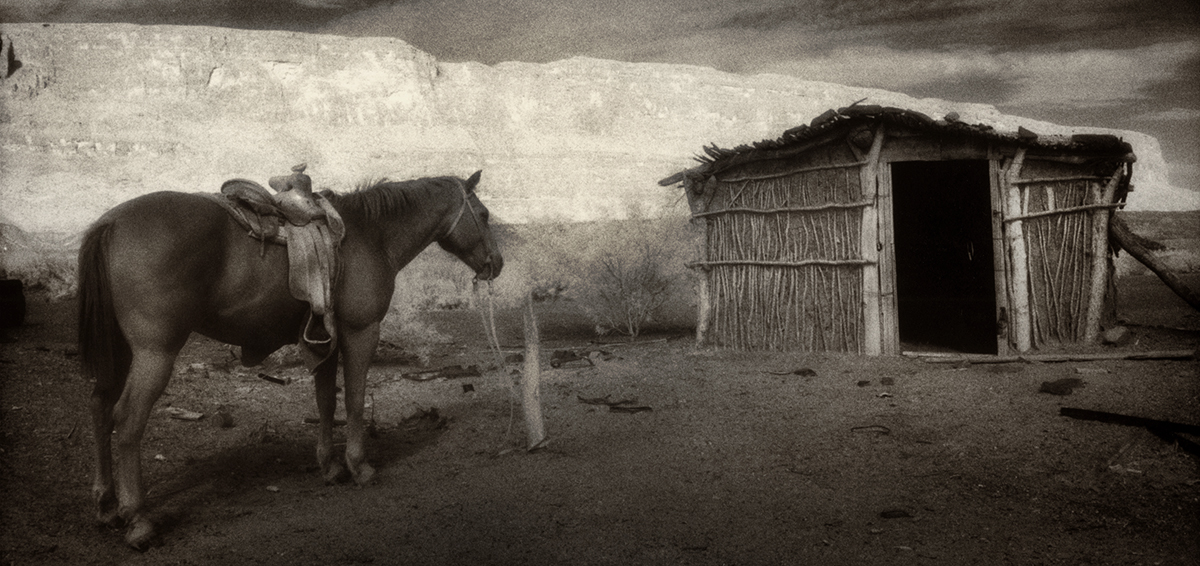
Christine chose commercial art photography over her pre-med studies and started her own Portrait studio in Denver. She liked to experiment, to stretch her creative muscles, and worked with infrared film, which plays off of the red spectrum to produce ethereal photos.
For six years, Christine ran her business and also spent two of those years caring for her aged grandmother. Soon, feeling stifled by traditional portraiture and her home life, she longed to follow her creative urges to travel and take pictures.
Always a traveler at heart, Christine had taken solo trips to China, Singapore and Hawaii. She knew her new dream of traveling the U.S. and taking photos was doable, with proper preparation. She talked about her project with a purpose. She dreamed about it. Finally Christine’s dad convinced here there was no time like the present to chase a dream.
Again, she listened to her dad and set her departure date for one year ahead.
Heeding the wanderlust call, Christine bought a 29-foot RV and converted the main bedroom into a compact custom darkroom. In April, she set out to visit all 48 lower U.S. states and photographically document workers of all professions. Her project, called Working in the USA, was a way for Christine to show people in other countries what real Americans look like, as opposed to those seen on TV shows and in movies.
“We’re a nation of diverse people who work hard,” Christine says, “and work is a common theme all over the world. The first thing we ask when meeting someone new is ‘what do you do?’”
For three-and-a-half years, Christine traveled 70,000 miles with her cat Ansel and her dog Gracie. When her travels were over, she worked on producing her book “Working in the USA,” which was published in 2006.
Christine had finally burst out of traditional portrait methods and captured people from all walks of life. Along the way, she learned to avoid tornado alley in May and June, to avoid the north in the winter, to look for free RV lots, to lay low while parking overnight at truck stops and to overcome her natural shyness to approach people and learn their stories. She was traveling before people were actively blogging and before social media provided a platform for instant sharing. She wrote about the people she met, in addition to photographing them, and she still has many stories to tell about the people in her book. I’m looking forward to hearing those stories. And to seeing what Courageous Christine does next.
“There are no excuses to not travel,” Christine says. “Don’t wait for a traveling companion. Don’t wait to pursue any dream. Get out there. You’ll survive.”
When I first saw Shawna’s large, bright canvases from a distance, I had to get down there… and fast… even if it meant passing up many other artists’ booths. Up close, her bold, singing work did not disappoint and when Shawna came around the corner with her wild hair barely contained and her stride full of joy, I instantly knew her natural glee perfectly matched her art. And who wouldn’t be drawn to both!
As an undergraduate at Auburn, Shawna was a nude model for painters at the nearby Columbus Museum of Art in Georgia.
“It took some getting used to,” Shawna says, “ but I made $20 an hour, the most I’d ever made.”
Her body isn’t the only thing she’s bared for art.
This past December, Shawna quit her job as an art therapist, packed a van with art supplies and home furnishings, and drove from Jensen Beach, Florida, to Scottsdale, Arizona, to exhibit her tissue paper pieces at the Arizona Fine Art Expo, a 10-week show housed in a giant white, u-shaped tent.
Shawna in her Expo booth, shared with her partner Gregory, a glassblower.
Every year from January to March, more than 100 artists occupy booths at the show and paint, sculpt, make jewelry, etc., in their spaces, sharing their work and techniques with guests seven days a week.
Shawna took a leap of faith to try her hand at being a full-time artist, encouraged by her boyfriend Greg Tomb, a masterful glass blower who has made a living from his art for years by traveling to shows around the country.
So, newish relationship, new “job,” new city, new condo… all at once. Hello, Overwhelm.
“January was a stinker of a month,” Shawna says, laughing. “Setting up a booth with a partner for the first time was stressful as we got used to each other. And traffic at the show was slow, so we naturally worried about money.”
By February, Shawna had made friends throughout the giant tent and she and Greg were grooving as a couple.
“I’m the type who has to be connected with people,” Shawna says. “If I’m making art, I must also be doing something to make a difference in other people’s lives.”
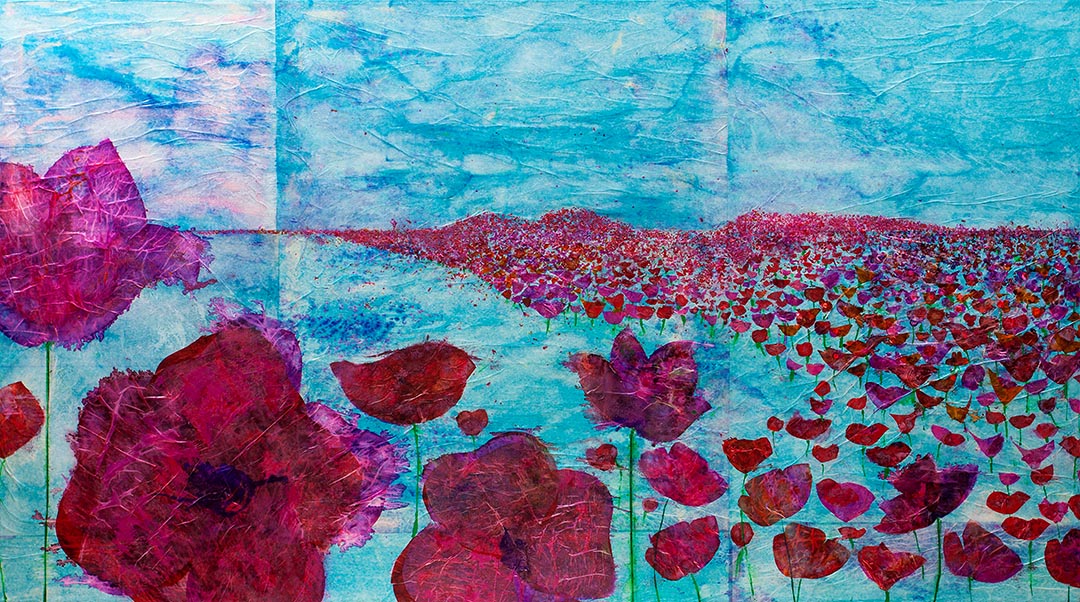
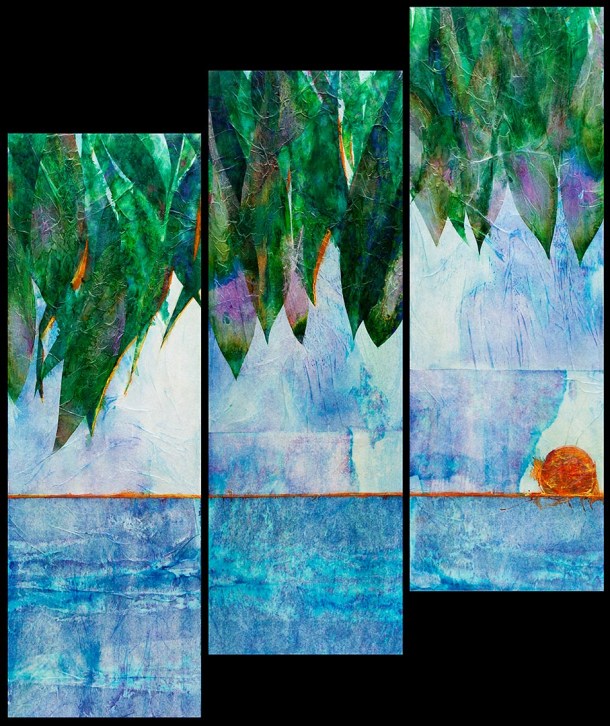
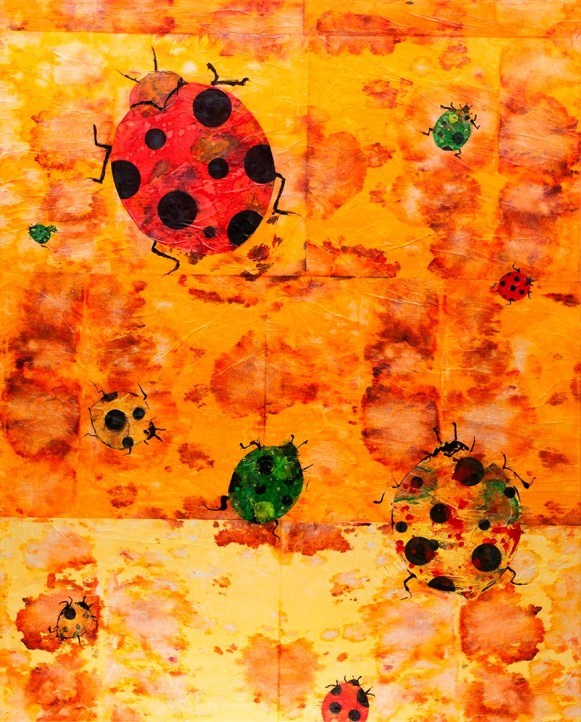
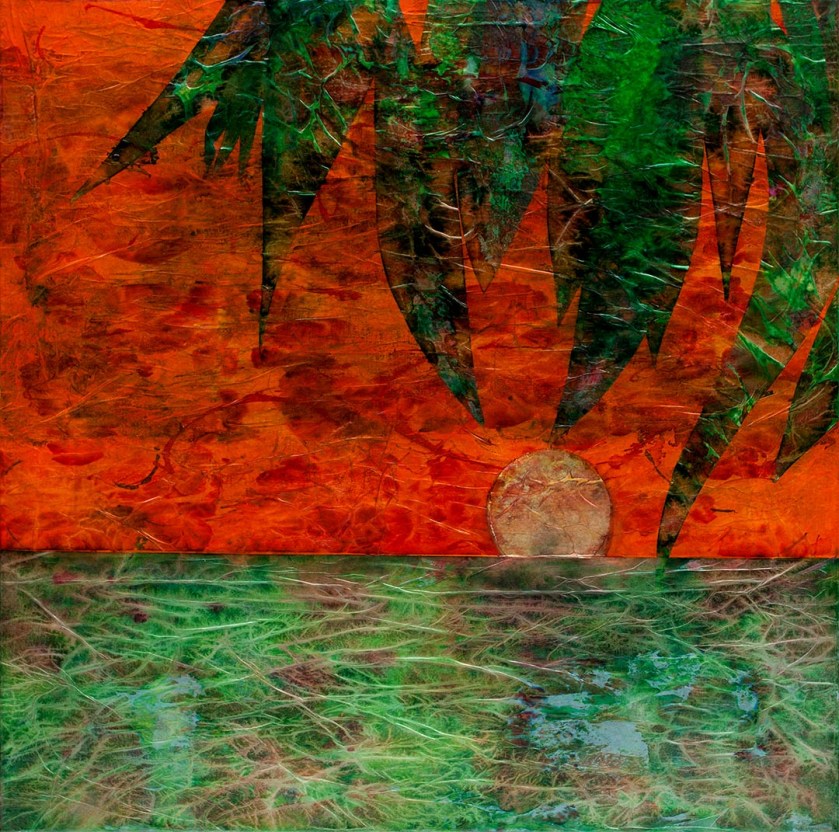
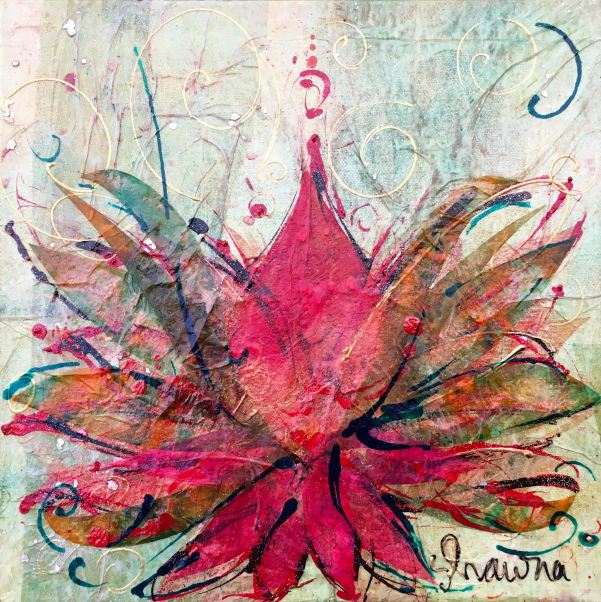
She’s a cheerful and kind spirit who gives and gives of herself. Her artwork, created by gluing colorful tissue paper onto canvases, is an outward sign of her inward joy. Full of happy, bright colors, her pieces cause continuous smiles.
After getting a Master’s degree in art therapy, Shawna has been a nationally board-certified art therapist for 20 years. She honed her skills working with tissue paper while showing clients how to express their emotions through their hands; even if it meant they used only black. The simple act of wanting to switch to a color other than black could signal a big breakthrough for a client.
How does someone help traumatized people day after day without succumbing to trauma themselves? Especially someone like Shawna who is sensitive and attuned to others’ feelings and energy.
“I’ve been lucky to work for companies that offer insurance with mental health benefits for employees, and really good self-care is a must,” Shawna says, with a chuckle. “Plus, helping people freely express in 2- and 3-dimensions while encouraging them to connect to their imaginations and innate creativity is very rewarding.”
Shawna was born in Alliance, Ohio, but grew up in Jensen Beach, Florida, influencing the definite coastal feel in some of her work. From the age of 2, Shawna chose crayons and paint over dolls and TV. Her mother knew, even then, that Shawna was an artist.
Shawna used her therapy training to acclimate to her new nomadic life and the self-contained art community that pops up each winter in the Sonoran desert.
When people show interest in her work, she delights in telling them how she does it. Oftentimes, they want to learn to do it.
“After several women expressed interest in doing tissue paper art, I put up a class sign-up sheet in my booth and it filled up in less than a week!”
Shawna has given several classes during the show in a classroom available to artists for just such activities, and she’s an excellent teacher/coach/cheerleader. I was lucky enough to take her “Tissue Paper Art 101” class and admired how she put everyone at ease about being creative.
“First thing we’re going to do is take off our judgement hat and throw it out of this room,” Shawna says.
Animated, she tosses her imaginary hat like a frisbee and smiles big. Her long hair, extra curly and full, moves when she does, accentuating her vibrant personality.
This slideshow requires JavaScript.
The room we’re in has walls but no ceiling, except for the big white tent overhead. We can hear cars on Scottsdale Road, but Shawna can easily be heard telling us about the nature of Bleeding Art tissue paper, the medium for her artwork. When the paper gets wet, colors bleed onto adjacent papers, creating unpredictable patterns.
Shawna then uses a sponge brush to gently apply a mixture of Elmer’s glue and water, adhering the paper to a canvas. Or she might use a bristle brush to smooth it into place. In this beginner’s class, our only objective is to experiment.
In class with Shawna, fellow student Annie and a big mound of tissue paper!
“Cut it or tear,” she says, “there is no wrong way. You’re learning about the paper’s qualities with every piece of tissue you add.”
After working with tissue paper for decades, Shawna has mastered composing images, although she admits controlling how the colors bleed is nearly impossible. Coat hangers hold folds of tissue paper already splashed with water and fully dried. Working when the paper is wet can be difficult, so Shawna always has lots of dried, prepared paper on hand.
Greg’s talent isn’t limited to blowing remarkably beautiful glass bowls. He’s a good carpenter, too, and built Shawna a rolling cart to hold her art supplies, including glitter glue, paints, tiny canvases on wooden easels and all sorts of tiny sparkly notions to add to a completed piece of art. The cart even has a handy rail on one side for displaying her many coat hangers of inspiring papers.
The rolling cart that Gregory built to hold Shawna’s supplies and paper.
In class, we get very quiet as we experiment with collages of tissue on a thick piece of paper, to get a feel for how to handle the glue, paper and active colors. The moistened foundation papers tend to warp or curl.
“No worries about curling papers,” Shawna assures us. “Once it’s dry, simply put it inside a large coffee table book overnight and it will emerge flat.”
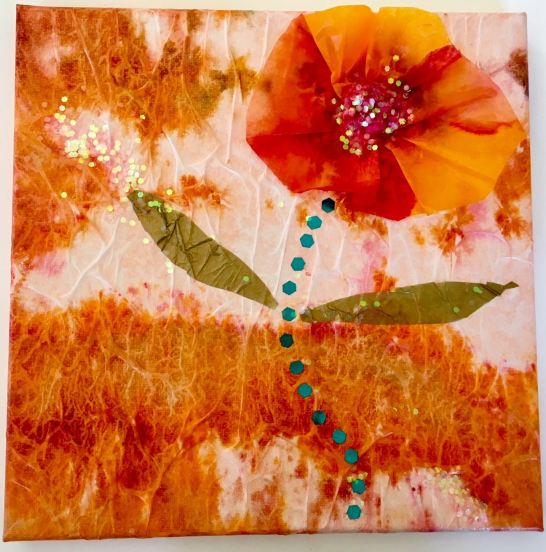
After experimenting, we tackle covering a canvas with tissue. Shawna has several canvas sizes available. I grab a 10-inch square and spot some prepared papers with orange, white, pink and yellow. The brighter the better is my motto. Plus, I have visions of Shawna’s art in my head. Using her prepared paper means my piece of artwork is a collaboration with her.
The piece I made in Shawna’s class using her prepared paper.
Two hours fly by. Shawna finishes our partially-dried artwork with a spray acrylic in either mat or gloss. It also provides UV protection.
I enjoy the class so much, I’m hoping to be able to take her Intermediate course before she packs up and goes back to Florida.
One wall of Shawna’s booth holds the smaller items she collages and paints.
Canvases aren’t the only surfaces Shawna covers in tissue paper and paint. She makes one-of-a-kind notecards and decorates the covers on planning calendars and bound journals, turning them into useful works of art. I bought one of her journals to use in a writing workshop my daughter Jaime and I are taking in Paris this June.
“Art is integral to who I am,” Shawna says. “I find a natural flow between creating therapeutic space for the art-making process for others and for myself. I’m in constant connection to my creative core, even when addressing an envelope, cooking or starting a new art project.”
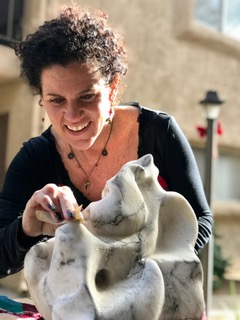
Sculpture is another 3-D art form Shawna relishes as she uses organic materials to evoke the Divine Feminine. “Nature is rarely linear and my sculptures are a celebration of all that is feminine, soulful and passionate,” Shawna says.
As an undergraduate, she dove into sculpting with wood, clay and stone, and sometimes using found objects to create assemblage pieces. In fact, her senior thesis was based on a theme for nine large-scale assemblage sculptures. But when she started working, sculpting took a back seat, even to her collage work.
Two years ago, Shawna’s best friend, Susannah, fell in love with the carved wood, alabaster and marble pieces Shawna had created in early 90s. “Susannah asked me who had done the carvings and she couldn’t stop touching them,” Shawna says. “When I described how I carved them, she nearly flipped because she’s only known my tissue paper collages. She emphatically told me I must, must, must get back into sculpture as soon as possible. In fact, she made me promise I would.”
The Expo, a creative place to the max, is the perfect spot for Shawna to sculpt, paint, and, most importantly, make good on her promise to Susannah.
Shawna is wise to acknowledge her need for being emotionally connected with the people around her. We all have that need to some extent, yet some of us don’t always honor it… and we’re the poorer for it.
A giver, Shawna has created a new life and a new relationship that gives back. She credits Greg with evoking the courage she needed to embark on this current desert adventure. In fact, he convinced her to see the possibility of taking a two-month hiatus from her job last summer and travel to New York where he would rent an apartment, giving Shawna the freedom to produce her large-scale pieces for two art shows in which she and Greg would participate.
Shawna’s employer did not offer anything like a hiatus and she expected a big fat “no.” But when she asked, they said yes!
Greg believed in her work enough to know she could pursue it, and they could share a life on the road as partners in every sense of the word. He also believed in her talent enough to hand-build the large canvases for her work.
“It was amazing and scary to wake up each day and only have to make art,” Shawna says. During those two months, she learned a lot about art, about Greg, about herself and about the public’s reaction to art.
When Greg suggested they both apply to exhibit at the Arizona Fine Art Expo, Shawna saw the stars aligning. That’s when she made the decision to leave her job of nearly four years and dive head first into being a professional artist. These last four months have been eye-opening, frightening and a catalyst for her next stage.
Recently, Shawna scheduled an art therapist job interview for early April back home. “I’m hopeful to go back to work full-time in South Florida,” Shawna says. “I will definitely continue to do my art on the side, and exhibit at shows.”
Greg has a few shows lined up for the remainder of 2018, giving them an opportunity to flex and strengthen their intermittent long-distance relationship with FaceTime and other technological wonders to stay connected.
Shawna sounds at peace with their future. “We have plans to join forces down the road,” she says.
I’ll miss Shawna when she’s back in Florida, but I have no doubts she’ll brighten the lives of her clients through art therapy and retail art therapy.
Shawna’s extraordinary parents, Jim and Melody, taught her to always be kind. She takes kindness one step further and is always loving, even with people she doesn’t know.
On a daily basis, Shawna bares her soul to those who are lucky enough to be near her, and she gives us permission to open our souls and be creative, be vulnerable, be colorful, be loved and see the joy in life.
Shawna shows us how to throw our judgement hats out the window, and we’re the richer for it.
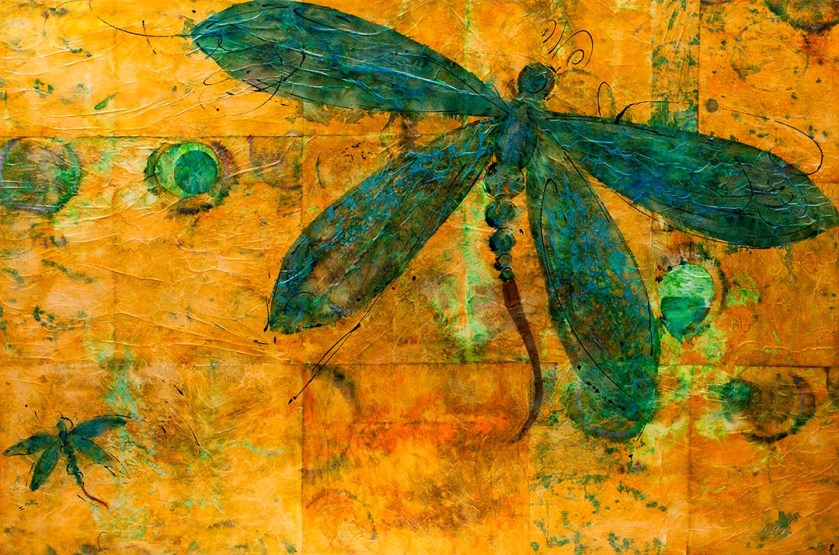
Detail of the dragonfly above.
Education
Bachelor of Fine Arts with a concentration in sculpture from Auburn University.
Master of Arts in Art Therapy from Ursuline College, Cleveland, Ohio.
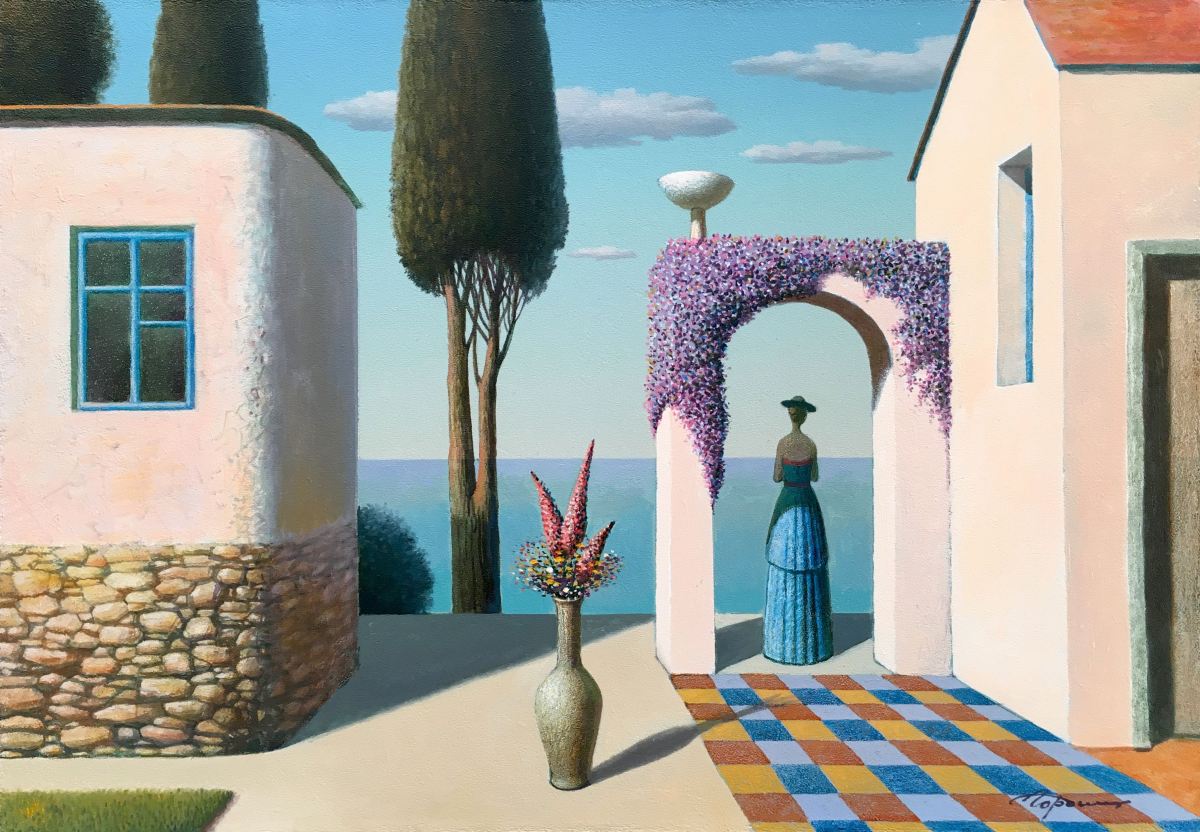
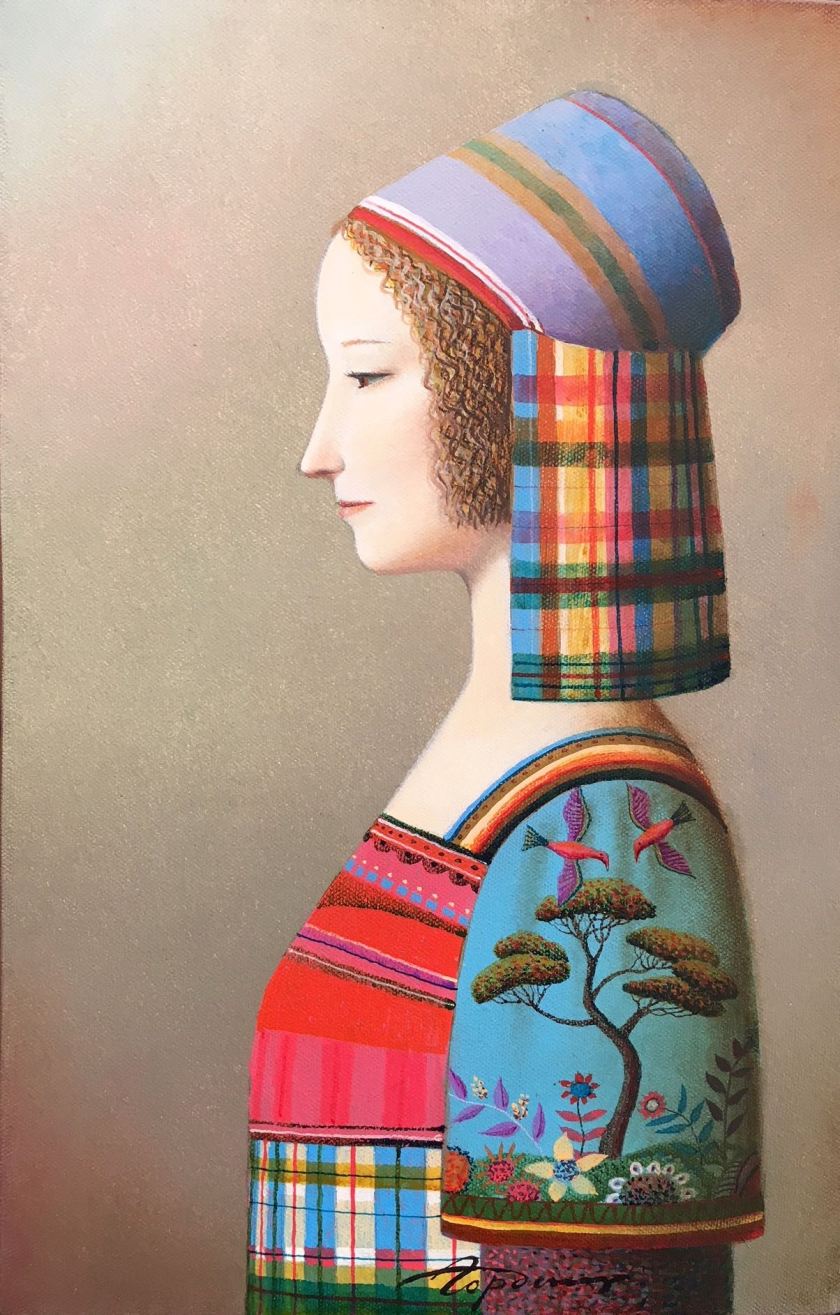
“There is nothing in this world that make more sense to me than the balance and beauty of nature,” Evgeni says on his website. “In my art, as in my life, I try to maintain this delicate process.”
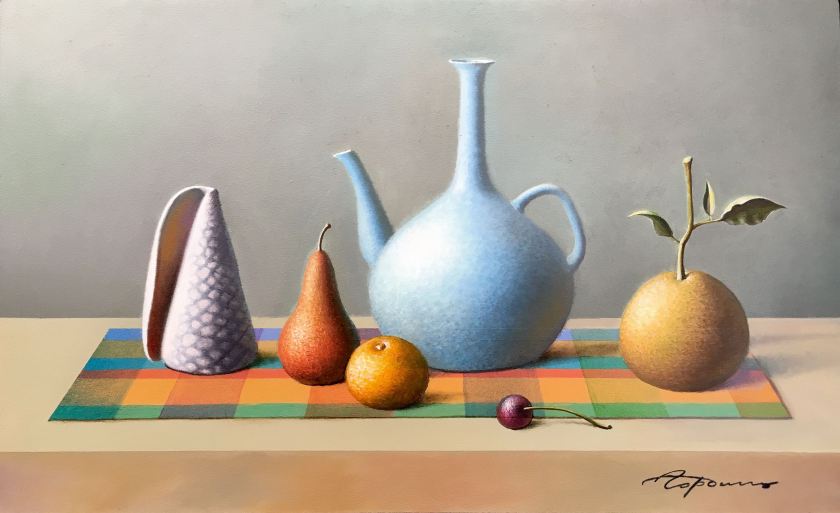
Apple and Cherry, 18″ x 24″.
Paintings to Live In
Ordinarily, I meet an artist whose work speaks to me, and I click with them on some level before writing them about them. However, Evgeni Gordiets is at home in Pennsylvania while his art is on exhibit at the Arizona Fine Art Expo through the end of this month. He may show up in Scottsdale for the last two weeks of the Expo. If he does, I will crawl across the desert to meet him. Meanwhile,his artwork is much, much too good to not show here… NOW!
“There is nothing in this world that makes more sense to me than the balance and beauty of nature,” Evgeni says on his website. “In my art, as in my life, I try to maintain this delicate process.”
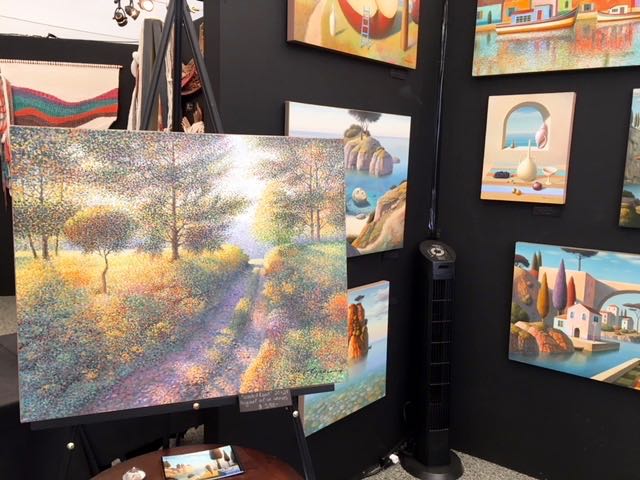
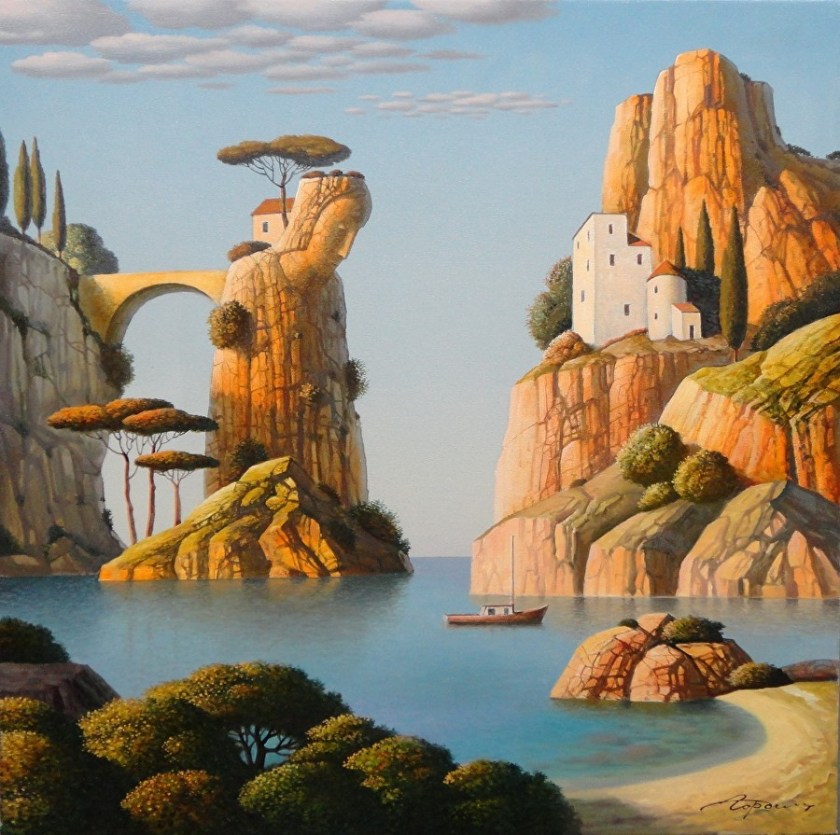
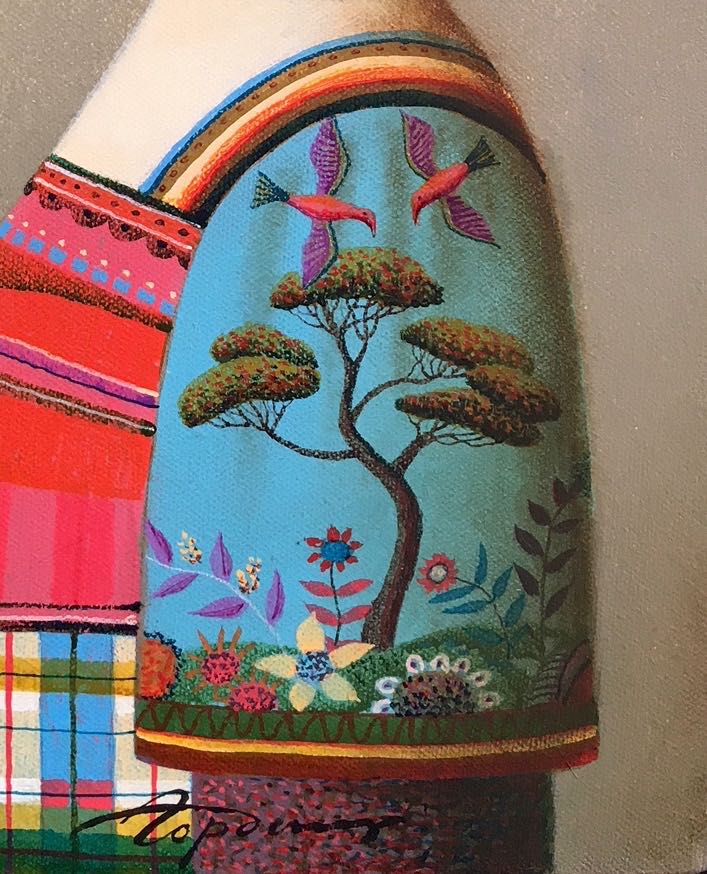
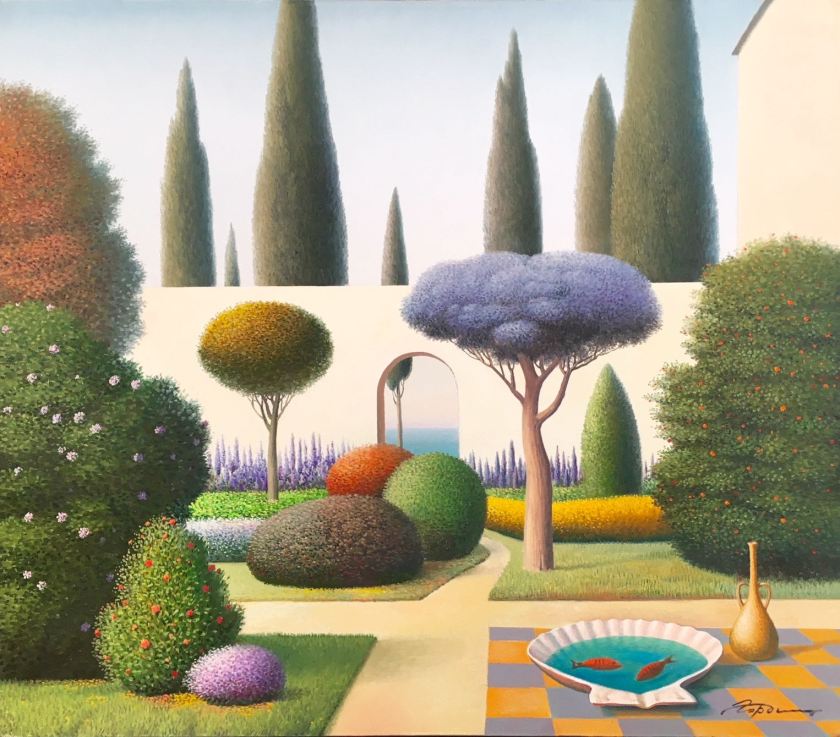
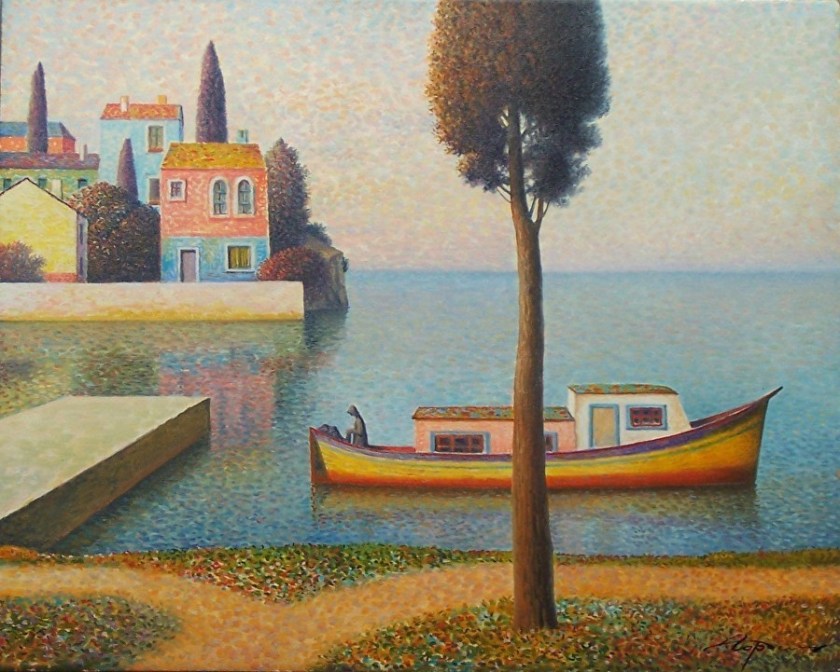
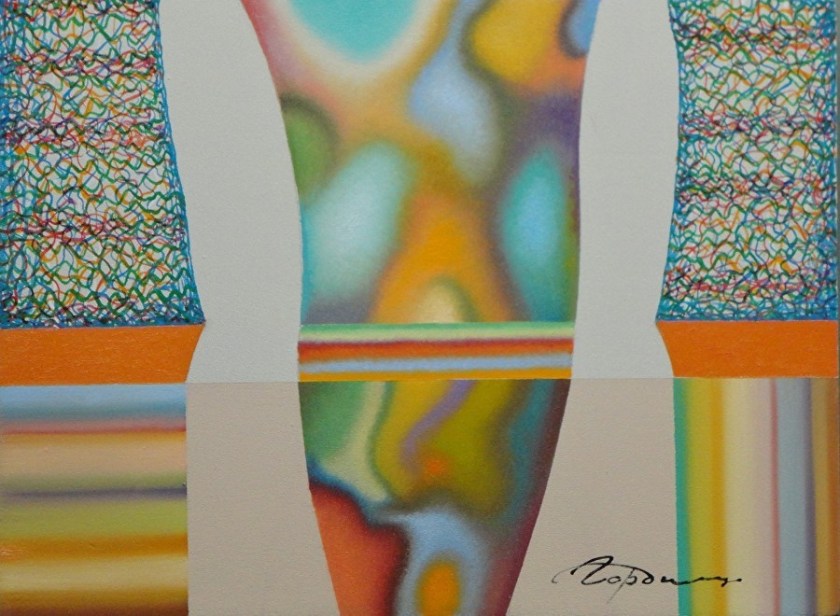
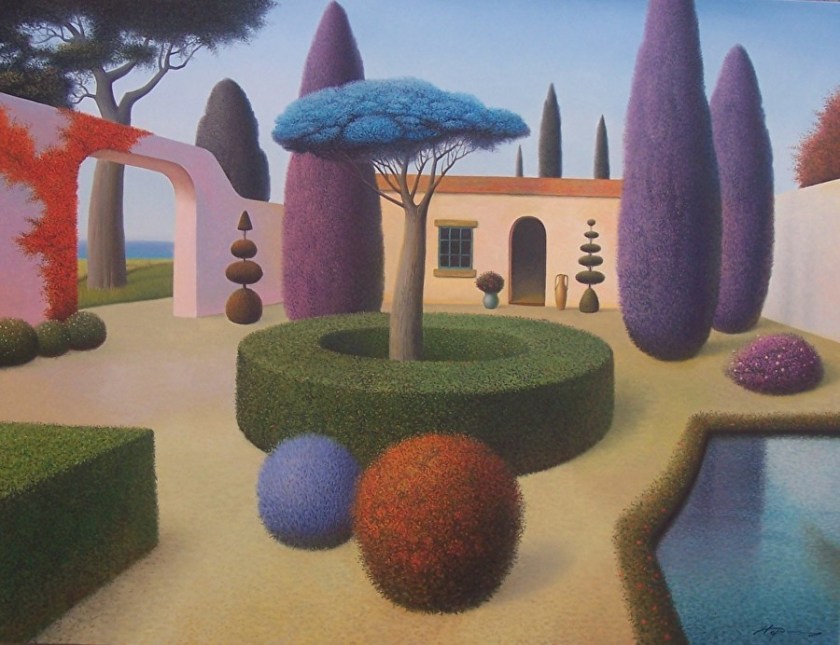
Graceful. Elegant. Serene. Pure. In some of his works, Evgeni uses pointillism to create his sometimes soft, sometimes vibrant scenes… layering tiny dots on top of tiny dots.
Looking at his still life paintings brings about a peaceful feeling, as though our daily worries are wiped away by ruminating on Evgeni’s images. Seeing one painting is not enough. Having another and another to contemplate brings contentment, like the meditative trance of watching water flow easily over river rocks.
Scouted as child prodigy at the age of five, Evgeni grew up in Ukraine and earned a Master’s of Fine Art degree from the State University of Fine Arts and his PhD in fine Arts from the State academy of Fine Art, both in Kiev. He was then a Professor of Art at the National Art University of Ukraine.
His work has been compared to Monet, Magritte and Dali, but it has a magical tranquility and sunniness unique to Evgeni. His artwork has won many awards and can be found in museums and private collections worldwide. His marketing flyer says, “In 1991, his work was chosen for the cover of Christie’s Evening Auction catalog.”
“Today, for me,” Evgeni says (on his marketing flyer), “life and painting are one. I have no desire to follow fashion; it has no value to me. In my art, the sea, the sky, woman and child are subjects of importance, eternity. In nature, I find a never-ending source of inspiration.”
Aksana and Paul, a local couple also originally from Ukraine, are working in Evgeni’s booth at the Expo while he’s in Pennsylvania. Paul tells me they own several pieces of his artwork (lucky them!!!!) and are helping out in hopes of Evgeni and his art gaining recognition in Scottsdale.
He sure has my attention!!
Paul was kind enough to allow me to take a few photos, and I pulled others from Evgeni’s website, which is definitely worth a visit: http://www.EvgeniGordietsArt.com
Gallery
Evgeni Gordiet’s booth at the Arizona Fine Art Expo in Scottsdale.Detail of the landscape photo above.Bay of Silence, 20″ x 20″.Seashell and Fruits, 10″ x 16″.Woman and Red Birds, 15″ x 10″.Detail of the sleeve in the above portrait.Garden with Blooming Tree, 24″ x 28″.Woman in Blue, 12″ x 9″.Summer and Butterfly, 22″ x 28″.Old Village with Red Cypress, 12″ x 15″.By the Red Tree, 20″ x 26″.Woman with Orange, 16″ x 12″.Improvisation with Yellow, 10″ x 8″.Lonely Cloud in the Afternoon, 20″ x 30″.Fishing Boat by the Old Village, 16″ x 20″.Rainbow, 8″ x 10.5.Garden with Blue Tree, 40″ x 52″.
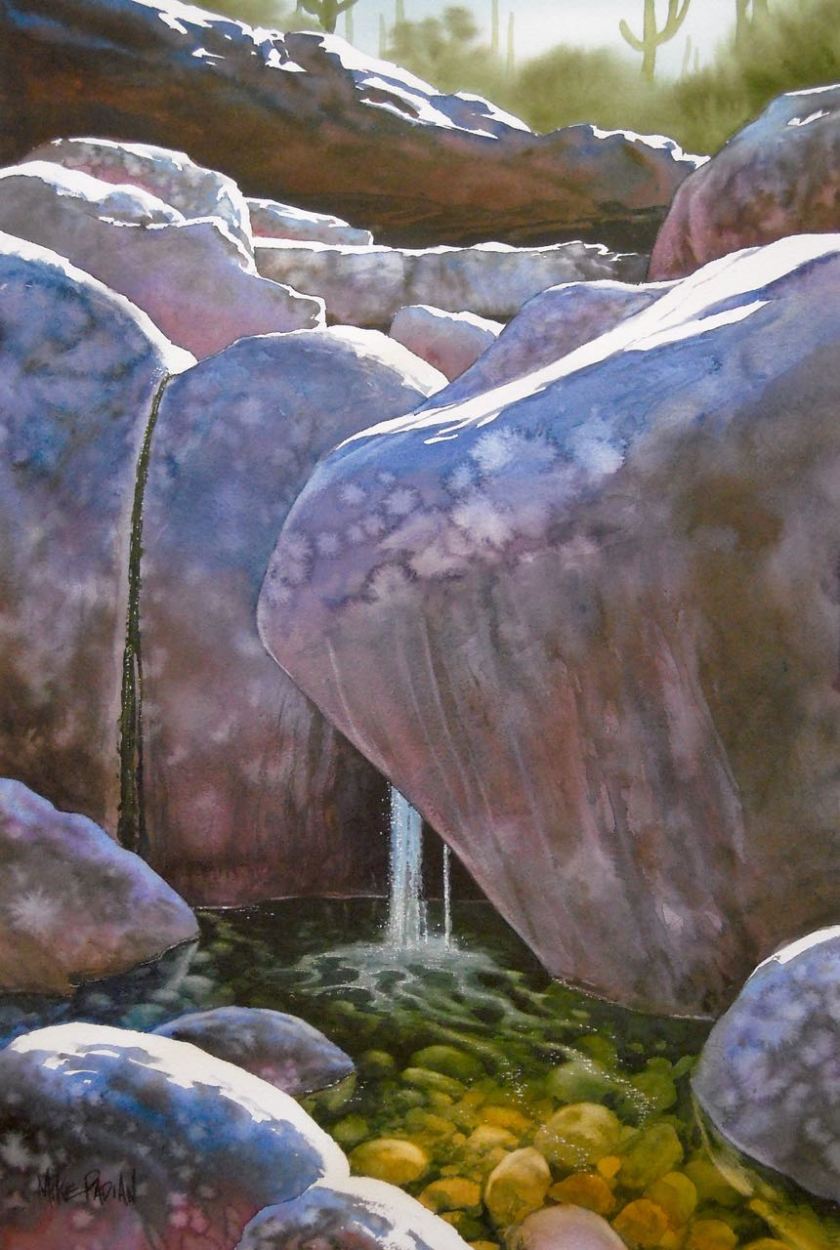
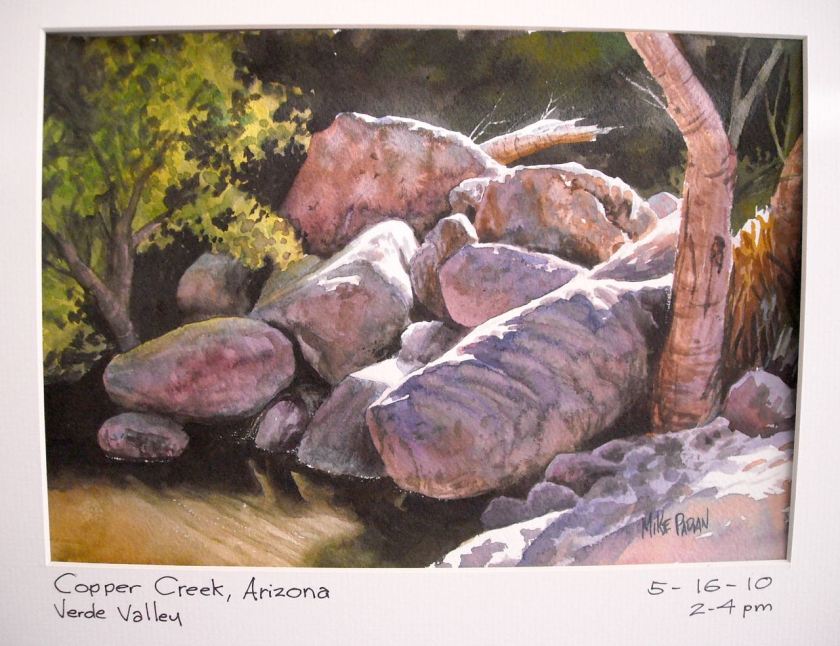
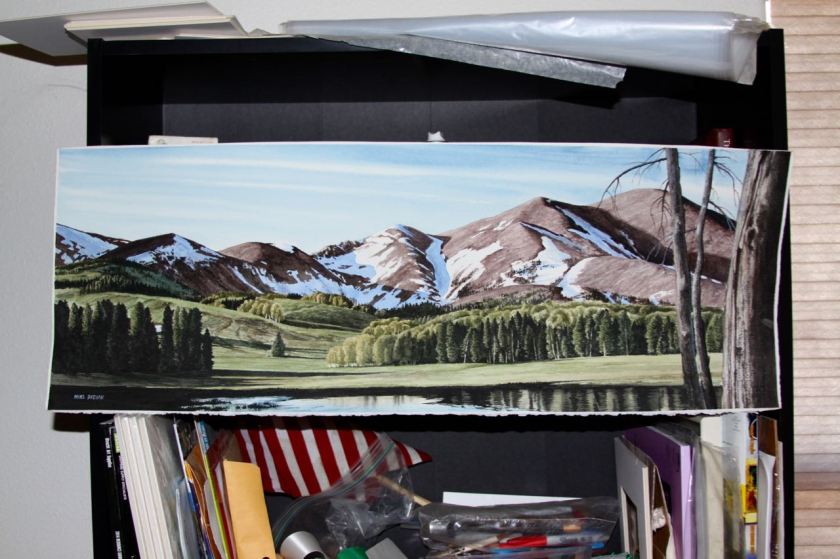
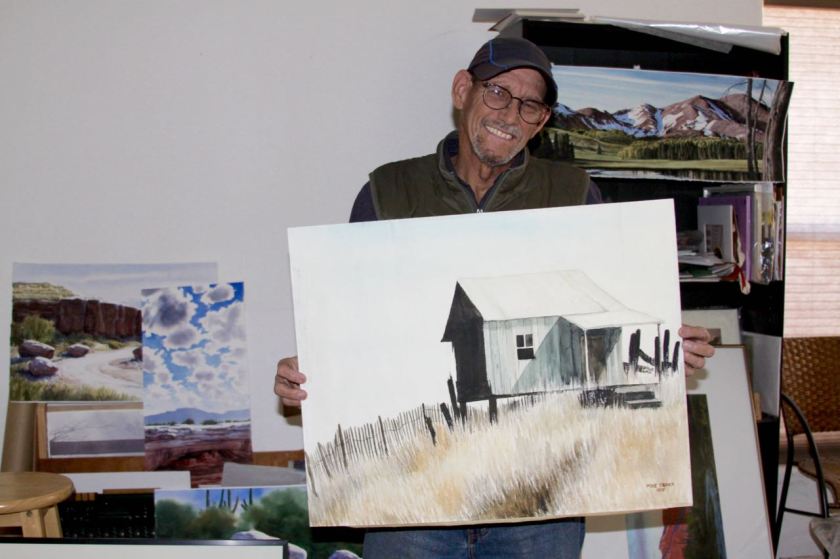
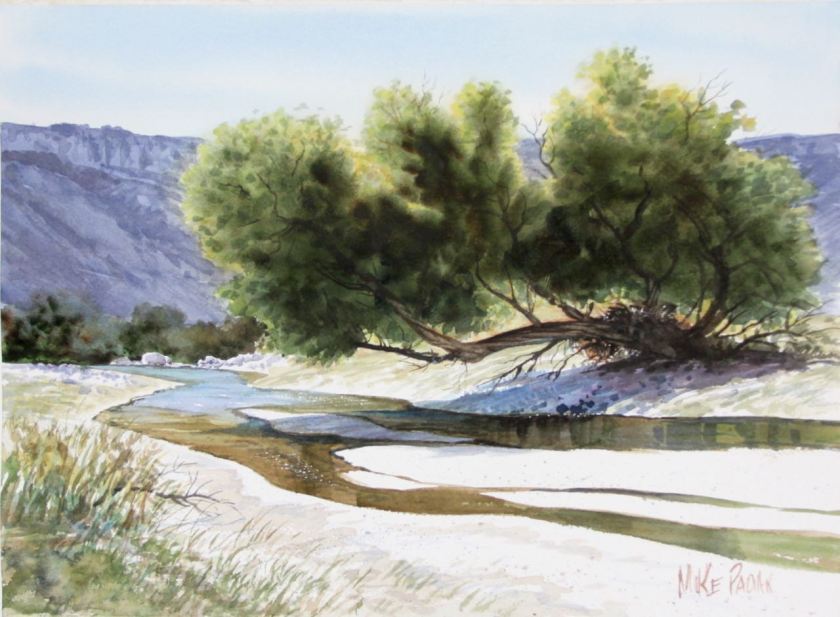
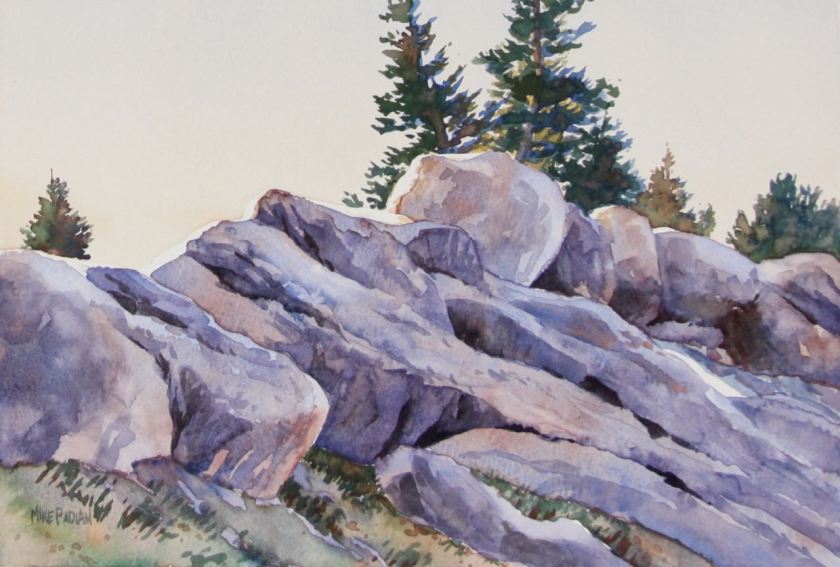
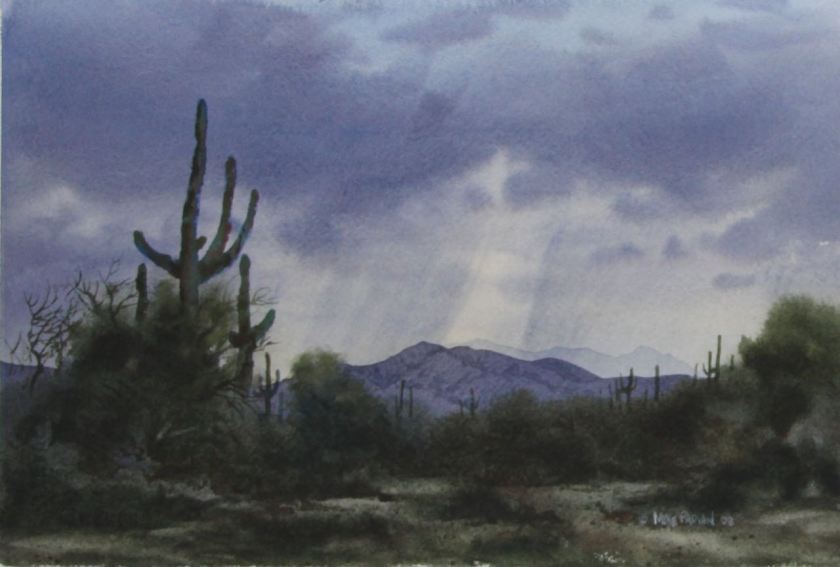
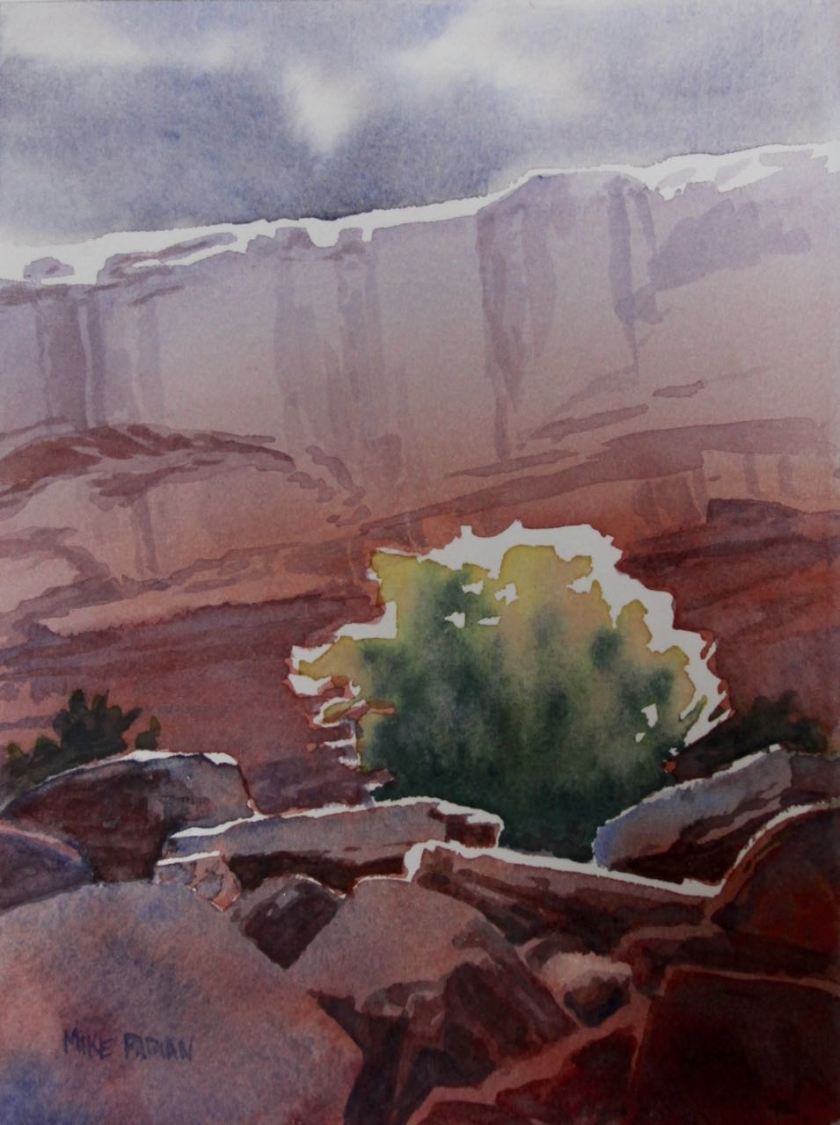
Mike Padian’s watercolor abilities were the best kept secret in Black Canyon City… until now. He’s mastered the medium, and life.
Watercolor Wizard
I met Mike last spring at a cooking class taught by Matt, French chef and owner of Nora Jean’s Koffee Kitchen; the second-best kept secret in Black Canyon City.
Mike’s talent as a watercolorist was the best kept secret.
During the monthly classes, where a group of wanna-be chefs try our hands at classic French dishes crafted with Matt’s imaginative twists, I’m always drawn to Mike, his sunny nature, quick smiles and absolute delight in the color, texture and chemistry of veggies, oils, meats and spices.
Delight. That’s Mike.
When I learned Mike painted watercolors, and asked him about it during class, he was standing behind a chair, hands resting on its back. Folks at our table were busy shoving haricots cooked with slivered almonds and garlic mashed potatoes into our mouths as Mike modestly said, “Yes, I paint watercolors.”
He mentioned being mystified by people who master oil painting. Soon, I’d learn just how modest Mike was being.
Last November, Black Canyon City hosted its third annual Hidden in the Canyon self-guided art studio tour. The weekend event included six artist studios in the small city. Each studio hosted multiple artists working in various mediums. When my husband Brent and I learned of the artist tour, we were in!
Most importantly, whatever studio Mike was exhibiting in would be our first stop.
Mike, along with a jewelry maker, glass artist and ceramicist, was showing his work in Lori M’s beautiful home, practically a museum of paintings, sculptures, ceramics, multi-media pieces and furniture by many artists; all tasteful and arranged for living with, not just looking at.
Lori is Black Canyon City’s patron saint of art patrons and she’s a huge Mike Padian fan.
“Wow,” Brent said when we first saw Mike’s watercolors, set up in Laura’s dining room, just off the patio. “Who knew he was this good?”
I had suspected Mike’s talent was great. But, the details… the colors. How was he able to so deftly manipulate colored water, the slipperiest of all media?
We immediately selected a small, rectangular landscape in a complementary frame and bought it. Fast. Before someone else did.
Lori, the homeowner, is a pretty woman, dark shiny hair, who was adorned in eclectic necklaces, bracelets and earrings made by local artists, each piece revealing her taste and personality.
“Since you bought a painting from Mike,” Lori said, “I want to show you something.”
She turned and removed a chair that blocked visitors from entering her living room. I felt like we had won the lottery as we followed Laura on our mysterious journey through her treasure-filled home. I found it difficult to walk forward because my head was constantly turning to take in each large painting, or sculptured figure or carved wall-hanging. Surprisingly, I didn’t bump into Lori, and Brent didn’t bump into me, when Lori stopped outside the closed door to her bedroom.
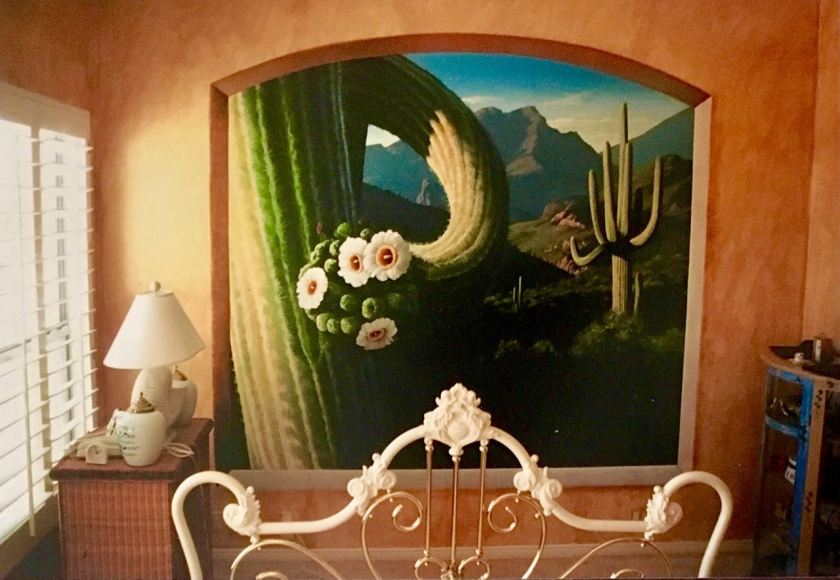
Drum roll, please. My head was actually buzzing with anticipation when we stepped into her room and our eyes immediately went to the mural over Lori’s metal bed, a faux window filled with a colorful Sonoran Desert scene.
Mike’s mural in Laura M’s bedroom
“What?!” is all I could say. Vaguely, I sensed Mike’s presence, but all my attention was on the gorgeous, red-blooming Ocotillo, white-tipped wildflowers and stately Saguaros showing through the optical illusion of a deep-set window.
Brent leaned over the bed to put his hand on the fake window sill and exclaimed, “I thought it was a real window ledge!”
The entire wall was painted to look like plaster, cracked in some places. Right then, I knew I had to feature Mike on this blog.
Lori beamed, clearly proud and in awe of Mike’s extraordinary talent. There was a hint of tears as she said, “The only reason I agreed to host artists in my home today is because of Mike.”
Lori knew something that would take me a little longer to figure out. Mike’s entire life had been spent making art, in one physical way or another, and sharing its beauty with people.
On a Saturday afternoon in December, I visited Mike in his home and began to put the pieces together, the ones Lori was already intimately familiar with, the ones that could bring tears of sadness and joy.
Mike’s home behind Ron’s Market is wooden, narrow and deep, reminiscent of shotgun houses found in the Deep South where I’m from. Cozy and inviting, each room is well-appointed and a reflection of Mike; his interests, his passions.
“I like my house,” he says simply.
His “Happy Wall” in the dining room has a kayak and paddles resting in a corner, a row of carefully arranged beer glasses, and a long, perfectly-executed oil painting, one of Mike’s masterpieces, of the Dirty Devil River, a tributary of Lake Powell. “The Dirty Devil only gets enough flow for kayaking five days out of the year,” Mike said. “We had a blast for a week on this river.”
Mike likes his beer/ale/lager dark and stout. In fact, he finishes a pint as we begin our tour of his home, and pours a new one.
“Would you like one?” he asks. A beer is tempting, but I say no. I must remain sharp and focused so I can remember everything he says.
Next to the refrigerator is a mound of empty beer bottles tucked into cases stacked one on the other. I stare at the pile.
“Don’t judge,” Mike says.
“I’m not judging,” I say. “Brent plans to build a greenhouse with walls of colored bottles. He’s not interested in brown bottles, so I’m just checking out how many clear and colored bottles you have.”
“I didn’t just drink all of those,” Mike says, still concerned I’m judging. “I’ve been saving them for a while.”
I’m truly not judging Mike, about anything. In fact, as we talk through the afternoon and explore his watercolors of all shapes and sizes, framed on the wall or tucked into boxes under tables, my high estimation of him steadily and steeply rises.
As we talk about his life, and painting, we pull out more and more pieces, each distinct and breath-taking. Mike knows the geographic location of each landscape, even those from his imagination. I feel like a gold miner striking a vein and can’t get enough. “Bring it on,” I say, when he remembers another stash.
Some of the framed watercolors reflect light from windows, which can be seen in the photographs we’re taking. Instead of going through the trouble of taking the paintings out of their frames, we pull them off the wall, prop them up and Mike stands across the room with a giant piece of cardboard, moving it up or down, right or left, according to my directions, attempting to block light from over the kitchen sink or through the sliding glass doors. It’s rather comical and the photos don’t turn, of course. They look like stars shooting out of desert rocks.
But that’s okay. Mike hands me a CD labeled “MIKE PADIAN’S PAINTINGS” and I happily discover these very framed masterpieces are quality jpegs on the CD.
In his studio, Mike and I excitedly arrange his library of unframed watercolors, one by one, on a white background and take photographs, me feeling like an amateur photographer next to the master. Like the guy who washed Michelangelo’s paint brushes, or brought him a sandwich.
‘Don’t judge,’ I think as I try to capture each piece of artwork with just the right light at just the right angle.
Distortions would be bad; I want to be true to Mike’s art. And to Mike.
Mike created his first painting at the age of nine. “It was large,” Mike says, “and Mother still has it.”
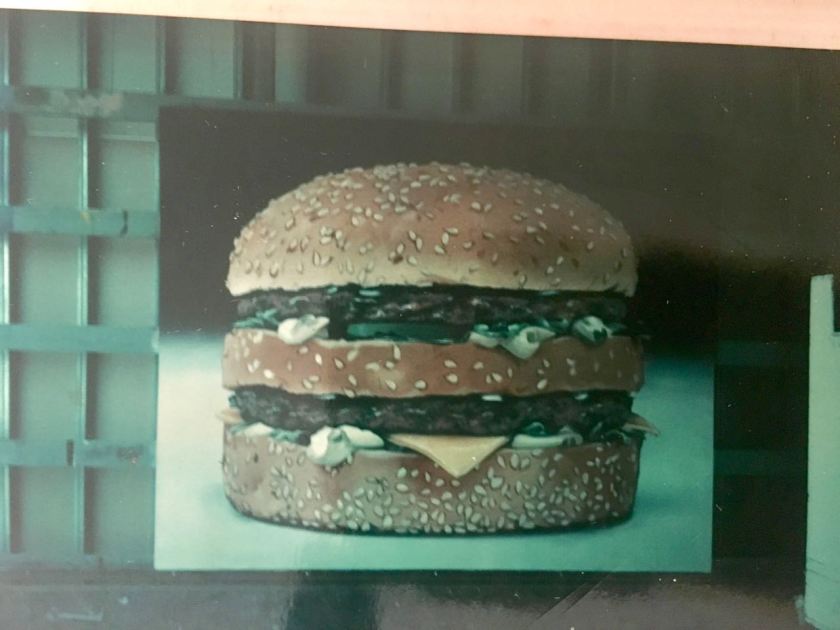
For 23 years, painting billboards 48-feet long was all in a day’s work for Mike. He painted 10-foot tall Big Macs, giant portraits of Phoenix newscasters and naked women. Well, he only painted naked women on Fridays as a practical joke for his boss, Don Weber; on Monday, Mike would paint clothes on the women before the billboards were hung in public.
10-Foot tall Big Mac sitting in the workshop
Mike admits that at 5′ 4″, he’s not a big man, so it’s ironic he created such massive artwork. “We used a projector,” Mike says, “to create enlarged sketches that I then painted in with detail. We had to paint quickly, too, because time was money.”
After billboard painting, Mike began a mural painting business in 2003. One day in 2004, he found out he needed a heart transplant… right away.
“In the emergency room, the doctor asked how many heart episodes I’d had, and I told him two. He said, ‘most people die on the third one,’ so I immediately went on the donor list, knowing that my small heart cavity meant I’d need the heart from a small woman or child.” The doctors gave Mike seven days to live.
A heart became available on Day Five.
These days, if you ask Mike how he’s doing, his face lights up as he says, “Great! Can’t complain.” If anyone has a right to complain, it’s Mike. The medicines necessary these many years to keep his body from rejecting the donor heart have damaged his health in significant ways. However, Mike chooses laughter over the alternative; curling up in a fetal position and dropping out.
Besides, Mike is too busy preparing for art shows and spending time with his brother Ron, who lives nearby, and crafting exquisite culinary dishes for his mother and stepfather; like Madeira sauce with tarragon and mushrooms.
While Mike focuses on watercolor painting, folks continue to fall in love with him and his work… it’s simply impossible not to!
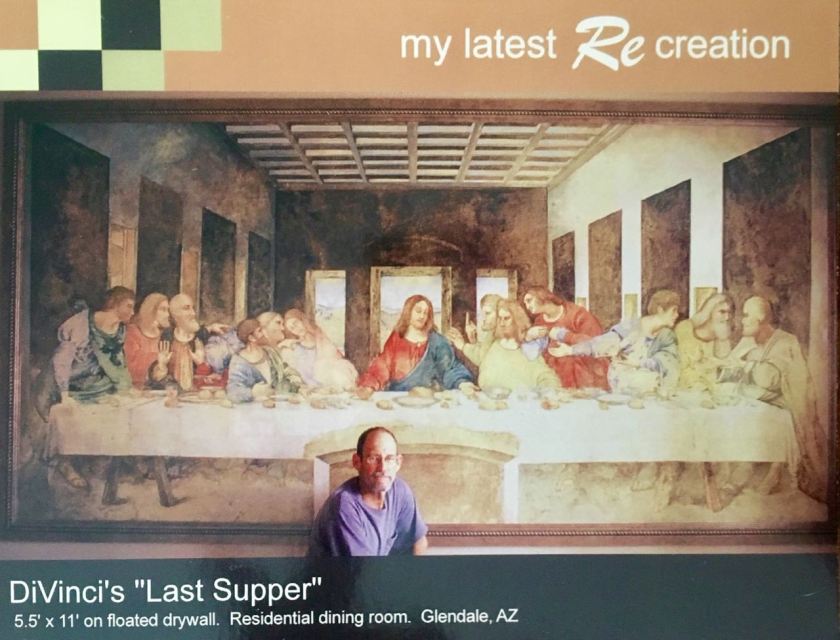
In the short time Mike painted murals around Phoenix, he was kept busy by quite a few customers. For his favorite client, Mike painted Davinci’s Last Supper on the man’s dining room wall, a John Force funny car mural in his home office and a movie-themed mural of vintage film posters surrounded by popcorn and movie reels on the wall over his TV.
Mike poses with his “Last Supper” mural
“My client called me this past December and told me he painted over the Last Supper mural,” Mike chuckles. “I mean, it was his to paint over. Now he wants me to paint a scene with the Ten Commandments’ stone tablets, maybe with Mt. Sinai in the background.”
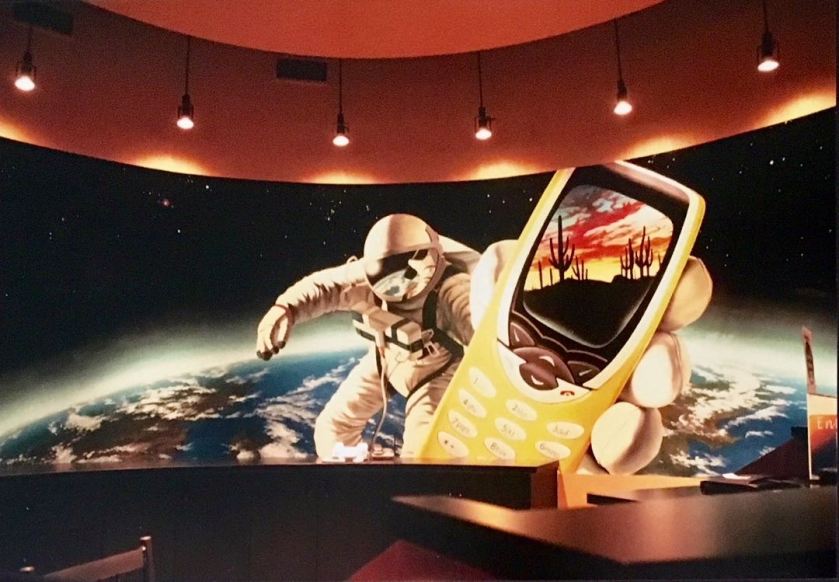
Mike’s mural work, like the one in Laura’s bedroom, is stunning and often contains T’rompe-l’oeil (French for “deceive the eye”), imagery that creates an optical illusion of objects existing in three dimensions. In homes, Mike has painted windows with desert scenes, extended hallways, floral trims and scroll work. He even painted a space-themed mural for a phone store.
The real hallway ends just after the hanging lamp. Everything beyond that point is illusion.
LEARNING TO PAINT ON A LARGE SCALE
Mike grew up in Phoenix and graduated from Moon Valley High School in 1976. He started painting billboards and signs one year later.
“At first, I was sloping panels and cleaning up messes. My boss said I should learn how to draw letters to scale, and once I had experience doing letters, I could paint billboards.”
Mike took a lettering class at Maricopa County College. Back then, all lettering was drawn out by hand using math to determine spacing, letter widths and heights. Every step was manual, no computers. After a year of lettering, Mike began painting his own billboards and over the next two decades, learned on-the-job.
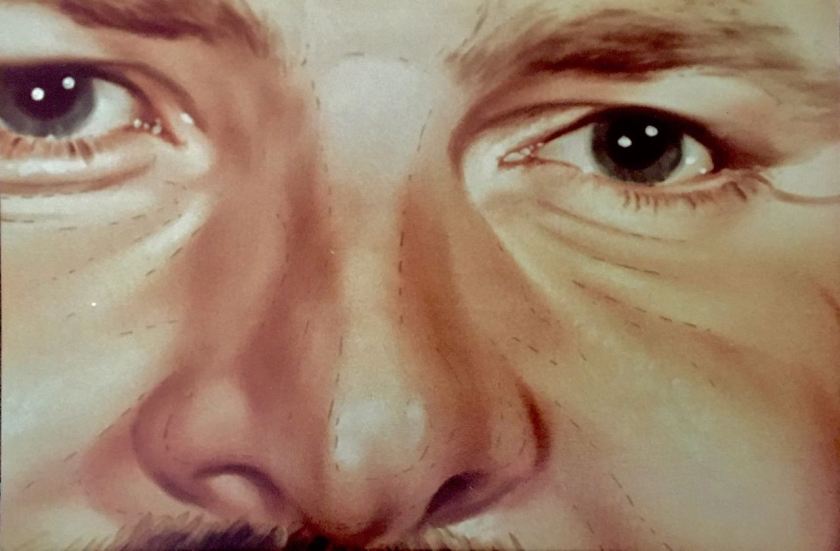
Painting giant faces on billboards was difficult because Mike was too close to see the entire face. To compensate, he developed a system of dotted lines to identify where he was on the face.
Mike’s dotted lines on a billboard face from the 80s.
“A line of long dashes meant a long blend,” Mike says. “Shorter dashes meant a short blend of colors and shadows, and dots represented things I needed to change. For instance, I would outline eyes in dots and knew I needed to go outside of those lines.”
Mike educated himself in the Venyetti effect, a phenomenon that causes proportions to distort when an image is enlarged. “Venyetti effect is especially critical when painting large objects on billboards,” Mike says. “A one percent distortion, or difference in size, can change the entire face.” Painting a huge face might have taken Mike an entire day. He didn’t want to have to redo the whole thing by not taking potential distortions into account.
Mike mostly painted billboards on the ground in a giant studio, though sometimes he would need to climb up on the catwalk and paint from there, which was dangerous for obvious reasons. While most billboards were 14-feet high and 48-feet long, some had 16- or 17-foot high extensions, making them mega-tall billboards.
Mike paints high in the air, under the desert sun.
Not only could rain ruin the paint on an outdoor job, the chance of falling was ever-present. In fact, Mike fell twice. Once when working with his boss, Don, on a billboard on Grand Avenue near the train tracks. They were standing on the catwalk when a board snapped and they both fell 15 feet. Mike landed in a barbed wire fence and got hung up. Don hit a truck and bounced onto Mike, then walked away unscathed, saying, “That’s what a good apprentice is for. Thanks, Mike.”
Even while bloodied with mud packed in his nose, Mike climbed back up and continued the job.
In the early 1990’s, with the advent of computers and big ink printers capable of producing large vinyl pieces, printing raced to overtake hand-painting. Within a decade, hand-painting would be gone.
“In the early days of printed billboards, the inks were inferior,” Mike says, “and our clients thought it looked awful. They would ask us to fix it. I had to match the dot matrix with a solid paint color, which was very difficult to do, all the while standing on the catwalk. To check my work, I’d have to climb down, run back to look at it, and then climb back up again.”
Around 1999, Mike decided he no longer wanted to be a billboard monkey, stretching vinyl, fixing bad print jobs and climbing up and down. It was simply too dangerous.
WORDS AND IMAGES
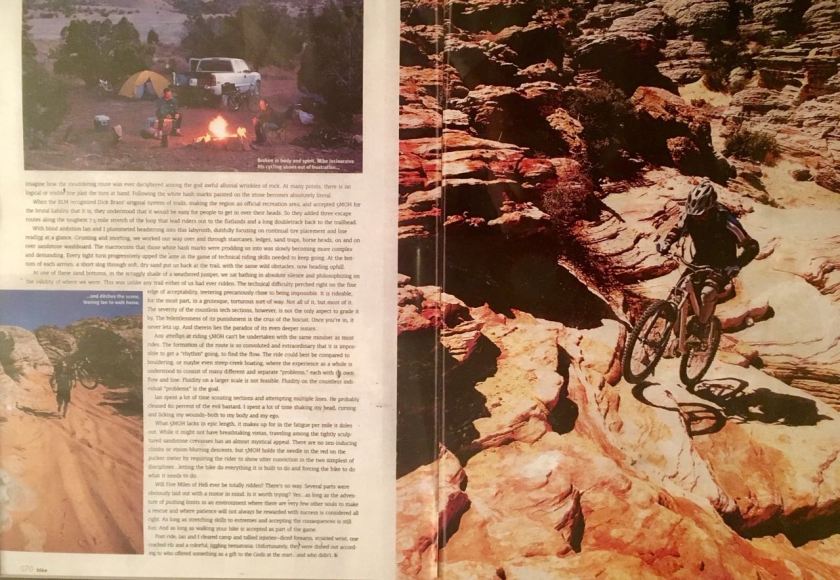
Mike’s artistic skills are broader than painting. He has always written poetry, lyrics and articles for magazines. During the 1980s and 1990s, while Mike painted billboards, he also ran his own stock photography company. Drawn to recreational sports and the outdoors, Mike took photos of models while kayaking, snow skiing, mountain biking and hiking. He catalogued the photos for use by publications and also sent monthly submissions to outdoor magazines and visitor guides.
In addition to publishing photos, Mike occasionally wrote pieces for Bike magazine, Mt. Bike magazine and National Geographic Explorer magazine. He honed his writing chops with Sweat Magazine.
Here’s an excerpt from an article Mike photographed and wrote for Bike magazine about the Five Miles of Hell (5MOH) trail system in Utah. The intro reads, “In this part of Utah, west and north of Moab’s storied red rocks, there’s a trail with a cruel name and a brutal reputation. To ride it, torture is salvation, punishment the prize.”
“What 5MOH lacks in epic length, it makes up for in the fatigue per mile it doles out. While it might not have breathtaking vistas, traveling among the tightly sculpted sandstone creases has an almost mystical appeal. There are no zen-inducing climbs or vision-blurring descents, but 5MOH holds the needle in the red on the pucker-meter by requiring the rider to show utter conviction in the two simplest of disciplines… letting the bike do everything it is built to do and forcing the bike to do what it needs to do.”
A spread of Mike’s article with photos of his model.
Mike’s ex-wife, Jill, published a piece in Bike magazine about Mike’s stock photography adventures titled People Who Ride. Here’s an excerpt:
“Then there was the time he came home two hours late and parked his truck in front of the house but didn’t get out. He just sat there. I kept working at my desk, figuring he was jamming to a song on the radio. Finally, a plaintive bleating of the truck horn awakened me to the fact that all was not right in the world of Kodachrome.
I found him naked except for a beer in his hand. That position was all the better for the setting sun to glint off the cactus prickers stuck all over his legs and buttocks, allowing me to find and pluck them from his body with tweezers. As I performed the delicate surgery, he of course fumed about the shots he’d missed.”
Mike doesn’t take up a lot of space in this world. He doesn’t push his ways on those around him. He’s gentle, unless conquering a river or landscape, either in kayaks, on bikes or with watercolors. He’s thoughtful. For instance, as a stock photographer, he would sometimes urge his clients to give their business to another stock photographer, one who was making a living at it, unlike Mike, who had his full-time job of painting billboards. Mike is considerate of others, sometimes to his own deprivation. But that’s who Mike is.
In 2005, Mike donated 4,000 of his stock photos of Downtown Phoenix to the city archives. He estimates 12,000 slides of outdoor recreational photos are currently stored in his art studio. “They’re outdated,” Mike says. I try to convince him publications would find value in those scenes, which could be considered vintage by now. Everything vintage is “in” these days. Besides, shot through his artistic eye, and on film nonetheless, these thousands of photos are pure Mike Padian Art.
WATERCOLOR
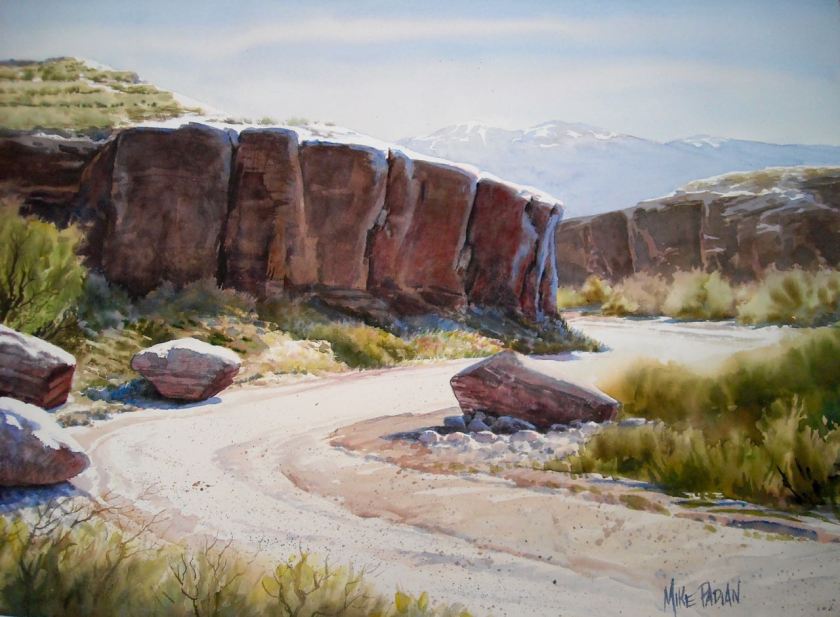
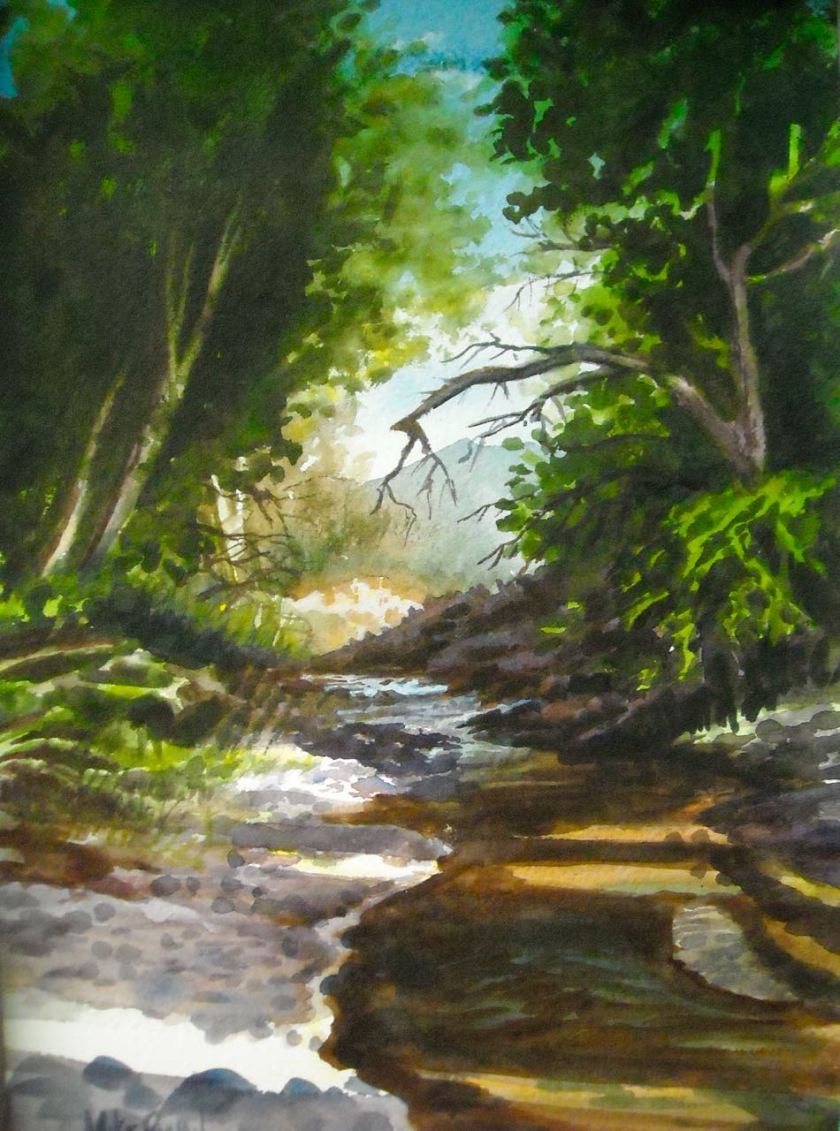
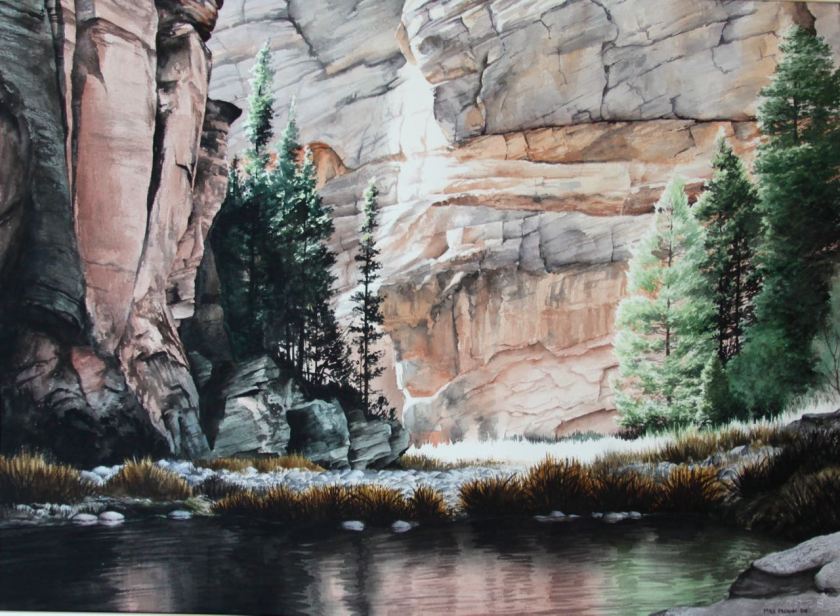
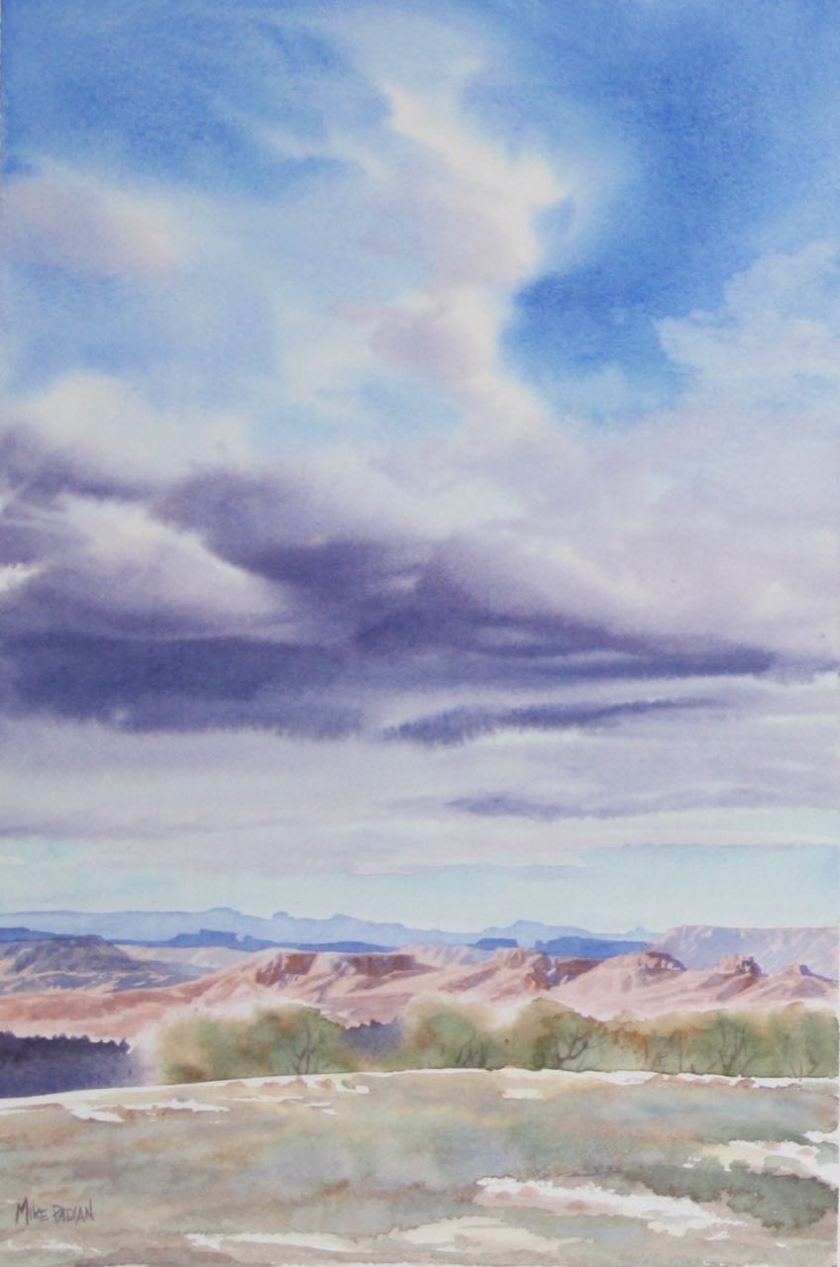
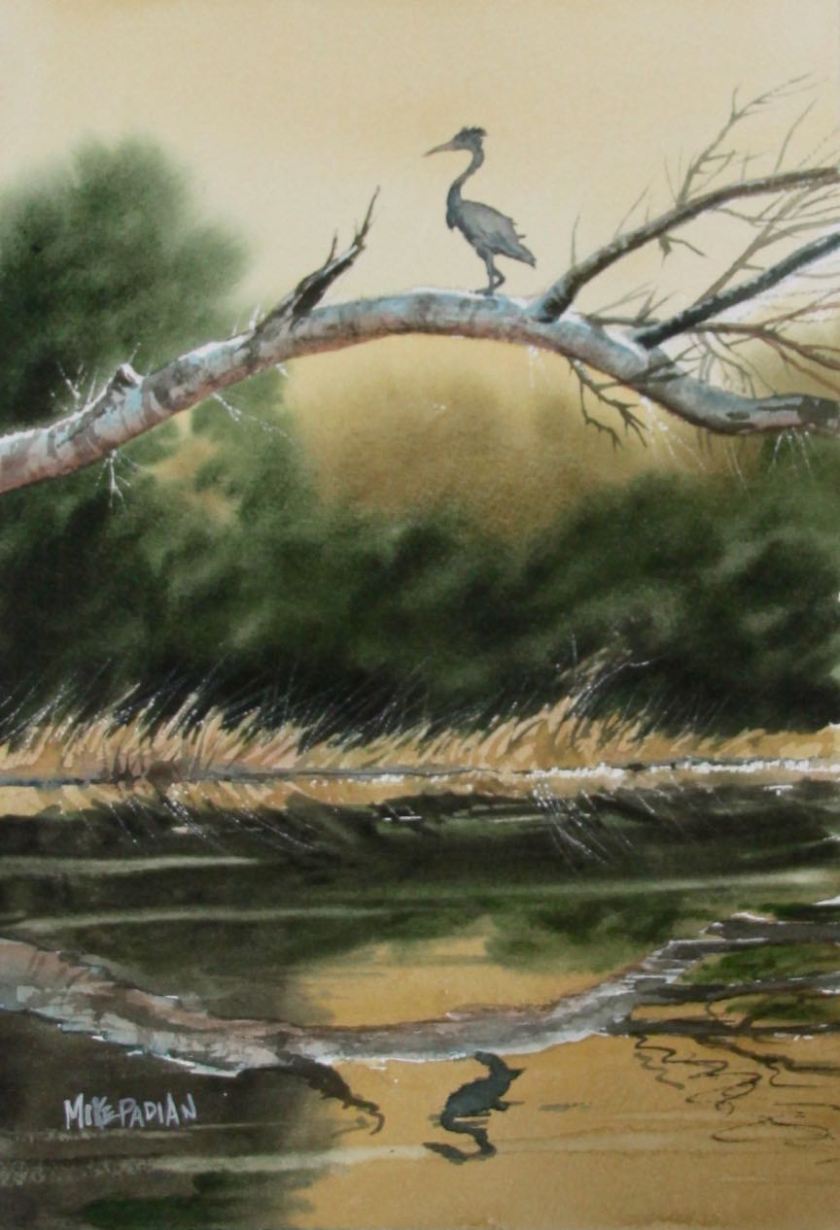
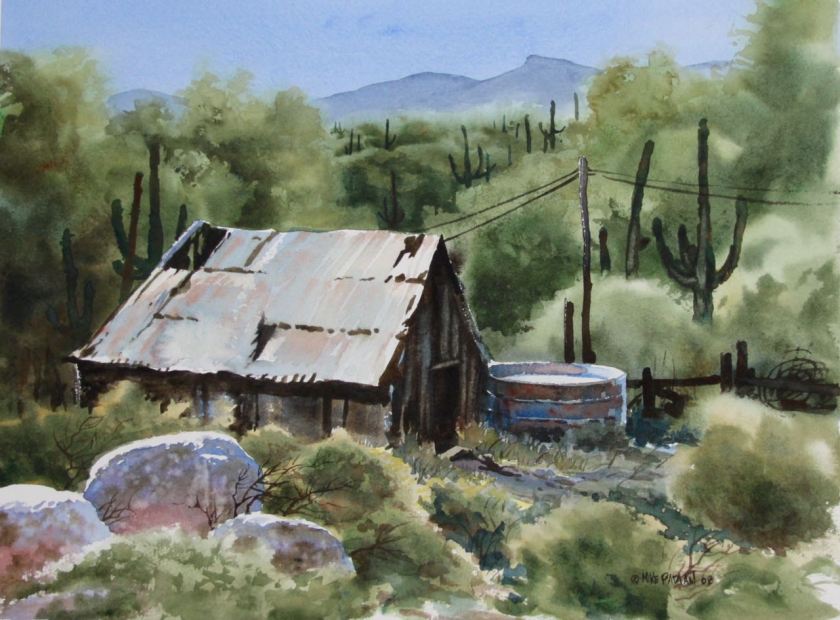
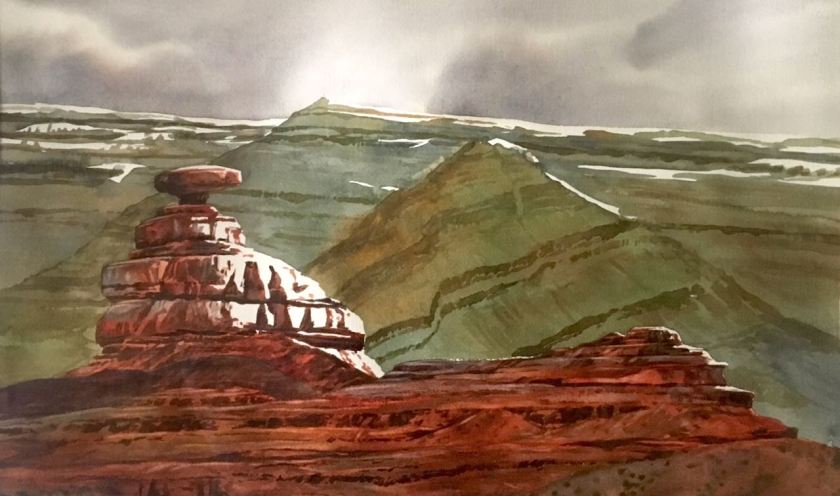
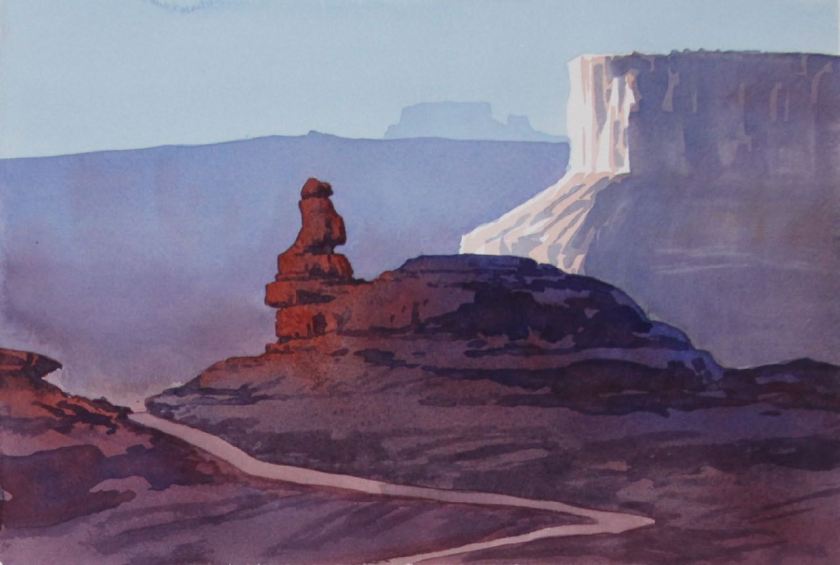
Watercolor is Mike’s medium of choice, and desert landscapes are his forte.
“Some people don’t like working with watercolors because they’re hard to manipulate,” Mike says. “People get frustrated at how difficult it can be to place the color exactly where they want it. But that’s what I love about it. It’s such a thrill when the colors go into place and turn out as I’d imagined.”
The “imagining” is Mike’s favorite part of the process. He uses an engineering approach to carefully plan exactly how he’ll apply colors in layers to create the image in his head. He will spend time thinking and strategizing before ever putting brush to paper.
Once his strategy is in place, Mike can create a painting in a day, including time for drying between layers. “I’ll paint the sky,” Mike says, “then I’ll wash dishes while it dries.”
“I’m self-taught,” Mike says. “I’ve learned from a lot of people by listening. I’m never too proud to attend a demonstration or a class. And I’ve studied light my whole life.”
In one class, Mike had an epiphany. “You must look past what you’re looking at to see the true colors,” Mike says. “An instructor in Sedona showed us how to look through a small hole punched into cardboard to view the object and see the colors as they really are.”
Nature can be a powerful teacher, too. “I hadn’t understood hot and cool in colors until one day I was hiking, not really thinking about painting, when I saw the sun burn around—and appear to nearly burn through—a saguaro. I was able to then see the orange and red, purple and blue in the rocks.”
Mike uses his knowledge of photography to enhance his eye for painting. “In photography, you must trick the camera into seeing the colors in the shadows, make lighter spots more light, and it works with painting, too.”
Years ago, Mike used black in his watercolors. “I don’t use black as a darkening agent anymore,” Mike says. “I’m able to manipulate my color pallet to get good dark colors without black.”
Mike had always painted from photographs, but after his heart transplant, he began to make up images in his head. Eventually, he began plein air painting, which is now his preference. Attending the Moab Plein Air Festival in Utah is one of his favorite past-times.
“They have competitions within a certain geographic area and you’re given a time frame for completing a painting and framing it,” Mikes says. He’s won several awards for various competitions, including Plein Air.
Mike’s Awards
First Place – Water media, 2014 Escalante Plein Air
Second Place – Water Media, 2013 Moab Plein Air Festival
First Place – Water Media, 2012 Moab Plein Air Festival
Honorable Mention – 2011, 36th Annual Western Federation of Watercolor Societies
Award of Excellence, 2011 AZ Watercolor Association Spring Exhibit
Purchase Selection – 2010 Watercolor West Juried Exhibit
Merchant Award – 2009 AZ Watercolor Association Spring Exhibit
Award of Excellence – 2008 AZ Watercolor Association Fall Exhibit
He enjoys the process of painting, it makes him happy, especially when he tries a new technique and it works. “It feeds my soul,” Mike says.
“You know, one painting represents four paintings, because three other paintings didn’t turn out exactly right. They had some glitch, but that happens working with any medium. Just the process itself, many times a painting doesn’t work out.”
Mike keeps the ones that don’t turn out and he’ll use the back for experimenting with colors. “I’ll rip up the really bad ones, though,” he admits, laughing.
His work space is simple and not crowded with paints, paper or other supplies. He works with only a few small tubes of paint or watercolors. “I’m not a supply hoarder. It’s funny to have so few supplies because when I was painting murals, I bought paints by the pint or gallons.”
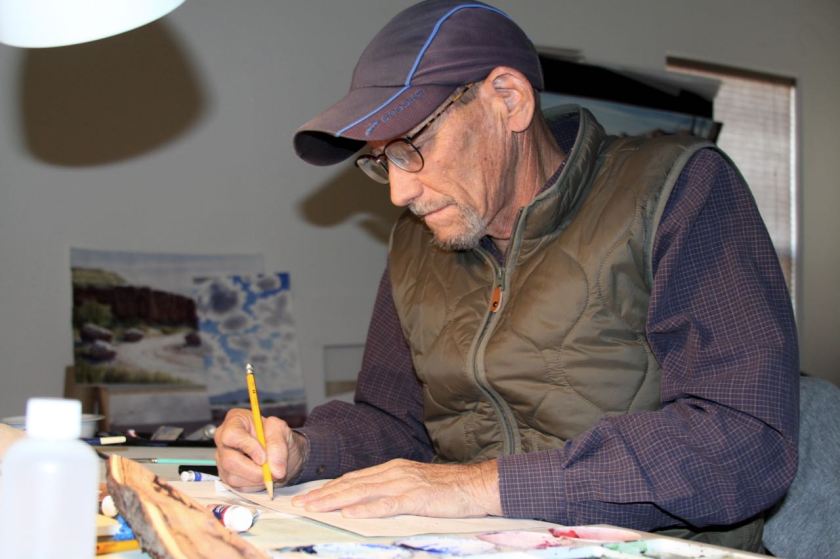
One raised drawing table, a work table and shelving occupy Mike’s creative space. Here he sketches and paints with his film cameras snugly stored in a nearby closet. Mike’s studio is at the back of his house. Soft light filters through the blinds. It’s quiet. A perfect spot to contemplate/engineer his paintings.
Mike sells his paintings through art shows, word of mouth, Sho ‘N Tell retail space in Rock Springs, and in the upstairs gallery at the Rock Springs Cafe. He has a devoted following, which now includes me and Brent. To give back, Mike donates paintings for various fundraisers around Phoenix.
Painting and preparing gourmet meals hasn’t been Mike’s only creative outlets, though. He’s also built a house and drummed.
Starting in 2000, for 53 weeks Mike and his then-wife of 25 years, Jill, built a home in Black Canyon City. Mike took a year off of work and acted as general contractor. He also did much of the on-hands work, including drywall, finishing, installing windows and logging his own timber from the Mogollon rim to hewn into vegas for his patio. Vegas are logs used as posts on patios or as architectural features indoors, perhaps to emphasize entry space between rooms.
Unfortunately, Mike went into the hospital for the heart transplant in 2004.
Mike built this gate in his backyard.
In his younger days, Mike played the drums, preferring to perform progressive rock by groups like Gentle Giant, Gong and Yes. But a couple of times, he was asked to sit in with a Country & Western band to play for residents of Shangri La, the famous nudist resort that’s been in New River, Arizona, for at least 50 years.
“I prefer rock music,” Mike says, “so I faked half of the Country & Western songs. But the crowd didn’t care. They were all just dancing in their natural glory on the tennis court, having a good time. After the first set, they started yelling for the band to take off our clothes, but we didn’t,” he laughs.
The second time the band played at Shangri-La, the bass player and guitarist dropped acid. “The guitarist went into a Jimi Hendrix riff and all these naked people stopped dancing to look at him like he was crazy.”
Most of his gigs were with professional bands and Mike even recorded in a studio; back then, it would have been on a reel-to-reel or tape cassette.
Mike’s life has always been about making art, beginning at the age of eight with painting, then as a billboard painter right out of high school, and eventually as a stock photographer, writer, drummer, gourmet cook, mural painter and watercolorist.
Mike has consistently brought beauty into the world.
“As I age,” Mike says, “I don’t need to paint every day like I used to. But I do have two compositions in my head right now and I need to draw them out, get them down on paper.”
In the last year, Mike’s painting has been overshadowed by other priorities, like going to dialysis three days a week for three-hour sessions each time.
“Dialysis isn’t awful,” Mike reassures me, “but it’s not great, either. Usually I put in ear plugs and just try to sleep through it.”
How considerate of Mike to make me and others feel better about what he has to endure. Just like he urged his clients to give other photographers their business, Mike thinks about not taking from others to give to himself. That’s why he is hesitant to seek donor kidneys; he speculates there’s a chance he might only live for two more years with new kidneys, which would take kidneys away from someone else who might live longer. I try to argue the point but Mike is following a deeply-ingrained moral imperative. That’s who he is. And that’s why I respect him.
“I have to make a decision, though,” Mike says. “I need to decide soon if I’m going to move forward with kidney transplants.”
One thing’s for sure, Mike is ready to crank up his painting again, dialysis sessions and moral dilemmas be damned!
“With everything I’ve studied, I haven’t mastered any of it, just figured things out. I was never a great biker or kayaker or skier or photographer. I’ve done everything half-assed, except for painting. I think I’ve finally mastered watercolor.”




























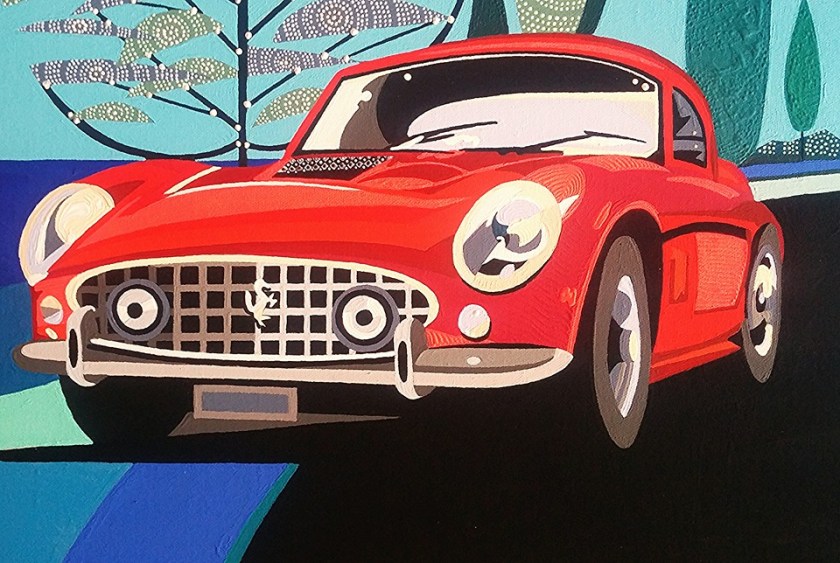


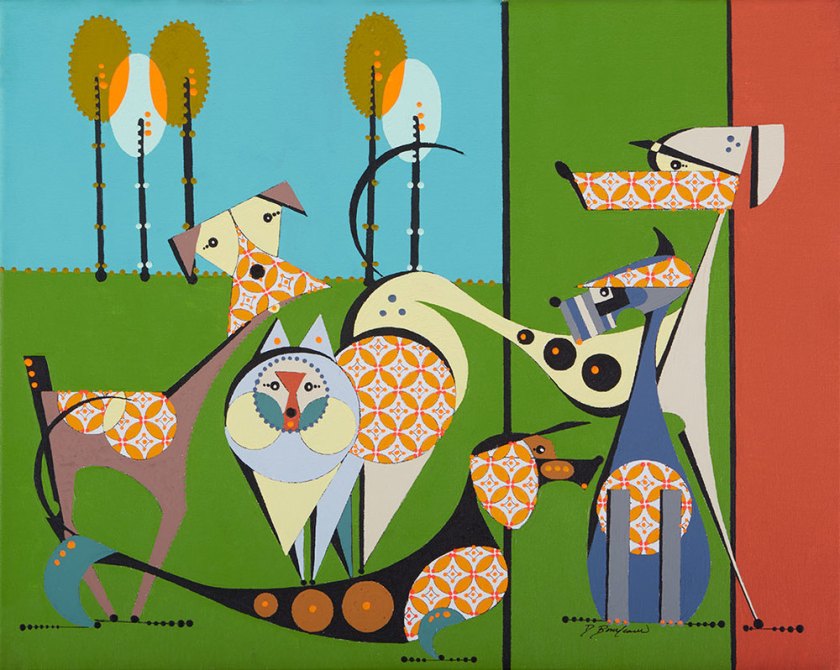


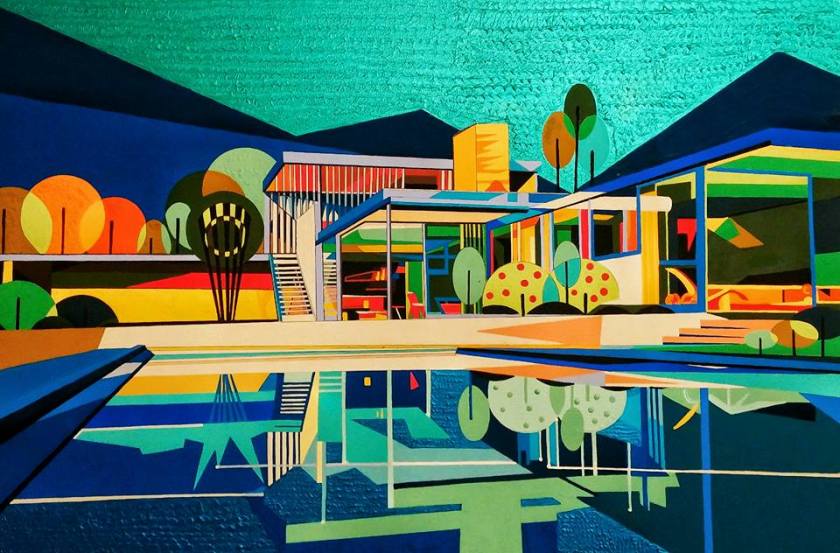

 Dominic’s artistic experiences also include throwing pottery, drawing portraits and painting murals for Shakespearean stage sets. He greatly admires artists such as Eames, Frank Lloyd Wright and Charley Harper, and is captivated by their use of simple, yet bold, design based on sophisticated, yet minimalist, geometry.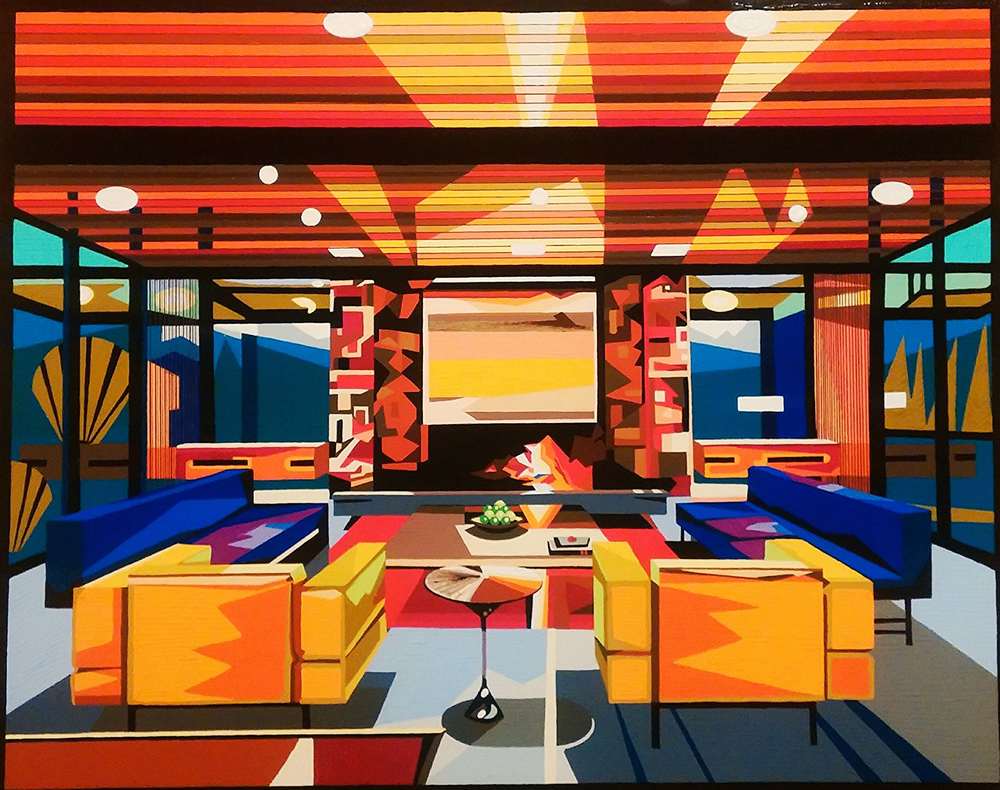













































 Cre8-Space