
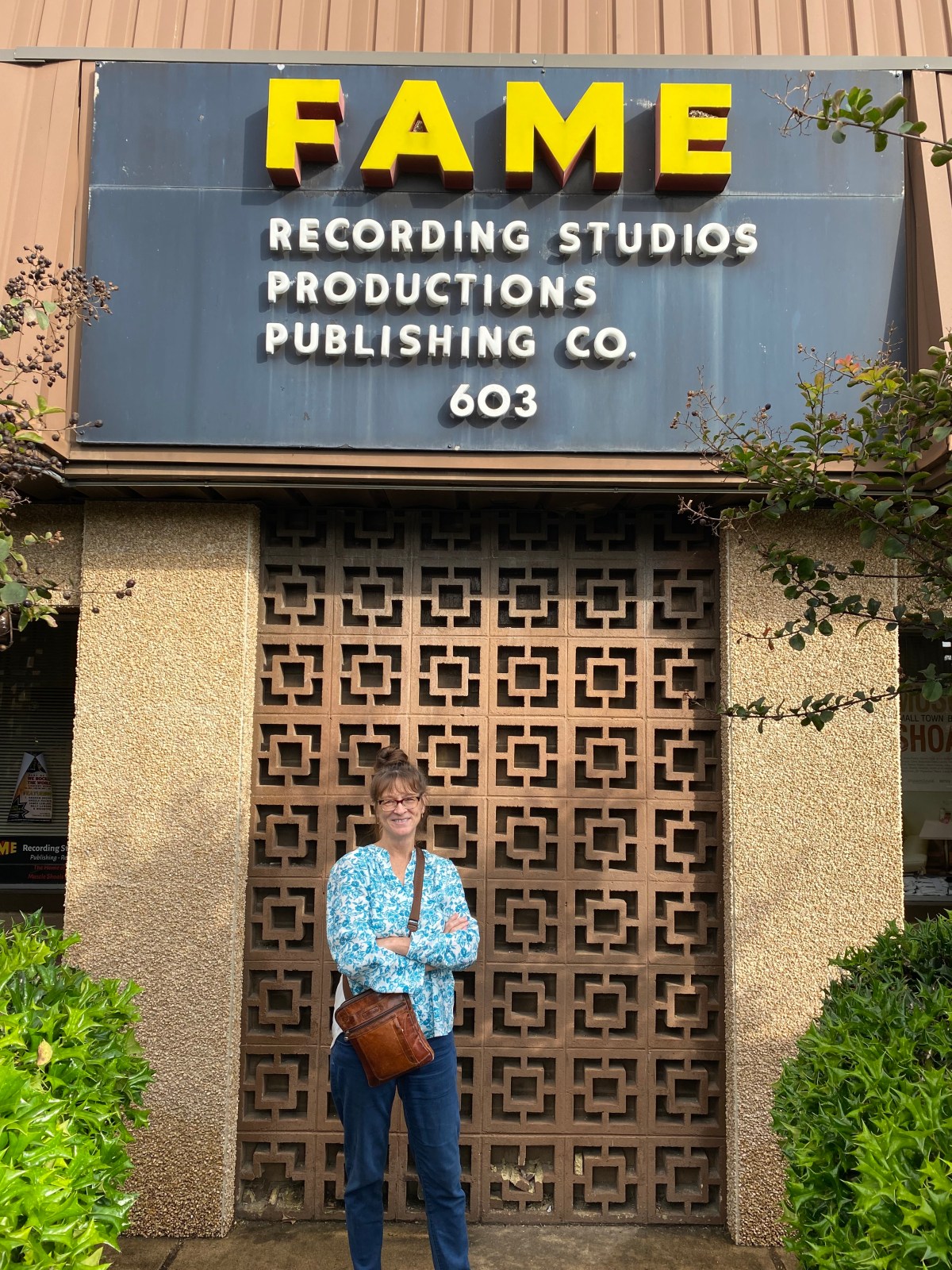
Home of the Muscle Shoals Sound
Above a plain brown door at FAME Recording Studios in Muscle Shoals, Alabama, are these hand-painted words:
“Through these doors walk the finest musicians, songwriters, artists, and producers in the world.”

Just think, through that plain brown door walked the likes of:
Etta James, Wilson Pickett, Aretha Franklin, Alicia Keys, Demi Lovato, Jason Isbell, Jimmy Hughes, Buddy Killen, Clarence Carter, Candi Staton, Dan Penn, Arthur Conley and Willie Hightower, Mac Davis, Paul Anna, the Gatlin Brothers, Jerry Reed, John Michael Montgomery, Pam Tillis, Blackhawk, Tim McGraw, Reba McEntire, All-4-One and Shenandoah Drive-by-Truckers, Heartland, Duane Allman, Gregg Allman, Blind Boys of Alabama, Michael McDonald, Delbert McClinton, Alan Jackson, Aloe Blacc, Alison Krauss, Steve Tyler, the Osmond’s, Marie Osmond.
That’s just a skimming of the artists who have recorded with FAME since 1971. There’s an entirely different catalogue of songs written by writers eventually signed to FAME’s publishing subsidiary, including:
Dixie Chicks, George Strait, Joe Diffie, Martina McBride, Travis Tritt, Sara Evans, Cyndi Thomson, Aaron Tippin, Billy Ray Cyrus, Alabama, John Michael Montgomery, Chris Ledoux, Perfect Stranger, 3 of Hearts, Chad Brock, Rebecca Lynn Howard, Michael Peterson, Kristin Garner, T. Graham Brown, Wild Horses and Kenny Chesney.
Rick Hall built FAME Recording Studios on Avalon Avenue in 1970. He consulted with an expert out of Nashville on Studio A’s dimensions — wall lengths and angles, ceiling heights — to optimize the sound.
Rick Hall was a task-master when it came to capturing sound… and not just any sound, but the Muscle Shoals sound he created by racially integrating artists and his studio. For instance, when he discovered the perfect sound from an instrument’s placement within the studio, he insisted on keeping that instrument in that exact spot for all recording sessions.
We know a great deal about Rick and his music philosophy from the 2013 documentary Muscle Shoals, a film that prompted people from all over the world to visit this village on the Tennessee River, tucked into the northwest corner of Alabama, close to the borders of Mississippi and Tennessee.
The Shoals area is made up of four communities/cities that all run together: Muscle Shoals, Tuscumbia, Florence, and Sheffield. They feel like one small town with different neighborhoods.
When you’ve traveled to Muscle Shoals, its location makes clear that visitors have a specific need to be there. Otherwise, they might not ever visit Muscle Shoals. I mean, it’s out there. But what a beautiful ride through Alabama countryside.
My friend Debra and I are in town to attend recording sessions with Reddog, her boyfriend and my long-time friend who was kind enough to invite me along as he puts together his latest blues album at East Avalon Recorders.
While in town, we also tour Helen Keller’s home, Ivy Green, built in 1820, the second home erected in Tuscumbia, and only three miles from FAME. The Keller’s house, and the pretty cottage where Helen lived with her teacher Anne Sullivan, are perfectly preserved and worth a visit.

Rick’s FAME building looks just like it did when Rick opened the doors: wood-paneled walls, low couches, chunky brown craved end tables and desks, massive beige ceramic lamps with yellowed drum shades, pictures hanging in the same spot for decades.
Stepping into FAME’s front door is stepping back into the 70s. Usually Linda Hall, Rick’s kind widow, is sitting in the little box office to the left, selling tickets or answering phones. Linda and Rick’s oldest son, Rick, Jr., is now President and CEO of FAME. Their second son, Mark, is a songwriter, known for penning the Brooks and Dunn tune I Like it, I Love it, (and other songs) and their third son, Rodney, is a lawyer in Birmingham.
Straight ahead, after stepping into FAME, is that doorway with the hand-painted letters.
My friend Debra and I take a minute to absorb exactly what those words mean and as we’re awwwing with our jaws dropped, the plain brown door opens and tall, lanky Will walks out. As the door slowly closes, Debra catches a glimpse of two guys chatting inside.
“Jordan!” She yells as the door clicks shut. “Is that you, Jordan?”
Will turns to us and says, “Yes, that’s Jordan,” and then the door opens and Jordan pokes his cute face in, smiling.
“Jordan,” Debra says, approaching him, “you probably don’t remember me but we met last year when I visited.”
That’s Debra, right there. She never meets a stranger and then she remains connected with her new friend for years. When Debra visited last year she also met Linda Hall, and when Linda heard Debra was from Andalusia, Alabama, Linda asked if Debra knew Brenda Gantt, a YouTube baking sensation who lives in Andalusia.
Linda is a big Brenda Gantt fan and it turns out Debra does know Brenda, so prior to our Muscle Shoals visit and tour of FAME Studios, Debra had Brenda Gantt autograph her latest cookbook to Linda, AND Debra is arranging for Linda to have a stay at Brenda’s B&B!
That’s Debra, right there. Always thinking of others. Debra is a huge music fan like me, which explains why she’s visited Muscle Shoals and the studios in the past (and to attend her granddaughter’s softball World Series competition). Debra is the perfect companion and guide for experiencing the space where so much of the music that shaped us was created. “Crafted” might be a better word for what Rick and those musical artists did in arranging the sound coming out of their mouths and instruments.
Music is a craft and an art and a science with notes guided by math; sound guided by physics; words guided by heart; and expression guided by soul. Deep soul. The deeper the better. And Rick’s artists knew their soul and how to send it around the studio to be captured for generations to enjoy… and emote to.
Music might just give life, and it sure makes life soar. Every singer, songwriter, engineer, and producer knows that fact. Life without music would be brutal.
Turns out Jordan does remember Debra from last year and so as they catch up and chat (Debra never lacks for things to talk about or ways of making people feel comfortable, even with a stranger or mere acquaintance), I get our tour tickets from Will, including a lanyard that visitors get to keep. Souvenir alert!
Wouldn’t you know it, because life is so good, Jordan is our tour guide!

Like most Muscle Shoals natives, Jordan is kind and responsive, answering our many questions with patience. Certainly he’s heard it all before, but never acts like it. I can only imagine how many people he meets who think they know more about FAME and its artists than he does.
But Debra and I are all ears, eager to learn what Jordan knows.
Here’s what we learn about Jordan: he grew up just a few blocks from Muscle Shoals.
“I remember driving by this building all the time with my grandfather and asking what it was,” Jordan says. “He told me about the studio’s history but I never considered it relevant to me.”
Jordan grew up smack-dab in the middle of the Muscle Shoals sound and didn’t think a thing about it. With music, though, you don’t really need to think to appreciate it. Just feel. Absorb.
Proximity is a powerful thing.
The Muscle Shoals part of The Shoals looks dated. Fast food and retail chains are all over Muscle Shoals now, but the original retail spaces built along Avalon Avenue are typical of the 60s and 70s; single story buildings with funky mid-century-inspired features; smallish with low ceilings.
I grew up in Warner Robins, GA, in the 70s, just 10 miles from Macon and Capricorn Records’ mighty productions, and at that time the main drag through town was Watson Boulevard sporting smallish retail spaces and several “shopping centers” that housed clothing and shoe stories, gift shops, barbers, beauty salons, local restaurants, bakeries, furniture, etc., that stand empty today, or now house thrift shops, insurance offices, quick loans, etc. These buildings are not-so-attractive anymore. All electric and phone lines run overhead on poles. Driving down Avalon Avenue in Muscle Shoals feels like driving through the old part of my hometown; shabby, dated, and comfortable.
Tuscumbia, where Helen Keller grew up, is much more quaint with big and small houses from all eras on genteel avenues, the yards neatly groomed and a nearby downtown area typical of the turn-of-the-century era with red brick facades and large windows to lure shoppers with merchandise displays; shoppers stroll leisurely by for the experience of discovering novel shops or hip cafes.
FAME’s building, with its mid-century cement-block patterns and odd-looking mansard-like roof, still screams 60s/70s, and it’s not attractive, but that’s part of its charm. In its own way, the building is a delight to look at; the bright sun creating interesting shadow patterns on the walls.

Once surrounded by open fields (where Duane Allman pitched a tent and hung out until Rick finally invited him into the studio to play), the building is now surrounded by asphalt parking lots, a CVS, and other homogeneous retail spaces, leaving little room between buildings.
So this is Jordan’s stomping grounds even though he knew very little about FAME when growing up. And then one day he was sitting at a friend’s birthday party when his friend told another guest, who worked at FAME, that Jordan had set up a recording system at home. When the FAME guy asked Jordan about his equipment, Jordan told him what he owned and why he had chosen it.
“You know more about equipment than a lot of people in the business,” the FAME guy told Jordan at the party. “You should work as a sound engineer.”
Jordan hadn’t thought of being an engineer, but buoyed by the guy’s advice he got a job at another studio in Muscle Shoals and worked there for four years, learning engineering before going to work at FAME as an assistant engineer… and tour guide.

FAME offers a 10am tour and a 3:30pm tour. At the 10am tour, Debra and I are joined by a middle-aged couple of newly-weds who work for the government in D.C., and live in Virginia. The guy is clearly a music nut and his wife made this trip happen to make him happy. He’s happy here, for sure, and as eager to learn as me and Debra.
The four of us tourists stayed in the building for more than two hours with Jordan’s kind guidance, asking questions, taking photos, lingering in certain spots to read materials, and goofing off by standing in Studio A and singing so we could say we sang there, along with Wilson Pickett, Etta James, Aretha Franklin, and our other idols. The building isn’t that big, but it’s filled with information, images, artifacts, and people recording records to this day (if it’s okay to still call them records).
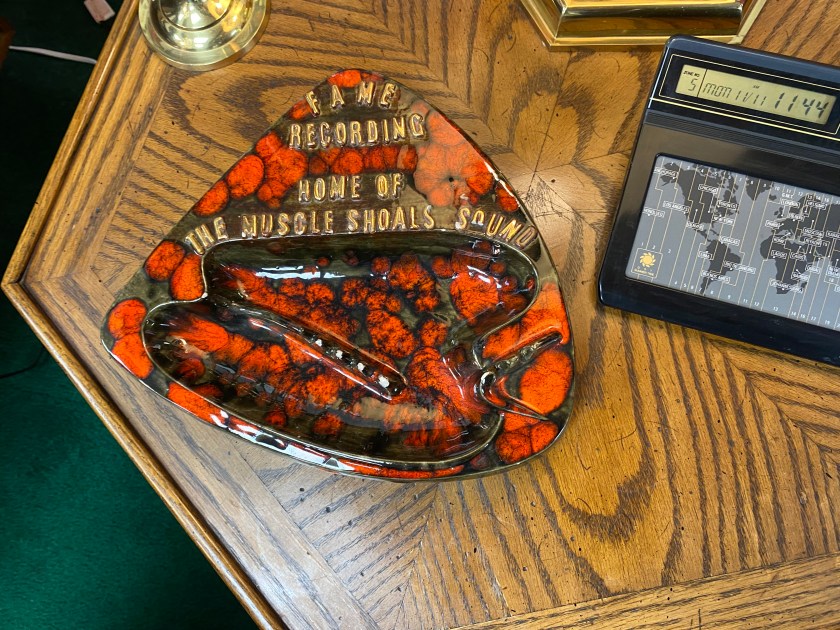
As a writer, I don’t even have the words for what it feels like to stand in Studio A and listen to the songs that were recorded there. As a huge Etta James fan, I got chills to hear Tell Mama blasting from the studio’s exceptional speakers. If you haven’t listened to Clarence Carter sing Patches in a while, do yourself that favor.
In studio A, Clarence’s deep emotions came through in each note, not just each word. Clarence, at first, had balked at recording the song, feeling its content about being poor reflected negatively on blacks, even though Rick, a white guy, totally related to the song because it absolutely reflected his extreme-poverty childhood and reminded him of his father’s struggles to bring up two kids alone in the 30s and 40s. Thank goodness Clarence listened to Rick and recorded that song.
Jordan also played Hey, Jude for us, Wilson Pickett’s version with Duane Allman playing guitar, which Duane had convinced them all to record. Wilson Pickett also recorded Mustang Sally in that room. And, of course, Jordan had to play Aretha singing I Have never Loved a man (The way I love you), which will bring any human to their knees, if they’ll just let go and feel Aretha feeling that song. Oh, my goodness, the glory… or the cathartic despair.
And then…
And then…
Etta James singing I’d Rather Go Blind, one of my favorite songs ever… and recorded right here in Studio A. Jordan plays it for us because I mention it.
If you ever want to shut the world out for eight minutes and experience Etta as a natural performer bringing joy and mischief, just watch as she sings I’d Rather Go Blind for a lucky audience at the 1975 Montreaux music festival. Thank goodness her performance was filmed!
Etta is an artist in many forms and she’s cute as heck in this video with her facial expressions and long, denim patchwork overall skirt! And her shouts of “Look out!” This performance is perfection. She shows up. She’s present with the audience and her band. She’s singing out — and loudly — into the venue space without a microphone at times. Her band members smile at her. She’s covered in sweat but it ain’t no thang.
Etta is precious. Just precious. She has the voice, but she also has the personality. The crowd is silent. As a viewer, I’m silent, watching every pixel on the screen. Etta is having a conversation with each person in the room and she’s not flashy. She’s the opposite of flashy. She’s herself. After watching her 1975 video, you must watch Etta sing I’d Rather Go Blind 12 years later, in 1987, with Dr. John and introduced by B.B. King!
I spoke with Dr. John on the phone once, when he called the hudspeth report, an entertainment newspaper in Atlanta where I worked in the 80s/90s. I distinctly remember sitting at the desk and writing down his phone number, aware of who he was, engaging in pleasant conversation and trying not to sound starstruck. Dr. John was so nice and kind. A New Orleans native, he played in Atlanta often and over the years he’d play with the Allman Brothers Band, the last time in 2014 at a Gregg Allman Tribute Concert.
Dr. John could the piano like nobody, and he had a unique sound and a sweet spirit, but his voice didn’t quite match Etta’s in their live performance. She knew how to perform from her soul and that alone is worth watching her video with Dr. John.
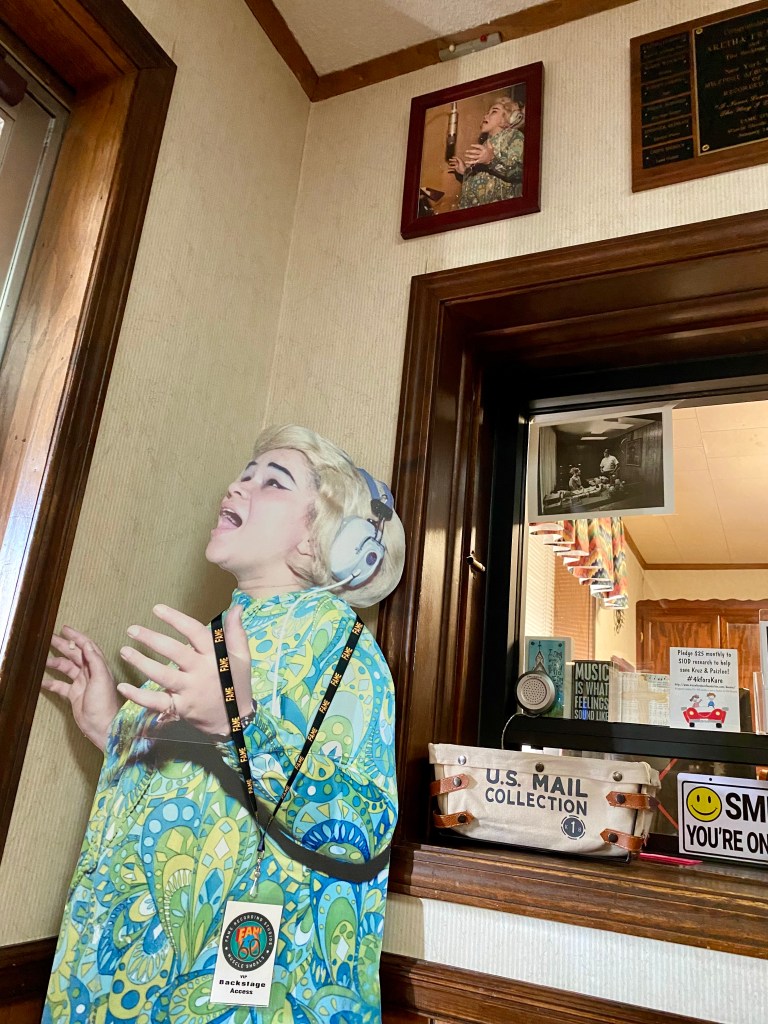
Standing in Studio A and hearing those songs by Etta, Wilson, Clarence, and Aretha was the best, most spiritual, experience of the whole tour. (Thanks so much, Jordan, for raising us into the rafters!)

Muscle Shoals might just be THE Mecca of music lovers, along with (or more so than) nearby Memphis and Nashville. What you get in Muscle Shoals that you don’t get in Memphis or Nashville is a feeling of being part of the music family just by being there, whether you make music or not.
Muscle Shoals people open their arms to everyone, fans and performers alike. Everyone in town has one goal: nourish their musical heritage. Some make a living making music and helping each other out, keeping Muscle Shoals a place that embraces fans. Folks who aren’t from Muscle Shoals, but choose it as their musical home, blend in with folks like Jordan who breathed in that sound their entire life.
Nashville feels like a small town when you’re walking on music row and enjoying the Ryman Theater, but the city sprawls and sprawls for miles into the surrounding countryside, making for a large metropolis along the river and beyond. Famous folks are usually left alone when out in public living their lives. That’s nice for them. They can go about their day without concerns of being hounded for autographs. And there’s charm in the Bluebird cafe, where the famous and the up-and-comers alike play for a crowd crammed into a tiny place. But the city is geographically large, diluting the on-site, in-town music magic.
You can just walk into FAME studios and meet the charming Miss Linda Hall, take a tour with Jordan and instantly be part of the family, connected to others in the area’s musical network where they all know each other. Muscle Shoals can’t sprawl out like Nashville or Memphis. It’s locked in by its surrounding Shoals neighbors. Not stunted growth, but a concentration of the sound, pinched in and influenced by its natural surroundings, especially the Tennessee river.
Ah, the river. Something in the water. That’s what they say about music in Macon, which sits on a straightaway of the Ocmulgee River that sometimes spills over, flooding so high it might cover vintage street lights on the river park’s pathway. And “something in the water” is said about Nashville, built up around the Cumberland River that sometimes spills over, once ruining treasured musical instruments housed in nearby storage units; and it’s said about Memphis, hugging the mighty Mississippi, a natural watery border between Tennessee and Arkansas.
Borders are funny things. They demarcate geography, but they can’t contain that geography’s influence.
Memphis has a tight downtown area, too, including the Peabody Hotel with its entertaining ducks just a block from Beale Street. But, boy oh boy, how commercialized is Beale Street? Feels almost like an adult theme park… like New Orleans’ Bourbon Street. Why adults have to drink big-ass cups of beer and liquor to listen to music is beyond me. If I have a gripe about live music, it’s that most live music starts late and is typically played in places that serve alcohol. Not that there’s anything wrong with imbibing spirits. But thank goodness for an afternoon of live music in a place where toddlers can do their first public dance down-front to the delight of a large crowd, even the artists onstage.
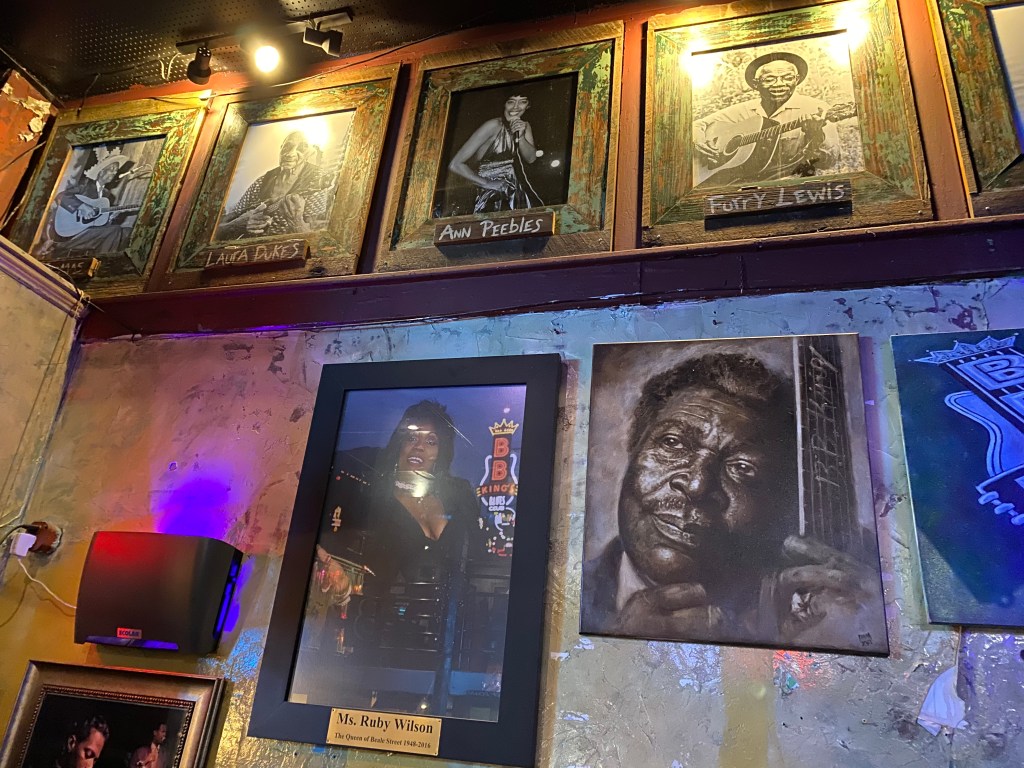
Beale Street has some serious music cred, though, known for players B.B. King, Albert King, Memphis Minnie, and Howlin’ Wolf. Beale Street is the home of the blues and the birthplace of rock n’ roll. W.C. Handy, the Father of the Blues, popularized the place and it just so happens that Mr. W. C. Handy was born in the Shoals (Florence). The log cabin he lived in is now a museum.
At least B.B. King’s famous BBQ place still sits at the top of Beale street and thrills diners with blues performances akin to what B.B. and original blues artists used to play.

There are plenty of stories about FAME studio, its musicians and artists; about Rick getting into a fight with Aretha Franklin’s husband in their hotel room; about songs that turned into massive hits because of one small tweak — maybe adding an instrument or moving an instrument against Rick’s wishes.
Rick tells his stories best in his book The Man from Muscle Shoals: My Journey from Shame to Fame, so I won’t retell any of those. It’s fun to hear the stories from Jordan when you’re standing next to the actual instrument or on the parquet patch in the center of Studio A or in the sound booth favored by Gregg Allman in Studio B.
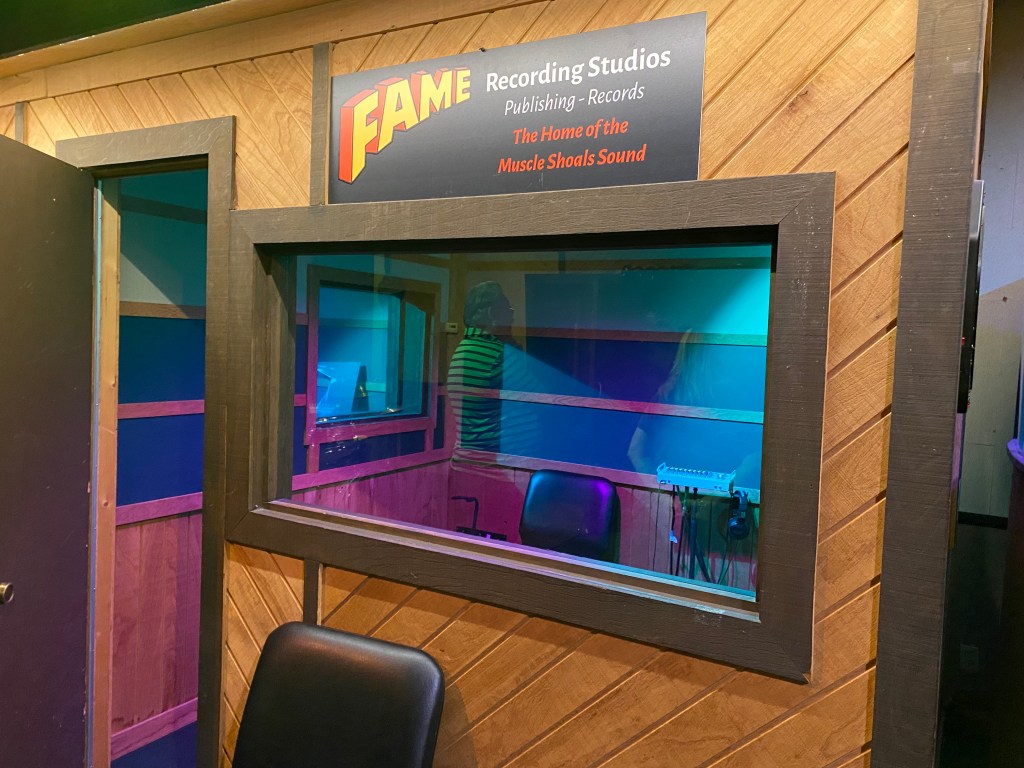
Rick tells those stories well in his book, and the FAME tour guides have other “unwritten” stories to share.
In addition to hearing those stories, there are many reasons to visit FAME:
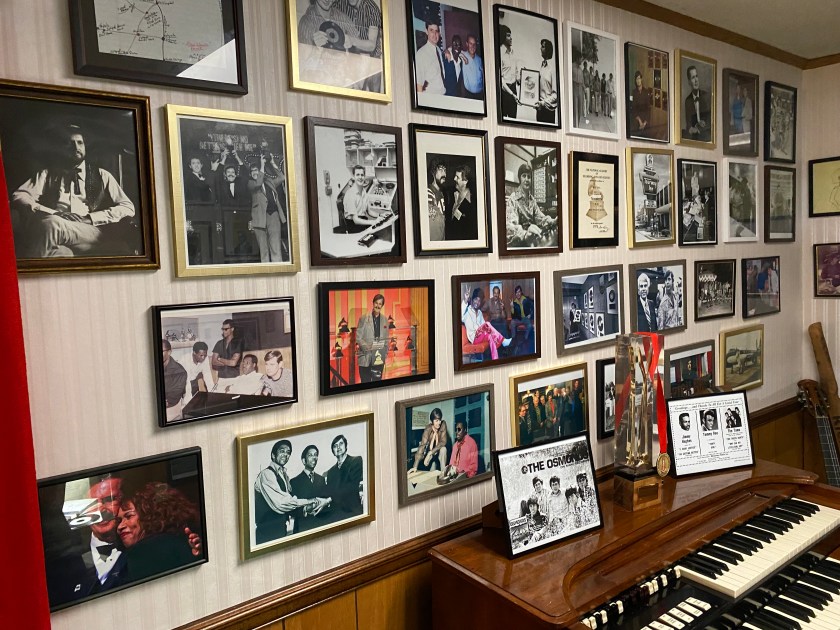
The chill bumps. The reminder of how significant the music still is. The knowledge gained of the recording process. The feeling of being part of the Muscle Shoals sound. The jolt your heart receives when Wilson Pickett hits the high note or Aretha soothes the low notes. Jordan. Miss Linda. The souvenir lanyard. Stickers and vinyl records and CDs of FAME music. Peering at black and white photos of black and white people from your youth who shaped your life… who made you YOU… and are no longer with us. Standing in Studio A and being washed in Soul and R&B that sticks to your hair and burrows into your bone marrow.
Debra can talk to anyone about anything. When she’s quiet and contemplative, something significant is happening. That’s what it’s like to be at FAME; seeing people become introspective and overwhelmed with emotion, feeling waves of meaning coming at them from all directions. Perhaps that’s the most important reason to visit FAME.

Let down your guard in a safe space, be the music lover your soul is calling out to be.
If Rick Hall’s dream for his studio and his body of work had been for eternal fame, for his music legacy to thrive, or for his FAME studio to operate for generations to come, then his dream came true and lives, humbly, at 603 Avalon Avenue, Muscle Shoals, Alabama, 35661.
Rick did it. In the curve of the Tennessee River he changed music.
He changed lives.
 Cre8-Space