New Orleans is celebrating its 300th birthday this year and the entire city continues to be the ultimate creative space. Dripping with history, NOLA is often thought of as a party town, especially along Bourbon Street in the French Quarter. But there is much, much more to New Orlean’s culture than alcohol.
Foremost, it’s the birthplace of Jazz and hometown of Louis Armstrong and Fats Domino… and Harry Connick, Jr., … and many other amazing musicians from the right and left banks of the Mississippi River.
Though it’s a strong one, Jazz isn’t the only draw to the Crescent City. There’s the food, cajun and creole and stuffed with fresh seafood. And beignets anytime of the day. Yes, BEIGNETS!
Like most grown-up cities, New Orleans also appreciates visual artists. On a recent trip to NOLA, I couldn’t resist visiting the Ogden Museum of Southern Art and the New Orleans Museum of Art (NOMA), both of which allow patrons to photograph their art!
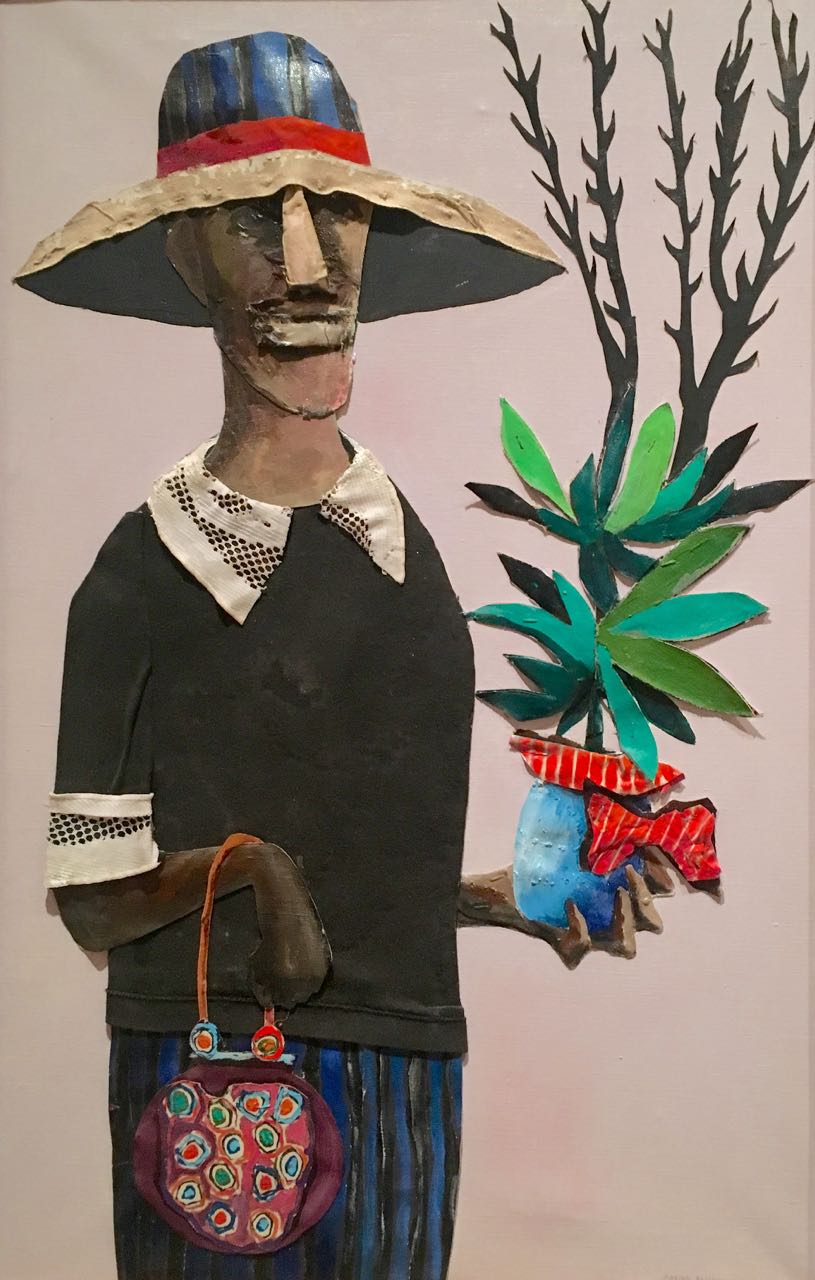
At the Ogden, I was thrilled to find a wing of “Southern Vernacular Art” featuring many oil and collage works by Benny Andrews. I can’t recall where I first saw a painting by Benny Andrews, but I liked his style and subjects and was hooked. When I researched Benny, not only did I find out Benny was from Georgia (like me), but he also attended Fort Valley State College (like me)! While I didn’t graduate from Fort Valley State College, I’m proud to have spent the academic year 1983-1984 at this remarkable historically black college in the heart of Georgia.
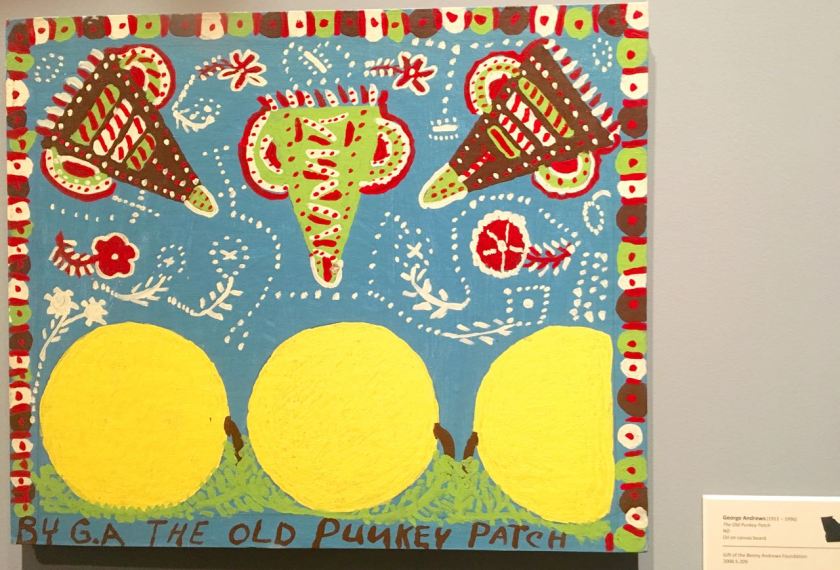
Benny was born in Plainview, Georgia, in 1930, and his father, George Andrews, was a sharecropper and a self-taught artist. (Both of my maternal grandparents, and their parents, were sharecroppers in South Georgia). After graduating high school, the first in his family to do so, Benny joined the service and later used his G.I. Bill to study at the the Art Institute of Chicago (the article “240 Minutes at the The Art Institute of Chicago” features a Benny Andrews painting!).
Benny was an activist and advocate for African-American artists. To my delight, the Ogden had several of his collages made using fabric and wallpaper. Some of the collage features are so 3-D, they cast shadows, as do some of the deep frames.
Following are Benny’s collages, plus other works that caught my eye at the Ogden and NOMA. Enjoy!!
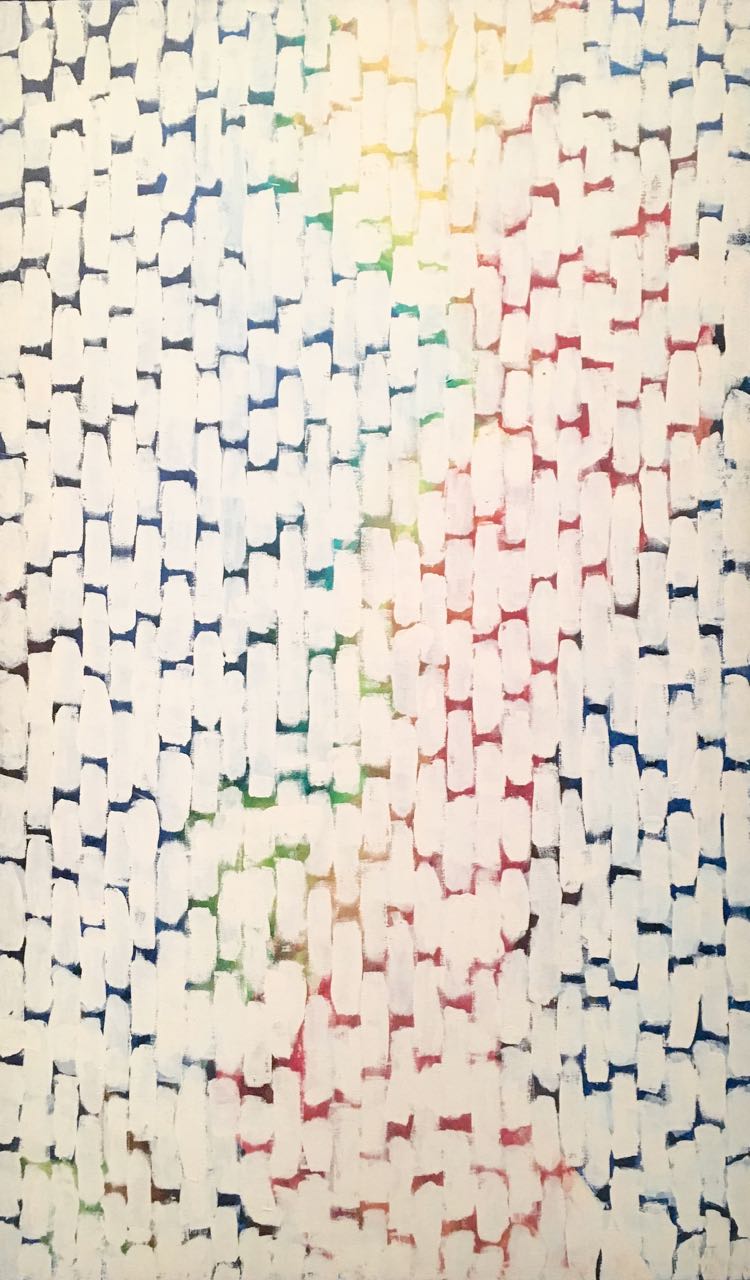
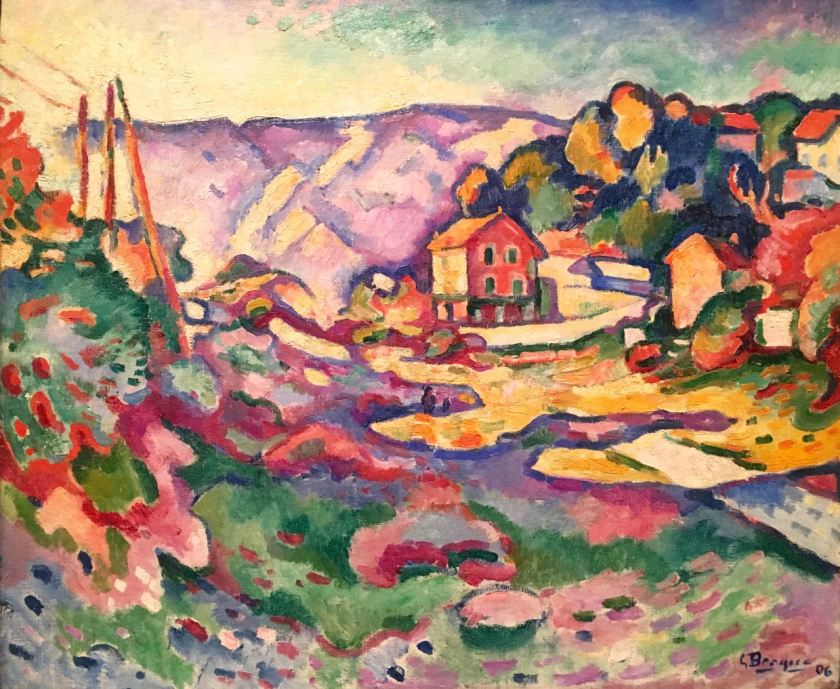
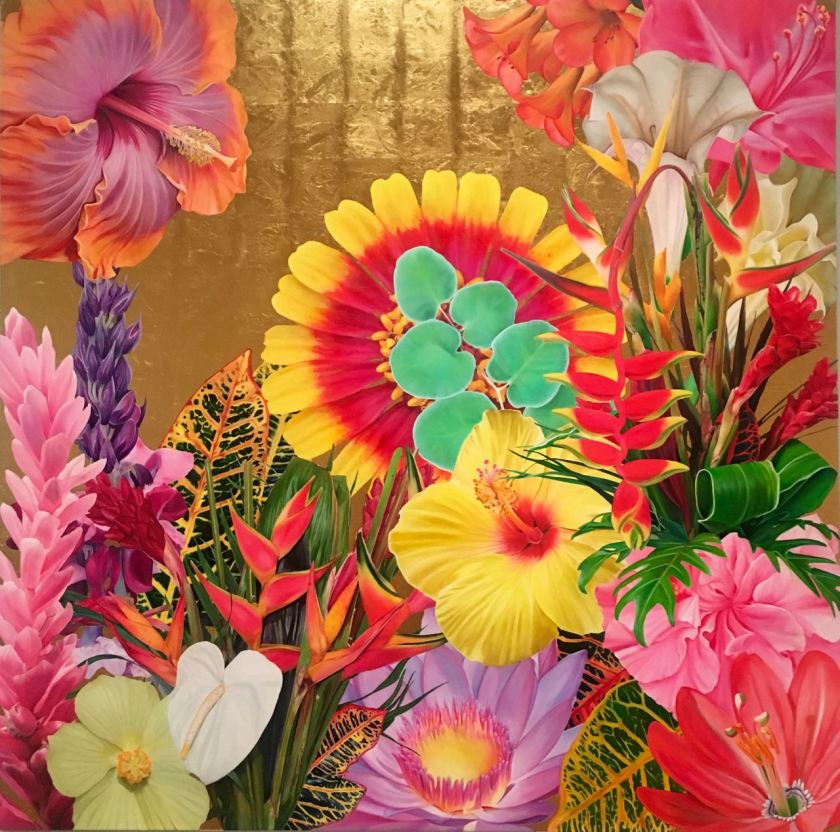
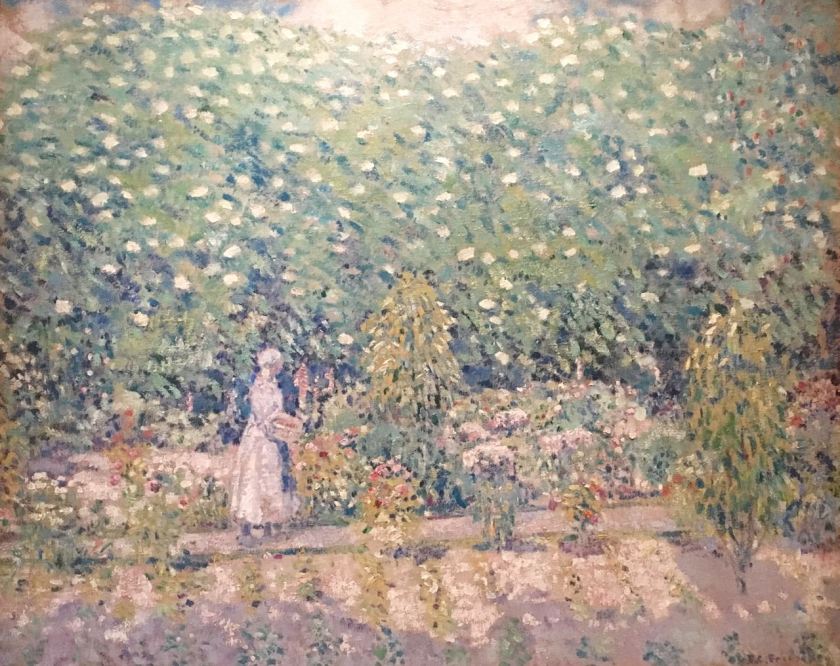
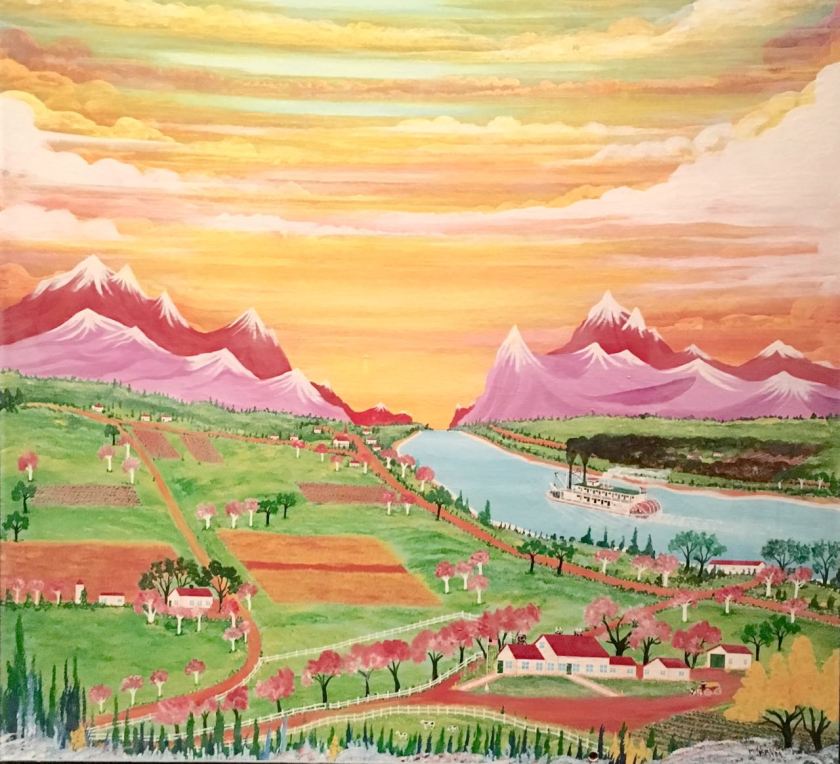
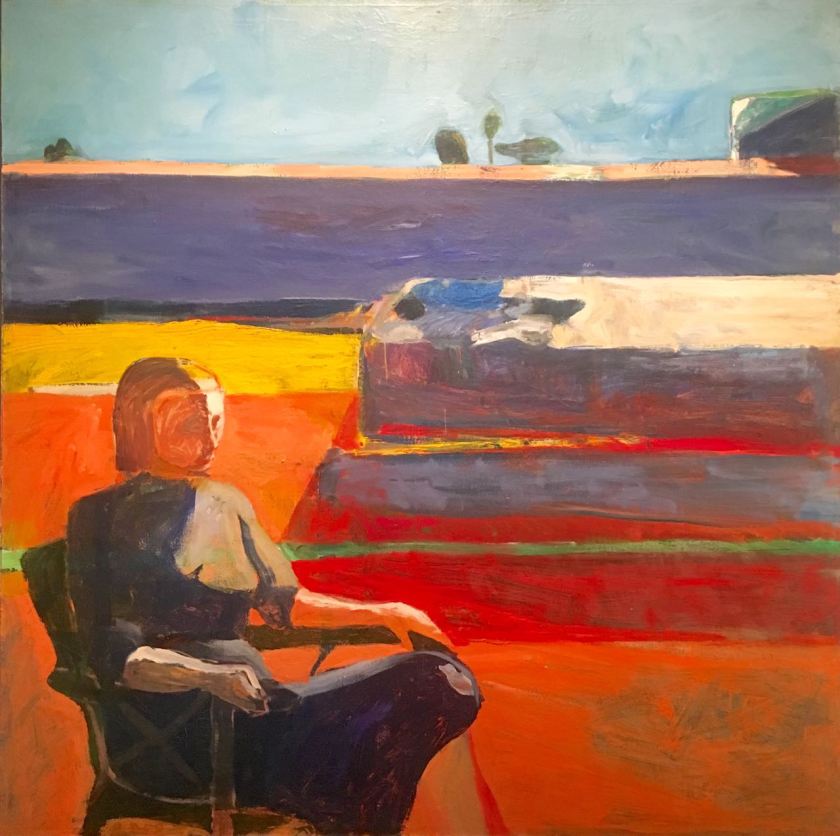
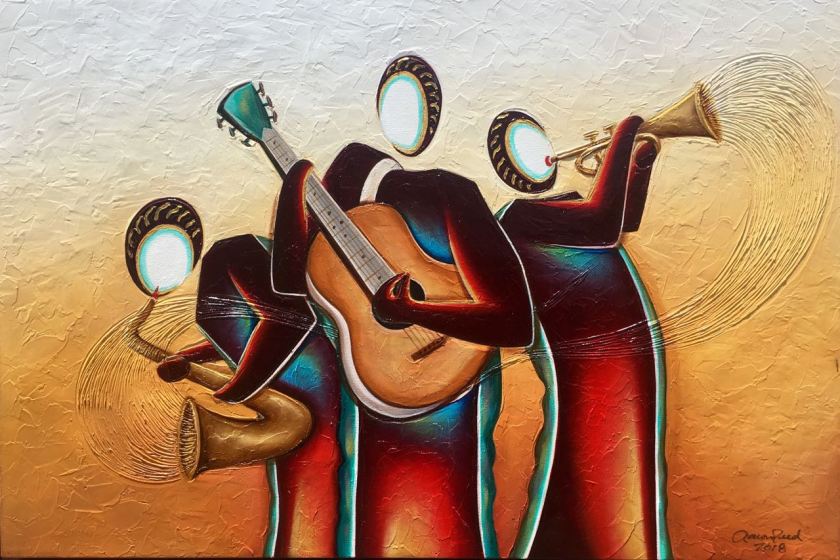
Benny Andrews, Alice, 1966, oil and collage (Ogden)Benny Andrews, Death of the Crow, 1965, oil and collage (Ogden)Benny Andrews, Dottie, 1981, oil and collage (Ogden)Benny Andrews, Eudora, 1978, oil and collage (Ogden)Benny Andrews, Mannerisms, 1962, oil and collage (Ogden)Benny Andrews, Mother Death, 1992, oil and collage (Ogden)Benny Andrews, 1989, Plower, oil and collage (Ogden)Benny Andrews (title and date unknown), oil and collage (Ogden)Painted by either George or Benny Andrews (title and date unknown) (Ogden)George Andrews, The Old Punkey Patch, date unknown, oil on canvas board (Ogden)John Hardy, Portrait of Benny Andrews, 1976, oil on canvas (Ogden)Caroline Durieux (1896-1989), Acolytes, 1935 (Ogden)Hans Hofmann, Abstraction of Chair and Mirror, 1943, oil on canvas (NOMA)Robert Gwathmey, Asleep at the Table, 1945, oil on Canvas (Ogden)Alma Thomas, Dogwood Display II, 1972, acrylic on canvas. Alma is one of my favorites and her painting Starry Nights and the Astronauts is featured in the Chicago Institute of Art article. (NOMA)Lee Krasner, Breath, 1959, oil on Canvas. Lee, a fine artist in her own right, was married to Jackson Pollock from 1945-1956. (NOMA)Shawne Major, Eating Cake, Quilt detail (Ogden)John William Godward, Far Away Thoughts, 1892, oil on canvas (NOMA)Gustavo Caillebotte, French Bouquet of China Asters and Sunflowers in Vase, c. 1887, oil on canvas (NOMA)Georges Braque, French Landscape at L’ Estaque, 1906, oil on canvas, 20 x 23 1/4 in. (NOMA)Carlos Rolon, Gild the Lily: Decadence Upon Decadence, oil, ink and 24-karat gold leaf on canvas (NOMA)Frederick Frieseke (1900-1995), In the Garden, Giverny, oil on canvasClementine Hunter (1886-1988), Panarama of Baptistm on Cane River, oil on window shade, 36″x67″ inches (Ogden)Joan Miro, Persons in the Presence of Metamorphosis, 1963, egg tempura on masonite, 19 3/4 x 22 5/8 inches (NOMA)Joan Miro, Portrait of a Young Girl, 1935, oil with sand on canvas, 41 3/8 x 29 3/8 inches; 49 x 37 inches (framed) (NOMA)Joan Miro, The Red Disk, 1960, oil on canvas (NOMA)Giovanni Boldini, Portrait of a Young Woman in Profile, c. 1895, oil on canvas (NOMA). The blurred brushstrokes and aqua accents in the lower left quadrant caught my eye and drew me to this large painting. Amadeus Modigliani, Portrait of a Young Woman, 1918, oil on canvas. 24 x 18 inches; 33 x 27 x 3 inches (framed with acrylic glass) (NOMA). Modigliani is one of my all-time favorites!!Wayne Thiebaud, Salmon Rose, 1966 (NOMA)Michael Frolich, Steamer New York, STeaming Upriver, 1989, oil on masonite (Ogden)Eddy Mumma, Untitled c. 1978-1986, oil on board (Ogden)Thornton Dial (1928-2016), Struggling Tiger in Hard Times, 1991, oil, tin, carpet and industrial sealing compound on canvas mounted on wood.Richard Diebenkorn, Woman on Porch, 1958, oil on canvas, 72 x 72 inches (NOMA)I ran across this art installation on the street, not in a museum. Artist Sally Heller, Scrap House. One of 20 “Art in Public Places” commissioned by the Art Council of New Orleans. An homage to Hurricane Katrina’s damage.Saw this artist, Aaron Reed from Albany, Georgia, at his booth at this year’s New Orleans Jazz & Heritage Festival.
Dominic Bourbeau doesn’t realize what a great painter he is.
Soft-spoken, Dominic is Minnesota nicer-than-nice. His unassuming nature shows up in his humble view of his work, which is colorfully geometric and stunning.
During last year’s Arizona Fine Art Expo in Scottsdale, Dominic’s artwork was tucked into a corner with little traffic flow, but I saw his work and was stopped cold by it.
In fact, his mid-century modern-style paintings intimidated me. How do you approach a genius? Especially one who is always painting, canvas lying flat on the table, head down? But it turned out that Dominic is highly approachable and generous with his time in explaining his supplies and techniques.
At this year’s Expo (January to March 2018), Dominic’s booth was in a high-traffic area near the cafe so his wall of art could be seen from the main hallway. Again this winter, Dominic kept his head down and painted constantly, but was as approachable and responsive to visitors as ever.
Hopefully, after hearing so many folks see his art for the first time and say “Wow!,” Dominic will realize how special his painting is.
Dominic’s Aubrey Hepburn-esque painting ran on the December 2017 cover of Modern Luxury Scottsdale magazine, and his sassy mid-century portrait of a well-dressed woman in red was used on all the Expo passes.
During the Expo, Dominic had to paint all day, every day, seven days a week, because everything he hung on his booth wall sold. Instantly.
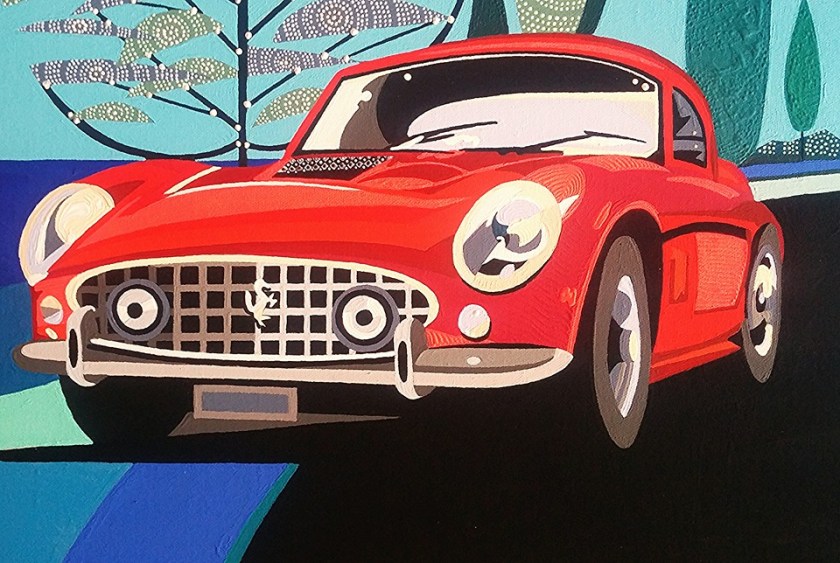
Or, he was asked to paint one of his classics, like Frank Sinatra’s Living Room, five times. Maybe six. Maybe seven.
“This was the year of commissions,” Dominic says, laughing. “I finally lost count.”
Luckily, not every client wanted to take possession of their painting before the Expo closed on March 25, allowing Dominic to return to Minneapolis and complete all his unfinished commissions.
One day at Kinko’s in Scottsdale, Dominic was scanning his painting of Frank Sinatra’s Living Room when an architect from Palm Springs saw the painting and asked about it. Dominic told the guy he painted it and the man instantly pulled out his check book and commissioned the painting for his home.
“That was unbelievable,” Dominic says to me the day it happened, and he’s shaking his head, like it shouldn’t have happened.
But it’s totally believable that someone saw his artwork and instantly wanted it. Dominic’s style is infectious.
His brother, Martin Bourbeau, is also an artist at the Expo. Martin uses cake frosting tubes to pipe paint onto magnificent landscapes on huge canvases, layering and layering the lines of paint to create 3-D art. They’re gorgeous and impressive and expensive.
“I originally struggled with how to price my paintings,” Dominic says, echoing every other artist. Pricing is always tricky. With advice from his fellow artists, Dominic has charged slightly more for his work lately, particularly when a subject is selling well, but psychologically it’s still hard for him to increase his prices.
This winter, he began to paint cityscapes depicting well-known landmarks, making them smaller than his usual paintings, and they all sold.
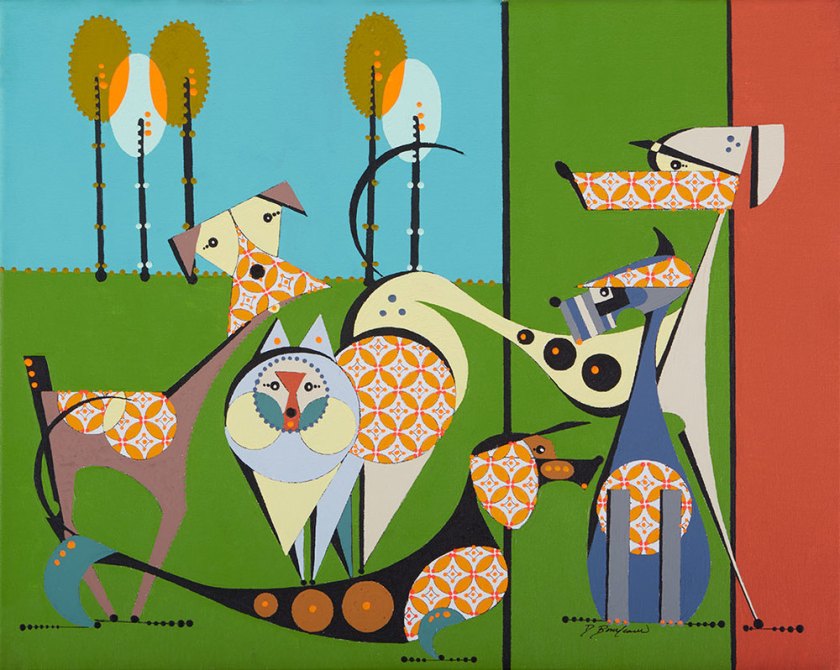
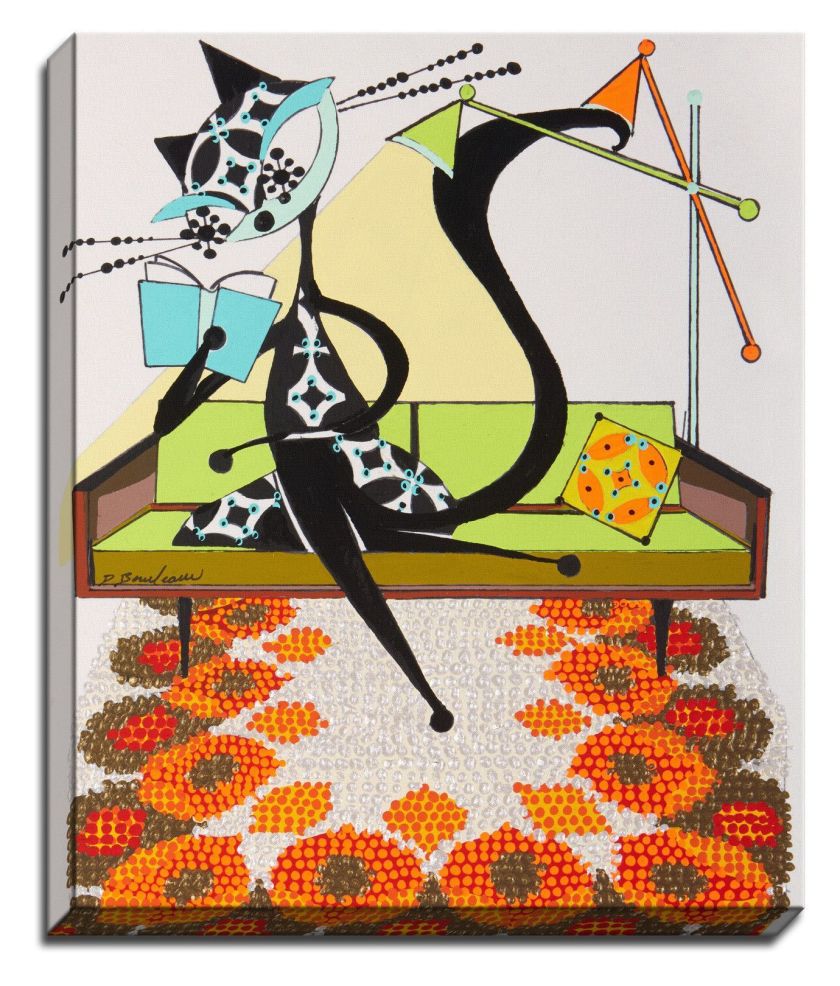
He painted a cat, then more cats, and the paintings sold before he could even hang them on the wall.
Gouache is Dominic’s medium of choice. Pronounced “gwash,” the medium is another type of watercolor, though it remains opaque rather than translucent and it dries matte. It’s fitting that Dominic uses Gouache because the medium was first used in creating Medieval Illuminated manuscripts and then became popular with French and Italian painters in the 18th century.
Also, before digital design, gouache was commonly used by Mid-20th century commercial artists because the medium made crisp images and letters possible, and it photographed well.
“I draw out the design in pencil, sketch over it in pen,” Dominic says, “and when all the details are done, I’ll start painting, which is the fun part.”
He smiles big.
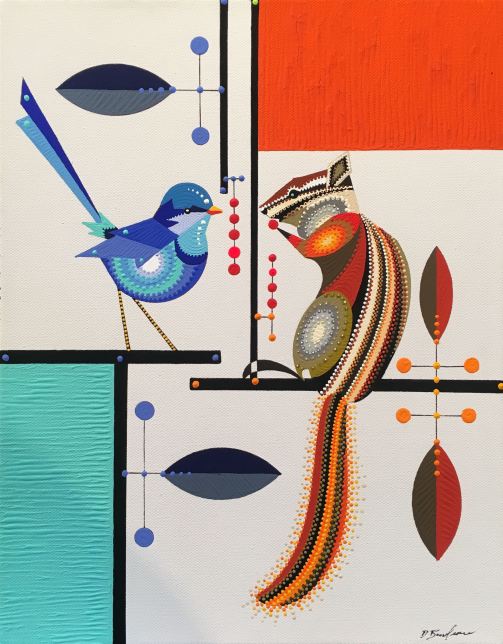
His technique is to texture different blocks of color by adding wavy or squiggly lines, or dots. His dots are amazing and appear to be machine-made, but he produces each one with absolute focus and precision.
While attending a boarding school in Michigan, Dominic studied iconology and followed the tradition of mixing his own tempura paints, including using a beetle to produce red.
In Iconology, every line has a purpose, nothing is used simply for the sake of being ornate. The strong geometry and symbolism of iconology are present in Dominic’s style.
Dominic’s artistic experiences also include throwing pottery, drawing portraits and painting murals for Shakespearean stage sets. He greatly admires artists such as Eames, Frank Lloyd Wright and Charley Harper, and is captivated by their use of simple, yet bold, design based on sophisticated, yet minimalist, geometry.
“I was able to pull from each of my past artistic experiences a segment of its beauty and technique,” Dominic says. “The geometry of iconography, the simple shapes of pottery, the puzzle-like composition of stained glass windows, the details of a portrait drawing, and the intensity especially in color of a mural painting.”
Frank Sinatra’s Living Room
Dominic, at 38, is the oldest of 11 children.
“All eight boys are artistic,” Dominic says. “My three sisters are not artistic. One brother, Peter, has a Master’s in Art and teaches art in a boarding school.”
Their mother, a school teacher, always brought art projects home for the kids to play with.
Dominic almost completed his Master’s in Art, so he could teach, but decided against teaching when he noticed students were using it as an elective and weren’t serious about learning.
Instead he got a degree to be a Surgical Technician and for 12 years now has specialized in assisting orthopedic surgeons in mostly hip and knee replacements.
With his “casual” employment, Dominic is hired to be the personal assistant of a physician and can work when he wants. That’s how he’s been able to take off three months for the last three winters to exhibit at the Expo in Scottsdale. Being a surgical assistant is a great gig; as long as Dominic is attached to a surgeon and keeps his medical qualifications current, he gains seniority in his position with the hospital.
Fours years ago, Dominic’s artistry was discovered by his hospital co-workers when he was drawing on sterile paper towels in the operating room. He then received commissions to create pen and ink portraits of his colleagues’ kids and families, or portraits of pets wearing sunglasses. Dr. Santos, a co-worker, asked Dominic to create anatomy illustrations for a book, including sketches of a spine and spinal implant.
At home in Minneapolis, Dominic paints in his kitchen, which does double-duty as his art studio.
Dominic is on his careful way to ultimately making a living solely as an artist.
In the meantime, he keeps his head down and paints for hours every day, in addition to doing all his own marketing and accounting… when he isn’t assisting in surgeries or exhibiting in Scottsdale.
I predict he’ll hit it big one day.
Maybe then he’ll realize just what a great artist he is.




















 Dominic’s artistic experiences also include throwing pottery, drawing portraits and painting murals for Shakespearean stage sets. He greatly admires artists such as Eames, Frank Lloyd Wright and Charley Harper, and is captivated by their use of simple, yet bold, design based on sophisticated, yet minimalist, geometry.




 Cre8-Space