Jeff Carol Davenport, Sculptor

One of Jeff’s earliest impulses to sculpt happened at Riazzi’s Italian Garden restaurant in Mesa, Arizona, circa 1964, when she was six years old. 

Sculptress-in-Demand

One of Jeff’s earliest impulses to sculpt happened at Riazzi’s Italian Garden restaurant in Mesa, Arizona, circa 1964, when she was six years old. 

“Our table had white candles,” Jeff said, “and I remember using my thumbnails to press the warm wax into shapes. Every time we ate there, I looked forward to playing with the wax. I always loved playing in the mud, too, because I could squeeze forms from the muck.” Sadly, Riazzi’s closed in August 2017 after 72 years in business, but Jeff continues to sculpt professionally and for fun. 


JeffDavenport_OverTheRainbow
“Over the Rainbow”

Growing up, Jeff stayed outdoors as much as possible, and claims to have been a Tom boy. “I was the perfect son for my father,” she laughs. Her father, Wade Hoffman, hailed from Gastonia, North Carolina. He’s the reason she has a masculine name. “I think he really, really wanted a son after they had my older sister, Patricia,” Jeff said. “And sometimes he says he named me after the actor Jeff Chandler. Then why didn’t he name me ‘Chandler?'” she laughs.

Wade started his career in the U.S. Secret service. Eventually, he was sent to Japan where he met Shizuko, a big-city girl brought up on the Ginza strip in Tokyo, what Manhattan is to NYC, with all the big-city accoutrements, including a fine education and an impeccable fashion sense. 

When they married in the late 50s, Wade could no longer be in the secret service, so he brought Shizuko and Patricia to Rock Hill, South Carolina, where Jeff was born in 1958. Three years later, Shizuoka could no longer stand the injustice of a segregated south and insisted they move. After traveling throughout the U.S., Wade and Shizuko chose Phoenix to make a home for their family.

Jeff has spirit. She’s gentle and energetic, witty and considerate, and always creating something with her hands. 

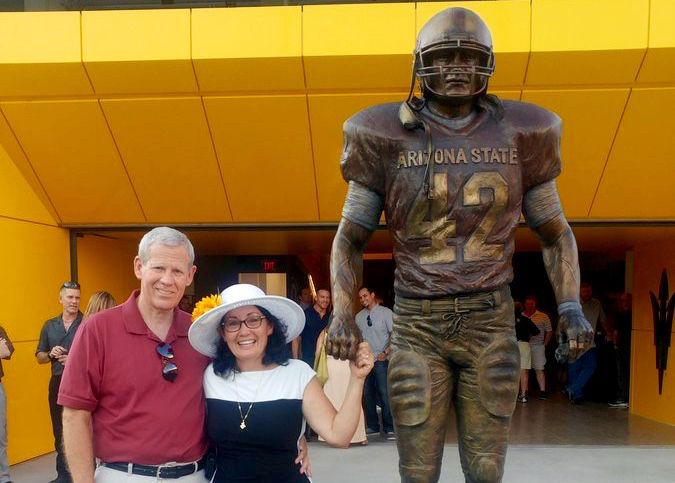
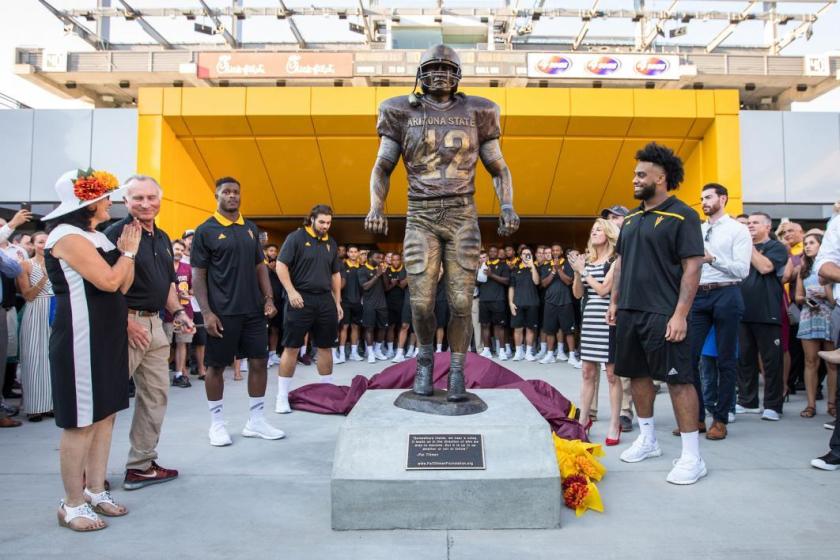
Jeff’s latest creation made the newspaper! She sculpted a life-size bronze statue of Pat Tillman posted at ASU’s Sun Devil stadium near the entrance of Tillman Tunnel. Arthur Pearce II provided funds for the statue and commissioned Jeff to do the piece.

TillmanUveiling
Left: Jeff & Art Pearce at the Pat Tillman statue reveal, ASU Sun Devil Stadium, August ’17.

Tillman is remembered as a former Arizona Cardinals and ASU football player who enlisted in the U.S. Army in June 2002 in the aftermath of 9/11, and who, as an Army Ranger, was tragically killed in Afghanistan in 2004 by friendly fire.


JeffTillmanModel
Jeff sculpting the Pat Tillman maquette, or model.

Jeff sculpted the 16-inch maquette, or model, in clay from a photo of Pat with his long hair flowing and his ASU helmet in his hand. Officials at ASU however, asked to have Pat’s likeness crafted from photo of him wearing a helmet. She revised the model and re-submitted it to ASU.

IMG_0846
In progress: Jeff’s maquette of Pat Tillman.

They approved the revised maquette and Jeff proceeded to work with local foundry Bollinger Atelier to digitize the model into a 3-D image, which was then enlarged to 1.1 times life size and cut out of foam to form the core of the statue. The foundry layered the foam with clay between 1/4 and 1/2 inch thickness all over.

Jeff later crafted the letters “ARIZONA” AND “TILLMAN” and laid them on the life-size clay sculpture. When she made the 16-inch maquette, it was too small to place raised lettering on the jersey.

The 6-foot, 400-pound statue was revealed in a dedication ceremony on Wednesday, August 30, 2017, and Jeff, her mother and husband Mike attended as special guests. With the statue’s unveiling, ASU’s new pre-game ritual involves players touching the statue as they run onto the field.

IMG_0839
Jeff with the clay-covered core sculpture after the mold was made.

The entire process of producing the statue was emotional for Jeff, who, as an ASU graduate, followed Pat’s career and story.

How did a young Amer-Asian woman become a bronze sculptor?

After studying fine arts at Northern Arizona University (NAU) in Flagstaff, Jeff worked as a metal chaser at Beyond Bronze Foundry in Colorado, where she welded parts together, ground down metal to clean seams and other surface imperfections to make just-poured pieces look like one complete piece.

Back in Tempe, though, her parents had opened a Japanese restaurant and asked Jeff to come help out, which she did. Next, she began her 25-year stint at Arizona Bronze (now Bollinger Atelier), a foundry in Tempe, Arizona, where she worked as a metal chaser, then switched to wax works when the pneumatic tools caused her hands to hurt. Jeff used dental tools to take down wax seams and design the gating system that feeds the bronze into a mold. She also learned the art of mold making.

IMG_0848
Miscellaneous pieces Jeff crafts as demos at school for her students.

“I love making molds!” Jeff said. “You must be methodical and plan everything out. It’s an engineering feat in mixing the rubber, brushing it on and them pulling the rubber as it sets.”

The one thing Jeff has never done at either foundry was pour the bronze. She also did not work on patinas for foundry clients, however, she occasionally adds patinas to her own works.

“To add a red patina to Pat Tillman’s ASU jersey, and a hint of gold to his pants,” Jeff said, “I brought in Aiya Jordan from San Francisco. Aiya is also an ASU grad and one of the best patina artists I know.”


There are at least 12 steps to producing a bronze sculpture and Jeff became intimate with them all during those 25 years. Here’s a five-minute video of a “How It’s Made” episode showing the lost-wax casting technique.

“I did the fine detail work on projects,” Jeff said. “If a piece required detailed precision, I’d have the stamina and small motor skills to make it right.”

IMG_0224
Jeff with Zebulon Pearce statue in Mesa, Arizona.

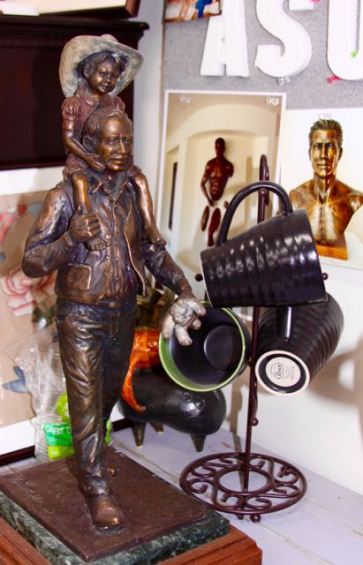
Having Art Pearce as a client means Jeff went from being a long-time employee of the foundry to being their valued customer. Before Pearce commissioned the Tillman statue from Jeff, he had asked her to create a bronze statue of his grandfather, Zebulon Pearce, a former Mesa mayor who owned the local Feed & Grain store on Main Street located at 155 W. Main Street. Zeb Pearce is also known for bringing Coors beer to the valley.

Like most folks, Jeff’s life hasn’t been all work. She married, had two sons Jeff and Cori, divorced and then married Mike, a retired NAU police officer, 21 years ago. Mike also has adult children; Michael, Lisa and Kyla. 

During her annual performance review 11 years ago, the foundry owner told Jeff her salary had topped out; if she wanted more money, she needed to work elsewhere.

“Like many people who hit a dead-end in their job,” Jeff said, “I considered going back to school to learn new skills.”

IMG_0860
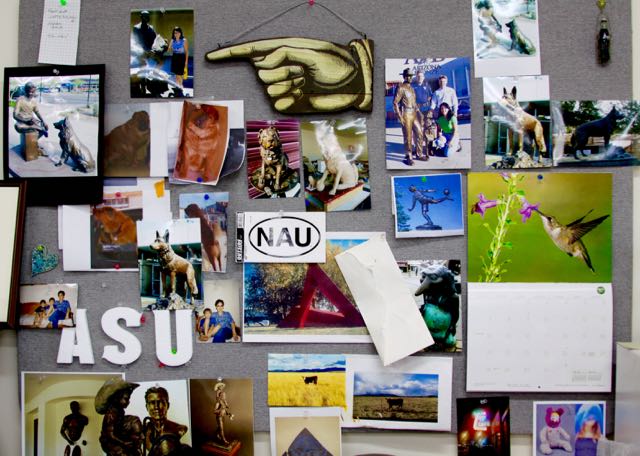
Art Studio inspiration.

A Friend suggested Jeff teach art; the pay is okay and benefits are really good, especially having summers off! Jeff applied to an education program offered by the Deer Valley Unified school district and Arizona State University. Having a bachelors degree was a pre-requisite. Of the 22 students accepted into the program, Jeff was one of 11 who made it all the way through. 
IMG_0862

She started teaching 10 years ago, initially instructing 4th graders. Four years ago, she went to Sandra Day O’Connor High school to teach art and ceramics.

“I enjoy building relationships with the kids, and I learn so much from them, Jeff said.”

Jeff challenges herself to make something every day. In class, as the kids work on their sculptures, Jeff molds earthenware clay into small animals or abstracts. 

“Sometimes, the little thing I’m sculpting becomes the inspiration for a statue, like the boy playing soccer, called ‘Over the Rainbow.'” 

“Learning Together” won first place in the Prescott Valley art show and now sits in public spaces of Prescott Valley, Mesa, and Oro Valley. Jeff has other public sculptures, including the “K9 Police Memorial” at Wesley Bolin Plaza in Phoenix and Vancouver, Canada, “Charlie” at Wickenburg Ranch, and the “Scottsdale Police Memorial.”


IMG_0843
Boy’s head from “Over the Rainbow” sculpture, plus forms for making animals.

“Learning Together” won the people’s choice award and features a boy with a ball and a dog ready to fetch. Jeff has a knack for making her subjects appear weightless and buoyant, even though they’re cast in bronze. And her style touches hearts, as evidenced by the connection between the boy and his dog while playing catch.

Learning Together
“Learning Together”

Charlie was Merv Griffin’s dog, and Merv donated the land in Wickenburg that became the Dog Park where Charlie watches over the visitors. 

“When my students see my sculptures in a public place,” says Jeff, “they come up to me with eyes wide, asking for my autograph, and I remind them I’m still the teacher they’ve always known. I’m me.”

Even on the days when Jeff sculpts at work, she still arrives home and sculpts or paints. Usually, she works in her detached art studio, which she and Mike built in 2016. Their house in New River sits on a hill and their backyard looks out toward hills and into a valley. 

“I look around and am amazed at how much I’ve produced,” Jeff said. “I was in a local gallery one day and admired a little bronze piece, an alligator bag on the back of a horse sculpture, and I said, ‘how would they do that?’ The gallery owner said, ‘Don’t you remember, you made that?’”

Jeff laughs at having made so many tiny bronze items and not being able to remember them all. If an artist needed a small item for their sculpture, they would ask her if she would create it. She’s made everything from that small alligator bag for a horse, to guns, holsters, rabbits, cats, and even a cowboy riding an armadillo. The last item was for an artist from Texas.

IMG_0851
Musical instruments called ocarinas made by Jeff.

When Jeff’s students complain about not being creative, she asks them if, when they play video games, do they go through all levels the first day. “Of course not,” Jeff said, “the more you play, the better you get. It’s the same with sculpting, or anything you do. I’ve been sculpting for 40 years, which is why my students think it looks easy.”

Her advice for anyone who wants to make a living doing the creative work they love is to “keep with it. That’s what I was told by my professor. The artists who make it are the ones who don’t quit. Work, work, work. You get a little bit better each time.”


GALLERY OF STUDIO AND PUBLIC ART PIECES

IMG_0869

IMG_0871

IMG_0870

IMG_0859

IMG_0855

MikeJeffTillman (1)

k9
K9 Police Memorial
Scottsdale Police
Scottsdale Police Statue
IMG_0849
Jeff playing her handmade ocarina.
CharlieatWickenbergRanch
Charlie, Merv Griffin’s dog, at Wickenburg Ranch Dog Park.

Athens: Gourmet Walking Tour

With the Beautiful and Spirited Sophia

We reach Monistroika Square, our meeting spot, and sit on a short wall next to the old town church surrounded by new shops. A petite young woman with blonde hair walks up and says, “Mrs. Brown?”

Ahh. We are in the right place. Sophia has found us. 

Sophia is 90 pounds of 100% Greek. But she’s unlike most Greek women. First, she’s 40 years old and unmarried. Second, she dyes her hair blonde. Third, she’s tiny. Fourth, she’s wearing short black shorts and a white tank top. 

“Greek men are useless,” Sophia laughs. “They don’t have decent jobs and often struggle financially. Why would I leave  my mother’s home, where I live free of rent and my mother buys and prepares my food, to struggle with a man?”

Makes sense.

Sophia loves her Greek coffee and cigarettes, yet she never lights up during our private gourmet tour of old town Athens. Even though she’s barely 5 foot, Sophia walks through the streets of Athens like she owns the place.

IMG_0135

We set out for our 4-hour tour at 10 a.m. with Sophia leading us out of the touristy area to where real Greeks buy shoes and attend church.

Our first stop is an ordinary corner bakery. Sophia settles us at a table for three then she speaks to a woman who prepares a little cheese pie and spinach pie (spanakopita) for tasting. Thank the mythical Gods, everything in Greece is made with phyllo. “Pita” means pie. So spanakopita is spinach pie. They  make everything into delicious savory or sweet pies.

Every Greek region and island has its specialty pie made of local cheese and greens. Pies are also made from milk, meats and fruits… with drizzled honey!

We eat the cheese and spinach pies, keeping in mind we’ll sample foods for the next four hours. Still, I eat it all. Shameless.

We move onto the street where Sophia stops at a food cart and buys a baked circle of thin bread covered in sesame seeds. The vendor puts it into a paper wrapper and hands it to me.

“Greek people will nibble on these throughout the morning,” Sophia says as she marches. “It’s another excuse to eat!” Brent and I take turns biting the crisp bread.

IMG_0125

“When we cross this street, we’ll be in a real Greek neighborhood,” Sophia says while staring down drivers and using her index finger as a command to brake.

Brent and I are thrilled to see authentic Greeks going about their authentic Greek lives.

“All these people,” Sophia says with a flourish of her right hand indicating men and women window shopping or speaking on the street, “they’re Greek!”

We pass a Greek Orthodox Church and when I comment on it, she insists we go in. I’m not budging because the sign says, “No shorts.”

“Go! Go!” Sophia insists, holding the door open and pushing us in.

“I’m not going,” I say. “I’m wearing shorts.”

“They won’t care because you’re not Greek,” she says. “Me, they won’t allow me in because I’m Greek.” Her shorts are shorter than mine.

Sophia has such a strong will, I can’t resist. Plus, I understand she’s only insisting because she thinks it will add to our experience. I mean, who ever heard of a church on a gourmet food tour?

I follow Brent in, reverently. Our eyes adjust and I see old Greek women at the front of the church queued to speak to the gray-bearded priest in his long black robe.

Other women knell in front of glass-enclosed shrines. They rise and kiss the glass.

IMG_0126The architecture is beautiful. A deep blue ceiling is dotted with gold stars, which sounds like the ceiling our guide described for the now-gone Parthenon and the entry buildings to the Acropolis.  

Brent, one of only three men in the entire church, stops in the back and I stand just behind him, trying to look invisible. I’m not religious, but I well understand sacred space, particularly for those who belong there. To our left, in an alcove, is a handsome young priest, perhaps in his early 40s, who is keeping a careful eye on the proceedings.

Sneaking out, I turn toward the back and there’s Sophia, outside the double doors, but craning her head inside, along with her right arm pointing as she says, “Take one of those!”

I look to where she’s pointing, at a desk/counter just inside the door with a woman sitting behind it. On the counter is a basket with small plastic bags of flour. I don’t want a bag of flour and keep walking. Sophia’s head and arm are active, though, and she’s whisper-yelling, “Take it! Take it!”

I pick up a bag to appease her (the price for being able to flee the church) and hear a voice say, “Excuse me!” It reverberates against the blue ceiling loud enough for everyone in the church to hear. Of course, it’s the good-looking priest, approximately 6 foot 3 inches, slender in his floor-length robe with a face like the guy who plays Riggs on Grey’s Anatomy.

Busted.

“That is for people who will bake bread for the church,” he says with very little Greek accent. “I don’t think you plan to make bread.” He reaches for the flour. He isn’t mean, but he isn’t nice. I just smile like a simpleton as he takes the flour out of my hand. I say, “Okay, thank you,” as though he is giving me something and escape outside, but not before Sophia has a curt exchange in Greek with the priest that most folks can easily hear. 

Sophia asks me what he said. I tell her.

“It’s not for making bread for the church,” she says with an eye roll. “The church is wealthy. People make large donations, including leaving their apartments when they die, which causes all kinds of family problems.” She’s a member of the Orthodox Church, she admits, but doesn’t allow it to dictate how she runs her life. 

Well, I didn’t want to intrude on the church in the first place. But how much goodwill would they have fostered by allowing me to the damn four tablespoons of flour? I’ve always been stumped by how much money goes into a church’s building, its décor and artifacts.

IMG_0117Hoping to forget about the handsome priest, I match Sophia’s quick pace until we see an old-timey bakery with a sign in front that reads, “Established in 1932.”
Seeing Sophia head for the bakery’s door makes me happy!

The shop’s specialty is Loukoumades, a doughnut-shaped treat made of flour and water, deep fried and coated in hot honey. Sophia’s 90-year-old grandmother brought her to this shop when Sophia was a small child. It feels like an old cafeteria, with foam green tile walls and everyone using trays. Most patrons are elderly, and alone. “This is nostalgic for them,” Sophia says about the patrons. They all have the same thing; a plate with six of the treats floating on honey. Sophia disappears and returns with our own tray and plate of six, which Brent and I gobble up in short order. 

As we leave, we pass a table where a very old woman sits with what appears to be her granddaughter. They chat and chew Loukoumades. The tradition continues!

“Some people look at me and think they should treat me like a child,” Sophia says. She has spunk aplenty, though, and a sharp intellect. Sophia can hold her own. She’s still irritated with the Turks for invading Greece and ruling for 400 years, from the 1400s until 1802, and for destroying monuments and forcing the Greek culture underground. “I’m just grateful we don’t speak Turkish and wear Burkas.”

Sophia’s brother lives in Hong Kong and she visits him each year. 

Our next stop is an authentic Greek coffee shop preparing coffee old-style, which is bitter. They serve the coffee with small sides of sweets made from just about anything; lemon, tomatoes, eggplant, cherries and other veggies. The small pieces of fruit or vegetables are cooked in sugar and water until it’s a syrup. The pieces remain whole, not crushed. 

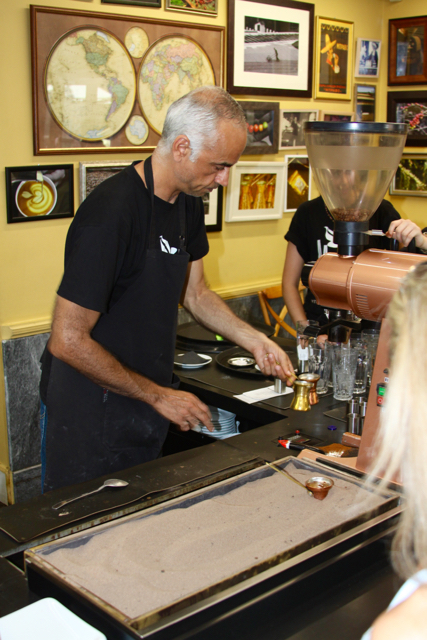
We watch as the tall, slim Greek barista with a small, gray beard grinds fresh coffee for each cupful. He places a little sugar and water into a brass cup with a long, straight handle. He then pours the coffee grinds into the little cup and squashes it into a tray of sand with a hot plate underneath. He pushes the sand up and around each cup so it heats evenly, and the grinds fall into the water mixture. After a few minutes, he stirs each cup with a long-handled spoon. 

IMG_0156

A pretty young woman who reminds me of my daughter, Jaime, brings our coffee on a tray. My plate holds the brass container and a small white cup in which the barista poured just a splash of coffee. Nearby, she places a plate of sugared baby eggplants, and another small plate of Turkish delights.

“Sip the coffee from the cup,” Sophia instructs, “and then pour the remaining coffee into the cup. Pour it all!” We do, and the coffee goes to the exact rim without going over. I admire the velvety foam. 

We sip coffee and take nibbles of the candied eggplant. The two flavors together are actually quite nice. Brent and I normally only drink decaf, but he opted for the caffeinated while I ordered decaf. Sophia can’t understand why anyone would drink coffee without the caffeine. I tell her I want to create my own energy, versus living off of caffeine’s artificial stimulation. 

“What are the potential ill effects of caffeine?” Sophia asks. She drinks eight shots of coffee each day. Before she met us at 10 a.m., she had taken two double shots, and she was now enjoying a shot of espresso with us. 

“I’m sleeping much better at night since I switched to decaffeinated,” Brent says.

I’m unable to articulate any ill-effects, but tell her how I quite cold turkey, which wasn’t smart, and had a headache for ten days, and got so depressed I questioned my existence and thought it would be okay if I died. I wasn’t suicidal. But I did think about death as my body got used to operating without caffeine.

IMG_0121“I’ll bet it tastes different,” she finally says, with a disapproving look. “I have stopped smoking seven times. When I wasn’t smoking, I didn’t have energy and my thoughts were slower. I didn’t feel normal. I missed feeling normal, so I started smoking again.” 

“Take a sip,” I tell her and hand her my cup. “Now taste Brent’s.”

We all take turns sipping the decaf and caffeinated. Ultimately there is a difference. Decaf isn’t as flavorful.

Because the coffee is unfiltered, the grounds make a sludge filling half the cup. She warns us not to sip any sludge. Brent picks up his cup and a spoon and pretends to take a big mouthful. 

Sophia leans forward and yells, “No!” Brent laughs and soon she is laughing, too. 

The Turkish delights are little rectangles of jellied candy covered in powdered sugar. Sophia explains that folks can’t distinguish if it is a Greek recipe, or something adopted from the Turks when they ruled Greece. The candies are flavored pine and rose. The pine tastes just like a pine tree and the rose tastes just like perfumed rose water. I don’t care for either of those odd flavors.

“If you like them,” Sophia says, “they are Greek. If you don’t like them, they are Turkish!”

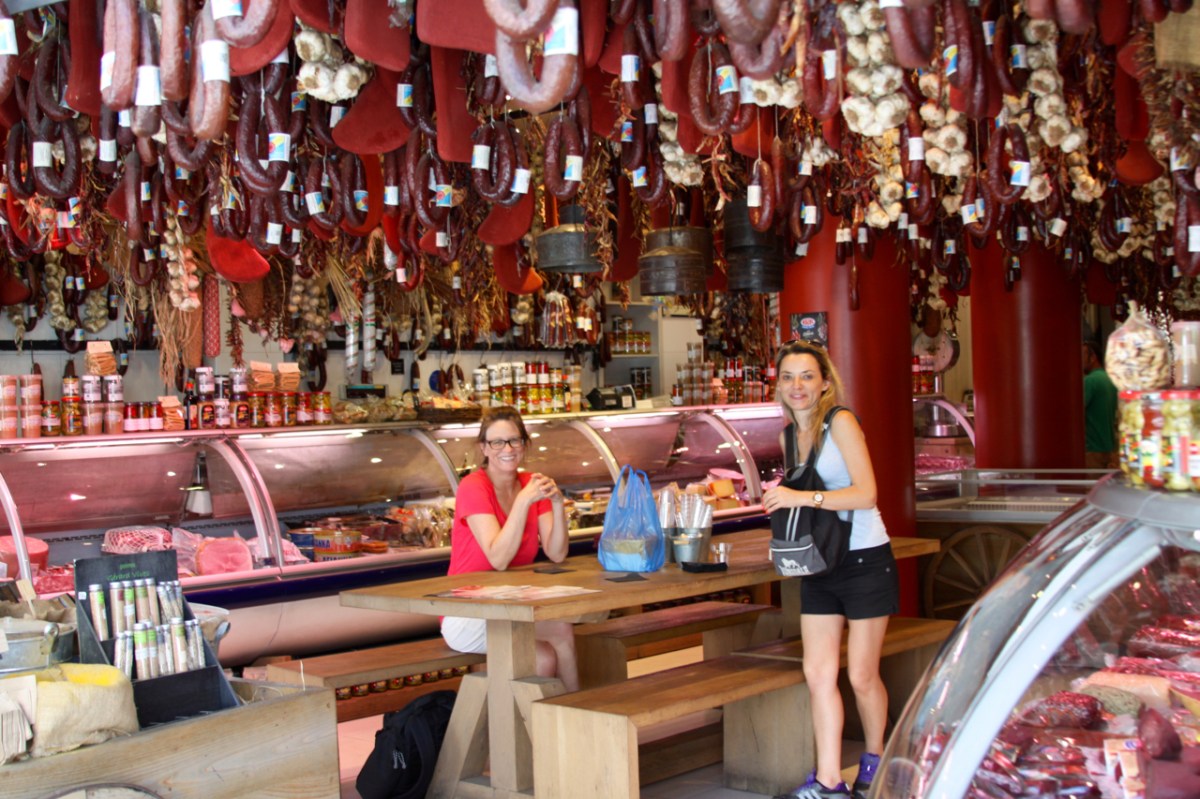
We leave the coffee shop and walk a couple of blocks to the meat market. Vendor stalls equipped with refrigerated cases line the corridor. The concrete floor is wet from constant hosing down. It is hard to listen to Sophia talk when looking at all the animal corpses hanging from hooks; rabbits skinned of everything except the white fur on their feet and tails; Goat heads skinned with eyeballs intact; cow heads; innards that include the lungs heart and intestines.

“Greeks don’t eat lamb,” Sophia says. 

IMG_0140

Brent takes lots of photos of everything. I’m not comfortable looking at the carcasses, which makes me a hypocrite because I eat meat. I can’t get through the meat market fast enough.

We exit the meat market and turn right into the fish market. 

IMG_0147

Next we’re surrounded by tables of spices and nuts. Vendors give us samples of walnuts, almonds and pistachios. Brent is consumed with looking at all the spices in plastic bags. He buys oregano and a powder for making Tzatziki (just mix it with Greek yogurt). He also buys a snack made of honey and sesame seeds. 

IMG_0155

At the fruit market, we try all types of olives; green, Kalamata and black prepared with and without salt. One is stuffed with red peppers. Yum. Brent buys a small basket of fruit that looks apricots or persimmons. A vendor peels one and offers it to Brent, so Brent buys it with Sophia’s assistance. 

Sophia purchases cherry tomatoes from her favorite vendor to prepare traditional Greek salad at a future stop on the tour. A woman in a burka pushes her way next to Sophia, who is talking to me and Brent. The woman then pushes Sophia to the right using her body.

“Do you see what this woman is doing to me?” Sophia asks. “She is pushing me out without evening looking at me.” Sophia stands her ground and pushes back. The woman keeps talking to her companion and keeps pushing, ignoring Sophia. 

As we walk away, Sophia says, “She thinks I have no value because I’m a non-believer. Like I’m not human.” There is truth in what Sophia says and I share with her my experience of a group of Muslim women in burkas at the Nairobi airport. They sat on the bench where I had been sitting for an hour and slowly pushed me, trying to crowd me out, but I would not be moved. As the old spiritual says, “Like a tree planted by the water, I shall not be moved.”

IMG_0157Our next stop is a lovely shop selling Greek food products. Sophia sets us up at a small table in the back and begins to make Greek salad, shooing us to explore the store. Brent selects several vacuum packs of olives. While we eat Sophia’s salad, we also sample wines from Crete and other islands. 

“Traditional Greek salad is only tomatoes, crumbled feta and olive oil,” Sophia says. “Greeks don’t like red onions, but they always add red onion for the tourists.” She insists on using cherry tomatoes cut in half. All other Greek salads we try are made with cut-up large tomatoes, and it’s not the same as Sophia’s salad. She spritzes a cherry-flavored olive oil, from the Isis brand, and a balsamic truffle vinegar on our salad. They are both amazing. We buy both products, which are reasonably priced.

By the time we check out of the store, we’re behind schedule. Our tour is only supposed to run four hours, until 2 p.m. It’s 2 p.m. now and we still have two stops to make! We’ve been doing lots of talking throughout the day. We decide to visit the meat shop and forgo the gyro shop because Brent and I have already been eating gyro. 

IMG_0160

The meat and cheese shop was started by two Armenian brothers in the 1930s. With customer input, they began preparing Greek meats and cheeses. Sophia brings a sweating carafe of water and I divide it equally between me and Brent. Because it’s a hot day and we’ve been out of water, I take a mouthful of the drink and instantly realize it’s not water, but some kind of alcohol! I sip it back into the glass and feel extremely wasteful. Brent likes it and continues to sip. I’m mortified that I’ve now dispensed the entire carafe and won’t be drinking it. I apologize to Sophia several times. She won’t have any of it. It’s far too much for Brent to drink as well, or he wouldn’t be able to walk home!

We try Buffalo salami and beef pastuma, a meat Greek’s love to use in pies, sandwiches, etc. Brent buys a chunk of pastuma made from camel meat, the way it was traditionally prepared by the Armenians. He also bought hard beef salami.

When our tour is officially over, Brent asks if Sophia knows where a currency exchange is and she says yes. She graciously takes us there. We’re ready to go back to the Acropolis, where the Segway tour office is located, and Sophia offers to help us find it because she lives near the Acropolis. We are very grateful for her assistance! It is now 3:15 and our tour starts at 4 p.m.

IMG_0186

With the address of the Segway tour office, Sophia leads the way, up one street then down another. We walk in the front of a row of restaurants where men at each place tell us how great their food is, and how deep their restaurant’s heritage. They push business cards on us. Sophia calls the Segway tour office to find out exactly where they’re located. We turn around and go back by all the restaurants with the men still talking to us. “Remember me?” one yells.

Sophia walks us right to the tour office. We say a difficult goodbye as the Segway folks look on. How can we properly thank her for such a personalized tour and for going out of her way to find the exchange and the Segway tour?! We tip her well and hope it’s enough to convey how much we appreciate her energy, time, thoughtfulness, and how much we enjoyed being around her, like spending the day with a spirited and fully-alive friend!