

From the Soul
I have an obsession with self-taught African-American artists, those from the deep South who use visuals and words and found objects in their works.
The Souls Grown Deep Foundation is dedicated to supporting many of these artists, and they provide an explanation of “The Tradition” on their website.
The following statement was once on the foundation’s website, but I can’t it find there now. Short and sweet, it overviews the genesis of the African American art forms the foundation seeks to preserve.
“In the African American South, over the course of three hundred years, there has evolved a highly sophisticated and abstract system of creative expression and cultural preservation. Operating in the woods, the cemeteries, the fields and churches, made in secrecy and privacy, this system gave rise to a cultural language that would ultimately become music such as gospel, blues, jazz, and rock n’ roll—now acknowledged to be perhaps the most popular and influential music in history. The music could be heard, recorded, and transported. But there was also a system of visual arts, made by the same population for the same purposes, and qualitatively equal to the music, that was intentionally abstracted, symbolic, and metaphorical. This secret language of visual arts stayed hidden for centuries in the woods and in the cemeteries, places of privacy and safety. It was only when the Civil Rights Movement in the 1960s began to provide African Americans with the freedom and security to express themselves publicly that the art came out into the open. It is now beginning to gain recognition as some of the most innovative and important art of modern times.”
William S. Arnett, an art historian, scholar and patron, discovered the quilters of Gee’s Bend, created the Souls Grown Deep foundation and publishes books about self-taught African-American artists.
The LA Times series written by J. R. Moehringer in 1999 won a Pulitzer Prize and masterfully captures the story of the quilters.

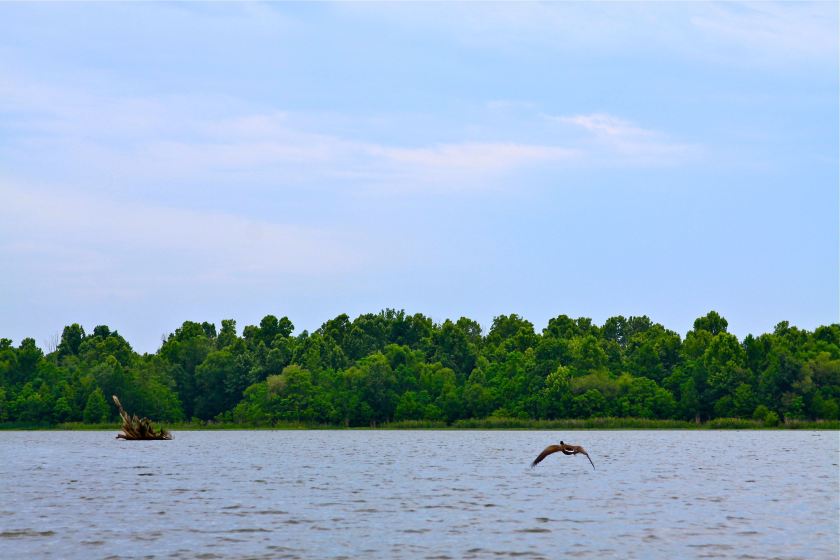
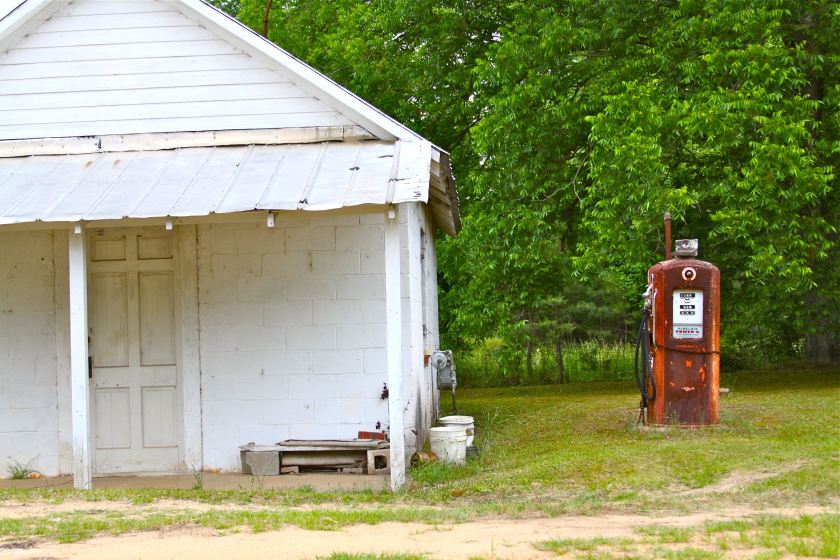
After Brent and I visited Gee’s Bend in May 2014, those quilters and that landscape remain in my soul. Gee’s Bend looks much like South Georgia, where I was born, especially in the rural areas where wild brush is tamed only to build roads or homes. My Granny lived about 300 yards from the Ocmulgee River, so we’re used to seeing water and bridges everywhere.
One big difference is that in South Georgia, the river didn’t cut us off from nearby towns, it connected us. Certainly there were racists, though, who would have done (and did do) just about anything to keep blacks from voting, like the white folks in Camden, Alabama, did when they stopped the ferry between Gee’s Bend and Camden during the Civil Rights Movement, just to keep the residents in isolation and away from the voting booths.
It’s hard to separate modern-day Gee’s Bend from its beginning as a home to hundreds of slaves. And it’s hard for me personally to separate from the white guilt I grew up with. So hard, in fact, I have difficulty putting into words what I feel as a welcomed guest at the Gee’s Bend cooperative.


Amazon wish list
Souls Grown Deep: African American Vernacular Art, Vol. 1
This book explores how the African American culture of the South has produced many of the twentieth century’s most innovative art forms.
Souls Grown Deep: African American Vernacular Art, Vol. 2
Completing the two-volume set, Souls Grown Deep, Vol. 2 takes the visual and historical presentation of the first volume to a richer level, offering an even broader array of artistic styles and media.
They are each about $100. Yikes! But I’m sure they’re are worth the price.
 Cre8-Space